Description
PrymaLab · Research use only
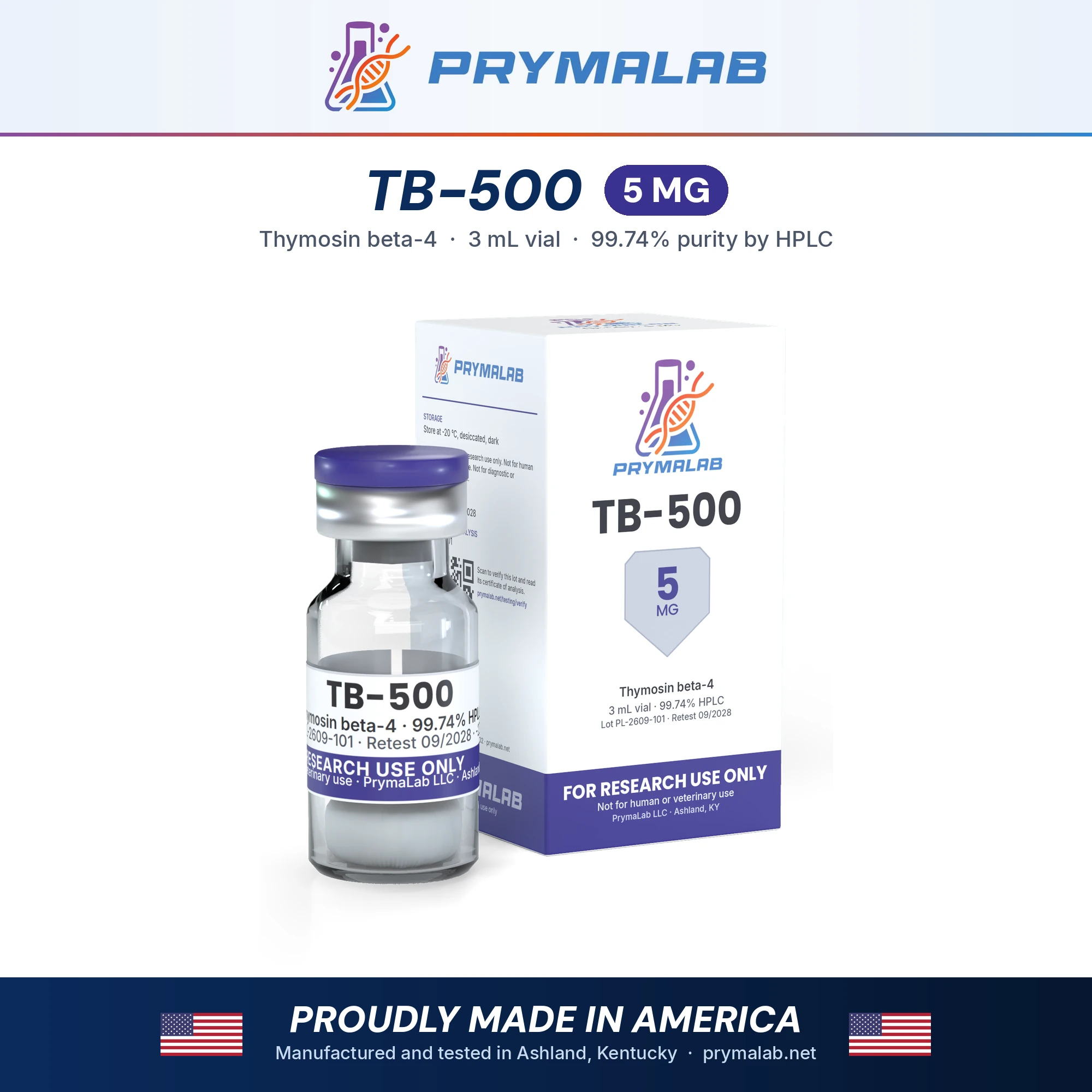
TB-500 (Thymosin Beta-4) 5mg
Full-length N-acetyl thymosin beta-4, 43 residues, freeze-dried in a 5 mg vial
TB-500 on this page means thymosin beta-4 in full: the 43-residue peptide, acetylated at its N-terminus, that cells use to keep actin monomers in reserve. This listing is the 5 mg vial of freeze-dried powder; a 10 mg vial is also sold. Research on thymosin beta-4 has looked at how it binds actin, at cell migration and tissue repair in animal and cell models, and at the active sites within its sequence.
Specifications
| Property | Value |
|---|---|
| Compound | TB-500 (Thymosin β4) N-acetyl thymosin β4, full-length 43-residue peptide |
| CAS number | 77591-33-4 |
| Molecular formula | C212H350N56O78S |
| Theoretical mass | 4963.5 Da |
| Sequence / structure | Ac-SDKPDMAEIEKFDKSKLKKTETQEKNPLPSKETIEQEKQAGES-OH (43 residues; N-acetyl; free C-terminus) |
| Label claim | 5 mg/vial |
| Form | Lyophilized (freeze-dried) powder or cake in a sealed glass vial with a rubber stopper and aluminium crimp cap |
| Storage, sealed | −20 °C, desiccated, dark |
| Purity specification | 99.0% or higher by RP-HPLC |
| Lot certificate | Results for the lot now shipping are in the certificate panel on this page |
| Safety data sheet | PL-SDS-159 |
Fills in this range
TB-500 is sold in 2 fills. The compound and the testing are the same in every fill; only the amount in the vial changes.
| Fill | Listing |
|---|---|
| 5 mg | TB-500 (Thymosin Beta-4) 5mg (this page) |
| 10 mg | TB-500 (Thymosin Beta-4) 10mg |
Which TB-500 this vial contains
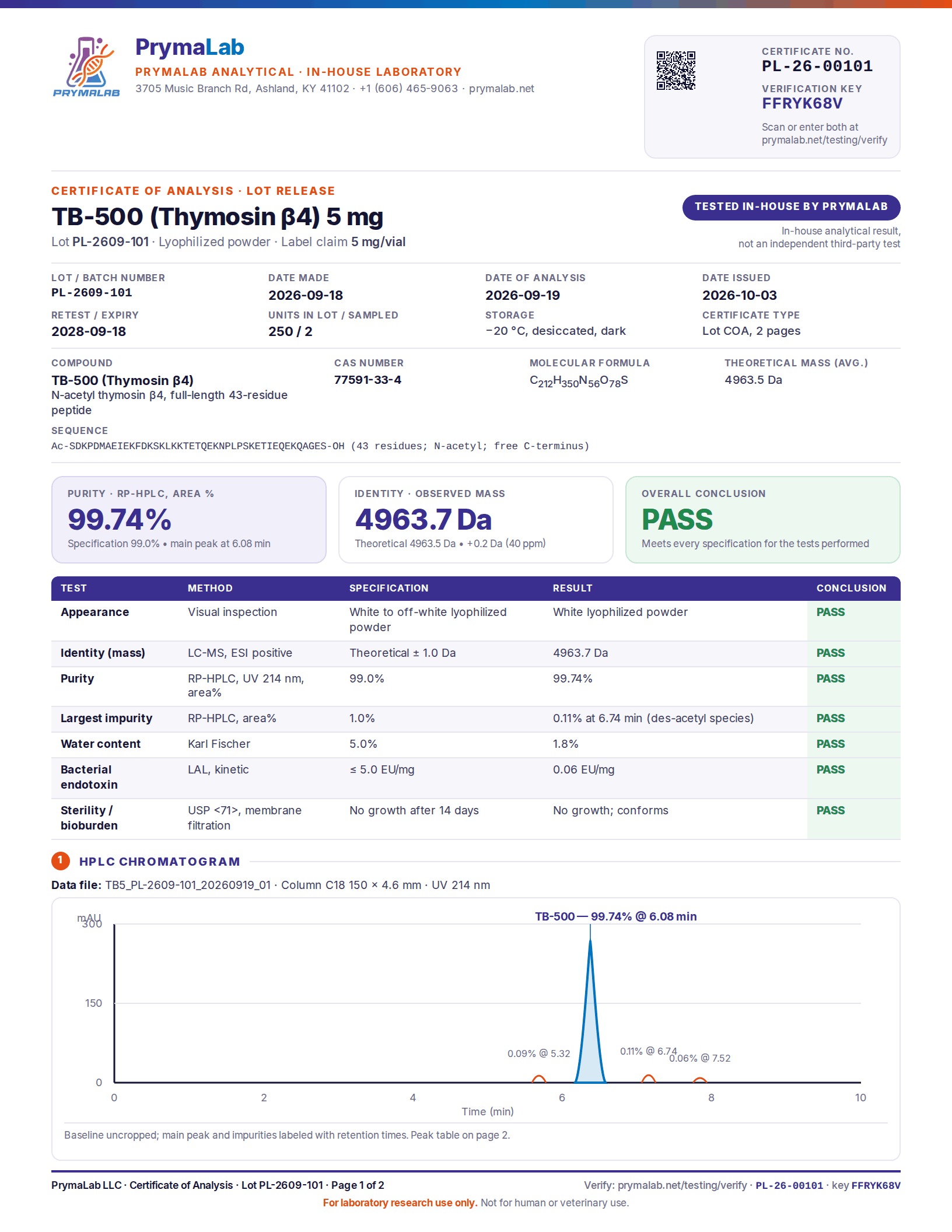
The name TB-500 is used loosely. Some sellers apply it to a short synthetic fragment built around LKKTETQ, the actin-binding stretch at residues 17 to 23, which weighs well under 1,000 Da. This vial holds the whole chain. The lot certificate gives the sequence as Ac-SDKPDMAEIEKFDKSKLKKTETQEKNPLPSKETIEQEKQAGES-OH: 43 residues with a free C-terminus and an acetylated N-terminus, matching the native protein. The theoretical mass is 4963.5 Da, and the LC-MS identity result on the certificate is the figure to compare with it, since a fragment would come in at less than a fifth of that.
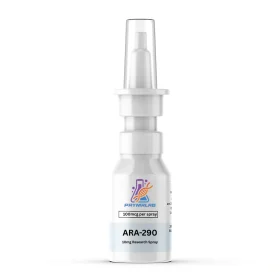
With the sequence and mass stated, molar amounts are simple arithmetic: 5 mg of a 4963.5 Da peptide is about 1.0 µmol. The true figure sits slightly lower because the powder also holds the residual water the certificate reports. The same peptide is sold already in solution as a TB-500 preloaded pen and a TB-500 nasal spray.
What the research covers
What it is and how it binds actin
Thymosin beta-4 was first isolated from a thymus extract called thymosin fraction 5 and was long thought to be a thymic hormone, a label later work did not support1. Its function inside cells was identified in 1990, when Dan Safer and colleagues found that it sequesters G-actin, the monomer form of actin1. The beta-thymosins are the main G-actin-sequestering peptides in most vertebrate cells, and thymosin beta-4 is present at high concentration in almost every cell2. Each molecule binds a single actin monomer and stops it polymerising, so the peptide acts as a buffer: monomers are held in reserve and released when the cell needs new filaments2. On its own the peptide has no fixed shape. It folds only on binding G-actin, and the complex forms and comes apart quickly1.
The native protein is modified as it is made. The initiator methionine is removed and the N-terminus is acetylated, and proteomic work has also found acetylated lysines and two phosphorylated threonines whose function is still unknown3.
Active sites in short sequences
A 2010 review by Sosne and colleagues traced several activities to particular stretches of the chain4. The N-terminal tetrapeptide Ac-SDKP was described as generally blocking inflammation and reducing fibrosis, a 15-residue N-terminal site as promoting cell survival and blocking apoptosis, and a short sequence around the central actin-binding domain LKKTETQ as promoting angiogenesis, wound healing and cell migration4. Ac-SDKP is cut from thymosin beta-4 by prolyl oligopeptidase3. Cavasin and colleagues showed this in kidney tissue homogenates, where added thymosin beta-4 yielded Ac-SDKP unless the enzyme was inhibited, and in rats, where long-term inhibition lowered Ac-SDKP in plasma, heart and kidney5. A fragment that covers only the actin-binding region lacks both N-terminal sites, while the full-length chain contains all three sequences.
Repair research by model
Thymosin beta-4 is also found outside cells, in blood plasma and wound fluid, where the effects attributed to it include induction of metalloproteinases, chemotaxis, angiogenesis and reduced inflammation2. A 2012 review described it as released by platelets, macrophages and other cells after injury6. The same review summarised findings that it limits apoptosis, inflammation and microbial growth, draws stem and progenitor cells into damaged tissue, and lowers the number of myofibroblasts in wounds, leaving less scar and fibrosis6. It covered skin, eye, heart and brain, and described clinical trials in dermal wounds, corneal injury and heart and nervous system repair as ongoing or planned; the abstract reports no outcomes6. The individual studies behind these reviews, most of them in rodents and cell culture, are set out in the TB-500 and thymosin beta-4 guide.
What is not established
How thymosin beta-4 acts outside the cell is still an open question. Huff and colleagues in 2001 and Hannappel in 2007 both wrote that little or nothing was known about the molecular mechanisms behind the extracellular effects2,1. Huff’s group also raised the possibility that higher beta-thymosin expression might help tumours spread by making cells more mobile2. Much of the review literature comes from a small circle of authors, with Goldstein, Hannappel and Sosne recurring across the papers cited here. Those papers describe thymosin beta-4 itself. None of them tested PrymaLab material, and none of the abstracts mentions a product sold as TB-500.
How each lot is tested
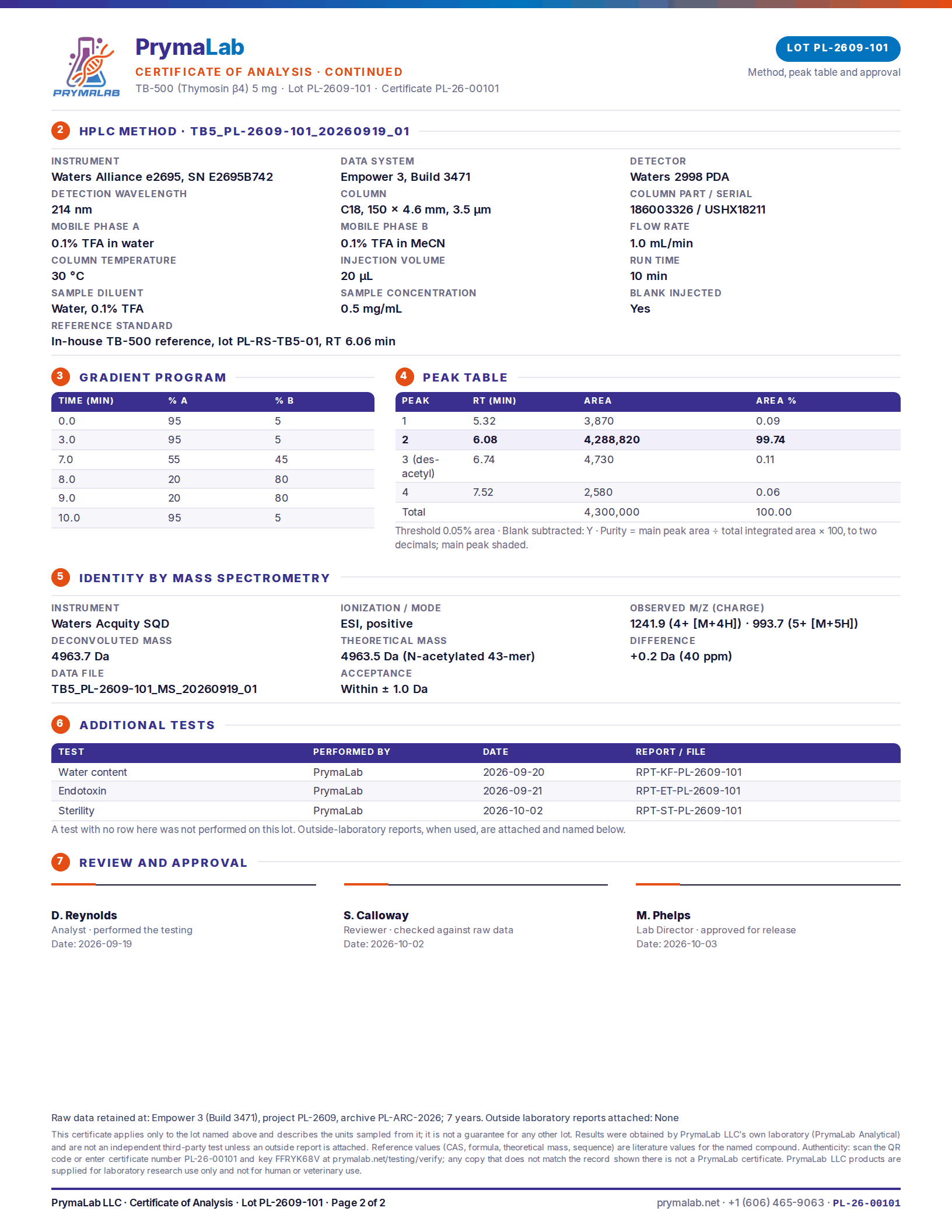
Every lot is tested in PrymaLab’s own laboratory in Ashland, Kentucky before release: RP-HPLC for purity, LC-MS for identity, Karl Fischer titration for water, LAL for endotoxin and USP <71> for sterility. The results for the lot now shipping are in the certificate panel on this page, and the certificate number, key and QR code can be checked on the verify page. These are in-house results from PrymaLab Analytical, not an independent test, and the lab is not accredited to ISO 17025. The third-party testing guarantee on this page still applies: if any independent laboratory finds the wrong compound, or less than the stated purity or amount, the order is refunded and the cost of the test is reimbursed.
Frequently asked questions
Is this full-length thymosin beta-4 or a TB-500 fragment?
Full length. The certificate gives the 43-residue sequence with an acetylated N-terminus and a free C-terminus, and a theoretical mass of 4963.5 Da. Fragments sold under the TB-500 name are built around the LKKTETQ region and weigh under 1,000 Da, so the LC-MS mass on the certificate separates the two at a glance.
How do the 5 mg and 10 mg vials differ?
Only in the amount of peptide. Both hold the same freeze-dried, full-length sequence, and each fill is made as its own lot with its own certificate. With the same volume of diluent the 10 mg vial gives twice the concentration.
How do I check the certificate for the vial I received?
Match the lot number printed on the vial to the certificate. The panel on this page shows the lot now shipping, older lots are on the testing results page, and the verify page confirms a certificate from its number and key.
How should the vial be stored before and after reconstitution?
Keep the sealed vial at −20 °C, dry and away from light. Let it reach room temperature before opening so moisture does not condense on the powder. Once reconstituted, keep the solution at 2 to 8 °C, protected from light, and use it within a period your laboratory has established.
What does the published research show, and what does it leave open?
Reviews describe thymosin beta-4 as the main actin-sequestering peptide in cells and summarise animal and cell work on wound repair, angiogenesis, inflammation and fibrosis. The papers cited here report no human trial results, the mechanism outside cells is unclear, and none of the studies used this product.
Can this product be used in people or animals?
No. It is sold for laboratory research only, is not approved by the FDA or any other authority for human or veterinary use, and must not be given to people or animals. Nothing on this page describes a clinical use.
References
- Hannappel E. beta-Thymosins. Ann N Y Acad Sci. 2007;1112:21-37. DOI · PubMed
- Huff T, Müller CS, Otto AM, et al. beta-Thymosins, small acidic peptides with multiple functions. Int J Biochem Cell Biol. 2001;33(3):205-20. DOI · PubMed
- Hannappel E. Thymosin beta4 and its posttranslational modifications. Ann N Y Acad Sci. 2010;1194:27-35. DOI · PubMed
- Sosne G, Qiu P, Goldstein AL, et al. Biological activities of thymosin beta4 defined by active sites in short peptide sequences. FASEB J. 2010;24(7):2144-51. DOI · PubMed
- Cavasin MA, Rhaleb NE, Yang XP, et al. Prolyl oligopeptidase is involved in release of the antifibrotic peptide Ac-SDKP. Hypertension. 2004;43(5):1140-5. DOI · PubMed
- Goldstein AL, Hannappel E, Sosne G, et al. Thymosin β4: a multi-functional regenerative peptide. Basic properties and clinical applications. Expert Opin Biol Ther. 2012;12(1):37-51. DOI · PubMed
Research use only
For laboratory research use only. TB-500 (Thymosin Beta-4) 5mg is not a drug, food, cosmetic or dietary supplement, is not approved by the FDA or any comparable authority for human or veterinary use, and must not be given to people or animals. It is sold to qualified researchers and institutions, and the buyer is responsible for lawful handling and disposal.
Other formats of TB-500
TB-500 is also stocked as BPC-157 + TB500 (10mg/10mg) "Wolverine Blend", BPC-157 Capsules (60/500mcg), BPC-157 Peptide Nasal Spray, BPC 157 5mg + TB500 5mg and BPC-157 5mg/ml preloaded 3ml pen. Each listing states its own quantity and concentration, and the pen and vial comparison explains what changes between formats.







6 reviews for TB-500 (Thymosin Beta-4) 5mg