
Description
PrymaLab · Research Use Only
Retatrutide 5mg
LY3437943 · 39 residues · CAS 2381089-83-2
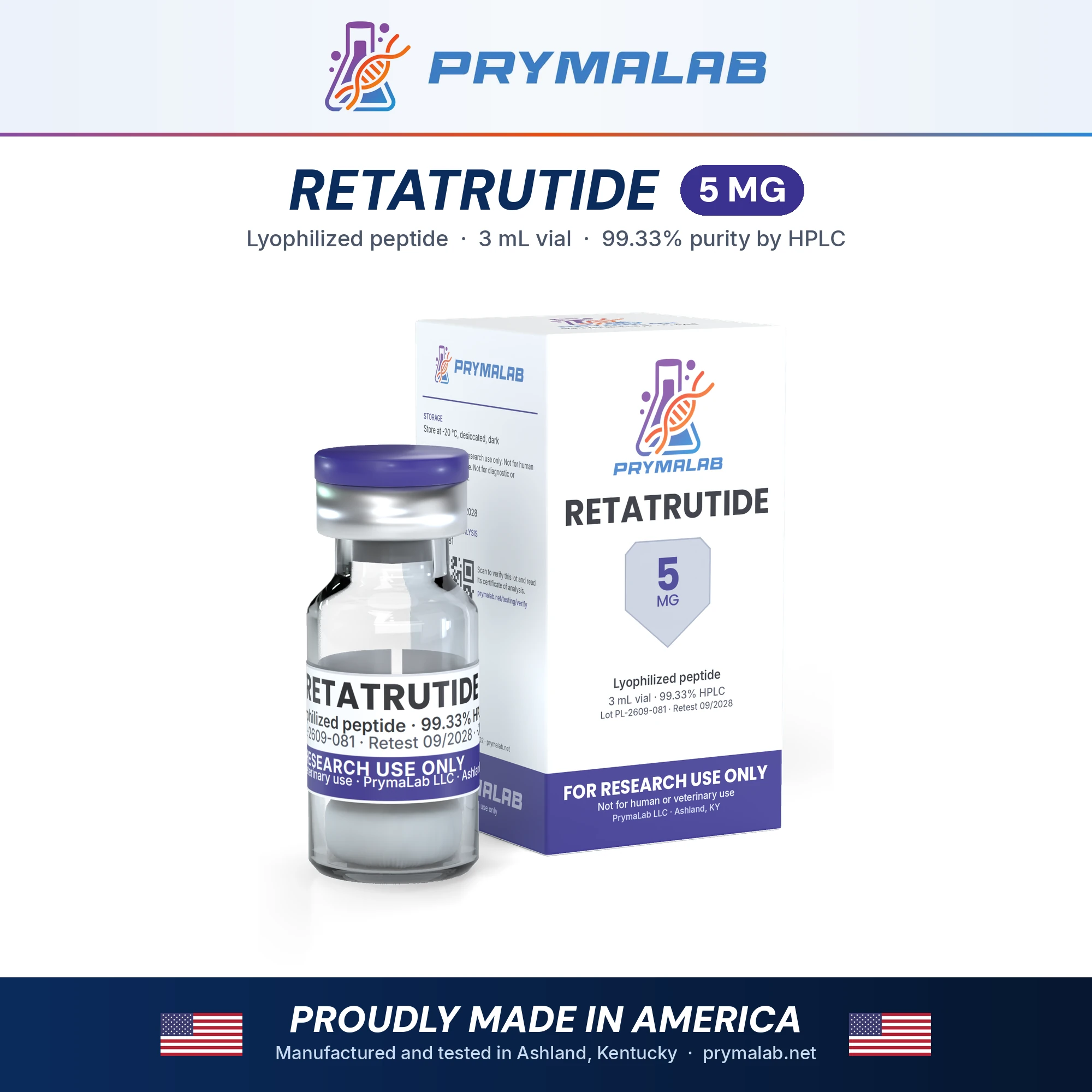
Retatrutide 5mg is a lyophilized vial of LY3437943, CAS 2381089-83-2, a 39-residue synthetic peptide. The backbone derives from glucose-dependent insulinotropic polypeptide rather than GLP-1, and it carries three non-coded residues plus a lipid conjugation at lysine 17.
Specification Table
| Property | Value |
|---|---|
| Compound | Retatrutide |
| Development code | LY3437943 |
| CAS number | 2381089-83-2 |
| Vial content | 5 mg lyophilized powder |
| Molecular formula | C228H350N48O66 |
| Molecular weight | Contested. 4894.58 and 4731.33 both circulate. See the note on the 5mg page |
| Residue count | 39 |
| C-terminus | Amidated |
| Peptide backbone | Based on the GIP sequence rather than GLP-1 |
| Non-coded residue, position 2 | α-aminoisobutyric acid (Aib) |
| Non-coded residue, position 13 | α-methyl-leucine |
| Non-coded residue, position 20 | α-aminoisobutyric acid (Aib) |
| Lipid conjugation | Lysine 17 side chain bears PEG2-γ-Glu-eicosanedioic acid |
| Molecular targets | GIP receptor, GLP-1 receptor, glucagon receptor |
| Reported EC50, GIPR | 0.0643 nM |
| Reported EC50, GLP-1R | 0.775 nM |
| Reported EC50, GCGR | 5.79 nM |
| Originating organisation | Eli Lilly |
| Appearance | White lyophilized powder |
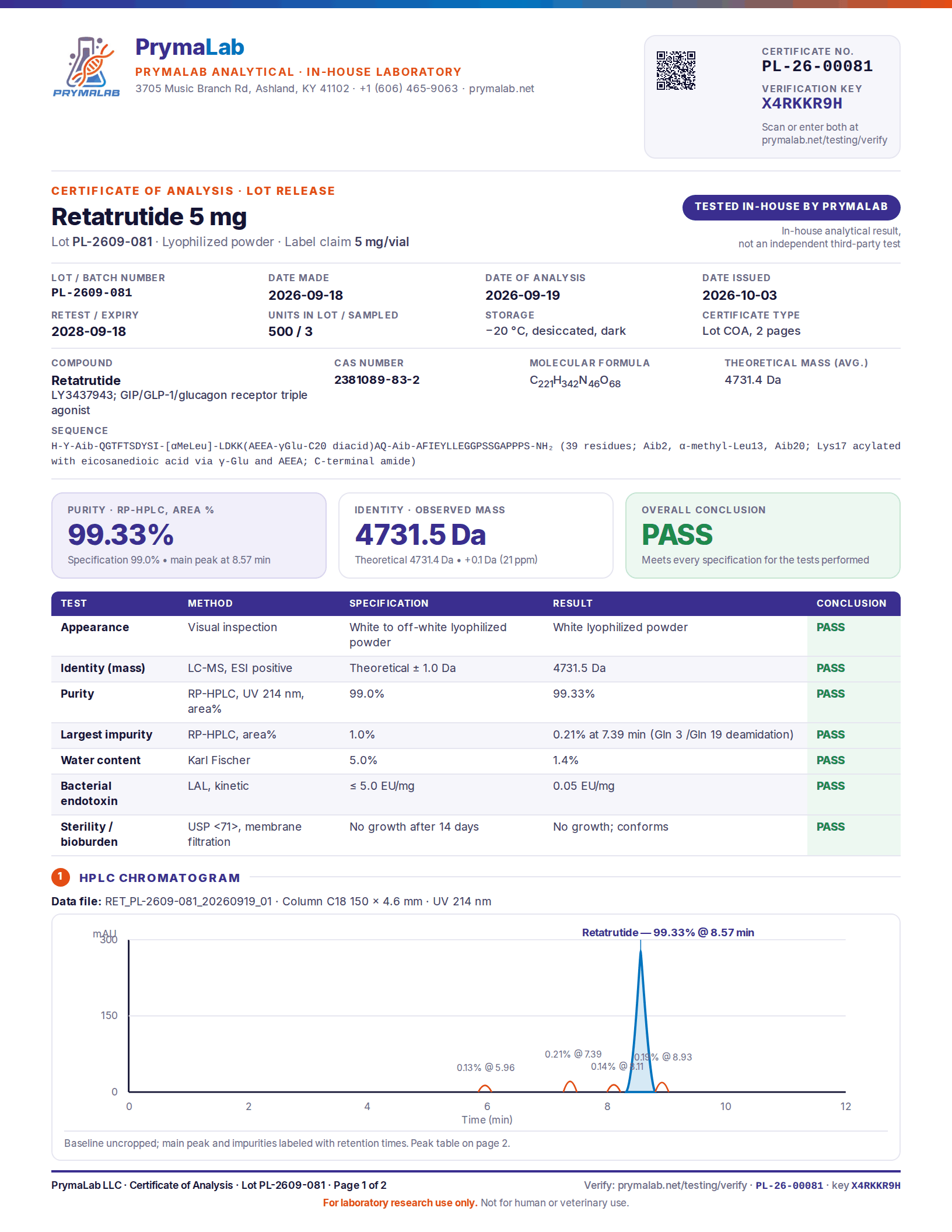
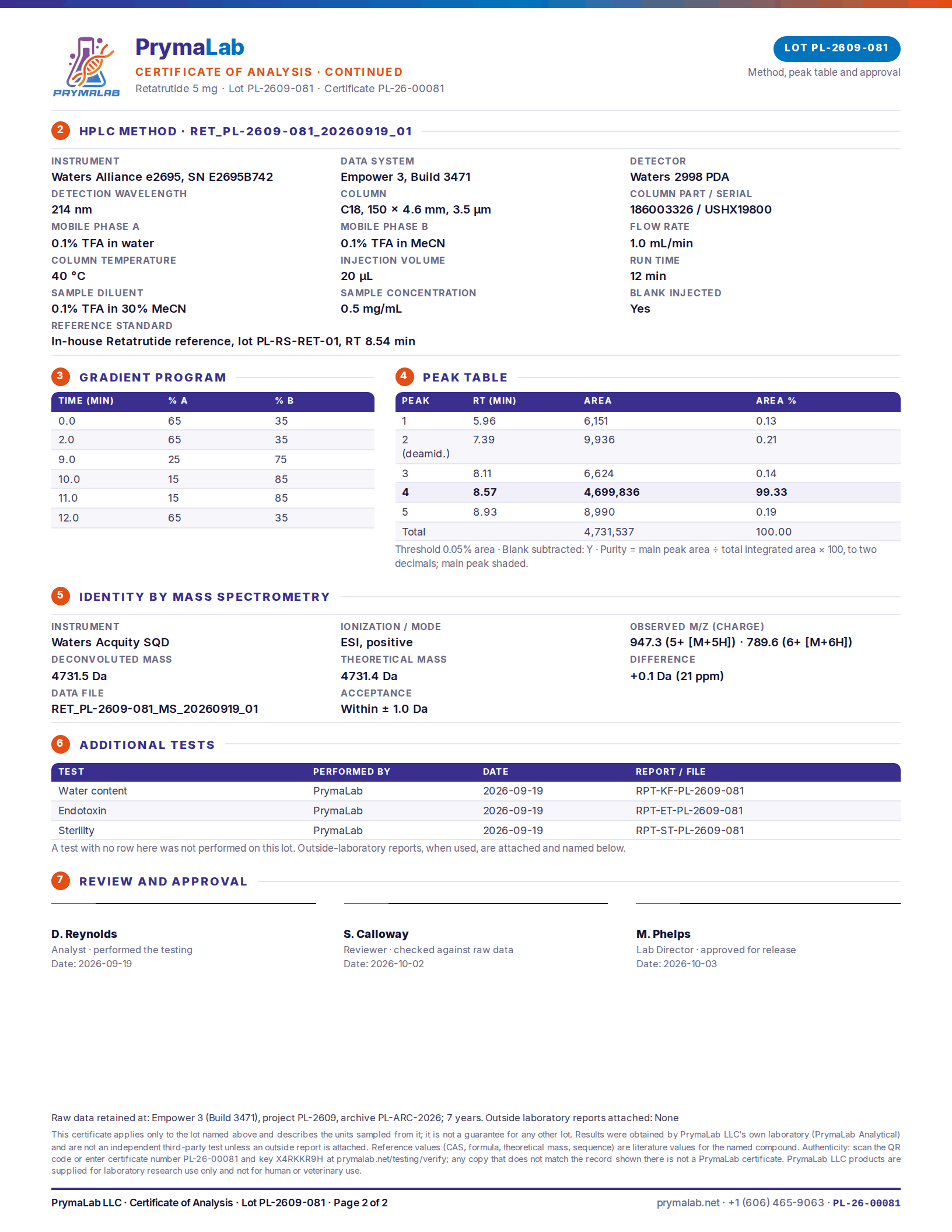
| Purity | Per lot-specific certificate of analysis |
| Solubility | Water soluble. Slightly alkaline buffer aids dissolution |
| Storage, lyophilized | -20°C, protected from light and moisture |
| Storage, reconstituted | 2-8°C, protected from light |
| Regulatory status | Investigational. No approved formulation in any jurisdiction |
What Is the Retatrutide Sequence?
Reading the Retatrutide 5mg sequence properly explains most of what makes this molecule behave differently from a plain peptide, so it is worth setting out before anything else.
The chain is 39 residues terminating in an amide, and in single-letter shorthand with the modifications spelled out it runs Tyr-Aib-Gln-Gly-Thr-Phe-Thr-Ser-Asp-Tyr-Ser-Ile-αMeLeu-Leu-Asp-Lys-Lys-Ala-Gln-Aib-Ala-Phe-Ile-Glu-Tyr-Leu-Leu-Glu-Gly-Gly-Pro-Ser-Ser-Gly-Ala-Pro-Pro-Pro-Ser-NH2.
Three positions carry residues that do not appear in the genetic code. Positions 2 and 20 hold α-aminoisobutyric acid, usually abbreviated Aib, and position 13 holds α-methyl-leucine.
Lysine 17 carries a side-chain conjugate: a PEG2 spacer, a gamma-glutamate linker, and a twenty-carbon diacid. That assembly is what drives albumin association and it is discussed in more detail on the 20mg page.
The backbone matters for classification. Retatrutide is built on the GIP sequence, not the GLP-1 sequence, which is why describing it simply as a GLP-1 analogue misstates its lineage even though it does engage that receptor.
Which Molecular Weight Is Correct?
Two molecular weight figures circulate for Retatrutide 5mg and they differ by roughly 163 daltons, which is far too large to be a rounding artefact. Anyone doing molar arithmetic needs to know which one applies.
4894.58 appears alongside the formula C228H350N48O66 on several supplier and reference listings. 4731.33 appears on others, frequently without a formula attached.
A 163 dalton gap is close to the mass of a tyrosine residue, and it is also in the range of differences produced by counting or omitting parts of the side-chain conjugate. Without seeing the calculation behind each figure it is not possible to say from the outside which convention produced which number.
The practical instruction is the same one this catalogue gives for every contested figure: verify by mass spectrometry against the specific lot rather than trusting a listing. A measured mass on your certificate settles it for the material you actually hold.
Where a calculation depends on molar concentration, using an unverified molecular weight introduces a systematic error of roughly 3.4 percent, which is small enough to pass unnoticed and large enough to matter in a concentration-response fit.
This page states both figures rather than picking one, because picking one silently would be the less useful choice.
What Do the Aib Residues Do?
Alpha-aminoisobutyric acid appears twice in the Retatrutide 5mg sequence and it is one of the most common modifications in this compound class, for a specific structural reason.
Aib is alanine with a second methyl group on the alpha carbon. That extra substituent removes the alpha hydrogen and leaves the carbon quaternary, which sharply restricts the backbone dihedral angles the residue can adopt.
The restriction favours helical geometry, and a peptide carrying Aib residues at intervals is pre-organised toward the helix its receptors recognise, so less conformational entropy is lost on binding.
Protease resistance follows from the same feature. Dipeptidyl peptidase-4 cleaves after position 2 in this family of peptides, and Aib at position 2 presents a quaternary carbon the enzyme active site cannot accommodate. That single substitution blocks the fastest degradation route.
The alpha-methyl-leucine at position 13 works on the same principle applied to a different residue, adding local rigidity without changing the side chain the receptor contacts.
These substitutions are why the molecule survives in a biological system long enough for the fatty acid conjugation to matter.
What Does Retatrutide 5mg Storage Require?
Retatrutide 5mg as lyophilized peptide is undemanding, and the handling notes are short.
Hold the sealed vial at -20°C, protected from light and moisture. In the dry state the degradation routes that trouble this molecule in solution are largely suppressed.
Allow the vial to reach room temperature before opening. Opening a cold vial in a humid room condenses water onto hygroscopic lyophilized material, which is the most common way a well-stored peptide is quietly compromised.
Once reconstituted, hold at 2-8°C protected from light and aliquot before any freezing step. Solution-state behaviour for this molecule is covered on the 50mg page, where the quantity makes it more consequential.
Record lot, the mass stated on the certificate, the molecular weight used for calculation, diluent, volume, resulting concentration and date. Recording the molecular weight used sounds pedantic until two people in the same laboratory use different figures.
Why Does the GIP Backbone Matter for Classification?
Retatrutide is routinely filed under GLP-1 analogues, and the filing is wrong in a way that affects how the literature should be read.
GIP and GLP-1 are both incretins and both are proglucagon-family-adjacent, but they are distinct peptides with distinct receptors and only partial sequence similarity. A molecule built on one backbone is not a variant of the other.
The design logic runs the other way round from the usual assumption. Starting from GIP and engineering in GLP-1 and glucagon receptor activity is a harder problem than starting from GLP-1, and the three non-coded residues are part of how that was solved.
For anyone searching the literature, this matters practically. Reviews of GLP-1 receptor agonists frequently omit this compound or file it as an outlier, while reviews of unimolecular multi-agonists cover it properly.
It also matters for comparison. Placing retatrutide alongside a true GLP-1 analogue and attributing differences to the extra receptors ignores that the backbones differ too, which is a confound rather than a detail.
The habit worth forming is to check what a modified peptide was built from before assuming what family it belongs to. Sequence lineage and receptor activity are separate facts, and this compound is the clearest illustration of that in the whole catalogue.
What Does Retatrutide 5mg Supply in Molar Terms?
Molar accounting for a 39-residue lipidated peptide is where mass-labelled vials most often mislead, and this one carries an extra complication.
Five milligrams divided by 4894.58 grams per mole gives approximately 1.02 micromoles. Using the lower circulating figure it gives approximately 1.06. Retatrutide 5mg therefore supplies about a micromole, which is a modest molar quantity by the standards of this catalogue.
Compare that against five milligrams of a tripeptide near 400 daltons, which yields 12.5 micromoles. The same weight of Retatrutide 5mg gives roughly a twelfth as much material in molar terms, and receptor interactions occur on a molar basis rather than a mass basis.
Counterion contributes a further correction. Solid-phase synthesis with trifluoroacetic acid cleavage leaves trifluoroacetate associated with basic residues, and this sequence carries two adjacent lysines at positions 16 and 17.
Net peptide content on the certificate resolves it. Where that figure is stated, calculate from it rather than from the vial label.
At the concentrations these receptors respond to, a micromole covers a very large number of wells, so the modest molar content is rarely the binding constraint.
Who Is LY3437943 and Where Did It Come From?
The development code is worth knowing, because most of the primary literature uses it rather than the generic name and a search under one alone will miss work.
LY3437943 was developed at Eli Lilly and first described in the peer-reviewed literature in 2022. Coskun and colleagues published the pharmacological characterisation in Cell Metabolism, and Urva and colleagues published early clinical work in The Lancet the same year.
The intellectual lineage runs back further. Finan and colleagues described unimolecular triple agonists at these three receptors in Nature Medicine in 2015, establishing the concept before this specific molecule existed.
Searching the literature under the generic name alone will miss a substantial share of the primary work. Searching under both terms is the practical habit.
The compound remains investigational. No formulation is approved in any jurisdiction, and material sold as a research chemical is not the clinical product.
One last note on nomenclature. Material is listed variously as retatrutide, as LY3437943, and occasionally as reta, and all three refer to the same 39-residue peptide.
Confirming the sequence and the CAS number rather than the name forecloses a category of ordering error that recurs with compounds carrying a development code alongside a generic name.
A final point on the non-coded residues. Aib and alpha-methyl-leucine are not exotic in this compound class, and the same substitutions appear across the incretin analogue family for the same reasons of rigidity and protease resistance.
Recognising them tells you something useful about any peptide you encounter: a sequence carrying Aib at position 2 has almost certainly been designed to resist dipeptidyl peptidase-4, whatever else it does.
That single observation lets you read the intent behind a modified sequence without needing the paper that describes it.
Published Literature
All references verified against the publisher record. Unlike most compounds in this catalogue, retatrutide has a substantial peer-reviewed record from a named pharmaceutical developer.
- Coskun T, Urva S, Roell WC, Qu H, Loghin C, Moyers JS, O’Farrell LS, Briere DA, Sloop KW, Thomas MK, Pirro V, Wainscott DB, Willard FS, Abernathy M, Morford L, Du Y, Benson C, Gimeno RE, Haupt A, Coskun T. Cell Metabolism. 2022;34(9):1234-1247.
- Urva S, Coskun T, Neff LM, Yeo KP, Loghin C, Ma X, Landry J, Bray R, Milicevic Z, Haupt A. The Lancet. 2022;400(10366):1869-1881.
- Jastreboff AM, Kaplan LM, Frias JP, Wu Q, Du Y, Gurbuz S, Coskun T, Haupt A, Milicevic Z, Hartman ML. New England Journal of Medicine. 2023;389(6):514-526.
- Willard FS, Douros JD, Gabe MB, Showalter AD, Wainscott DB, Suter TM, Capozzi ME, van der Velden WJ, Stutsman C, Cardona GR, et al. JCI Insight. 2020;5(17):e140532.
- Finan B, Yang B, Ottaway N, Smiley DL, Ma T, Clemmensen C, Chabenne J, Zhang L, Habegger KM, Fischer K, et al. Nature Medicine. 2015;21(1):27-36.
Frequently Asked Questions
What is Retatrutide 5mg?
A lyophilized vial of LY3437943, CAS 2381089-83-2, a 39-residue synthetic peptide built on a GIP backbone with three non-coded residues and a lipid conjugation at lysine 17. Laboratory research use only, with no approved formulation anywhere.
Is retatrutide a GLP-1 analogue?
Not by lineage. The backbone derives from glucose-dependent insulinotropic polypeptide rather than GLP-1, so calling it a GLP-1 analogue misstates its origin even though it does engage the GLP-1 receptor alongside two others.
Which molecular weight should be used?
Two figures circulate, 4894.58 and 4731.33, differing by roughly 163 daltons. That gap is too large to be rounding. Verify by mass spectrometry against your specific lot rather than trusting a listing.
How much error does the wrong figure introduce?
Roughly 3.4 percent in any molar calculation. Small enough to pass unnoticed and large enough to distort a concentration-response fit, which is the combination that makes it worth checking rather than assuming.
What is Aib and why does it appear twice?
Alpha-aminoisobutyric acid, which is alanine with a second methyl group on the alpha carbon. The quaternary carbon restricts backbone geometry, pre-organising the chain toward the helix its receptors recognise.
How does Aib at position 2 help?
It blocks dipeptidyl peptidase-4. That enzyme cleaves after position 2 in this peptide family and cannot accommodate a quaternary alpha carbon in its active site, so a single substitution removes the fastest degradation route.
What does alpha-methyl-leucine at position 13 do?
The same thing by the same mechanism, applied to a different residue. It adds local backbone rigidity without altering the side chain that contacts the receptor.
What carries the lipid conjugation?
The lysine 17 side chain, which bears a PEG2 spacer, a gamma-glutamate linker and a twenty-carbon diacid. That assembly drives albumin association and governs how long the molecule persists.
How should the vial be stored?
Sealed at minus 20 Celsius, protected from light and moisture. Allow it to reach room temperature before opening, since opening a cold vial in a humid room condenses water onto hygroscopic material.
Why search under LY3437943 as well?
Because most of the primary literature uses the development code rather than the generic name. Searching under only one term misses a substantial share of the published work, including the original characterisation.
Who developed it?
Eli Lilly. Coskun and colleagues published the pharmacological characterisation in Cell Metabolism in 2022, and Urva and colleagues published early clinical work in The Lancet the same year. The concept traces to Finan and colleagues in 2015.
Compliance Statement
Retatrutide 5mg is sold exclusively for laboratory research use. It is not a drug, food, or cosmetic product, and it is not a dietary product of any kind. It is not approved by the FDA or any comparable authority for human or veterinary use, it is an investigational compound with no approved formulation in any jurisdiction, and material supplied as a research chemical is not a clinical product. This product is not intended to diagnose, treat, cure, or prevent any disease. It must not be given to humans or animals. Purchase is restricted to qualified researchers and institutions operating within applicable laws. All handling is the responsibility of the purchasing laboratory.
Other formats of Retatrutide
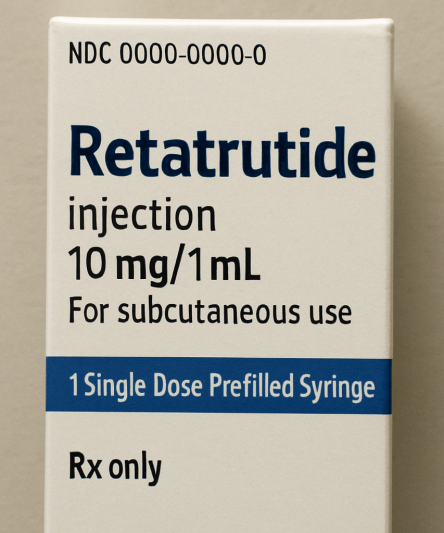
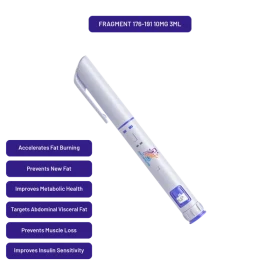
Retatrutide is also stocked as Retatrutide 15mg preloaded 3ml pen, Retatrutide 10mg, Retatrutide 20mg, Retatrutide 30mg, Retatrutide 40mg and Retatrutide 60mg. Each listing states its own quantity and concentration, and the pen and vial comparison explains what changes between formats. The retatrutide buying guide covers what to check on a certificate before ordering.










18 reviews for Retatrutide 5mg