Description
PrymaLab · Research use only
GHRP-2 10mg
Pralmorelin (KP-102), a six-residue growth hormone secretagogue, in a 10 mg vial
GHRP-2, also known as pralmorelin and KP-102, is a synthetic hexapeptide that releases growth hormone by acting at the receptor for ghrelin. This listing is the 10 mg vial of white freeze-dried powder, the main fill of the GHRP-2 range, and a 5 mg vial is also sold. Studies of GHRP-2 cover its origin in Cyril Bowers’ peptide series, its use as a test of pituitary growth hormone reserve, how quickly it clears in children and its effect on food intake in men.
Specifications
| Property | Value |
|---|---|
| Compound | GHRP-2 Pralmorelin; KP-102; growth hormone-releasing hexapeptide |
| CAS number | 158861-67-7 |
| Molecular formula | C45H55N9O6 |
| Theoretical mass | 818.0 Da |
| Sequence / structure | H-[D-Ala]-[D-2-Nal]-A-W-[D-Phe]-K-NH₂ (6 residues; C-terminal amide) |
| Label claim | 10 mg/vial |
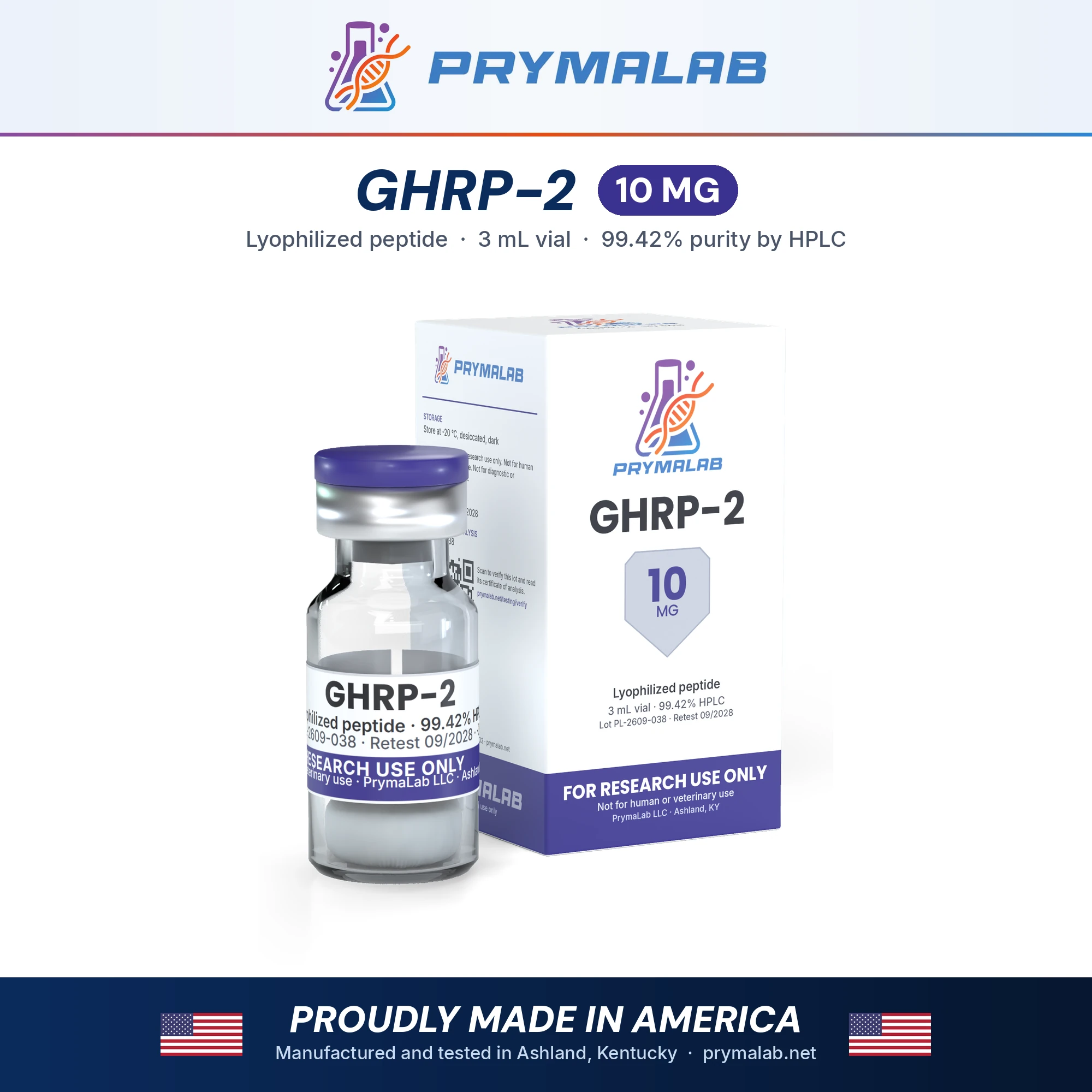
| Form | Lyophilized (freeze-dried) powder or cake in a sealed glass vial with a rubber stopper and aluminium crimp cap |
| Storage, sealed | −20 °C, desiccated, dark |
| Purity specification | 99.0% or higher by RP-HPLC |
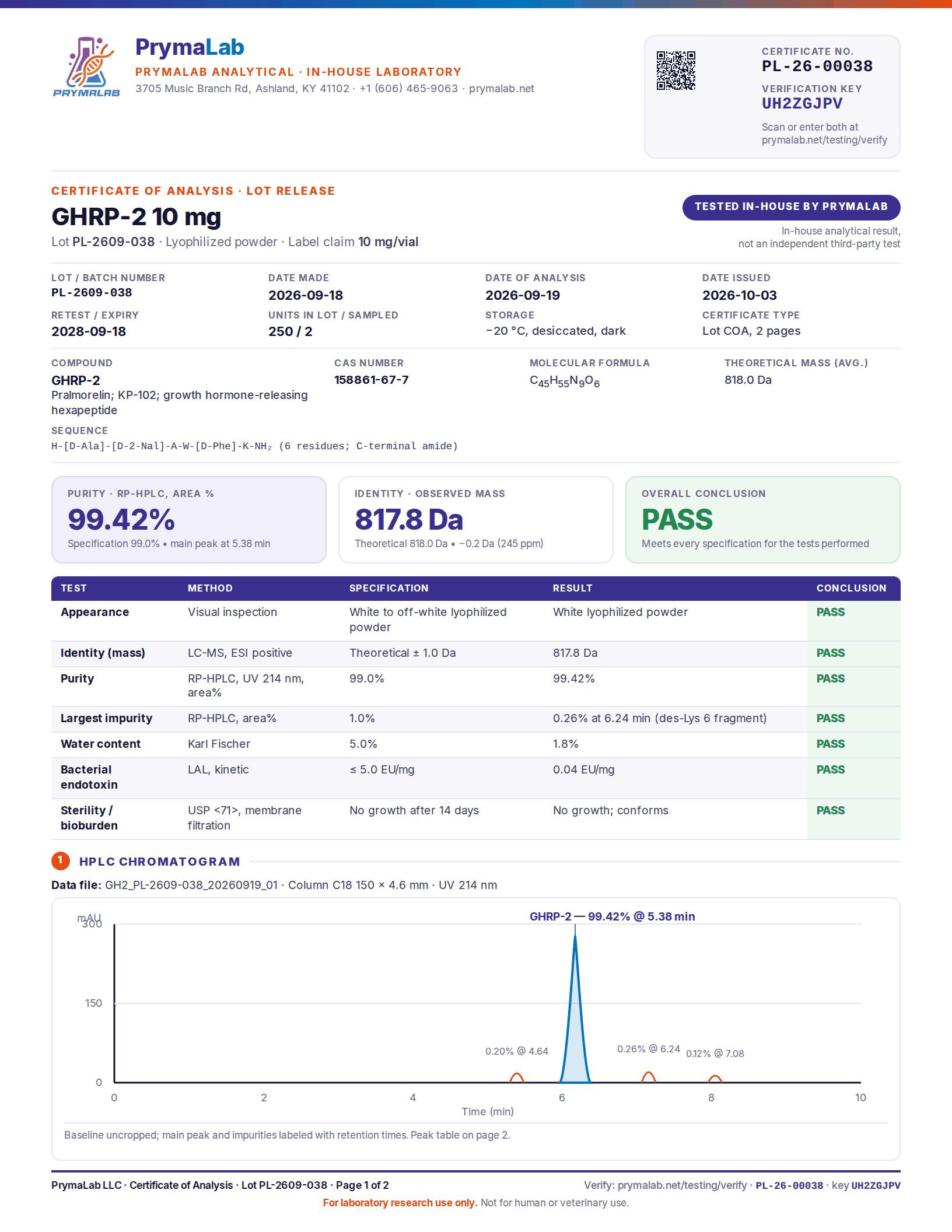
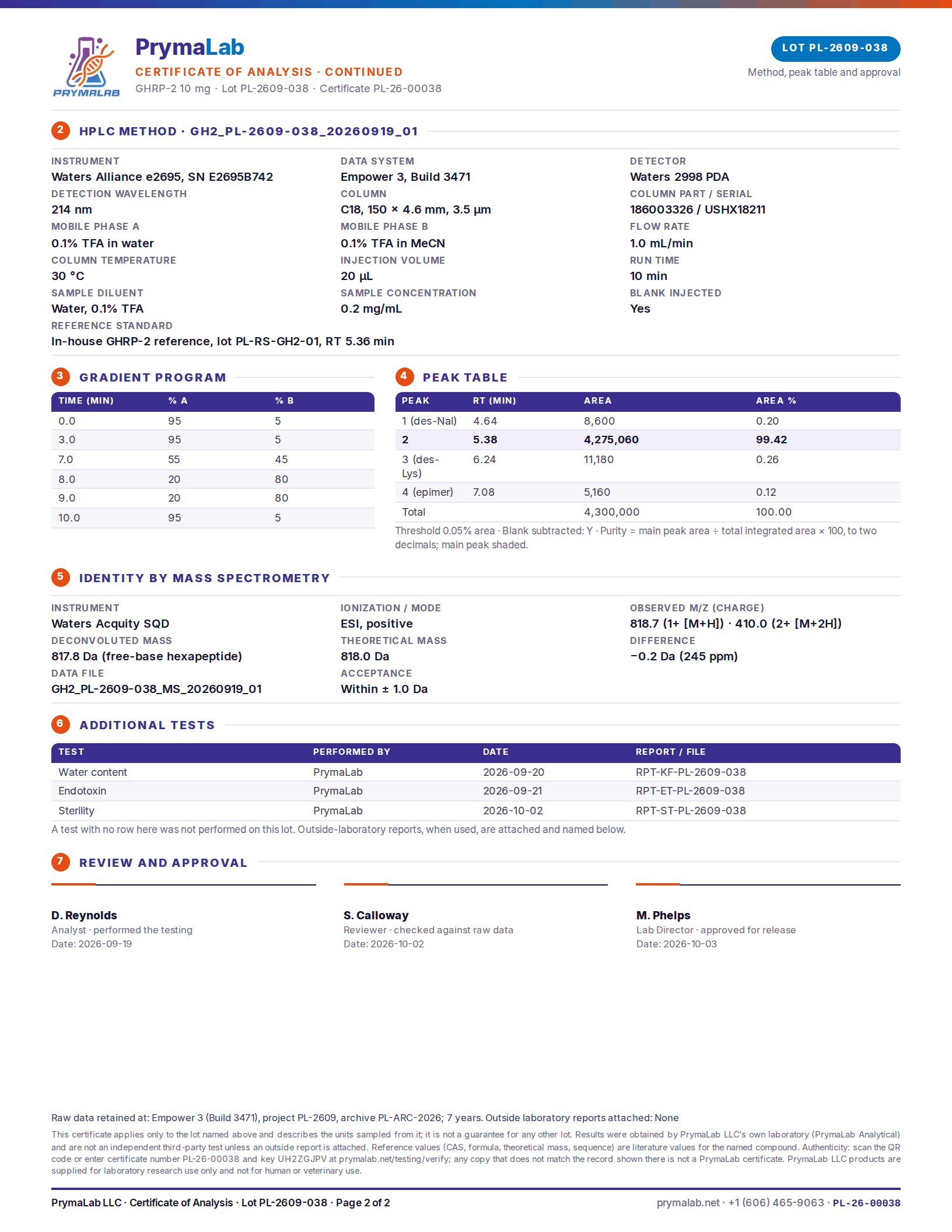
| Lot certificate | Results for the lot now shipping are in the certificate panel on this page |
| Safety data sheet | PL-SDS-061 |
Fills in this range
GHRP-2 is sold in 2 fills. The compound and the testing are the same in every fill; only the amount in the vial changes.
| Fill | Listing |
|---|---|
| 5 mg | GHRP-2 5mg |
| 10 mg | GHRP-2 10mg (this page) |
Sequence, and how it differs from GHRP-6
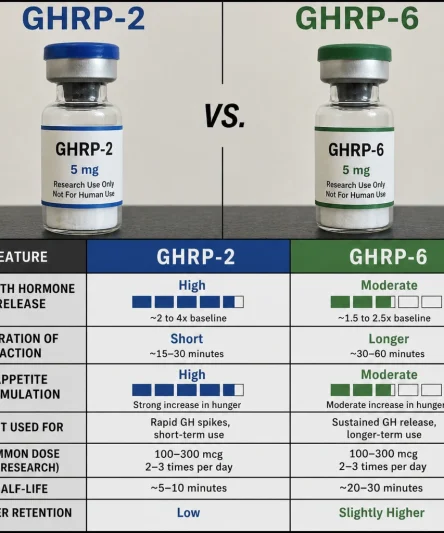
Written out in three-letter code, the sequence on the lot certificate is H-D-Ala-D-2-Nal-Ala-Trp-D-Phe-Lys-NH2. Three of the six residues are D-amino acids, the C-terminus is an amide, and position 2 holds D-2-naphthylalanine, a synthetic aromatic residue that proteins do not contain. GHRP-6, the older peptide with the near-identical name, begins His-D-Trp instead and shares the remaining four residues and the amide. Those two substitutions separate the peptides clearly by mass. GHRP-2 has a theoretical mass of 818.0 Da and GHRP-6 873.0 Da, so the LC-MS identity result on the certificate shows which of the two is in the vial. The same figure puts 10 mg of GHRP-2 at about 12.2 µmol, a little less in practice because the powder also holds the residual water the certificate reports.
What the research covers
Where GHRP-2 came from
GHRP-2 belongs to a series of small growth hormone-releasing peptides synthesised by Cyril Bowers’ group at Tulane University and developed with the German company Polygen1. An earlier peptide from the same laboratory, GHRP-6 (His-D-Trp-Ala-Trp-D-Phe-Lys-NH2), was studied by Bowers and colleagues in 18 healthy men in 1990: it was a potent releaser of growth hormone, and at submaximal amounts it acted synergistically with growth hormone-releasing hormone (GHRH)2. GHRP-2 keeps the last four residues of that peptide and replaces the first two. When these peptides were made, nobody knew which receptor they acted on. Howard and colleagues cloned it in 1996, a G protein-coupled receptor in the pituitary and hypothalamus of pigs and humans, and showed that it was the target of the growth hormone secretagogues3. A 2004 drug profile describes pralmorelin as mimicking the actions of ghrelin, a 28-residue octanoylated peptide that regulates growth hormone release1.
Use as a test of growth hormone reserve
The clinical interest in pralmorelin was diagnostic. The same profile reports that it raises plasma growth hormone sharply in healthy subjects regardless of sex, obesity or age, while the response in growth hormone deficiency is much smaller1. A receiver-operating-characteristic analysis set a growth hormone peak of 15.0 µg/L as the threshold separating deficient from normal secretion, and Kaken acquired worldwide manufacturing and marketing rights1. A 2010 doping-control paper described GHRP-2 as in use for diagnosing growth hormone deficiency4.
Pharmacokinetics and appetite in human studies
Pihoker and colleagues ran a phase I study in ten prepubertal children with short stature, measuring GHRP-2 and growth hormone in blood over two hours after a single exposure5. Plasma GHRP-2 fell in two phases, and the terminal half-life averaged 0.55 hours5. GHRP-2 also affects eating, as ghrelin does. In seven lean, healthy men, GHRP-2 compared with saline increased the amount eaten at a buffet meal by 35.9%, every subject ate more, the mix of fat, protein and carbohydrate did not change, and growth hormone rose as expected6. The authors proposed GHRP-2 as a tool for studying how ghrelin acts on eating in humans6.
Detection and metabolism
Growth hormone secretagogues are prohibited in sport by the World Anti-Doping Agency, and Okano and colleagues developed a liquid chromatography and tandem mass spectrometry method to find GHRP-2 in urine4. Alongside the intact peptide the method targets a metabolite, D-Ala-D-2-Nal-Ala-OH, which is the first three residues of the chain ending in a free acid; in ten male volunteers both were detected in every case4.
What is not established
The human evidence for GHRP-2 rests on small, short studies: ten children in the pharmacokinetic work5 and seven men in the food intake study6. Several findings often quoted for the whole class were measured with GHRP-6. In the 1990 study, prolactin and cortisol roughly doubled only at the highest amount of GHRP-6 tested, while LH and TSH did not change2, and none of the abstracts cited here reports the same hormone panel for GHRP-2. None of these studies used PrymaLab material, and the vial sold here is not Kaken’s diagnostic product. The GHRP-2 vs GHRP-6 guide sets the two peptides side by side.
How each lot is tested
Every lot is tested in PrymaLab’s own laboratory in Ashland, Kentucky before release: RP-HPLC for purity, LC-MS for identity, Karl Fischer titration for water, LAL for endotoxin and USP <71> for sterility. The results for the lot now shipping are in the certificate panel on this page, and the certificate number, key and QR code can be checked on the verify page. These are in-house results from PrymaLab Analytical, not an independent test, and the lab is not accredited to ISO 17025. The third-party testing guarantee on this page still applies: if any independent laboratory finds the wrong compound, or less than the stated purity or amount, the order is refunded and the cost of the test is reimbursed.
Frequently asked questions
How is GHRP-2 different from GHRP-6?
They differ at the first two of six positions. GHRP-2 starts D-Ala-D-2-naphthylalanine and GHRP-6 starts His-D-Trp, while the last four residues and the C-terminal amide are shared. GHRP-2 is 818.0 Da and GHRP-6 is 873.0 Da, so the LC-MS identity figure on the certificate tells them apart. Their research literatures are also largely separate.
How do the 5 mg and 10 mg vials differ?
Only in the amount of peptide. Both hold the same freeze-dried GHRP-2, each fill is made as its own lot with its own certificate, and the same volume of diluent gives the 10 mg vial twice the concentration of the 5 mg.
How do I find the certificate for the vial I received?
Read the lot number on the vial label and match it to a certificate. The panel on this page shows the lot now shipping, older lots are listed on the testing results page, and the verify page confirms any certificate from its number and key.
How should GHRP-2 be stored?
Keep the sealed vial at −20 °C, dry and dark. Let it come to room temperature before opening so moisture does not condense on the powder. After reconstitution, keep the solution at 2 to 8 °C away from light and use it within the period your laboratory has set.
Is GHRP-2 an approved drug?
Pralmorelin was developed as a diagnostic agent for growth hormone deficiency, and Kaken holds the rights to that product. The vial sold here is research material, not that product, and it is not approved by the FDA or any other authority for use in people or animals.
References
- . Pralmorelin: GHRP 2, GPA 748, growth hormone-releasing peptide 2, KP-102 D, KP-102 LN, KP-102D, KP-102LN. Drugs R D. 2004;5(4):236-9. DOI · PubMed
- Bowers CY, Reynolds GA, Durham D, et al. Growth hormone (GH)-releasing peptide stimulates GH release in normal men and acts synergistically with GH-releasing hormone. J Clin Endocrinol Metab. 1990;70(4):975-82. DOI · PubMed
- Howard AD, Feighner SD, Cully DF, et al. A receptor in pituitary and hypothalamus that functions in growth hormone release. Science. 1996;273(5277):974-7. DOI · PubMed
- Okano M, Sato M, Ikekita A, et al. Determination of growth hormone secretagogue pralmorelin (GHRP-2) and its metabolite in human urine by liquid chromatography/electrospray ionization tandem mass spectrometry. Rapid Commun Mass Spectrom. 2010;24(14):2046-56. DOI · PubMed
- Pihoker C, Kearns GL, French D, et al. Pharmacokinetics and pharmacodynamics of growth hormone-releasing peptide-2: a phase I study in children. J Clin Endocrinol Metab. 1998;83(4):1168-72. DOI · PubMed
- Laferrère B, Abraham C, Russell CD, et al. Growth hormone releasing peptide-2 (GHRP-2), like ghrelin, increases food intake in healthy men. J Clin Endocrinol Metab. 2005;90(2):611-4. DOI · PubMed
Research use only
For laboratory research use only. GHRP-2 10mg is not a drug, food, cosmetic or dietary supplement, is not approved by the FDA or any comparable authority for human or veterinary use, and must not be given to people or animals. It is sold to qualified researchers and institutions, and the buyer is responsible for lawful handling and disposal.
Other formats of GHRP-2
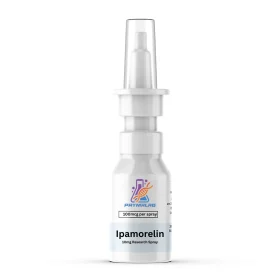
GHRP-2 is also stocked as GHRP-2 Nasal Spray and GHRP-2 10mg preloaded 3ml pen. Each listing states its own quantity and concentration, and the pen and vial comparison explains what changes between formats.







Reviews
There are no reviews yet.