Description
PrymaLab · Research Use Only
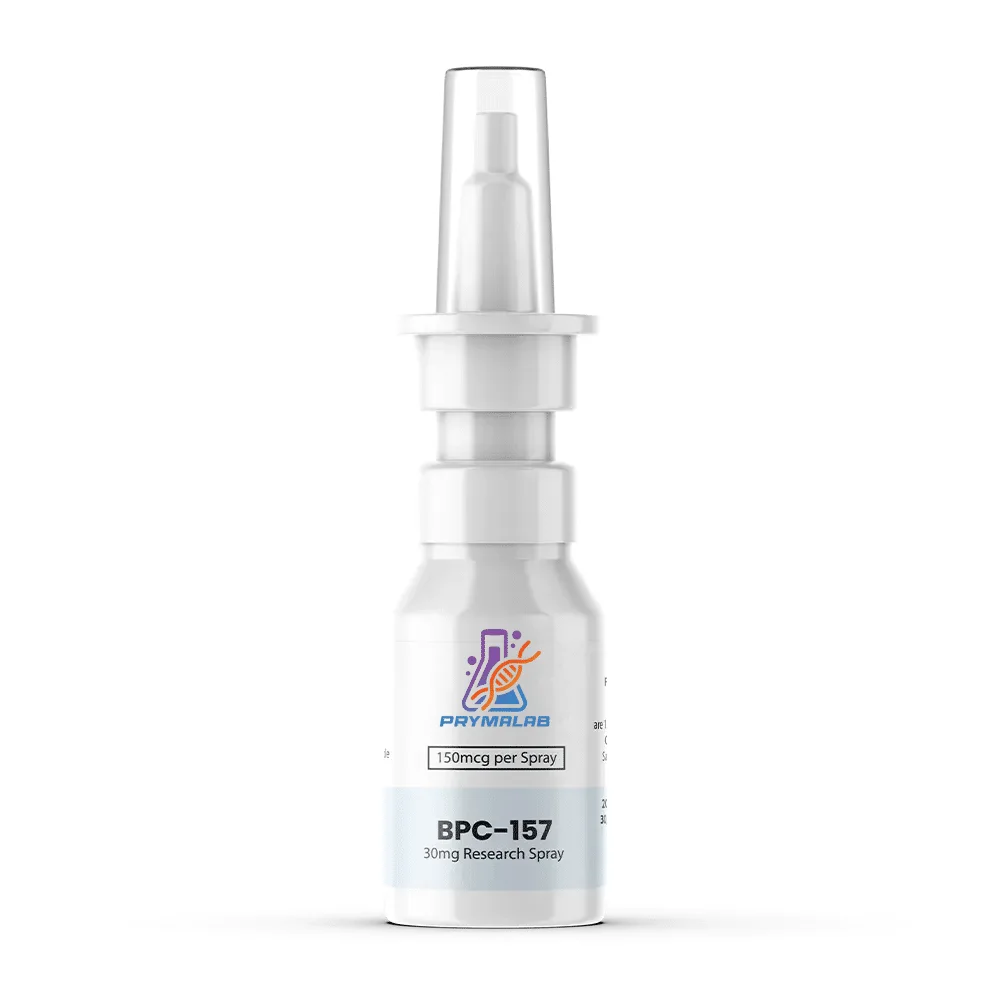
BPC-157 Nasal Spray
GEPPPGKPADDAGLV · 15 residues · 1419.5 Da
BPC-157 nasal spray supplies a 15-residue peptide, sequence GEPPPGKPADDAGLV, molecular weight approximately 1419.5, in a metered spray. The sequence is a partial fragment of body protection compound, a protein identified in gastric juice.
Specification Table
| Property | Value |
|---|---|
| Compound | BPC-157 |
| Full designation | Body protection compound 157 |
| Single-letter sequence | GEPPPGKPADDAGLV |
| Three-letter sequence | Gly-Glu-Pro-Pro-Pro-Gly-Lys-Pro-Ala-Asp-Asp-Ala-Gly-Leu-Val |
| Residue count | 15 |
| Approximate molecular weight | 1419.5 g/mol |
| Parent protein | A protein isolated from human gastric juice |
| Proline content | Four of fifteen residues |
| Net charge at neutral pH | Net negative, from one glutamate and two aspartates against one lysine |
| Oxidation-prone residues | None. No methionine, cysteine or tryptophan |
| Cysteine content | None. No disulfide chemistry |
| Receptor | Not identified. No specific receptor has been characterised |
| Reported pathway associations | Nitric oxide system, VEGFR2, focal adhesion kinase. All proposed rather than established |
| Format | Metered nasal spray, solution state |
| Appearance | Clear colourless solution |
| Purity | Per lot-specific certificate of analysis |
| Storage | 2-8°C, protected from light. Do not freeze |
| Human clinical data | Limited. No completed large randomised trial published |
| Regulatory status | No approved human or veterinary formulation in any jurisdiction |
Where Does This Sequence Come From?
The origin story explains the name and it also explains why the compound is unusually stable, which is the practically useful part.
Body protection compound is a protein reported in human gastric juice. BPC-157 is not that protein. It is a 15-residue stretch of it, synthesised separately, and the number refers to the fragment rather than to any position in a standard numbering.
Gastric juice is an aggressive environment: strongly acidic, rich in pepsin. A sequence that persists there is under selective pressure to resist exactly the conditions that destroy most peptides.
That shows in the composition. Four prolines out of fifteen constrain the backbone and obstruct protease access, since proteases need their substrate extended in the active site. No cysteine means no disulfide chemistry. No methionine or tryptophan removes the fastest oxidation routes entirely.
The practical consequence is that this is among the more durable peptides in the catalogue, which matters more for a solution-state spray than for a lyophilized vial.
Does BPC-157 Nasal Spray Work, and What Does the Evidence Show?
This exact phrasing is searched often enough to deserve a direct answer rather than a deflection, and the direct answer has two halves.
The rodent literature on BPC-157 is large. Multiple groups, predominantly associated with Sikiric and colleagues in Zagreb, have reported findings across tissue injury models spanning tendon, muscle, gut and vascular endpoints over roughly three decades.
The intranasal literature specifically is much thinner. Most published work used intraperitoneal or intragastric routes in rodents. Extrapolating from those to a nasal spray is an assumption rather than a finding, and it is the assumption a page like this should name.
No receptor has been identified. Proposed pathway associations include the nitric oxide system, VEGFR2 and focal adhesion kinase signalling, and all of them are correlative rather than established as the mechanism.
Human clinical evidence is limited, with no completed large randomised trial published. The honest position is a substantial animal literature concentrated in one research tradition, a thin intranasal subset, and an unidentified mechanism.
What BPC-157 Nasal Spray Dosage Appears in Published Work?
Figures below come from published rodent studies, in the route each study used. The route qualifier matters more than usual here.
The most commonly cited rodent range is roughly 10 micrograms per kilogram, with a substantial body of work spanning approximately 1 to 500 micrograms per kilogram depending on model and endpoint. Sikiric and colleagues report throughout this band.
Those figures come overwhelmingly from intraperitoneal and intragastric exposure. A published intragastric amount tells you the peptide survived the gut, which is consistent with its gastric origin, but it does not tell you what an equivalent intranasal amount would be.
Allometric scaling by body surface area is required for any cross-species comparison, and the FDA conversion factors are the standard method. Body weight arithmetic alone overestimates substantially.
For the spray specifically, what a pump delivers is a metered volume at a stated concentration. What reaches the mucosa is less, and how much less depends on plume geometry and drainage. That gap is unmeasured on most products.
How Does BPC-157 Spray Compare With Injection?
The route question carries an irony worth pointing out, because it bears on the answer.
This peptide was identified in gastric juice and much of its published characterisation used intragastric exposure. It is one of the few peptides in this catalogue with a documented basis for surviving an oral route, which is exactly the property that makes the nasal route less obviously necessary.
Injection, whether intraperitoneal in the rodent literature or subcutaneous elsewhere, delivers a known quantity and is what the majority of the published record used. Comparing a spray result against that record introduces a route difference on top of every other variable.
The nasal route offers the partial nose-to-brain pathway, which would matter for a centrally directed question. Most BPC-157 endpoints in the literature are peripheral tissue endpoints, where that pathway offers no particular advantage.
What the spray does offer is repeatable delivery without a needle, which for extended rodent protocols is an operational consideration rather than a pharmacological one.
A design comparing routes directly, matched for delivered amount, would be more informative than another endpoint study, and the material is inexpensive enough to make that feasible.
What Should the Certificate Show for a 15-Residue Peptide?
Fifteen residues is long enough that synthesis defects become likely and short enough that they resolve cleanly, which makes the analysis worth doing properly.
Mass confirmation against approximately 1419.5. Deletion sequences at this length differ by one residue and separate well on a competent gradient rather than co-eluting.
Purity by reversed-phase chromatography. Note that a proline-rich peptide can show peak broadening from cis-trans proline isomerisation, which is a real chromatographic behaviour and not a purity problem. A broad peak is not automatically an impure one here.
Analytically determined solution concentration. This sequence has no tryptophan, so 280 nanometre absorbance is unreliable and quantitative amino acid analysis or a colorimetric assay is the dependable route.
Counterion identity and net peptide content, and the fill date, as for any solution product.
What Does the Proline Content Do Structurally?
Four prolines in fifteen residues is a high proportion, and it shapes both the chemistry and the analysis.
Proline is the only proteinogenic amino acid whose side chain bonds back to the backbone nitrogen. That ring removes the amide hydrogen, so a proline residue cannot donate a hydrogen bond to stabilise an alpha helix, and it restricts the backbone angles the chain can adopt.
A sequence with prolines clustered as this one has them, three consecutive at positions three through five, cannot form conventional secondary structure across that stretch. What proline-rich regions adopt instead is the polyproline II conformation, an extended left-handed helix used widely as a protein recognition surface.
The analytical consequence is cis-trans isomerisation. The peptide bond preceding a proline interconverts between two geometries slowly enough to be seen on a chromatographic timescale, which produces peak broadening or even split peaks in a preparation that is chemically pure.
Misreading that as impurity is a common error. Running the column at raised temperature speeds the interconversion and sharpens the peak, which distinguishes isomerisation from a genuine second species.
For the buyer the practical point is to ask how the purity figure was obtained before treating a broad peak as a defect.
How Should the Spray Be Stored?
This peptide tolerates storage better than most, and the requirements are correspondingly modest.
Refrigerate at 2 to 8 degrees Celsius and keep the bottle in its packaging between uses. With no cysteine, no methionine and no tryptophan, the oxidation routes that drive most peptide degradation are simply unavailable.
Protect from light as good practice, though the absence of aromatic residues makes photodegradation less of a concern here than for a tryptophan-containing sequence.
Do not freeze. As with every spray in this range, the constraint is the pump assembly and its seal rather than the peptide.
Watch for microbial growth rather than chemical degradation. A pump draws air in with every actuation, and a peptide solution is a growth medium. Cloudiness or particulate warrants discarding the unit, and the preservative status of the formulation is worth confirming on the certificate.
Write the date of first actuation on the bottle. For a chemically stable peptide in a pump, in-use time is about contamination rather than oxidation, and it is still the number no label carries.
A closing note on the literature concentration. The great majority of BPC-157 publications originate from one group in Zagreb, working across three decades with internally consistent methods.
Internal consistency within a single group is weaker evidence than convergence across independent laboratories. That is a statement about what the evidence supports rather than a criticism of the work, and for a researcher it means an independent replication is worth more to the field than another novel endpoint.
A well-controlled negative replication would be particularly valuable here, and it is the kind of study the low material cost of this peptide actually makes practical.
Material cost is genuinely low for this sequence, which removes the usual excuse for underpowered group sizes in a replication design.
Published Literature
References verified against the publisher record. The concentration of this literature in one research group is discussed above and should inform how it is weighted.
- Sikiric P, Seiwerth S, Rucman R, Turkovic B, Rokotov DS, Brcic L, Sever M, Klicek R, Radic B, Drmic D, et al. Current Pharmaceutical Design. 2011;17(16):1612-1632.
- Chang CH, Tsai WC, Lin MS, Hsu YH, Pang JS. Journal of Applied Physiology. 2011;110(3):774-780.
- Seiwerth S, Rucman R, Turkovic B, Sever M, Klicek R, Radic B, Drmic D, Stupnisek M, Misic M, Vuletic LB, et al. Current Pharmaceutical Design. 2018;24(18):1972-1989.
- Gwyer D, Wragg NM, Wilson SL. Cell and Tissue Research. 2019;377(2):153-159.
- Illum L. Journal of Pharmacy and Pharmacology. 2004;56(1):3-17.
Frequently Asked Questions
What is BPC-157 nasal spray?
A metered spray supplying a 15-residue peptide, sequence GEPPPGKPADDAGLV, molecular weight approximately 1419.5. The sequence is a partial fragment of a protein identified in human gastric juice. Laboratory research use only.
Is BPC-157 the gastric protein itself?
No. It is a 15-residue stretch of body protection compound, synthesised separately. The number refers to the fragment rather than to a position in any standard numbering scheme.
Why is the gastric origin relevant?
Because gastric juice is strongly acidic and rich in pepsin, so a sequence persisting there resists the conditions that destroy most peptides. That durability shows in the composition and it makes solution-state storage more forgiving.
Does BPC-157 nasal spray work?
The rodent literature on the compound is large, spanning tissue injury models over roughly three decades. The intranasal subset is much thinner. Most published work used intraperitoneal or intragastric routes, so extrapolating to a spray is an assumption rather than a finding.
Has a receptor been identified?
No. Proposed pathway associations include the nitric oxide system, VEGFR2 and focal adhesion kinase signalling, and all of them are correlative rather than established as the mechanism.
What dosage figures are published?
The most commonly cited rodent figure is around 10 micrograms per kilogram, within a body of work spanning roughly 1 to 500 micrograms per kilogram depending on model and endpoint. Those come overwhelmingly from intraperitoneal and intragastric exposure.
Why does the route qualifier matter so much here?
Because a published intragastric amount tells you the peptide survived the gut, which is consistent with its origin, but says nothing about what an equivalent intranasal amount would be. The routes are not interchangeable.
What is the irony in the route comparison?
This is one of the few peptides in the catalogue with a documented basis for surviving an oral route, which is exactly the property that makes a needle-free nasal route less obviously necessary than it is for a fragile peptide.
Why can concentration not be checked at 280 nanometres?
The sequence contains no tryptophan and no tyrosine to speak of, so the usual absorbance calculation is unreliable. Quantitative amino acid analysis or a colorimetric protein assay is the dependable route.
Is a broad chromatography peak a purity problem?
Not necessarily. A proline-rich peptide can show peak broadening from cis-trans proline isomerisation, which is genuine chromatographic behaviour. Four prolines out of fifteen makes that likely here, so a broad peak is not automatically an impure one.
What is the main storage risk?
Microbial growth rather than chemical degradation. A pump draws air in with every actuation and a peptide solution is a growth medium. The oxidation routes that trouble other peptides are unavailable here, since the sequence has no cysteine, methionine or tryptophan.
Compliance Statement
BPC-157 nasal spray is sold exclusively for laboratory research use. It is not a drug, food, or cosmetic product, and it is not a dietary product of any kind. It is not approved by the FDA or any comparable authority for human or veterinary use, no receptor for this compound has been identified, human clinical evidence is limited with no completed large randomised trial published, and amounts cited are figures from published rodent studies. This product is not intended to diagnose, treat, cure, or prevent any disease. It must not be given to humans or animals. Purchase is restricted to qualified researchers and institutions operating within applicable laws. All handling is the responsibility of the purchasing laboratory.


19 reviews for BPC-157 Peptide Nasal Spray