
Description
PrymaLab · Research Use Only
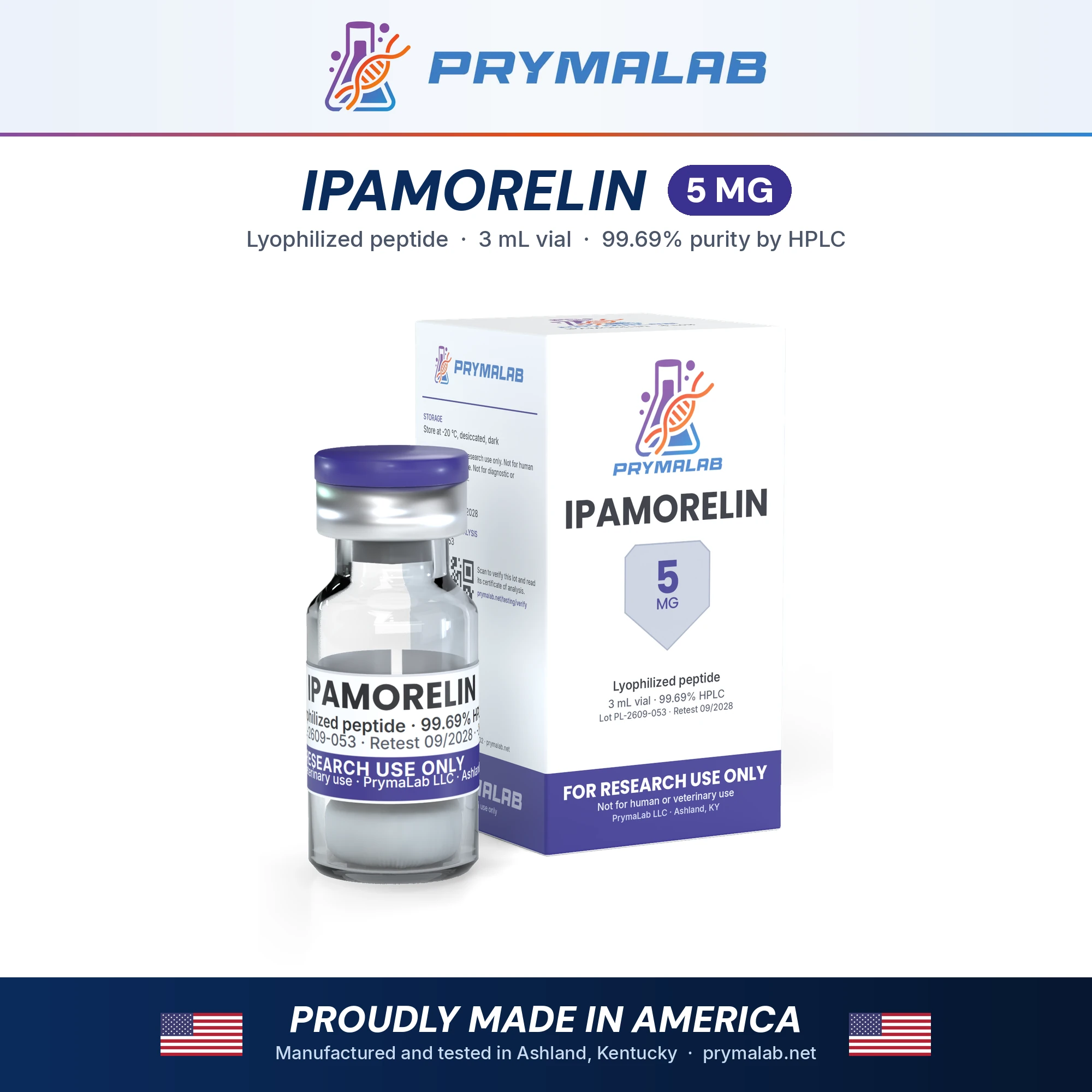
Ipamorelin 5mg
The smaller vial · and when the smaller vial is the right call
Ipamorelin 5mg is the smaller of two fill sizes for the same compound, and the choice between them is not only about cost. Fill tolerance, counterion correction and the number of times a vial gets opened all behave differently at 5 mg than at 10 mg, and those differences reach the data.
Specification Table
| Property | Value |
|---|---|
| Compound | Ipamorelin |
| Nominal fill | 5 mg |
| Alternative fill available | 10 mg, same compound and same lot programme |
| Class | Growth hormone secretagogue, pentapeptide |
| Molecular weight, calculated | Approximately 711.9 g/mol for the free base |
| CAS | 170851-70-4 |
| Receptor | GHS-R1a |
| Approximate molar quantity at nominal fill | Roughly 7 micromoles of free base, before counterion correction |
| Counterion | Per certificate. Trifluoroacetate unless an exchange step is documented |
| Net peptide content | Per lot-specific certificate. This figure matters more at 5 mg than at 10 mg |
| Appearance | White lyophilized powder |
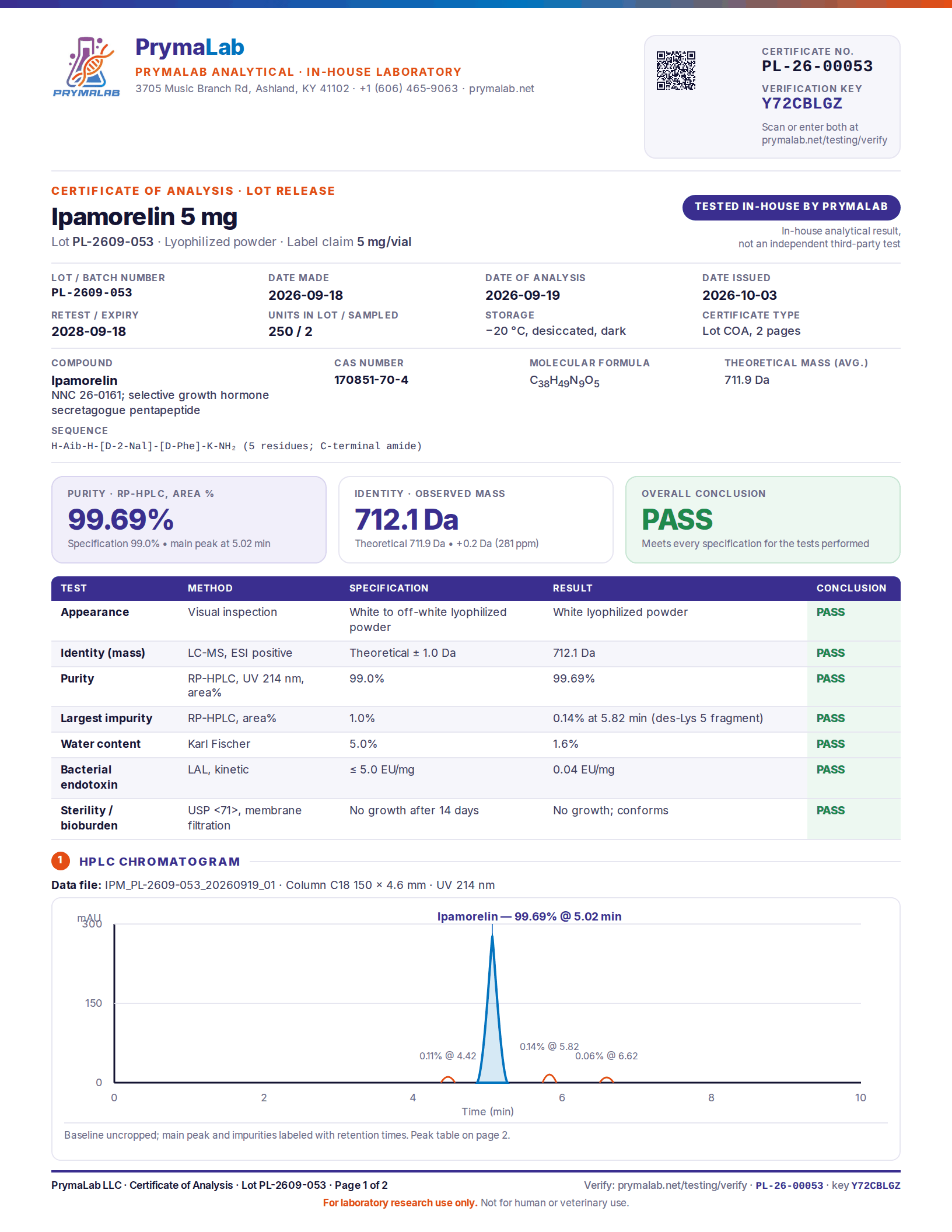
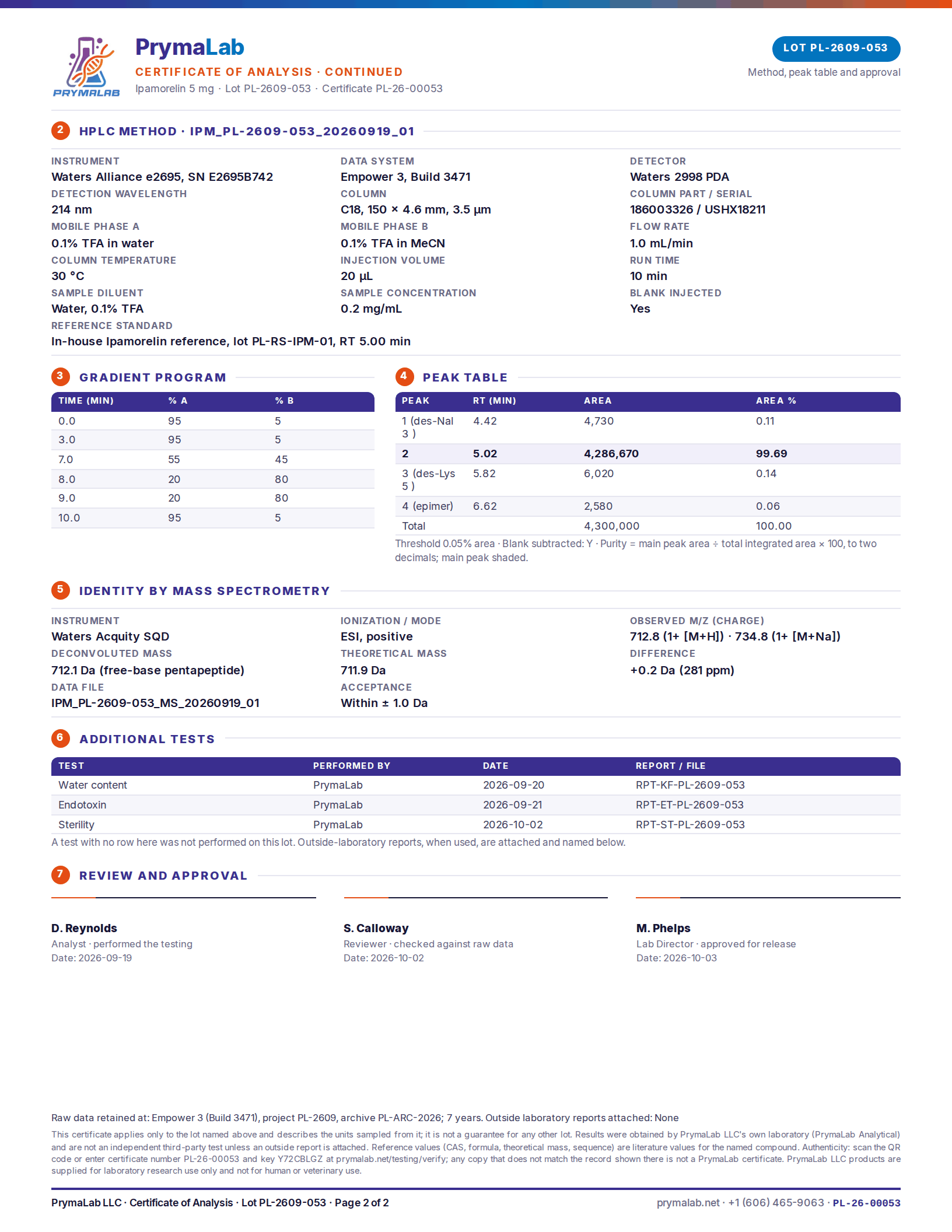
| Purity | Per lot-specific certificate of analysis |
| Storage, lyophilized | 2-8°C short term, -20°C for extended storage, protected from light and moisture |
When Is Ipamorelin 5mg the Right Choice?
Four situations favour ipamorelin 5mg and one clearly favours the 10 mg fill, and the decision is worth making deliberately rather than on price alone.
A single defined experiment with a known consumption figure. Buying more than the experiment needs means storing the remainder, and stored peptide degrades on a clock that runs whether or not anyone is using it.
A first lot from an unfamiliar supplier. Ipamorelin 5mg limits exposure while the certificate is checked against an independent analysis, and repeat orders can move to the larger size once the supplier has been verified.
Any study where the compound must be freshly reconstituted for each run. A vial opened once and used once avoids the freeze-thaw problem entirely, and that is easier to arrange at 5 mg.
Method development, where consumption is unpredictable and a wasted 5 mg vial is a smaller loss than a wasted 10 mg one.
The case for 10 mg is a multi-arm study with a known total requirement, where a single lot across all arms removes lot-to-lot variation as a confounder.
That last point is the strongest argument in either direction. Two vials from different lots introduce a variable that no amount of careful pipetting removes.
If a study needs more than one 5 mg vial, the larger fill is usually the better scientific choice as well as the cheaper one.
A fifth situation is worth adding because it comes up more often than the other four. Teaching and method transfer, where the material is being used to establish that a procedure works rather than to generate reportable data.
Ipamorelin 5mg suits that well. The quantity is enough to run a preparation end to end, and losing it to a mistake costs little.
How Does Fill Tolerance Behave at 5mg?
An ipamorelin 5mg fill carries a tolerance, and that tolerance does not scale down proportionally with the fill.
Filling is a volumetric operation performed on a solution before drying. The equipment has a fixed absolute precision, so a smaller target volume carries a larger proportional error.
A fill line accurate to plus or minus 0.1 mg delivers two percent error on ipamorelin 5mg and one percent at 10 mg, for the same machine performance.
That is before the drying step, which removes water at a rate that depends on cake geometry, and cake geometry differs between fill sizes in the same vial format.
None of this is large. It becomes relevant when a written method takes the label figure as exact and reconstitutes to a nominal concentration without weighing.
The correct approach at either size is the same: read the label as nominal, use the certificate net peptide content figure as the working basis, and record which figure was used.
Some certificates state an actual fill weight rather than the nominal figure. That is the more useful document and it is worth asking whether it is available.
A supplier who provides actual fill weights per lot is doing something most do not, and it removes the largest single source of preparation error at this scale.
Why Does Net Peptide Content Matter More Here?
The correction is the same proportion at both fill sizes and its consequences differ, which is a point about study design rather than chemistry.
Ipamorelin is a 712 dalton peptide carrying a basic lysine, purified with trifluoroacetic acid unless an exchange step is documented. The trifluoroacetate correction commonly sits near twenty percent once water and residual salt are counted.
Applied to a nominal ipamorelin 5mg vial that is roughly 4 mg of actual peptide, and the missing milligram is a fifth of the material.
At 10 mg the same proportion is two milligrams, which is a larger absolute quantity and a smaller share of what a typical single experiment consumes.
The reason it bites harder at 5 mg is that smaller vials are more often used whole for one preparation, where the error goes directly into the working concentration with nothing to average against.
A larger vial is more often aliquoted, and aliquoting forces a concentration calculation that surfaces the correction rather than hiding it.
So the practical rule is that the smaller the vial, the more likely the label figure is to be used uncorrected, which is exactly backwards from what accuracy requires.
Reading net peptide content from the certificate before reconstituting takes one minute and it is the single highest-value minute in the preparation.
One qualification on the twenty percent figure. It is a typical value for a trifluoroacetate salt of a peptide this size and it is not a constant, and lots differ.
A certificate reporting an actual measured figure is worth more than any rule of thumb, including this one.
Where a certificate omits it entirely, the honest position is that the working concentration carries an unquantified error of roughly that magnitude, which is worth writing in the record rather than leaving implicit.
What Should the Certificate Show at This Size?
An ipamorelin 5mg certificate carries the same six fields as the larger vial, with two read more carefully.
Net peptide content, for the reasons above. On an ipamorelin 5mg fill this figure sets the working concentration more directly than at any larger size.
Actual fill weight where the supplier records it, which resolves the tolerance question entirely rather than bounding it.
Observed mass against calculated mass. On a 712 dalton peptide a deletion is a large proportional change and any mass spectrometer will see it.
Purity by reverse-phase HPLC with the chromatogram rather than a summary figure, since the deletion sequences elute close to the main peak.
Amidation of the carboxy terminus, stated explicitly. The free acid weighs one dalton more and behaves differently, and the field is frequently left off.
Lot number and synthesis date, tying every other figure to the vial that ships.
A certificate that answers all seven is a short document, and the absence of any one of them is a question worth asking before the vial is opened rather than after.
How Does Ipamorelin 5mg Cost Out Against the Larger Vial?
The comparison is worth doing in molar terms rather than in milligrams, because milligrams are what the label states and moles are what the experiment consumes.
A nominal 5 mg fill of a 712 dalton peptide is roughly 7 micromoles of free base before any correction.
Apply a twenty percent counterion and moisture correction and the usable figure falls to somewhere near 5.6 micromoles.
The 10 mg vial runs to roughly 14 micromoles nominal and 11.2 corrected, which is exactly double, since the correction is a proportion rather than a fixed amount.
So the scientific comparison is clean and the economic one is not, because the larger vial is almost never twice the price.
That gap is the argument for the larger fill and it holds only while the material gets used.
Peptide in a freezer degrades on a clock that runs whether or not anyone opens the vial, so unused material bought cheaply per milligram is not cheap per experiment.
The break-even question is simple to state. If a laboratory will consume more than one 5 mg vial inside the useful storage window, the larger fill wins on both cost and lot consistency.
If it will not, ipamorelin 5mg is the correct purchase and the price per milligram is the wrong metric to judge it by.
Costing a vial against what an experiment actually needs is unglamorous arithmetic and it is more reliable than the per-milligram figure most catalogues lead with.
What Happens When Two Lots Get Mixed?
The lot-consistency argument is easy to state and easy to underestimate, so it is worth working through what actually goes wrong.
Two lots of the same compound differ in net peptide content, in the identity and proportion of their deletion sequences, and in residual moisture.
None of those differences is large. All of them are systematic, which is the problem, because a systematic difference between two arms of a study does not average out with more replicates.
A study that runs arms one and two on lot A and arms three and four on lot B has confounded lot with arm. Any difference between the pairs could be the variable under test or could be the material.
Nothing in the data distinguishes those two explanations after the fact, and no statistical method recovers the distinction.
Two things rule it out and both are cheap. The first is buying enough material in one lot to finish the study, which is the main argument for the larger fill.
The second is blocking. Where two lots are unavoidable, splitting every arm across both lots converts a confound into a source of variance, which does average out.
That costs nothing beyond planning and it is rarely done, because lot is usually recorded once on an order form rather than per data point.
Recording the lot alongside each measurement rather than once per study is the habit that makes the correction possible at all.
For anyone buying ipamorelin 5mg specifically, this is the decisive question: if the study will outlast one vial, the arithmetic favours the larger fill for reasons that have nothing to do with price.
How Should a Single Vial Be Handled?
An ipamorelin 5mg vial is often used in one session, which changes the handling priorities.
Dry powder under an intact seal holds at 2 to 8 degrees Celsius for short periods and at minus 20 for longer, kept dark.
Warm the vial to ambient temperature before breaking the seal. A 5 mg cake has a smaller surface area than a 10 mg one and takes up condensed moisture just as readily.
Reconstitute by adding diluent down the vial wall and swirling rather than shaking. Agitation at the air-liquid interface is the main aggregation route for any peptide.
If the whole vial is being used in one session, the freeze-thaw problem disappears and the adsorption problem does not. Low-binding consumables still recover a measurable fraction that ordinary plastics do not.
If part of the vial will be kept, aliquot immediately on first reconstitution rather than after the session, since the decision to keep material is usually made when the material has already sat at room temperature.
Record the lot, the net peptide content used, the diluent volume and the date. Four fields, and they make the preparation reproducible.
For a single-vial experiment those four fields are the entire provenance record, which is an argument for writing them down before the work starts rather than after.
Published Literature
Selected references on the compound and on the counterion question that governs preparation accuracy.
- Raun K, Hansen BS, Johansen NL, Thogersen H, Madsen K, Ankersen M, et al. European Journal of Endocrinology. 1998;139(5):552-561. DOI: 10.1530/eje.0.1390552
- Andrushchenko VV, Vogel HJ, Prenner EJ. Journal of Peptide Science. 2007;13(1):37-43. DOI: 10.1002/psc.793
- Howard AD, Feighner SD, Cully DF, Arena JP, Liberator PA, Rosenblum CI, et al. Science. 1996;273(5277):974-977. DOI: 10.1126/science.273.5277.974
- Manning MC, Chou DK, Murphy BM, Payne RW, Katayama DS. Pharmaceutical Research. 2010;27(4):544-575. DOI: 10.1007/s11095-009-0045-6
Frequently Asked Questions
When is the 5mg vial the better choice?
A single defined experiment with known consumption, a first lot from an unfamiliar supplier, any method requiring fresh reconstitution each run, or method development where consumption is unpredictable.
When is the 10mg vial better?
A multi-arm study with a known total requirement. A single lot across all arms removes lot-to-lot variation as a confounder, which no amount of careful pipetting can do afterwards.
So two 5mg vials are worse than one 10mg?
Usually, if they come from different lots. That introduces a variable into the study that a single larger vial avoids, and the larger fill is generally cheaper as well.
Does fill tolerance scale down with vial size?
Not proportionally. Filling equipment has a fixed absolute precision, so a smaller target volume carries a larger proportional error. The same machine gives roughly two percent at 5 mg and one percent at 10 mg.
How should the label figure be treated?
As nominal. The working basis should be the net peptide content figure from the certificate, and which figure was used should be recorded alongside the preparation.
What is actual fill weight?
A per-vial or per-lot weight recorded by the supplier rather than the nominal target. It resolves the tolerance question entirely rather than bounding it, and most suppliers do not record it.
How large is the counterion correction on ipamorelin?
Commonly near twenty percent once water and residual salt are counted, because the molecule is only 712 daltons and carries a basic lysine that pairs with trifluoroacetate during purification.
Why does that matter more at 5mg?
Because smaller vials are more often used whole for one preparation, where the error goes straight into the working concentration. Larger vials get aliquoted, and aliquoting forces a calculation that surfaces the correction.
What is the most commonly omitted certificate field?
Whether the carboxy terminus was amidated. The free acid weighs one dalton more, behaves differently, and many certificates never state which of the two forms was made.
Will a deletion sequence show on the mass spectrum?
Yes. At 712 daltons a single missing residue is roughly ten to fifteen percent of total mass, which any mass spectrometer detects. Short peptides make this failure visible rather than hidden.
What if the whole vial is used in one session?
The freeze-thaw problem disappears and the adsorption problem does not. Low-binding consumables still recover a measurable fraction of dilute peptide that ordinary polypropylene does not.
What is the minimum record for a single-vial experiment?
Lot number, net peptide content used, diluent volume and date of reconstitution. Those four fields are the entire provenance record and are best written before the work starts.
Compliance Statement
Ipamorelin 5mg is sold exclusively for laboratory research use. It is not a drug, food, or cosmetic product, and it is not a dietary product of any kind. It is not approved by the FDA or any comparable authority for human or veterinary use, nominal fill figures are label values rather than assayed quantities and the lot-specific certificate is the authoritative document for net peptide content, and no compound in this range is offered for any human or veterinary purpose. This product is not intended to diagnose, treat, cure, or prevent any disease. It must not be given to humans or animals. Purchase is restricted to qualified researchers and institutions operating within applicable laws. All handling is the responsibility of the purchasing laboratory.
Other formats of Ipamorelin
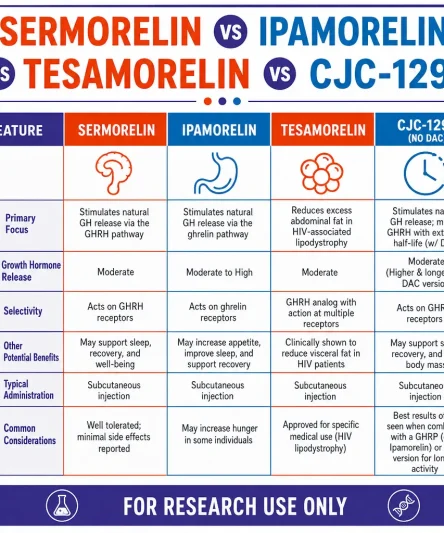
Ipamorelin is also stocked as Ipamorelin 10mg Nasal Spray, Ipamorelin 10mg, CJC-1295 (no DAC), Ipamorelin 10mg (Blend), CJC-1295 (No DAC) + Ipamorelin 15mg preloaded 3ml pen, CJC-1295 (NO DAC) 5MG and CJC-1295 (NO DAC) 10MG. Each listing states its own quantity and concentration, and the pen and vial comparison explains what changes between formats.









20 reviews for Ipamorelin 5mg