
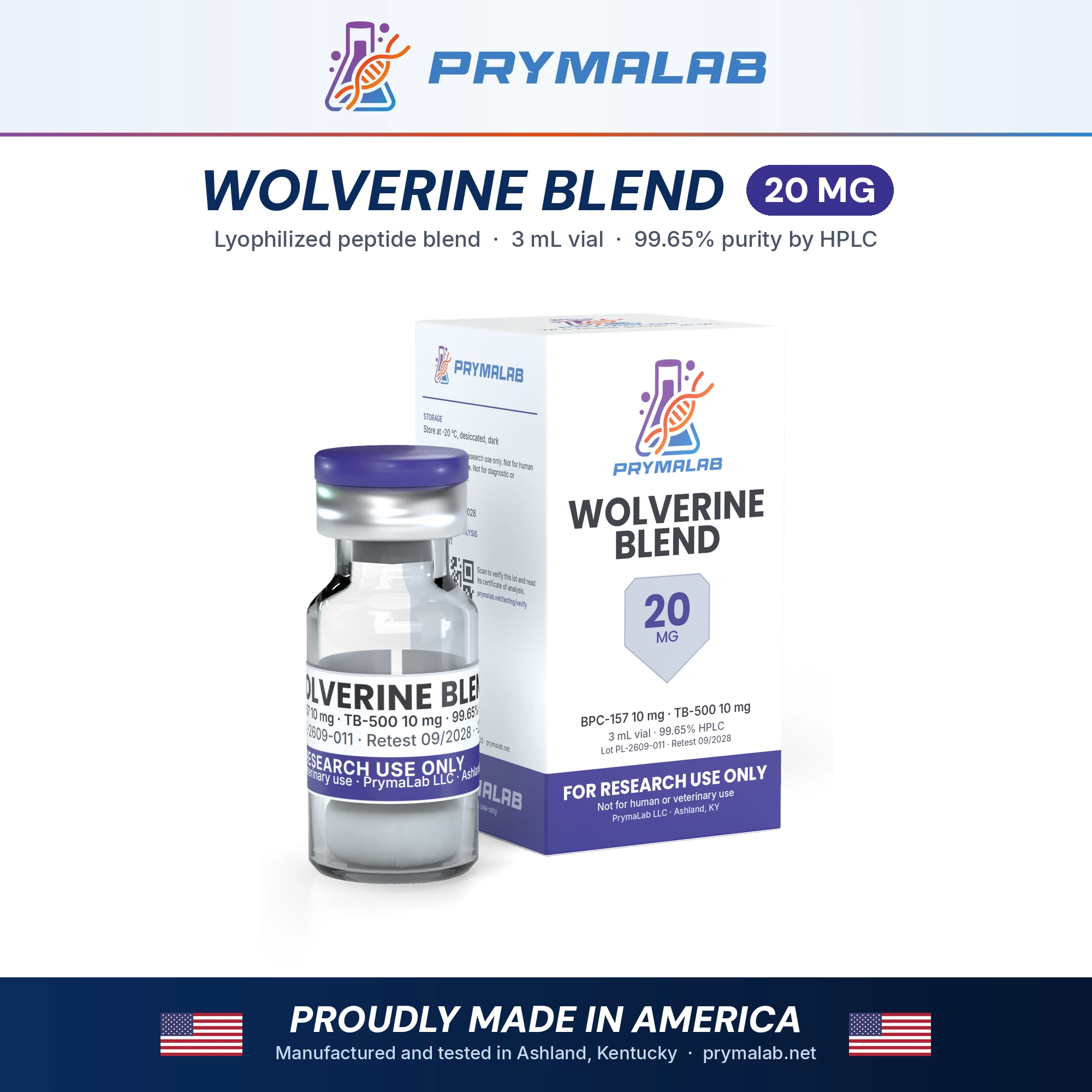
Description
PrymaLab · Research Use Only
BPC-157 10mg + TB-500 10mg
Two actives in one vial, and one purity figure cannot describe them
A single-compound vial can be described by one purity figure because there is only one thing in it. BPC 157 TB 500 is two peptides in one container, and almost every certificate written for a blend in this market reports a single percentage anyway. That number does not mean what it appears to mean.
Specification Table
| Property | Value |
|---|---|
| Article | A two-component blended vial |
| Component one | BPC-157, a fifteen residue sequence, CAS 137525-51-0 |
| Component one sequence | GEPPPGKPADDAGLV |
| Component two | TB-500, a designation that covers more than one article |
| Component two caveat | The certificate must state which sequence. See the single-compound page for that question |
| Declared quantities | Ten milligrams of each, thirty milligrams of contents once counterion is included |
| Ratio | One to one by declared mass, which is not one to one by moles |
| Why moles differ | The two components have different molecular weights, so equal masses are unequal counts |
| Analytical consequence | Two identity confirmations, two purity figures and a ratio determination are all required |
| Single purity figure | Uninterpretable on a two-component article. It does not say which component it describes |
| Trade designation | Sold in this market under a nickname that describes nothing about the contents |
| Separability | Not separable after blending. The ratio is fixed at manufacture |
| Storage | Sealed at minus 20°C. Protect from light and moisture |
Why Does a BPC 157 TB 500 Blend Break the Certificate?
Purity on a single-compound vial has a clear meaning, and on a bpc 157 tb 500 vial it does not. It is the fraction of the material present that is the intended molecule, and everything else is impurity.
On a two-component vial that definition collapses.
If a certificate reports ninety-eight percent, the immediate question is ninety-eight percent of what.
It could be the purity of one component before blending. It could be the purity of the other. It could be the combined fraction of material that is either of the two intended peptides, which is a number that says nothing about the balance between them.
A vial holding nineteen milligrams of one and one milligram of the other scores very well on that definition. It is also the wrong article entirely.
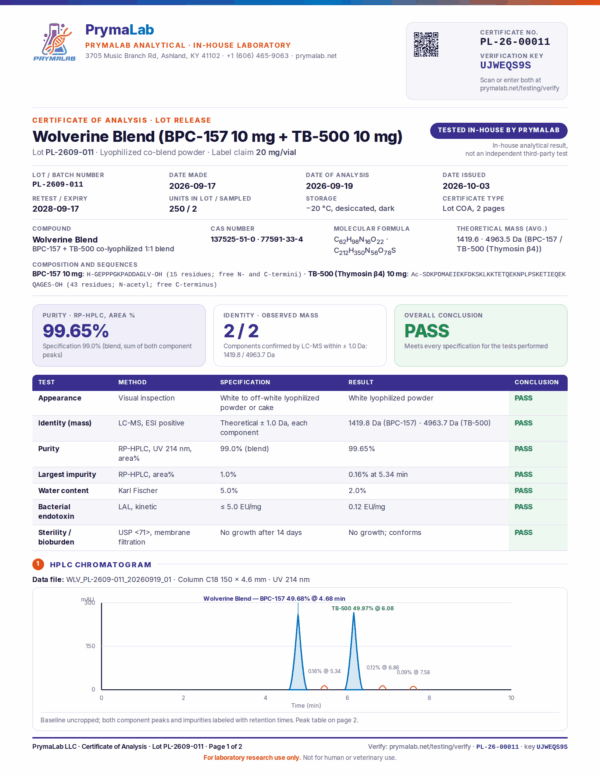
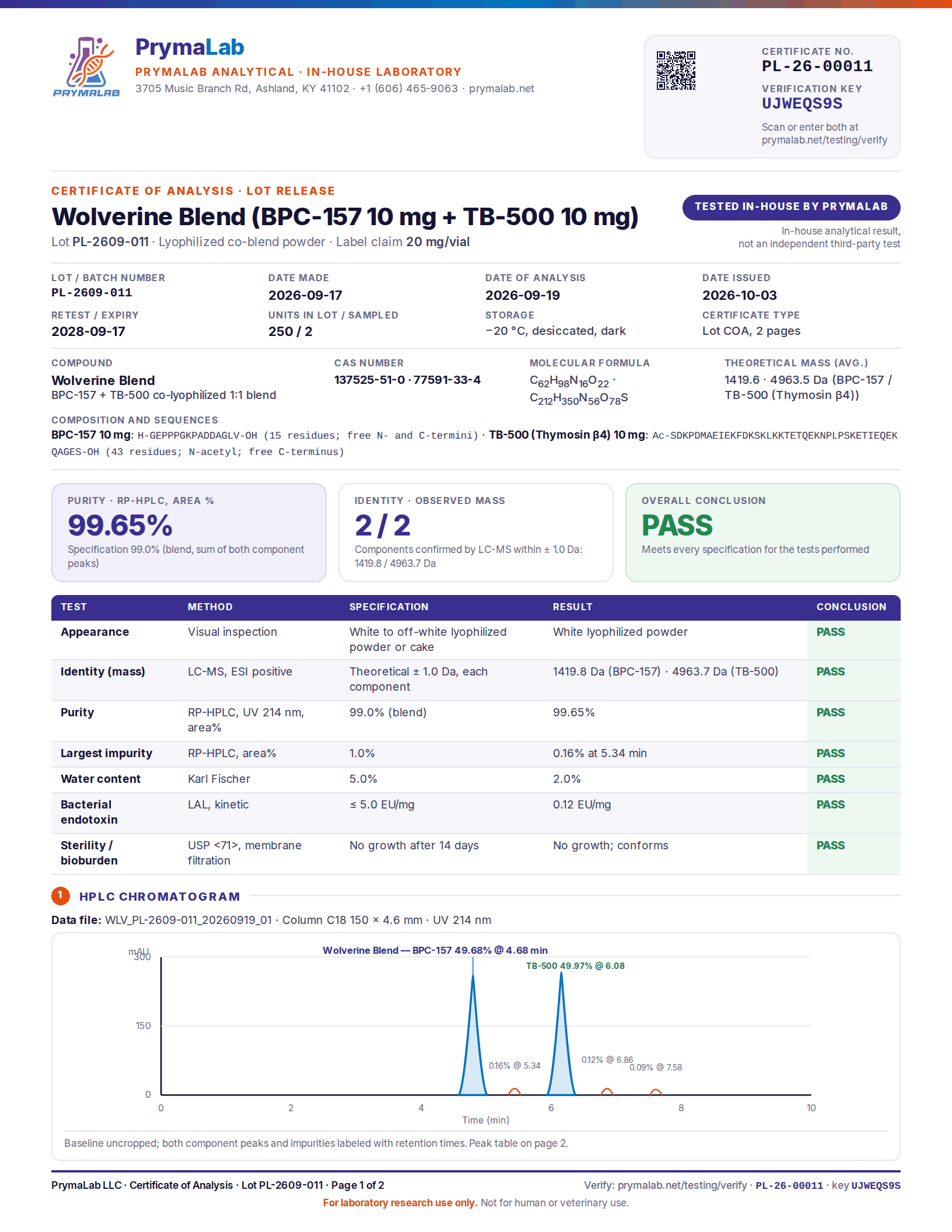
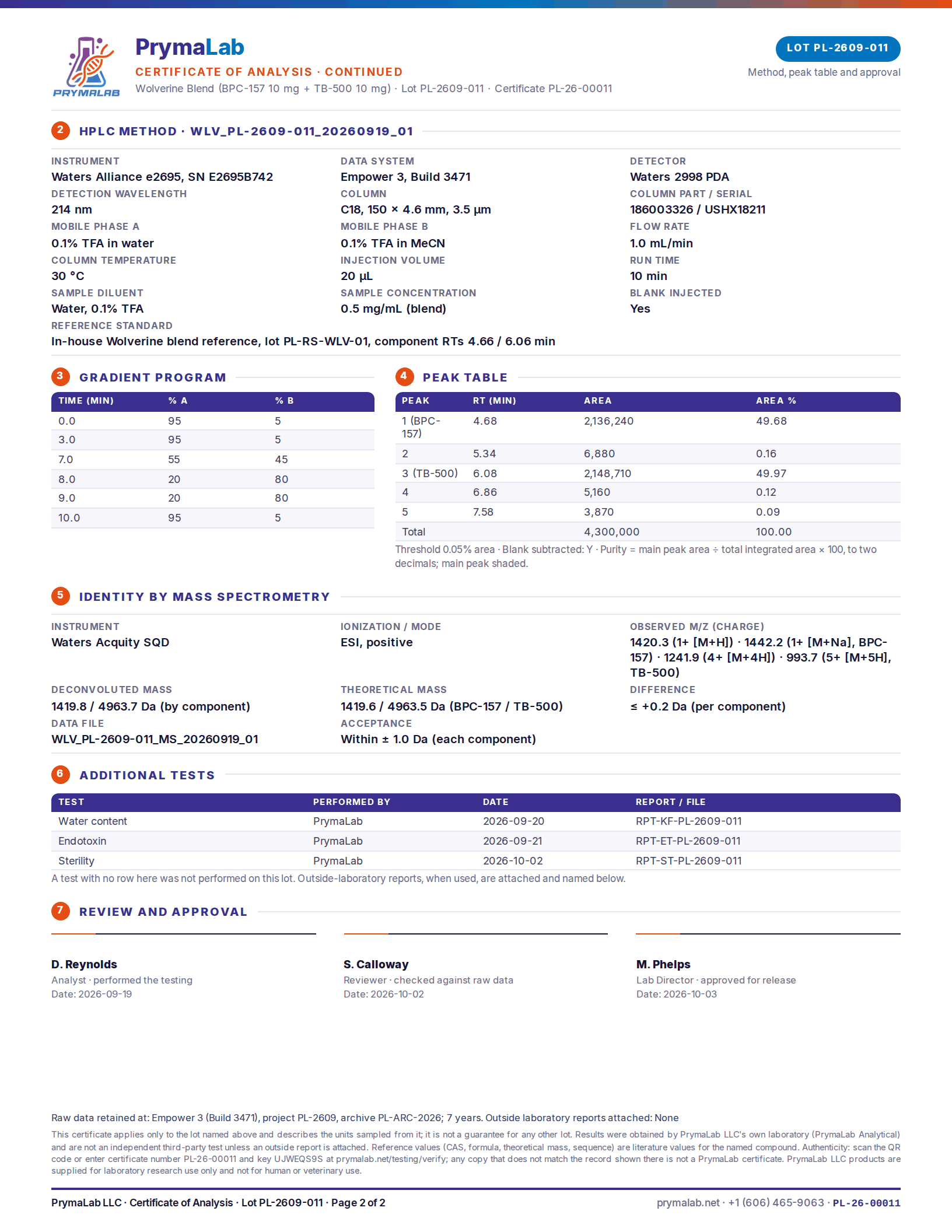
The honest characterisation of a blend requires three things rather than one: identity confirmed separately for each component, purity reported separately for each, and the ratio between them determined in the finished material.
The third is the one that is almost never present, and it is the one that describes what was actually blended rather than what went into the blender.
There is a straightforward test for whether a blend certificate has done its job.
Read it and ask whether the document would let you rebuild the vial.
If it names two sequences, gives a purity for each and states the proportion found in the finished material, the answer is yes.
If it gives one number and two trade names, the answer is no.
It is the difference between a document that characterises an article and one that asserts a description of it.
What Does Equal Mass Mean in Moles?
The bpc 157 tb 500 label says ten milligrams of each, and that is a statement about mass.
An experiment is sensitive to molar concentration rather than to mass, and the two components do not have the same molecular weight.
Ten milligrams of a smaller peptide is more molecules than ten milligrams of a larger one, in direct proportion to the difference in mass.
So a one to one blend by label is not a one to one blend at the receptor, and any statement about relative contribution has to be worked out from the masses rather than read off the front of the vial.
This is arithmetic rather than a subtlety, and it is skipped constantly.
The related point is that the ratio is fixed. A researcher who wants to vary the proportion of one component against the other cannot do it from this vial, because the two are already mixed.
Varying the ratio requires the two single-compound articles and two separate weighings, which is the argument for buying them separately when the ratio is a variable of interest rather than a convenience.
Where the ratio is not a variable of interest, the blend removes two weighing steps and the errors that come with them, which is a real advantage and the reason the format exists.
A related point about how the quantities on a blend label should be read into a record.
The declared figure is what was intended to be blended, and net peptide content applies to each component separately.
Two peptides purified separately can carry different counterion loads, so a vial declaring ten milligrams of each may hold noticeably different quantities of actual peptide.
That compounds the molar point above rather than replacing it, and it is another reason the ratio in the finished material is the field worth asking for.
Which TB-500 Is in the Vial?
This is the identity problem that the single-compound page covers in full, and it applies here with an extra complication.
The designation TB-500 has been attached to more than one article in this market, and the sequences involved are not the same molecule.
On a single-compound vial that ambiguity is resolvable by asking for the sequence.
On a blend it is harder, because the two components have to be distinguished from one another before either can be identified, and a method developed for one compound may not resolve the other cleanly.
The practical requirement is that the certificate writes out both sequences in full.
A document naming two trade designations and giving one purity figure has identified neither component and characterised neither.
Anyone comparing results generated with a blend against results generated with the separate compounds should confirm that the sequences match before treating the two as comparable, and the TB-500 component is where that check usually fails.
What Can Be Attributed to Which Component?
A two-component preparation raises the same interpretive problem as a non-selective compound, arriving by a different route.
Any observed change has two candidate sources and the design cannot separate them.
That is not a flaw in the article. It is a property of what a blend is, and it only becomes a flaw when a result generated with a blend is reported as though it belonged to one of the components.
Separating the contributions requires running the two compounds individually alongside the blend, which is a three-arm design rather than a one-arm one.
It is also worth noting that the two components have quite different published literatures.
One is a fifteen residue sequence from a gastric protein with a large body of animal work behind it. The other is a fragment designation attached to actin-binding thymosin beta-4 chemistry, and that literature is separate, older and built on different questions.
The two bodies of work were not designed to be combined and the combination has very little published characterisation of its own.
A researcher reading about the blend is usually reading two separate literatures stapled together, and the staple is a marketing decision rather than an experimental result.
What Does the Trade Name Describe?
This article circulates under a nickname borrowed from a comic book character.
It is worth saying plainly that the name describes nothing about the contents, the mechanism or the evidence.
It is a marketing designation, it is widely used, and this catalogue lists it as a synonym only because researchers search for it and would otherwise not find the page.
Naming it here is not an endorsement of what it implies.
The material designation that does carry information is the pair of sequences and the pair of declared quantities, and those are what belong in a laboratory record.
A study record that names the blend by its nickname has recorded a shopping decision. A record that names both sequences, both declared masses, the lot and the supplier has recorded an article.
This distinction comes up across the blended products in this market and it is unusually stark here, because the nickname is more memorable than either of the compounds in the vial.
How Should the Vial Be Handled?
Handling bpc 157 tb 500 follows the stricter of the two component requirements rather than the average of them.
Sealed lyophilized powder holds at minus 20 degrees Celsius, protected from light and moisture.
Bring the vial to ambient temperature before opening, since a lyophilized cake is hygroscopic and cold glass condenses room moisture onto it.
Reconstitute gently by adding diluent down the wall and allowing the cake to dissolve rather than swirling hard.
Confirm the cake has fully dissolved before drawing anything. A blend of two peptides with different solubilities can leave one component behind, and a partially dissolved blend is a different ratio from the one on the label.
That failure mode is specific to blends and it is the one worth watching for here.
Aliquot on first reconstitution.
Record both sequences, both declared masses, the lot, the diluent, the storage temperature and the date.
Recording both sequences rather than the blend name is what makes the work comparable against anything generated with the separate compounds, and it costs one extra line.
One final observation on why blends are worth approaching carefully as a category.
A blend is a decision someone else made about an experiment, packaged and sold as a convenience to whoever buys it.
Where that decision matches the design, the format saves real work and removes real error.
Where it does not, it removes a variable the researcher needed, and the removal is invisible because the vial looks like any other vial.
Knowing which situation applies is the whole of the judgement here.
Published Literature
Selected references on each component separately, since the combination has little published characterisation of its own, and on peptide storage generally.
- Sikiric P, Seiwerth S, Rucman R, Turkovic B, Rokotov DS, Brcic L, et al. Current Pharmaceutical Design. 2011;17(16):1612-1632. DOI: 10.2174/138161211796196954
- Safer D, Elzinga M, Nachmias VT. Journal of Biological Chemistry. 1991;266(7):4029-4032. PMID: 1999384
- Goldstein AL, Hannappel E, Kleinman HK. Trends in Molecular Medicine. 2005;11(9):421-429. DOI: 10.1016/j.molmed.2005.07.004
- Manning MC, Chou DK, Murphy BM, Payne RW, Katayama DS. Pharmaceutical Research. 2010;27(4):544-575. DOI: 10.1007/s11095-009-0045-6
Frequently Asked Questions
What is in this vial?
A bpc 157 tb 500 vial holds two different peptides, ten milligrams of each by declared mass. One is the fifteen residue gastric sequence and the other is supplied under the TB-500 designation.
Why is a single purity figure a problem?
Because it does not say which component it describes. It could be one, the other, or the combined fraction that is either, which says nothing about the balance between them.
What should a blend certificate contain?
Identity confirmed separately for each component, purity reported separately for each, and the ratio between them determined in the finished material rather than assumed from what was weighed in.
Which of those is usually missing?
The ratio in the finished material. It is the field that describes what was actually blended rather than what went into the blender.
Is ten milligrams of each a one to one ratio?
By mass, yes. By moles, no. The two components have different molecular weights, so equal masses are unequal numbers of molecules.
Can the ratio be varied?
Not from this vial. The two are already mixed and the proportion is fixed at manufacture. Varying it requires the two single-compound articles, two separate weighings and the errors those bring.
Why buy a blend at all then?
It removes two weighing steps and the errors that come with them. That is a real advantage wherever the ratio is a fixed convenience rather than a variable of interest.
Why is the TB-500 component ambiguous?
Because that designation has been attached to more than one article, and the sequences are not the same molecule. The certificate has to write the sequence out.
Can an effect be attributed to one component?
Not from the blend alone. Any observed change has two candidate sources, and separating them requires running both compounds individually alongside the blend.
Do the two have a shared literature?
Very little. One has a large animal literature from a single group, the other sits in an older actin-binding literature, and the combination has almost no published characterisation of its own.
What does the nickname mean?
Nothing about the contents. It is a marketing designation borrowed from a comic book character, listed here only because researchers search for it.
What is the blend-specific handling risk?
Incomplete dissolution. Two peptides with different solubilities can leave one component behind, and a partially dissolved blend is a different ratio from the labelled one.
Compliance Statement
This blended article is sold exclusively for laboratory research use. It is not a drug, food, or cosmetic product, and it is not a dietary product of any kind. It is not approved by the FDA or any comparable authority for human or veterinary use, it contains two separate compounds and no observed effect can be attributed to either of them without running each individually alongside the blend, the TB-500 designation covers more than one sequence and the certificate rather than the label establishes which is present, the combination has very little published characterisation of its own and the literature on each component was not generated with the other present, and no compound in this range is offered for any human or veterinary purpose. This product is not intended to diagnose, treat, cure, or prevent any disease. It must not be given to humans or animals. Purchase is restricted to qualified researchers and institutions operating within applicable laws. All handling is the responsibility of the purchasing laboratory.
Other formats of BPC-157 + TB500 Wolverine Blend
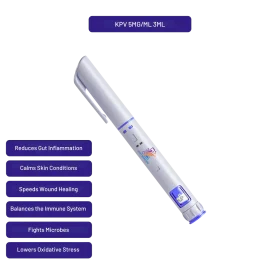
BPC-157 + TB500 Wolverine Blend is also stocked as Wolverine Stack (BPC-157 + TB-500) 20mg preloaded 3ml pen, BPC 157 5mg + TB500 5mg, BPC-157 5MG, BPC-157 10MG, BPC-157 Capsules (60/500mcg), BPC-157 Peptide Nasal Spray, BPC-157 5mg/ml preloaded 3ml pen and TB-500 5mg/ml preloaded 3ml pen. Each listing states its own quantity and concentration, and the pen and vial comparison explains what changes between formats.










23 reviews for BPC-157 + TB500 (10mg/10mg) “Wolverine Blend”