Description
PrymaLab · Research use only
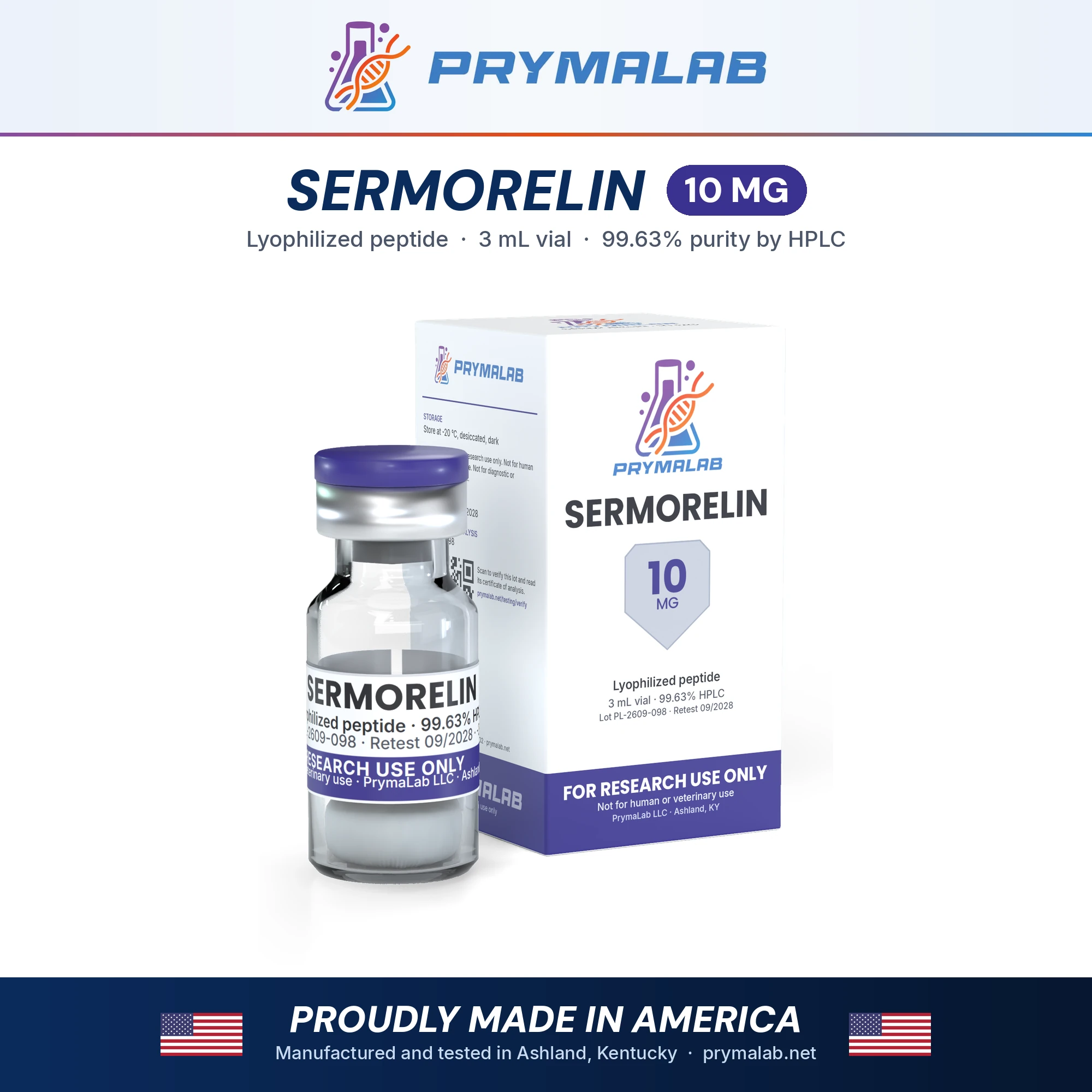
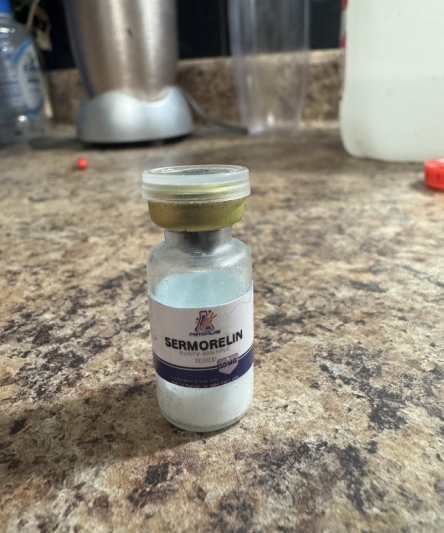
Sermorelin 10mg
GHRH(1-29) amide, the 29-residue sermorelin sequence, freeze-dried in a 10 mg vial
Sermorelin is a synthetic copy of the first 29 amino acids of human growth hormone-releasing hormone (GHRH), finished with a C-terminal amide. This listing is the 10 mg vial of freeze-dried powder, the main fill in a range that also includes a 5 mg vial. Published work on sermorelin covers how it drives growth hormone release from the pituitary, its clinical use as a diagnostic test and growth treatment in children, short studies in older men, and the ways it breaks down in water.
Specifications
| Property | Value |
|---|---|
| Compound | Sermorelin GHRH(1–29)-NH₂; GRF(1–29) |
| CAS number | 86168-78-7 |
| Molecular formula | C149H246N44O42S |
| Theoretical mass | 3357.9 Da |
| Sequence / structure | H-YADAIFTNSYRKVLGQLSARKLLQDIMSR-NH₂ (29 residues; C-terminal amide) |
| Label claim | 10 mg/vial |
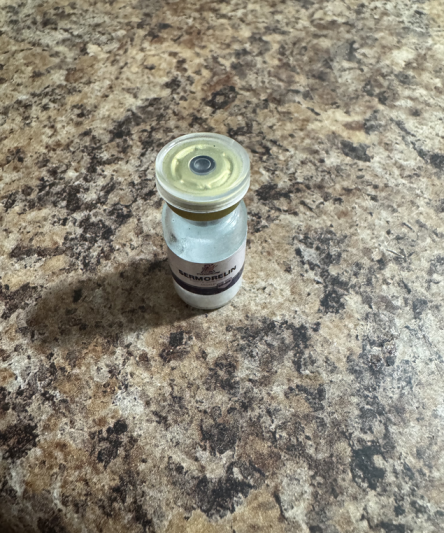
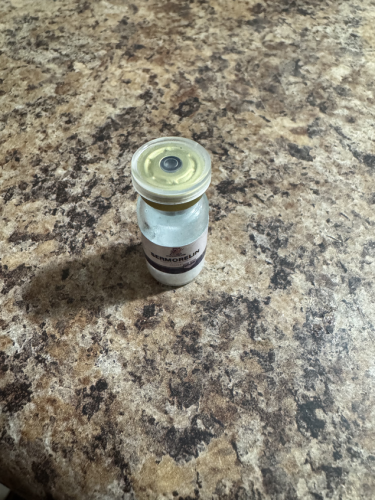
| Form | Lyophilized (freeze-dried) powder or cake in a sealed glass vial with a rubber stopper and aluminium crimp cap |
| Storage, sealed | −20 °C, desiccated, dark |
| Purity specification | 99.0% or higher by RP-HPLC |
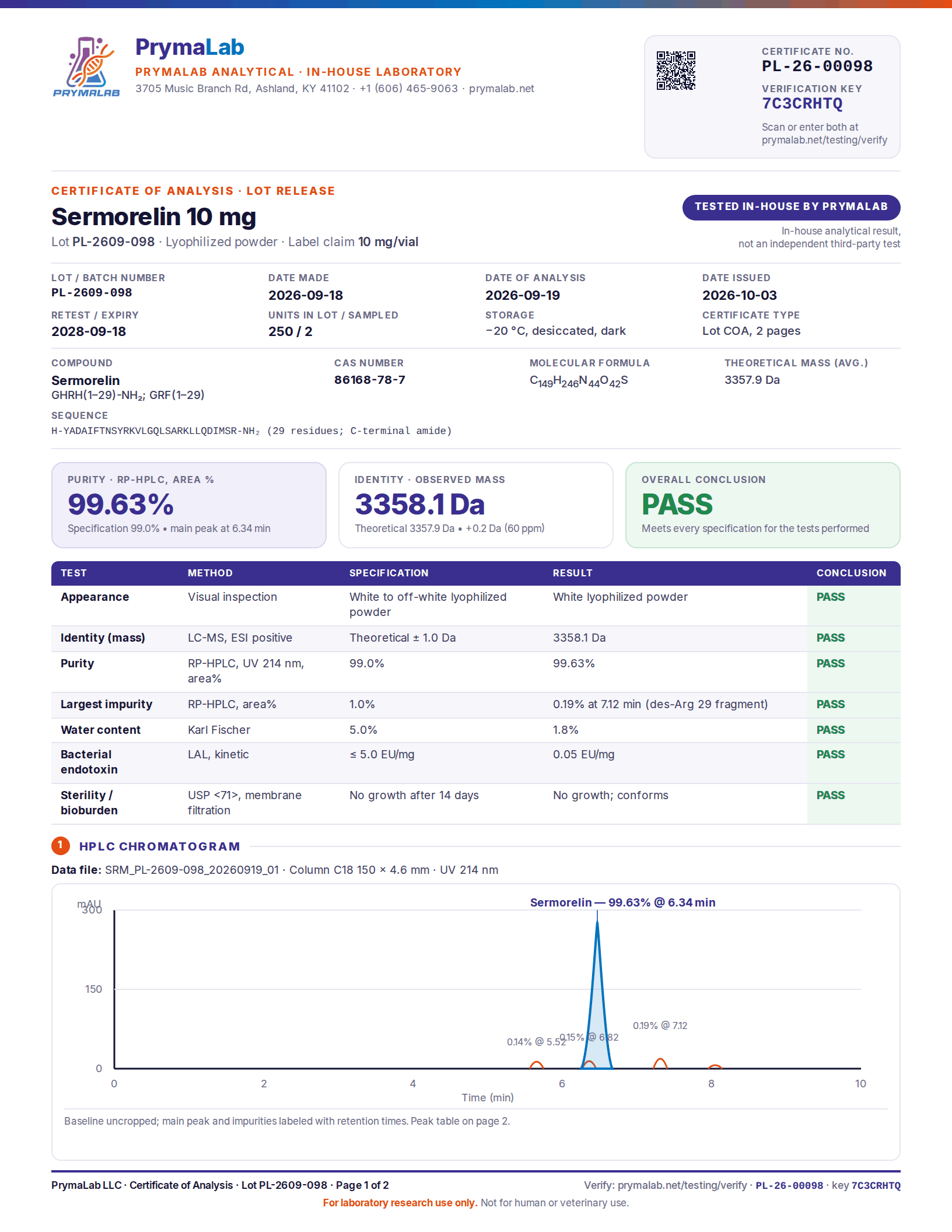
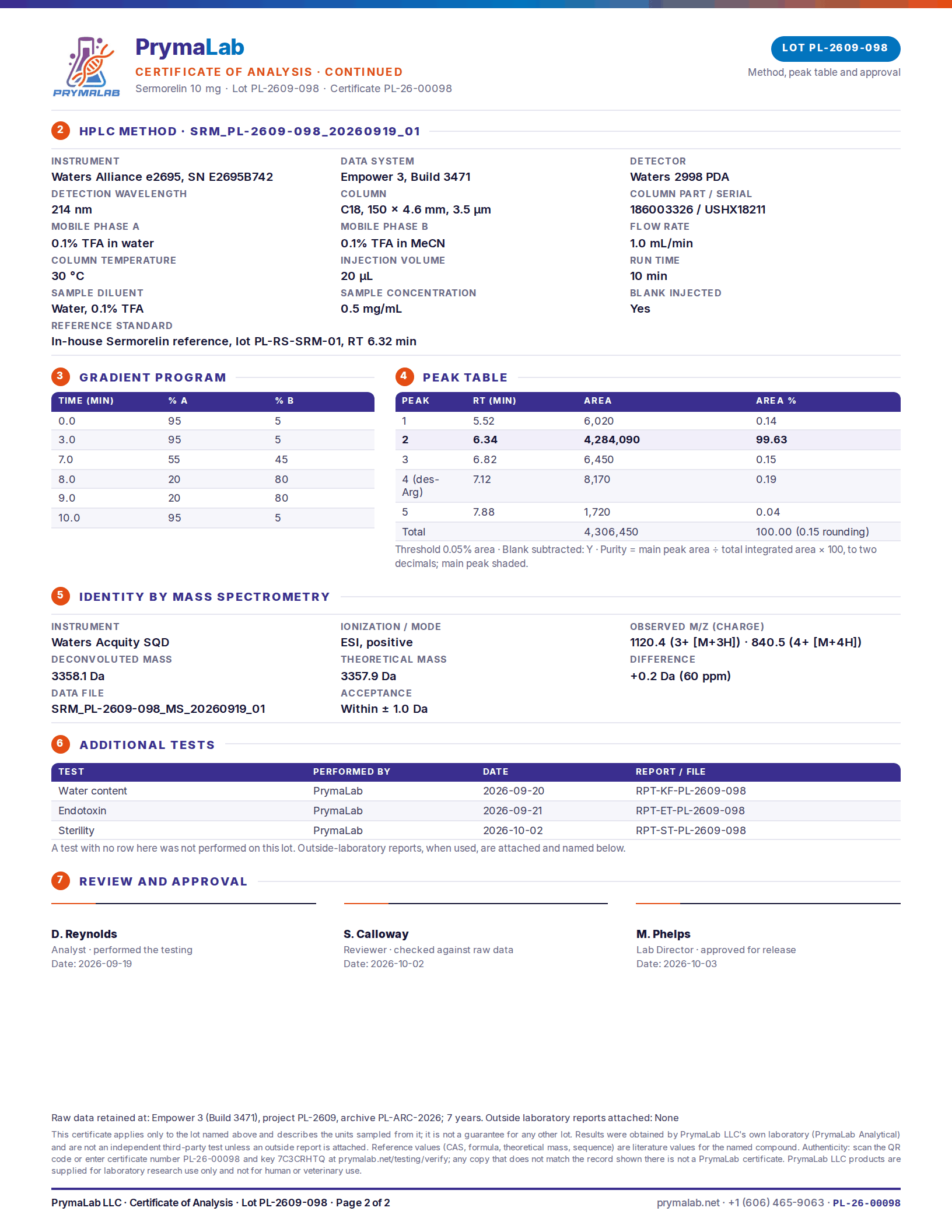
| Lot certificate | Results for the lot now shipping are in the certificate panel on this page |
| Safety data sheet | PL-SDS-150 |
Fills in this range
Sermorelin is sold in 2 fills. The compound and the testing are the same in every fill; only the amount in the vial changes.
| Fill | Listing |
|---|---|
| 5 mg | Sermorelin 5mg |
| 10 mg | Sermorelin 10mg (this page) |
Sequence, mass and molar amount
The lot certificate gives the sequence as H-YADAIFTNSYRKVLGQLSARKLLQDIMSR-NH₂. Those 29 residues are identical to positions 1 to 29 of the 44-residue hormone that Guillemin’s group sequenced in 19821; sermorelin simply stops at arginine 29 and carries an amide where the chain was cut. The theoretical mass is 3357.9 Da, and the LC-MS identity figure on the certificate is the number to compare with it.
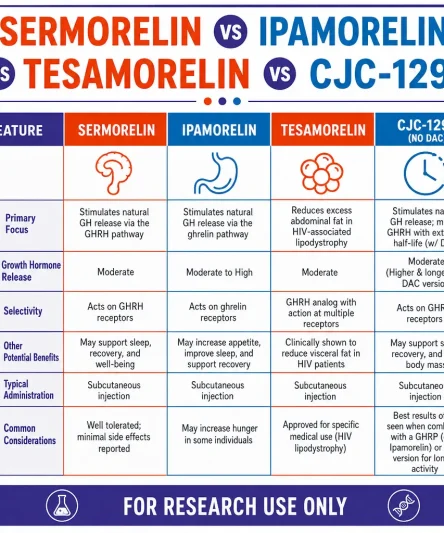
From the stated mass, 10 mg of sermorelin is about 3.0 µmol. The real figure is a little lower because the powder also holds the residual water the certificate reports. For how sermorelin sits beside the other GHRH analogues and the ghrelin-receptor peptides, see sermorelin vs ipamorelin vs tesamorelin.
What the research covers
Where sermorelin comes from
GHRH was first isolated in 1982 from a human pancreatic tumour that had caused acromegaly. Guillemin and colleagues reported a 44-residue amidated peptide whose synthetic copy was fully active in vitro and in vivo and acted specifically on growth hormone secretion1. Sermorelin is the 29-residue analogue of that hormone, described in a 1999 review as the shortest synthetic peptide with the full biological activity of GHRH2. By both routes the review covered, it stimulated growth hormone secretion specifically from the anterior pituitary2.
Clinical studies in children
Most of the human evidence comes from paediatric endocrinology. Prakash and Goa reviewed sermorelin as a diagnostic test and found it a rapid, fairly specific test for growth hormone deficiency, with fewer false positives than other provocative tests2. They also noted its limit: a normal response cannot rule out deficiency of hypothalamic origin, so other tests are still needed2. As a treatment, the Geref International Study Group ran an open-label multicentre study in 110 previously untreated prepubertal children with growth hormone deficiency3. Mean height velocity rose from 4.1 cm a year at baseline to 8.0 at six months and 7.2 at twelve months, 74% of children were judged good responders at six months, and bone age advanced in step with height age3. No adverse changes in blood chemistry, fasting glucose or IGF-I were seen3. The review added that growth responses were smaller than those reported with somatropin, although the two had not been compared head to head, and that transient facial flushing and local pain were the adverse events reported most often2.
A short study in older men
Corpas and colleagues compared ten healthy men aged about 68 with nine young men. At baseline the older men had lower IGF-I and shorter growth hormone peaks; after two weeks of GHRH(1-29) at the higher of two amounts tested, 24-hour growth hormone output and IGF-I no longer differed between the age groups4. Fasting glucose, blood pressure and routine blood chemistry were unchanged4.
Chemistry in solution
Two residues near the N-terminus decide how long sermorelin lasts once dissolved. Bongers and colleagues isolated the breakdown products of GRF(1-29)-NH₂ in water: below about pH 4 the chain is cut between Asp3 and Ala4, leaving GRF(4-29)-NH₂, while above pH 4 Asp3 mostly isomerises to beta-aspartate5. At pH 5 and higher, Asn8 deamidates to beta-Asp8 and Asp8 in roughly a 4:1 ratio5. Every product they tested had much lower in vitro potency than the intact peptide, and the chain was most stable between pH 4 and 55. Working with a related GRF analogue at pH 7.4 and 37 °C, Friedman’s group found the Asn8 route dominant and measured the beta-Asp8 product as 400 to 500 times less potent in pituitary cells6.
What is not established
The older-men study ran for two weeks in ten people and measured hormones only. Its authors suggested that longer treatment might change body composition, but the study did not test that4. In children, the effect of long-term treatment on final adult height had not been determined when the 1999 review was written2. All of it was clinical research in defined groups of people, and none of it tested PrymaLab material. The sermorelin research guide covers the wider literature.
How each lot is tested
Every lot is tested in PrymaLab’s own laboratory in Ashland, Kentucky before release: RP-HPLC for purity, LC-MS for identity, Karl Fischer titration for water, LAL for endotoxin and USP <71> for sterility. The results for the lot now shipping are in the certificate panel on this page, and the certificate number, key and QR code can be checked on the verify page. These are in-house results from PrymaLab Analytical, not an independent test, and the lab is not accredited to ISO 17025. The third-party testing guarantee on this page still applies: if any independent laboratory finds the wrong compound, or less than the stated purity or amount, the order is refunded and the cost of the test is reimbursed.
Frequently asked questions
How do the 10 mg and 5 mg vials differ?
Only in the amount of peptide. Both hold the same freeze-dried GHRH(1-29) amide, and each fill is made and tested as its own lot with its own certificate. With the same volume of diluent the 10 mg vial gives twice the concentration.
Is sermorelin the same thing as GHRH?
It is part of it. Natural GHRH has 44 residues; sermorelin is residues 1 to 29 with a C-terminal amide, and its theoretical mass is 3357.9 Da. Tesamorelin, by contrast, keeps all 44 residues and adds an N-terminal acyl group.
How do I check the certificate for the vial I received?
Read the lot number printed on the vial and match it to the certificate. The panel on this page shows the lot now shipping, and the verify page confirms any certificate from its number and key.
How should the vial be stored before and after reconstitution?
Keep the sealed vial at −20 °C, dry and away from light, and let it reach room temperature before opening so moisture does not condense on the powder. Once dissolved, hold the solution at 2 to 8 °C, protected from light, and use it within a period your laboratory has set.
What does the published research show, and what does it leave open?
Sermorelin raised growth hormone output from the pituitary, worked as a diagnostic test and increased growth rate in children with growth hormone deficiency. Data in adults are short and small, final adult height was not determined, and none of the studies used this product.
Can this product be used in people or animals?
No. Sermorelin was studied clinically, but this vial is research material sold for laboratory use only. It is not approved by the FDA or any other authority for human or veterinary use and must not be given to people or animals.
References
- Guillemin R, Brazeau P, Böhlen P, et al. Growth hormone-releasing factor from a human pancreatic tumor that caused acromegaly. Science. 1982;218(4572):585-7. DOI · PubMed
- Prakash A, Goa KL. Sermorelin: a review of its use in the diagnosis and treatment of children with idiopathic growth hormone deficiency. BioDrugs. 1999;12(2):139-57. DOI · PubMed
- Thorner M, Rochiccioli P, Colle M, et al. Once daily subcutaneous growth hormone-releasing hormone therapy accelerates growth in growth hormone-deficient children during the first year of therapy. Geref International Study Group. J Clin Endocrinol Metab. 1996;81(3):1189-96. DOI · PubMed
- Corpas E, Harman SM, Piñeyro MA, et al. Growth hormone (GH)-releasing hormone-(1-29) twice daily reverses the decreased GH and insulin-like growth factor-I levels in old men. J Clin Endocrinol Metab. 1992;75(2):530-5. DOI · PubMed
- Bongers J, Heimer EP, Lambros T, et al. Degradation of aspartic acid and asparagine residues in human growth hormone-releasing factor. Int J Pept Protein Res. 1992;39(4):364-74. DOI · PubMed
- Friedman AR, Ichhpurani AK, Brown DM, et al. Degradation of growth hormone releasing factor analogs in neutral aqueous solution is related to deamidation of asparagine residues. Replacement of asparagine residues by serine stabilizes. Int J Pept Protein Res. 1991;37(1):14-20. DOI · PubMed
Research use only
For laboratory research use only. Sermorelin 10mg is not a drug, food, cosmetic or dietary supplement, is not approved by the FDA or any comparable authority for human or veterinary use, and must not be given to people or animals. It is sold to qualified researchers and institutions, and the buyer is responsible for lawful handling and disposal.
Other formats of Sermorelin
Sermorelin is also stocked as Sermorelin 6mg preloaded 3ml pen. Each listing states its own quantity and concentration, and the pen and vial comparison explains what changes between formats.







1 review for Sermorelin 10mg