$54.99 / month – $465.99
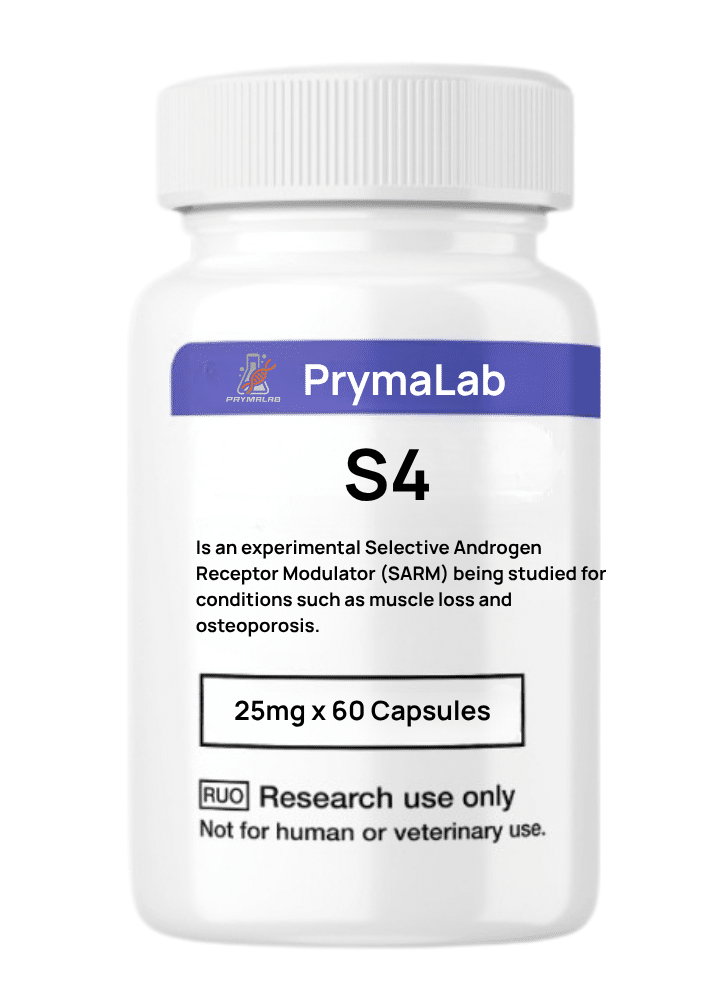
S4 (Andarine) 25mg capsules, 60 per bottle. A first-generation SARM with high androgen receptor binding affinity, researched for lean mass and bone density applications. ≥99% HPLC-verified purity with COA. For research use only.
S4, commonly known as andarine, is a non-steroidal selective androgen receptor modulator (SARM) originally developed by GTx, Inc. for the treatment of muscle wasting, osteoporosis, and benign prostatic hyperplasia. Andarine selectively binds to androgen receptors in skeletal muscle and bone tissue with approximately one-third the binding affinity of testosterone, while exhibiting markedly reduced androgenic activity in reproductive tissues.
Among the first-generation SARMs to undergo extensive preclinical evaluation, S4 demonstrated potent anabolic effects at doses that produced minimal prostate stimulation in castrated rat models. The compound’s oral bioavailability, relatively short half-life of approximately four to six hours, and well-characterized pharmacological profile have made it a standard reference compound in SARM research. Andarine is particularly noted in body composition studies for its ability to simultaneously promote lean mass accretion and enhance fat oxidation, a dual-action profile that distinguishes it from many single-mechanism anabolic agents.
| Specification | Detail |
|---|---|
| Product Name | S4 (Andarine) |
| Dosage | 25 mg per capsule |
| Quantity | 60 capsules per bottle |
| Form | Oral capsule |
| CAS Number | 401900-40-1 |
| Molecular Formula | C19H18F3N3O6 |
| Molecular Weight | 441.36 g/mol |
| Purity | ≥99% (HPLC verified) |
| Testing | Third-party HPLC and MS analysis |
| Storage | Room temperature, cool dry place, away from light |
| Classification | Non-steroidal SARM |
Andarine functions as a partial agonist at the androgen receptor, binding with high selectivity to AR in muscle and bone while exhibiting competitive antagonism in prostate tissue. This partial agonist profile creates a unique pharmacological signature: S4 activates anabolic transcriptional programs in target tissues while simultaneously blocking dihydrotestosterone-mediated signaling in androgenic tissues, explaining its original investigation for benign prostatic hyperplasia.
In skeletal muscle, andarine promotes nitrogen retention and protein synthesis through AR-mediated transcriptional upregulation of myogenic genes. In bone, S4 stimulates osteoblast differentiation and mineralization pathways. Preclinical studies demonstrate that andarine restores skeletal muscle mass and bone mineral density in castrated animals to levels approaching those of intact controls, confirming potent tissue-selective anabolism.
The compound’s relatively short half-life of four to six hours allows researchers precise control over plasma concentrations, making S4 particularly valuable in dose-response studies and pharmacokinetic modeling. Andarine does not undergo aromatization and does not directly influence estrogen levels.
Body composition research represents the most extensively documented application for S4 andarine. Preclinical studies consistently demonstrate simultaneous lean mass gains and fat mass reductions, with the fat loss component attributed to enhanced fatty acid oxidation in skeletal muscle during androgen receptor activation. These dual-action effects position andarine as a key compound in recomposition research.
Bone density research has shown that andarine increases periosteal bone formation, cortical bone thickness, and biomechanical bone strength in ovariectomized rat models, establishing it as a reference compound for osteoporosis and fracture healing investigations. Muscle preservation studies in catabolic models confirm that S4 effectively attenuates muscle wasting induced by glucocorticoids, immobilization, and androgen deprivation.
Comparative SARM research frequently uses S4 as a benchmark compound due to its well-characterized binding kinetics, established dose-response curves, and extensive published data. Researchers studying andarine vs ostarine or other SARM comparisons benefit from the compound’s documented selectivity index and reproducible pharmacological effects.
| Protocol | Dosage | Duration | Notes |
|---|---|---|---|
| Standard research dose | 25–50 mg/day | 8–12 weeks | Split dosing recommended |
| Beginner protocol | 25 mg/day | 8 weeks | Single daily dose acceptable |
| Advanced protocol | 50 mg/day (split) | 8–12 weeks | 25 mg twice daily |
| Timing | Split AM/PM | — | 4–6 hour half-life |
Due to its relatively short half-life of four to six hours, research protocols with S4 frequently employ split dosing, administering 25 mg in the morning and 25 mg in the evening to maintain more stable plasma concentrations throughout the day. Some protocols incorporate five-days-on, two-days-off cycling schedules to manage vision-related observations reported in higher-dose preclinical studies.
| Parameter | S4 (Andarine) | Ostarine (MK-2866) |
|---|---|---|
| AR binding affinity | ~33% of testosterone | ~50% of testosterone |
| Primary application | Recomposition (lean mass + fat loss) | Lean mass preservation |
| Half-life | 4–6 hours | ~24 hours |
| Dosing frequency | Split (2x daily optimal) | Once daily |
| Androgenic activity | Very low (partial antagonist in prostate) | Low |
| Suppression potential | Mild to moderate | Mild |
| Clinical stage | Preclinical | Phase II completed |
Store S4 andarine capsules at controlled room temperature between 20°C and 25°C (68°F to 77°F) in the original sealed container. Protect from direct sunlight, excessive heat, and moisture. Under recommended conditions, S4 capsules maintain full potency for at least 24 months from manufacture. Do not freeze.
Every batch of PrymaLab S4 undergoes independent third-party testing by accredited laboratories using HPLC for purity and mass spectrometry for identity confirmation. Each order ships with a batch-specific Certificate of Analysis documenting ≥99% purity and comprehensive contaminant screening. Pharmaceutical-grade encapsulation ensures precise 25 mg dosing, GMP-compliant manufacturing guarantees consistency, and free priority shipping is included on all domestic orders.
Andarine is a partial agonist at the androgen receptor, meaning it activates anabolic pathways in muscle and bone while acting as a competitive antagonist in prostate tissue. This dual agonist-antagonist profile, combined with its shorter half-life allowing precise dosing control, distinguishes S4 from full agonist SARMs like RAD-140 and LGD-4033.
The relatively short plasma half-life of S4 (approximately four to six hours) means that a single daily dose produces significant peak-to-trough fluctuations. Split dosing, typically 25 mg in the morning and 25 mg in the evening, maintains more stable plasma concentrations and reduces the magnitude of intermittent peak exposure.
S4 produces mild to moderate suppression of endogenous testosterone at standard research doses. Protocols lasting eight weeks or longer frequently incorporate a post-cycle therapy phase using SERMs such as enclomiphene or clomiphene. Baseline and endpoint hormone panels are recommended to guide PCT decisions in any research design.
Andarine is generally favored in recomposition and cutting-focused research due to its documented dual-action profile of promoting lean mass while enhancing fat oxidation. Ostarine is typically preferred for lean mass preservation during caloric deficit conditions. Both compounds show favorable tissue selectivity profiles in preclinical data.
Research-grade S4 andarine should test at ≥99% purity by HPLC analysis. PrymaLab provides batch-specific Certificates of Analysis with every order, documenting HPLC purity, mass spectrometry identity confirmation, heavy metal screening, residual solvent analysis, and microbial testing results from independent accredited laboratories.
PrymaLab maintains pharmaceutical research-grade quality standards for all S4 products. Independent third-party laboratories conduct HPLC purity analysis, MS identity verification, heavy metal screening, residual solvent testing, and microbial assessment on every production batch. Batch-specific Certificates of Analysis accompany each order, providing full analytical transparency for research documentation and regulatory compliance.
S4 (andarine) is sold strictly for laboratory research and scientific investigation purposes only. This product is not intended for human consumption, veterinary use, or therapeutic application. S4 has not been approved by the FDA or any regulatory agency for medical use. Purchasers must be qualified researchers affiliated with accredited institutions or licensed research organizations. By purchasing this product, you confirm that it will be used exclusively in accordance with all applicable local, state, and federal regulations governing research materials.
| Weight | N/A |
|---|---|
| Dimensions | N/A |
Only logged in customers who have purchased this product may leave a review.

support@prymalab.net info@prymalab.net

30 Day return window. Satisfaction guaranteed or your money back.

All orders over %150 in value will receive free shipping.
Reviews
There are no reviews yet.