
Description
PrymaLab · Research Use Only
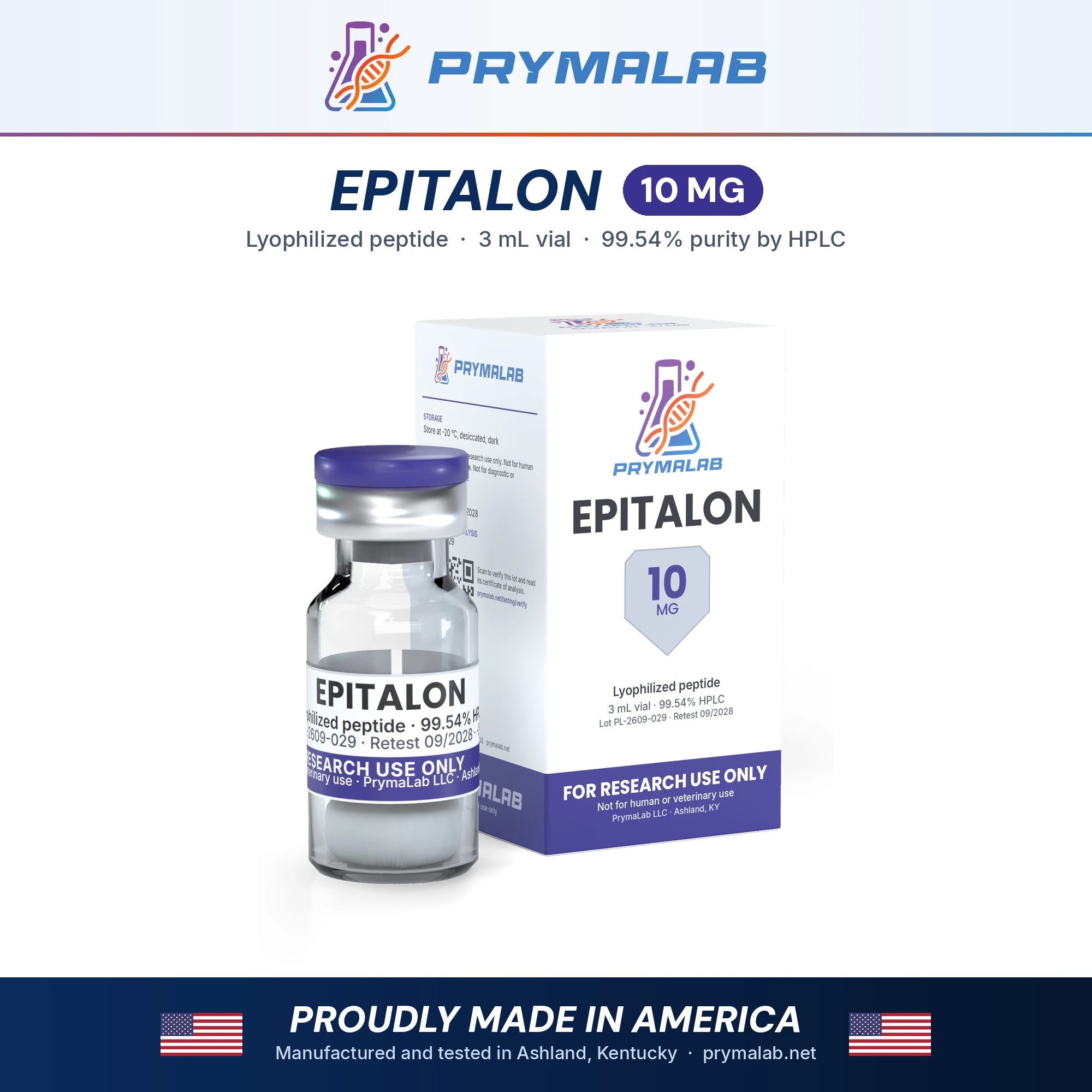
Epitalon 10mg
Two spellings, three salt forms · and one number that settles it
Epitalon peptide is four residues and 390 daltons, which makes it one of the smallest articles in this catalogue. At that size the counterion is not a rounding error on the label. It can be a fifth of what is in the vial.
Specification Table
| Property | Value |
|---|---|
| Compound | Epitalon |
| Alternative spelling | Epithalon. Both refer to the same tetrapeptide |
| Sequence | Ala-Glu-Asp-Gly |
| Single-letter notation | AEDG |
| Residue count | 4 |
| Molecular weight, calculated | 390.35 g/mol for the free acid |
| CAS | 307297-39-8 |
| Acidic residues | Two. One glutamate and one aspartate |
| Net charge at neutral pH | Negative, which determines the salt form |
| Expected counterion | A cation such as sodium, rather than trifluoroacetate |
| Aromatic residues | None, so 280 nanometre detection is not usable |
| Relationship to the pineal extract | A synthetic tetrapeptide developed to reproduce activity attributed to a pineal preparation |
| Regulatory status | No approved human or veterinary formulation in any jurisdiction |
| Appearance | White lyophilized powder |
| Storage, lyophilized | 2-8°C short term, -20°C for extended storage, protected from light and moisture |
Which Epitalon Peptide Mass Belongs on the Certificate?
Masses quoted for epitalon peptide vary by tens of daltons across suppliers, and the variation is not error. It reflects genuinely different articles.
The free acid is 390.35 daltons. That figure comes from Ala, Glu, Asp and Gly joined by three peptide bonds. It is the number a certificate should quote for unmodified material.
A sodium salt is heavier by roughly 22 daltons for each acidic group that has been neutralised, so a disodium form sits near 434.
Trifluoroacetate would add 114 daltons per site, which is why seeing a figure near 500 on a tetrapeptide is a signal worth following up.
That last case should be rare here and is not impossible. Epitalon peptide carries a free amino terminus, which is a basic site, so one trifluoroacetate can pair with it even though the side chains are acidic.
The point is that all of those numbers can be correct for something, and only one of them is correct for the article being bought.
A certificate that quotes a mass without saying which form it measured has not answered the question, and at 390 daltons the difference between forms is a large fraction of the total.
The check takes one line. Ask which form was supplied, then confirm the observed mass against the calculated figure for it.
Why Does the Counterion Matter So Much at This Size?
The counterion correction applies to every peptide in this catalogue, and on epitalon peptide its proportional weight is unusually large because the molecule is unusually small.
On a 5,000 dalton peptide a single sodium is under half a percent of the mass, and on a 390 dalton tetrapeptide the same sodium is over five percent.
Two sodiums on a disodium salt take that above ten percent before any other correction is applied.
Residual water adds its own share. Material of this kind commonly retains several percent by mass after lyophilisation.
Put together, a nominal 10 mg vial of a salt form with typical residual moisture can contain closer to 8 mg of actual tetrapeptide.
That is not a defect and it is not disclosed by the label, which states the fill rather than the peptide content.
The consequence is arithmetic rather than chemistry. A molar concentration calculated from the nominal fill will be high by that margin, consistently, in the same direction every time.
A systematic error of that size does not average out across replicates and it is invisible in the data.
Net peptide content from the certificate is the figure that removes it, and on a compound this small it is the single most consequential number on the document.
One qualification on the figures above. The residual moisture share varies with how the material was dried and how it has been stored since.
A lot that has been opened repeatedly carries more water than one that has not, which is a further reason to record the number of openings alongside the date.
What Do the Two Spellings Mean?
Epitalon peptide and epithalon both appear in the literature and in the market, and they refer to the same four residues.
The variation comes from transliteration rather than from chemistry. The original work was published in Russian and the compound name has come across in more than one form.
A third designation, AEDG, is the single-letter notation for the sequence and is the least ambiguous of the three.
None of that would matter except that the spellings fragment the searchable record. A search on one spelling returns a different set from a search on the other, which is a real hazard for anyone trying to read the record completely.
Anyone reviewing the published work on this compound should run both, and add the sequence notation as a third query.
There is a related name that does not refer to the same thing and it is worth separating out. Epithalamin describes a pineal extract rather than a synthetic tetrapeptide.
Epitalon peptide was developed to reproduce activity attributed to that preparation, so the two are connected historically and are not the same article.
A study using the extract and a study using the tetrapeptide are testing different materials, and the distinction is frequently blurred in secondary sources.
The longevity hub sets out what the published record on this family does and does not establish.
What Should the Certificate Show?
An epitalon peptide certificate carries six fields, and three of them follow from the small size.
The sequence written out, or the AEDG notation. Four residues is short enough that there is no excuse for omitting it.
Which form was supplied, free acid or a named salt, stated explicitly rather than implied by a mass figure.
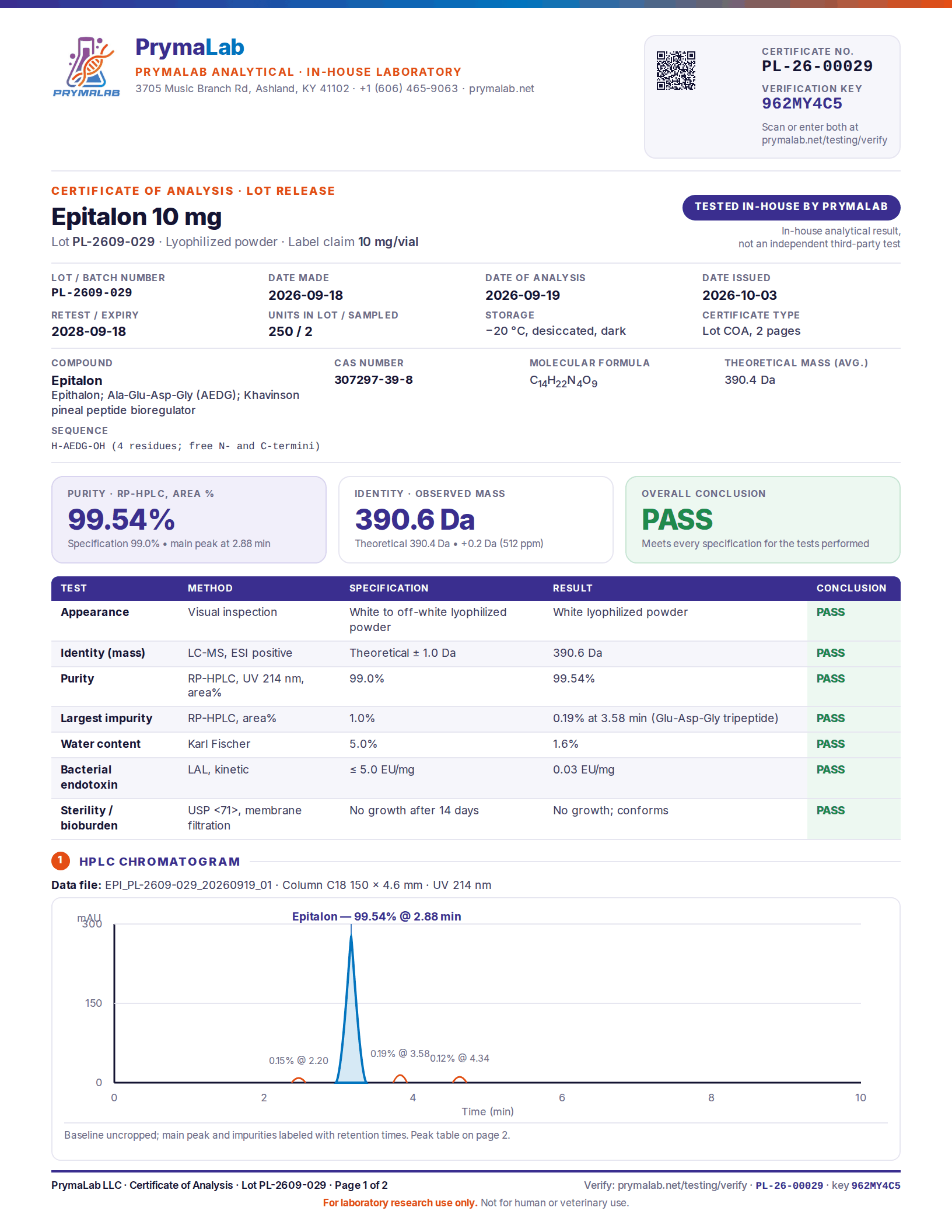
Observed mass against the calculated figure for that form. Roughly 390 for the free acid, higher for a salt, with the arithmetic stated.
Net peptide content, which at this molecular weight is the most consequential number on the certificate.
Purity by reverse-phase HPLC at 214 nanometres, since this sequence carries no aromatic residue and a 280 nanometre reading is close to blind to it.
A note on the chromatography is worth adding. A very small, very polar peptide elutes early on a standard reverse-phase gradient, sometimes close to the void, where it can be poorly resolved from buffer components.
A certificate showing a peak with real retention has used a method suited to the compound. One showing a peak at the solvent front has not.
Lot number and synthesis date complete the set.
Where Did the Compound Come From?
The origin story explains the naming confusion and it is short.
Work at a research institute in St Petersburg from the 1970s onward fractionated animal tissue extracts and reported activity in the resulting preparations.
One of those preparations came from pineal tissue and was given a name of its own, and the activity attributed to it prompted the obvious question of which component carried it.
The answer offered was a four-residue sequence, and the synthetic tetrapeptide was made to test it.
So the compound is a designed article rather than an isolated one. It was proposed as the active fragment of a preparation and then synthesised, not purified out of tissue and sequenced.
That ordering matters when reading the literature, because the older papers describe the extract and the newer ones describe the tetrapeptide.
Results from the two are routinely cited together as though they concerned one material, and they do not.
The programme that produced this compound also produced the short bioregulator peptides that occupy a large part of this catalogue, which is why they share a design logic and a literature.
It is also why the same caveats apply across the whole family. The publication volume is substantial, the concentration in one programme is high, and independent Western replication is thin.
Reading the primary work rather than summaries of it is the only way to see which of those three statements applies to any particular claim.
How Should the Vial Be Handled?
Epitalon peptide has no cysteine and no methionine, which makes it chemically simple, and one feature of the sequence still deserves attention.
Sealed dry powder holds at refrigeration temperature briefly and at minus 20 for longer, with light and moisture excluded.
Warm the vial to ambient temperature before the seal is broken, because small polar peptides are strongly hygroscopic and a 10 mg cake takes up water quickly on cold glass.
Reconstitute in neutral or slightly basic buffer where the assay allows, since an acidic tetrapeptide dissolves more readily there than in acidified water.
Aliquot on first reconstitution. The molar quantity in a 10 mg vial of a 390 dalton compound is large, so repeated freeze-thaw of the whole volume wastes material as well as degrading it.
The aspartate in this sequence is followed by glycine. That is the arrangement which rearranges in water to a mass-identical isomer.
No mass measurement detects that change, and chromatography separates the two species only on a method developed for the purpose.
Elapsed time in solution is therefore the practical proxy, which makes the date of first reconstitution a more important record here than for most compounds.
Record lot, form and counterion, net peptide content, diluent composition and that date. The date is the field that cannot be recovered later.
A closing note on the diluent choice.
Bacteriostatic water carries benzyl alcohol, which is fine for most work and is worth recording, because it is one more component that a second laboratory would otherwise have to guess at.
The Epitalon 10mg nasal spray moves that decision upstream. It arrives already in a fixed buffer, so the counterion and diluent questions above are answered at manufacture rather than at the bench, and the fill date becomes the number worth recording instead.
Published Literature
Selected references on this compound, on the originating programme and on the rearrangement that governs its solution life.
- Khavinson VK, Bondarev IE, Butyugov AA. Bulletin of Experimental Biology and Medicine. 2003;135(6):590-592. DOI: 10.1023/A:1025493705728
- Anisimov VN, Khavinson VK. Biogerontology. 2010;11(2):139-149. DOI: 10.1007/s10522-009-9249-8
- Geiger T, Clarke S. Journal of Biological Chemistry. 1987;262(2):785-794. PMID: 3805008
- Khavinson VK, Malinin VV. Gerontological Aspects of Genome Peptide Regulation. Karger, Basel; 2005.
Frequently Asked Questions
What is epitalon peptide?
A synthetic tetrapeptide with the sequence Ala-Glu-Asp-Gly, written AEDG in single-letter notation, calculated at 390.35 daltons for the free acid.
Why do quoted masses vary?
Because different salt forms are genuinely different articles. A sodium adds roughly 22 daltons per neutralised acidic group, so a disodium form sits near 434 rather than 390.
What if the mass is near 500?
That suggests trifluoroacetate, which adds 114 daltons per site. It is uncommon here because the side chains are acidic, and it is possible because the free amino terminus is a basic site.
Which figure is correct?
All of them can be correct for something and only one is correct for the article being bought. A certificate should state which form it measured rather than printing a mass alone.
Why does the counterion matter more here?
Because the correction scales inversely with size. A single sodium is under half a percent on a 5,000 dalton peptide and over five percent on a 390 dalton tetrapeptide.
How much peptide is in a 10mg vial?
For a salt form with typical residual moisture, closer to 8 mg than 10. The label states the fill rather than the peptide content, and the certificate figure is what resolves it.
Does that error average out?
No. It is systematic and runs in the same direction every time, so it does not cancel across replicates and it is invisible in the resulting data.
Why are there two spellings?
Transliteration rather than chemistry. The original work was published in Russian and the name has come across as both epitalon and epithalon. AEDG is the least ambiguous designation.
Does the spelling affect a literature search?
Yes, substantially. A search on one form returns a different set from a search on the other, so both should be run alongside the sequence notation.
Is epithalamin the same thing?
No. That name describes a pineal extract rather than a synthetic tetrapeptide. This compound was developed to reproduce activity attributed to that preparation, so the two are connected and distinct.
Why is 280 nanometre detection unusable?
The sequence carries no aromatic residue, so there is nothing to absorb at that wavelength. Purity should be measured at 214 nanometres, which reads the peptide bond.
What limits a reconstituted solution?
The aspartate is followed by glycine, which rearranges in water to a mass-identical isomer that no mass measurement detects. Elapsed time is the practical proxy, so the reconstitution date matters more than usual.
Compliance Statement
Epitalon peptide is sold exclusively for laboratory research use. It is not a drug, food, or cosmetic product, and it is not a dietary product of any kind. It is not approved by the FDA or any comparable authority for human or veterinary use, it is supplied in more than one salt form and the lot-specific certificate is the only document establishing which, the aspartate-glycine arrangement in this sequence rearranges in aqueous solution to a mass-identical isomer that routine analysis does not detect, and no compound in this range is offered for any human or veterinary purpose. This product is not intended to diagnose, treat, cure, or prevent any disease. It must not be given to humans or animals. Purchase is restricted to qualified researchers and institutions operating within applicable laws. All handling is the responsibility of the purchasing laboratory.
Other formats of Epitalon
Epitalon is also stocked as Epithalon 15mg preloaded 3ml pen and Epitalon 50mg. Each listing states its own quantity and concentration, and the pen and vial comparison explains what changes between formats.










20 reviews for Epitalon 10mg