Description
PrymaLab · Research Use Only
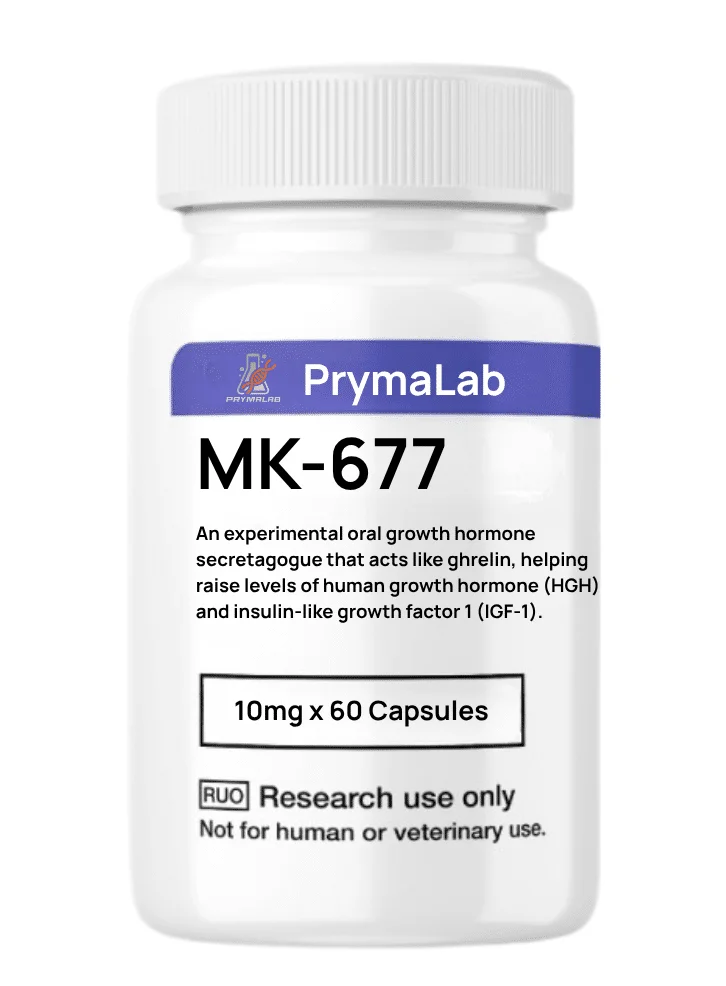
MK-677 (Ibutamoren) 10mg Capsules
Non-peptide growth hormone secretagogue · orally active · 60 capsules
MK-677 ibutamoren capsules contain an orally active non-peptide growth hormone secretagogue that acts at the growth hormone secretagogue receptor. Unlike the peptide secretagogues in this catalogue, ibutamoren is a spiroindane small molecule designed specifically to survive oral exposure and provide a long duration of receptor engagement.
Specification Table
| Property | Value |
|---|---|
| Compound | Ibutamoren |
| Common names | MK-677, MK-0677 |
| CAS, mesylate salt | 159752-10-0 |
| CAS, free base | 159634-47-6 |
| Molecular formula, free base | C27H36N4O5S |
| Molecular weight, free base | 528.66 g/mol |
| Molecular weight, mesylate salt | Approximately 624.8 g/mol |
| Salt-form caution | Many sources pair CAS 159752-10-0 with MW 528.66. That combination is internally inconsistent. Confirm which form a lot contains |
| Chemical class | Spiroindane, non-peptide |
| Molecular target | Growth hormone secretagogue receptor 1a (GHS-R1a) |
| Endogenous ligand at that receptor | Ghrelin |
| Peptide or small molecule | Small molecule. Contains no amino acids and no peptide bonds |
| Oral activity | Yes. This is the defining design feature |
| Reported duration | Long, supporting once-daily exposure in published human studies |
| Originating organisation | Merck, described by Patchett and colleagues, 1995 |
| Capsule strength | 10 mg |
| Count per bottle | 60 capsules |
| Appearance | White to off-white powder within a gelatin capsule shell |
| Purity | Per lot-specific certificate of analysis |
| Solubility | Soluble in DMSO. Limited aqueous solubility as free base |
| Storage | Room temperature, sealed, protected from light and moisture |
| Anti-doping status | Growth hormone secretagogues are prohibited by the World Anti-Doping Agency |
| Regulatory status | No approved human or veterinary formulation in any jurisdiction |
Why Is a Non-Peptide Secretagogue Significant?
Every other growth hormone secretagogue in this catalogue is a peptide. Ipamorelin is five residues. Modified GRF (1-29) is twenty-nine. Peptides share a problem: they are digested.
A peptide taken orally encounters gastric acid, pepsin, and then the full pancreatic protease complement in the small intestine. Very little survives to be absorbed intact, which is why peptide secretagogues are supplied for parenteral routes in research settings.
Ibutamoren was designed around that constraint. It is a spiroindane, a rigid small-molecule scaffold with no amide backbone for a protease to recognise, and it engages the same receptor that ghrelin and the peptide secretagogues act on. Patchett and colleagues described the design programme that produced it (Patchett et al., Proceedings of the National Academy of Sciences, 1995).
The achievement was mimicking a peptide ligand with a non-peptide molecule while retaining receptor selectivity. That is a hard medicinal chemistry problem, and MK-677 is one of the cleaner published solutions to it.
Which CAS Number Is Correct for MK-677 Ibutamoren Capsules?
MK-677 ibutamoren capsules deserve a section on this because the published and commercial record is genuinely inconsistent, and the inconsistency has practical consequences.
Two registry numbers circulate. CAS 159634-47-6 designates ibutamoren as the free base. CAS 159752-10-0 designates ibutamoren mesylate, the methanesulfonic acid salt.
The free base has molecular formula C27H36N4O5S and molecular weight 528.66. Adding methanesulfonic acid brings the mesylate salt to approximately 624.8. Those are different numbers for different substances.
Many supplier listings and secondary sources pair CAS 159752-10-0 with molecular weight 528.66, which cannot both be right. The likely explanation is that the mesylate CAS number became the commonly cited one while the free-base weight remained in circulation alongside it.
The practical consequence is a roughly 18 percent difference in molar content for a given mass. Ten milligrams of free base is approximately 18.9 micromoles. Ten milligrams of mesylate is approximately 16.0. A study normalising by mass across preparations of different salt forms carries that error silently. Confirm the salt form from the certificate of analysis.
What Does the Clinical Literature Report?
MK-677 has more human data behind it than most compounds in this catalogue, which is worth stating plainly given how often research chemicals have none.
Nass and colleagues conducted a randomised controlled study in healthy older adults, reporting on growth hormone and insulin-like growth factor 1 concentrations along with body composition measures over a two-year period (Nass et al., Annals of Internal Medicine, 2008). That is a longer controlled human exposure than almost anything else described on this site.
Earlier work by Murphy and colleagues and by Chapman and colleagues examined the endocrine response in shorter studies, establishing that oral exposure produces sustained raising of the growth hormone and IGF-1 axis rather than a transient pulse.
The compound nonetheless has no approved formulation. Development did not lead to marketing authorisation in any jurisdiction, and it remains an investigational compound with a research literature rather than an approved medicine.
One consistently reported finding worth noting for study design: increases in fasting glucose and reductions in insulin sensitivity appear across the human studies. Any metabolic endpoint measured alongside this compound needs to account for that.
How Does It Differ From the Peptide Secretagogues?
Same receptor, different molecule, and a substantially different exposure profile.
Ipamorelin is a pentapeptide acting at GHS-R1a with a short duration, producing a discrete pulse. Ibutamoren acts at the same receptor with a long duration, producing sustained raising. Those are different experimental conditions even though the receptor is identical.
That distinction matters more than it first appears. Growth hormone is secreted in pulses, and target tissues respond differently to pulsatile and to continuous exposure. A compound producing sustained receptor engagement flattens the pulse architecture, which is either the point of the experiment or a confounder depending on the question.
Modified GRF (1-29) acts at a different receptor entirely, the GHRH receptor, through adenylyl cyclase rather than the Gq and phospholipase C route GHS-R1a uses. Comparing ibutamoren against it compares two pathways, not two versions of the same intervention.
For any study designed around pulse timing, the long duration of this compound is the wrong tool. For studies of sustained axis raising, it is the right one and the only orally active option.
What Does Sustained Receptor Engagement Change?
The pharmacological difference between a pulse and a plateau is larger than it sounds, and it is the main reason this compound behaves unlike the peptide secretagogues.
Growth hormone secretion is normally pulsatile, with the largest pulses during slow-wave sleep and low concentrations between them. Target tissues are exposed to a waveform rather than a level, and the waveform carries information. Published work in several systems shows that continuous and pulsatile exposure to the same total amount produce different downstream gene expression.
A long-acting oral secretagogue raises the trough between pulses rather than simply amplifying the peaks. Whether that reproduces the physiological signal at higher amplitude or produces a qualitatively different one is a real question, and it is the question a study comparing this compound against a short-acting peptide is actually asking.
Receptor desensitisation is the second consideration. Sustained agonist occupancy at a G-protein-coupled receptor commonly drives phosphorylation, arrestin recruitment and internalisation. Whether GHS-R1a desensitises appreciably under continuous exposure is relevant to any study running longer than a few days, and a declining response over time may reflect receptor regulation rather than any change in the compound.
Neither point argues against the compound. Both argue for measuring the time course rather than a single endpoint.
What the Spiroindane Scaffold Achieves
The chemistry behind MK-677 ibutamoren capsules is worth a paragraph because it explains the one property that makes this compound distinct.
A spiroindane is a rigid bicyclic system in which two rings share a single atom. Rigidity matters in medicinal chemistry because a flexible molecule pays an entropic penalty on binding, freezing out rotational freedom it previously enjoyed. A pre-organised scaffold that already approximates the bound conformation pays less.
For a molecule intended to mimic a peptide ligand, that pre-organisation is doing the work a peptide backbone would otherwise do through its own folding. The scaffold holds the pharmacophore groups in roughly the arrangement the receptor recognises, without any amide bonds for a protease to cleave.
The design programme that produced it is a well-documented example of converting a peptide lead into an orally active small molecule, which remains one of the harder transformations in the field and one that fails far more often than it succeeds.
Handling and Storage in Laboratory Practice
Capsules are supplied at 10 mg. Weigh contents for analytical work rather than relying on nominal fill, and record which salt form the lot contains alongside the mass.
DMSO is the practical stock solvent. Aqueous solubility differs between the free base and the mesylate salt, with the salt substantially more soluble, which is one of the reasons salt forms exist. A preparation that dissolves unexpectedly well or poorly relative to expectation may indicate a different salt form than assumed.
Dry powder is stable sealed at room temperature away from light and moisture. Record lot number, salt form, solvent, concentration and preparation date. Given the molar discrepancy between forms, the salt form belongs in the record next to the concentration rather than being inferred later.
Published Literature
Checked against publisher records or primary indexes. The human studies listed represent more controlled clinical exposure than most compounds in this catalogue have behind them.
- Patchett AA, Nargund RP, Tata JR, et al. Proceedings of the National Academy of Sciences. 1995;92(15):7001-7005.
- Nass R, Pezzoli SS, Oliveri MC, Patrie JT, Harrell FE Jr, Clasey JL, Heymsfield SB, Bach MA, Vance ML, Thorner MO. Annals of Internal Medicine. 2008;149(9):601-611.
- Chapman IM, Bach MA, Van Cauter E, et al. Journal of Clinical Endocrinology and Metabolism. 1996;81(12):4249-4257.
- Murphy MG, Plunkett LM, Gertz BJ, He W, Wittreich J, Polvino WM, Clemmons DR. Journal of Clinical Endocrinology and Metabolism. 1998;83(2):320-325.
- Howard AD, Feighner SD, Cully DF, et al. Science. 1996;273(5277):974-977.
Frequently Asked Questions
What are MK-677 ibutamoren capsules?
Capsules containing ibutamoren, an orally active non-peptide growth hormone secretagogue acting at the ghrelin receptor GHS-R1a. Ten milligrams per capsule, sixty per bottle. Laboratory research use only, with no approved human or veterinary formulation in any jurisdiction.
Is MK-677 a peptide?
No, and the distinction is the entire point of the molecule. Ibutamoren is a spiroindane small molecule containing no amino acids and no peptide bonds. A peptide taken orally is degraded by gastric acid and pancreatic proteases, whereas a scaffold with no amide backbone survives to be absorbed.
Which CAS number is correct?
It depends which salt form the lot contains. CAS 159634-47-6 designates the free base at molecular weight 528.66, while CAS 159752-10-0 designates the mesylate salt at approximately 624.8. Many sources pair the mesylate registry number with the free-base weight, which cannot both be right.
Why does the salt form matter?
Roughly eighteen percent difference in molar content per unit mass. Ten milligrams of free base is approximately 18.9 micromoles against roughly 16.0 for the mesylate. A study normalising by mass across preparations of different salt forms carries that error silently through every subsequent calculation.
How does MK-677 differ from ipamorelin?
Same receptor, very different exposure profile. Ipamorelin is a pentapeptide producing a short discrete pulse, while ibutamoren is orally active with a long duration producing sustained raising of the axis. Target tissues respond differently to pulsatile and continuous exposure, so these are distinct conditions.
What human data exists?
Considerably more than for most compounds in this catalogue. A randomised controlled study in healthy older adults reported growth hormone and IGF-1 concentrations alongside body composition measures across two years. Earlier shorter studies established that oral exposure produces sustained axis raising.
Is MK-677 approved anywhere?
No. Development never led to marketing authorisation in any jurisdiction, so it remains an investigational compound with a research literature rather than an approved medicine. It is supplied here strictly for laboratory research.
What should metabolic study designs account for?
Increases in fasting glucose and reductions in insulin sensitivity appear consistently across the human studies, so any metabolic endpoint measured alongside this compound has to account for them. Treating that as an incidental observation rather than a design consideration will confound the readout.
What was significant about the original design work?
Mimicking a peptide ligand with a non-peptide molecule while keeping receptor selectivity is a genuinely hard medicinal chemistry problem that fails more often than it succeeds. The 1995 programme produced a rigid spiroindane scaffold engaging the same receptor as ghrelin, with no amide bonds for proteases to find.
How should the capsules be stored?
Sealed at room temperature and protected from light and moisture, conditions under which the dry powder is stable. DMSO is the practical stock solvent. Note that aqueous solubility differs markedly between free base and mesylate, so unexpected dissolution behaviour may signal a different salt form.
What changes when receptor engagement is sustained rather than pulsed?
Growth hormone is normally secreted as a waveform, and that waveform carries information rather than being incidental. Published work in several systems shows continuous and pulsatile exposure to the same total amount produce different downstream gene expression. A long-acting secretagogue raises the trough.
Does the receptor desensitise under continuous exposure?
It is a real possibility worth designing around rather than discovering. Sustained agonist occupancy at G-protein-coupled receptors commonly drives phosphorylation, arrestin recruitment and internalisation. A declining response in a longer study may reflect receptor regulation rather than any change in the compound.
What does this imply for study design?
Measure the time course rather than a single endpoint. One measurement cannot distinguish sustained signalling from an initial response followed by desensitisation, and an endpoint-only design would report those two quite different biological findings identically.
Compliance Statement
MK-677 ibutamoren capsules is sold exclusively for laboratory research use. It is not a drug, food, or cosmetic product, and it is not a dietary product of any kind. It is not approved by the FDA or any comparable authority for human or veterinary use, and growth hormone secretagogues are prohibited in competitive sport under World Anti-Doping Agency rules. This product is not intended to diagnose, treat, cure, or prevent any disease. It must not be given to humans or animals. Purchase is restricted to qualified researchers and institutions operating within applicable laws. All handling is the responsibility of the purchasing laboratory.


20 reviews for MK-677 (Ibutamoren) (10mg/capsule) 60 Capsules