Description
PrymaLab · Research Use Only
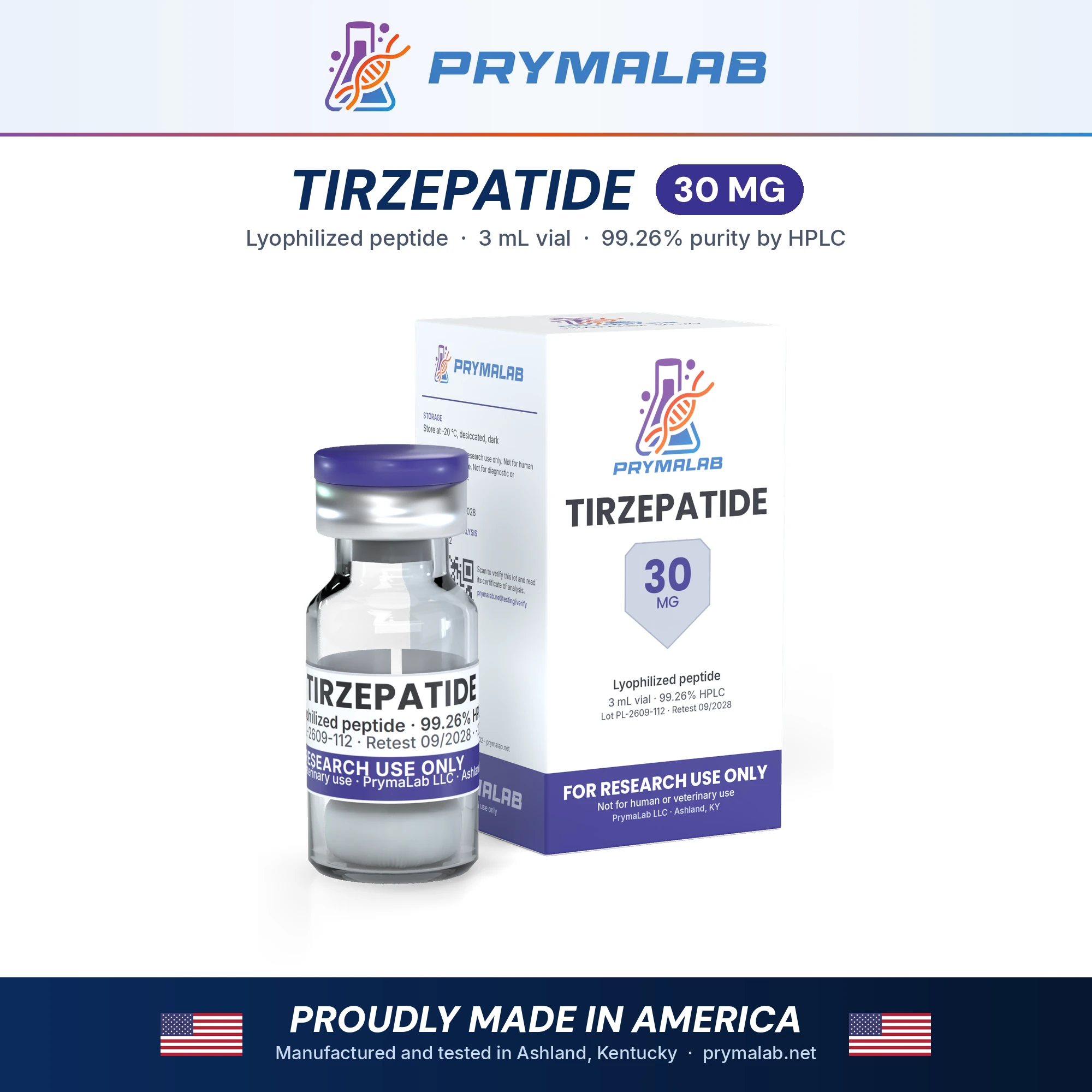
Tirzepatide 30mg
A large fill is a bet that one lot will carry the whole dataset
A tirzepatide 30mg vial holds six times what the smallest fill in this range holds, and the argument for it has nothing to do with price per milligram. It is that a dataset generated from one vial has one lot number attached to it, and a dataset generated from six has six.
Specification Table
| Property | Value |
|---|---|
| Compound | Tirzepatide |
| Development code | LY3298176 |
| CAS number | 2023788-19-2 |
| Declared content | 30 milligrams |
| Molecular weight | Approximately 4.8 kDa. Read the exact figure from the lot certificate |
| Approximate molar content | Around 6 micromoles |
| Position in the range | Sixth of ten fills, from 5mg to 100mg |
| Compound differences between fills | None |
| Main advantage | One lot, one reconstitution and one degradation history across a dataset |
| Main constraint | Solution stability. An acylated peptide has a limited useful life once dissolved |
| Freezing a reconstituted solution | Not an option. Ice formation concentrates the peptide differentially |
| Practical consequence | Reconstitute a portion, or accept a shorter usable window |
| Pharmacology | Covered on the 10mg page. It does not change with fill size |
| Storage, sealed | Minus 20°C, dark and dry |
| Storage, reconstituted | Refrigerated, for the period the supplier states |
Why Buy a Tirzepatide 30mg Vial?
For lot consistency. That is the only argument for a tirzepatide 30mg purchase that survives scrutiny.
Every vial of a synthetic peptide comes from a production lot with its own purity, its own net peptide content and its own impurity profile.
Those figures are close between lots from a good supplier and they are not identical, and the differences are usually smaller than the effects being measured.
Usually. The problem with lot variation is that when it does matter, it looks like biology.
A dataset generated entirely from one vial has removed that variable completely. Every point in it saw the same material.
That helps on any compound and it helps more here, because tirzepatide is acylated and acylated peptides have more ways to differ between lots than unmodified ones do.
Incomplete acylation, aggregate content and the exact composition of the fatty acid attachment are all lot properties, and none of them is captured by a purity figure.
So the case for the large fill is straightforward: it converts an uncontrolled variable into a fixed one.
What Is the Argument Against It?
Time in solution. Against a tirzepatide 30mg fill that is a real constraint rather than a hedge.
Once reconstituted, an acylated peptide starts losing material to adsorption and to self-association, and neither shows up in the appearance of the solution.
The useful life of that solution is measured in days to a small number of weeks under refrigeration, and the supplier figure is the one to use rather than a general assumption.
Freezing is not the escape route it would be on a smaller unmodified peptide. Ice formation concentrates the peptide in the shrinking liquid phase, which is exactly the wrong direction for something prone to associating with itself.
So 30 milligrams reconstituted at once is more material than most studies can use before it degrades.
The answer is to reconstitute part of the vial and leave the rest as solid, which is possible on a lyophilised cake and is not how most people handle a vial.
It means weighing out powder, with the error that brings, or opening the vial repeatedly and letting the remaining cake take on moisture.
Neither of those is free, and the honest position is that a large fill trades a lot-consistency gain against a handling cost that gets paid every time the vial is entered.
Whether that trade is worth it depends on how much of the study runs in parallel. A design that consumes its material over two weeks should buy large. One running over six months should not.
How Much Study Does 30 Milligrams Cover?
At roughly 4.8 kilodaltons, a tirzepatide 30mg fill is around 6 micromoles.
Reconstituted into 6 millilitres that gives a 1 millimolar stock, which is a convenient number and far above assay concentrations.
Six millilitres of 1 millimolar stock diluted to a 100 nanomolar working concentration makes 60 litres of working solution, which is more than any in vitro study needs.
So the constraint is never the amount of compound. It is always the clock, and the clock starts the moment diluent goes in.
That inverts the usual sizing question. For most articles you work out how much you need and buy that. Here you work out how much you can use inside the stability window and buy that, and the answer is often a smaller vial than the total requirement suggests.
A study needing 30 milligrams over eight months should buy three 10 milligram vials and accept three lots, or buy one 30 and reconstitute in thirds.
I lean toward three vials, because a lot change is at least visible in a record while a slowly degrading stock is not.
What Should the Certificate Show?
Everything the smaller fills need, plus one thing they do not.
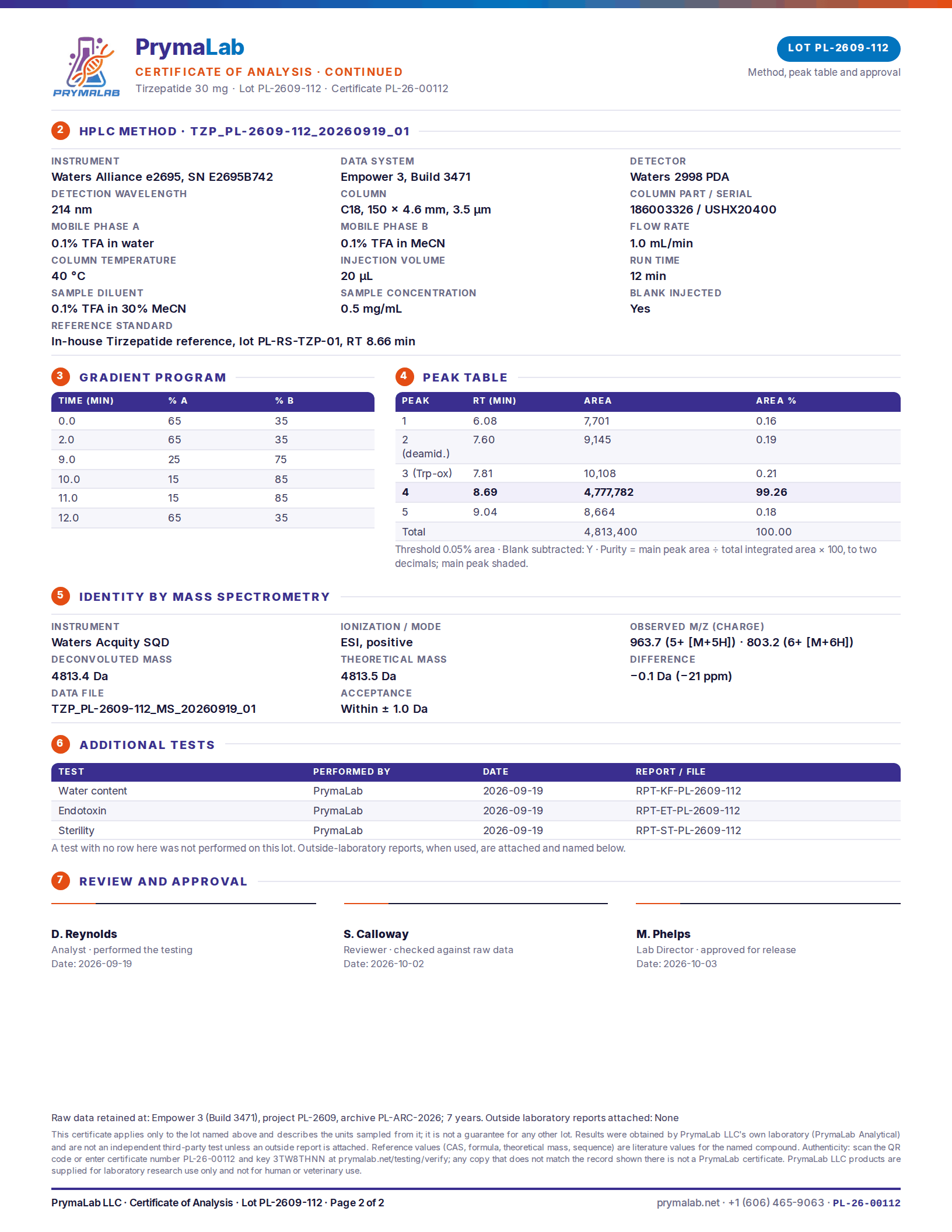
The stability statement with a temperature attached, and a stated useful life for the reconstituted solution.
That figure decides how the vial gets used, and on a large fill it decides whether the purchase makes sense at all.
Net peptide content with the determination named.
The sequence in full, with the position of the fatty acid attachment named.
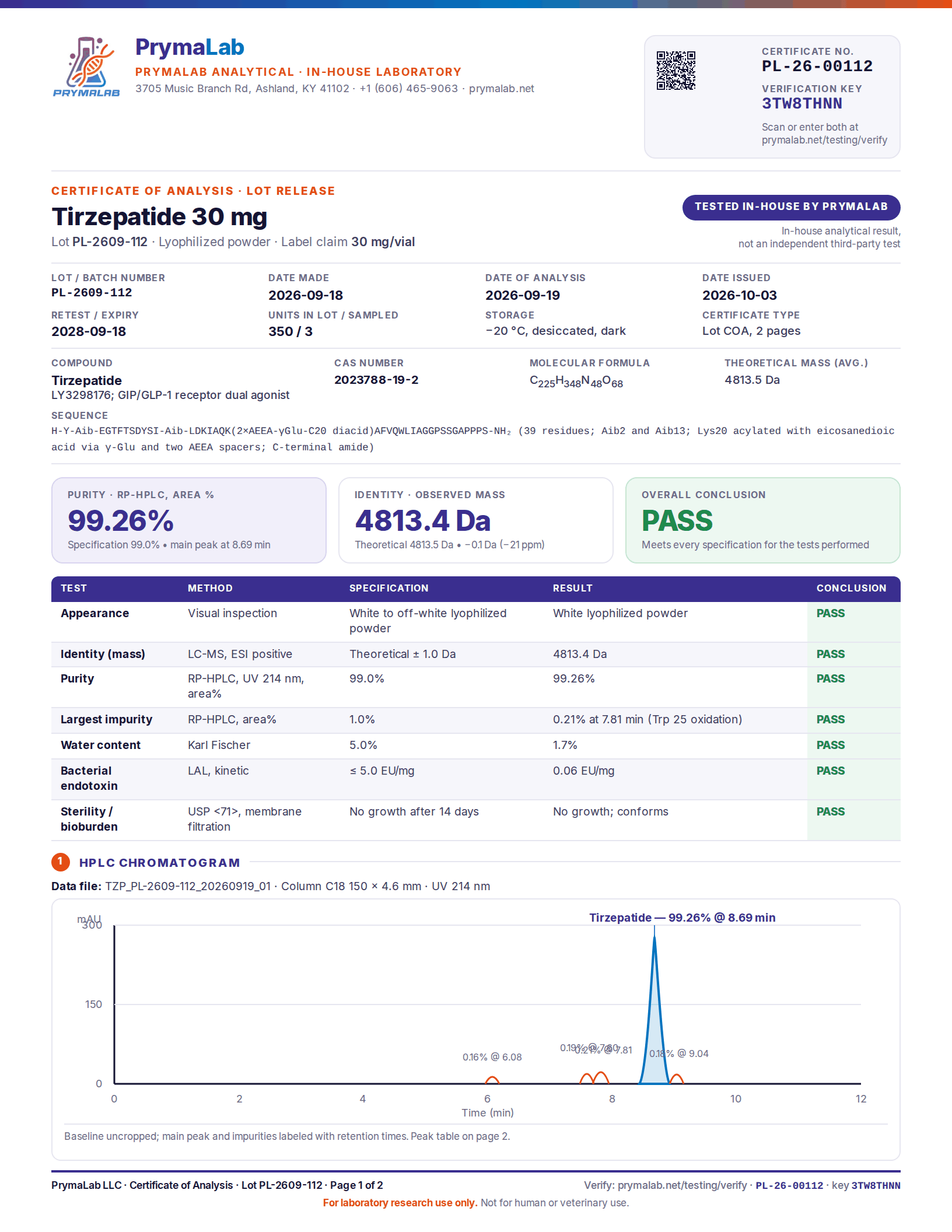
Observed mass by spectrometry. Incomplete acylation gives a predictable mass difference.
Aggregate content, measured by size exclusion chromatography and reported as a figure.
Purity by chromatography with the method named, and the salt form.
Lot number and manufacturing date.
A supplier who cannot state a reconstituted stability figure has not tested one, and on a 30 milligram fill that omission matters more than any purity decimal place.
How Should a Large Vial Be Split?
A tirzepatide 30mg cake is split by weighing the solid, which is the part nobody wants to do.
A lyophilised cake can be divided, and dividing it means opening the vial in a low-humidity environment, transferring a weighed portion into a second container, and resealing both.
That introduces a weighing error on a hygroscopic solid, adds a container, and exposes the remaining cake to room air.
The alternative is reconstituting the whole vial and aliquoting the solution, which is easier and starts the stability clock on all 30 milligrams at once.
Between those two, I would weigh, and I would do it once rather than repeatedly.
Splitting a 30 milligram vial into three 10 milligram portions at the start of a study gives three sealed solids with one exposure event between them, which is better than three exposures or one long clock.
It also produces something the intact vial does not: portions with a known common origin. That is the lot-consistency gain the large fill was bought for, kept rather than spent.
The thing that makes this awkward is that most laboratories do not have a balance appropriate for weighing tens of milligrams of a light powder, and using an unsuitable one is worse than not splitting at all.
Where Does This Fill Sit in the Range?
Sixth of ten, which puts tirzepatide 30mg in the middle of the range rather than at the top.
The range runs 5, 10, 15, 20, 30, 40, 50, 60, 80 and 100 milligrams, so 30 is a mid-range fill that behaves like a large one for most purposes.
The threshold where the solution stability argument starts to dominate is somewhere below this, and where exactly depends on how fast the study consumes material.
A study using 2 milligrams a week reaches it at 10. A study using 10 milligrams a week does not reach it until 40 or beyond.
So there is no fill size that is correct in general, and any page telling you one size suits research is selling rather than describing.
The useful exercise takes two minutes: work out weekly consumption, multiply by the supplier stability figure in weeks, and buy the fill closest to that number without going over.
That calculation is the whole content of the fill-size decision and almost nobody does it.
Why Does Aggregate Content Matter More Here?
Because a large fill means a solution that sits longer, and aggregation is a function of time as well as of concentration.
An acylated peptide carries a fatty chain that finds other fatty chains in aqueous solution. That association is slow at low concentration. It does not stop.
A stock prepared and used inside a week has had little opportunity. A stock prepared and drawn from over a month has had a great deal.
Size exclusion chromatography separates aggregate from monomer directly and it is the only routine method that sees the problem.
On a small fill, running it is arguably optional because the solution does not last long enough for much to happen.
On 30 milligrams reconstituted at once and used across weeks, it stops being optional, and the trace should be kept with the record rather than only the conclusion.
The certificate figure covers the material as supplied. What happens after reconstitution is the laboratory problem and nobody else can measure it for you.
How Should the Vial Be Handled?
Handle a tirzepatide 30mg vial as an acylated peptide, with one addition.
Sealed powder sits at minus 20 degrees Celsius, kept dark and away from moisture.
Decide before opening whether the whole vial is being reconstituted or a portion. Deciding afterwards means the cake has already been exposed.
If reconstituting in portions, work fast, reseal immediately and record how many times the vial has been entered.
Let the vial reach ambient temperature before it is opened.
Run the diluent down the wall. Leave the cake to dissolve.
Do not vortex and do not freeze the reconstituted solution.
Aliquot the reconstituted portion into single-use volumes so the working stock is opened once.
Record lot, net peptide content, salt form, diluent, the reconstitution date, the number of vial entries and the calculated stock concentration.
Number of entries is the field specific to this fill. On a vial that gets opened repeatedly it is the closest thing to a record of how much moisture the remaining cake has seen.
Published Literature
Selected references on the receptor pharmacology, on the structural basis of dual engagement and on peptide storage generally. The 10mg page carries the same list, since the compound is the same.
- Willard FS, Douros JD, Gabe MB, Showalter AD, Wainscott DB, Suter TM, et al. JCI Insight. 2020;5(17):e140532. DOI: 10.1172/jci.insight.140532
- Sun B, Willard FS, Feng D, Alsina-Fernandez J, Chen Q, Vieth M, et al. Proceedings of the National Academy of Sciences. 2022;119(13):e2116506119. DOI: 10.1073/pnas.2116506119
- Frias JP, Davies MJ, Rosenstock J, Perez Manghi FC, Fernandez Lando L, Bergman BK, et al. New England Journal of Medicine. 2021;385(6):503-515. DOI: 10.1056/NEJMoa2107519
- Manning MC, Chou DK, Murphy BM, Payne RW, Katayama DS. Pharmaceutical Research. 2010;27(4):544-575. DOI: 10.1007/s11095-009-0045-6
Frequently Asked Questions
Why buy a larger fill?
Lot consistency. A dataset generated entirely from one vial has removed lot variation as a variable, and every point in it saw the same material.
Does lot variation actually matter?
Usually it is smaller than the effects being measured. The problem is that when it does matter, it looks like biology rather than like a materials difference.
Why is that worse on an acylated peptide?
Because incomplete acylation, aggregate content and the exact composition of the fatty acid attachment are all lot properties, and none of them appears in a purity figure.
What is the argument against a large fill?
Time in solution. An acylated peptide loses material to adsorption and self-association once dissolved, and 30 milligrams is more than most studies use before that happens.
Can the solution be frozen?
Not usefully. Ice formation concentrates the peptide in the shrinking liquid phase, which is the wrong direction for something that self-associates.
So how should a large vial be used?
Reconstitute a portion and leave the rest as solid. That means weighing out powder, or accepting repeated entries and the moisture each one brings.
How much working solution does 30mg make?
Around 6 micromoles. Into 6 millilitres that is a 1 millimolar stock, which diluted to 100 nanomolar makes about 60 litres of working solution.
So the amount is never the constraint?
Correct. The constraint is the stability clock, which inverts the sizing question: buy what you can use inside the window rather than what the study needs in total.
What about a study running over months?
Three 10 milligram vials and three lots, or one 30 and reconstitution in thirds. I lean toward three vials, since a lot change is visible in a record and a degrading stock is not.
What extra certificate field does this fill need?
A stability statement for the reconstituted solution, with a temperature attached. On a large fill that one figure decides whether the purchase makes any sense at all.
What should be recorded that a small fill would not need?
The number of times the vial has been entered. On a repeatedly opened vial it is the closest available record of how much moisture the remaining cake has seen.
Is the compound different from the smaller fills?
No. It is identical across all ten sizes. Pharmacology is on the 10mg page and does not change here.
Compliance Statement
Tirzepatide is sold exclusively for laboratory research use. It is not a drug, food, or cosmetic product, and it is not a dietary product of any kind. It is not approved by the FDA or any comparable authority for human or veterinary use, a reconstituted solution of an acylated peptide has a limited useful life and material is lost to adsorption and self-association without any visible change, freezing a reconstituted solution concentrates the peptide differentially and is not a way to extend that life, it engages two receptors unequally and published findings cannot be attributed to either without a receptor-null system or a selective antagonist run alongside, and no compound in this range is offered for any human or veterinary purpose. This product is not intended to diagnose, treat, cure, or prevent any disease. It must not be given to humans or animals. Purchase is restricted to qualified researchers and institutions operating within applicable laws. All handling is the responsibility of the purchasing laboratory.


18 reviews for Tirzepatide 30mg