Description
PrymaLab · Research Use Only
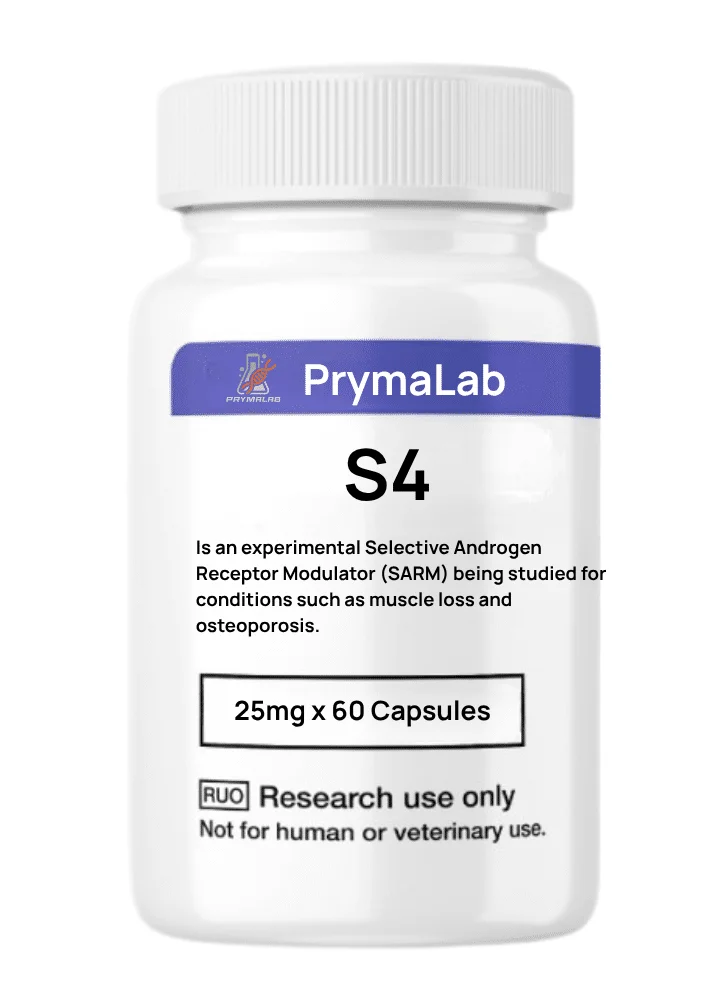
S4 Andarine 25mg Capsules
Non-steroidal androgen receptor partial agonist · CAS 401900-40-1 · 60 capsules
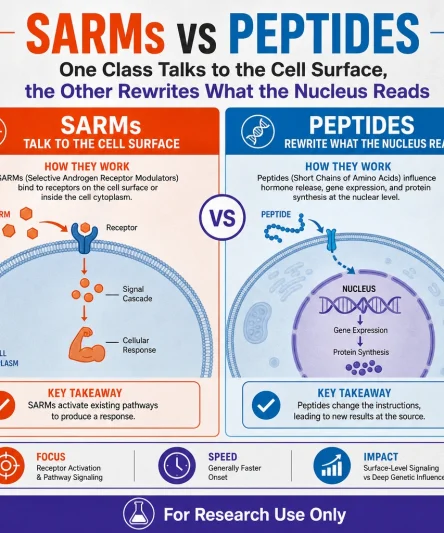
S4 Andarine 25mg capsules contain andarine, a non-steroidal selective androgen receptor modulator with reported binding affinity near 4 nM at the androgen receptor. Developed under the code GTx-007, the compound is characterised in published work as a partial agonist showing anabolic activity in skeletal muscle and bone with comparatively weak activity in prostate tissue.
Specification Table
| Property | Value |
|---|---|
| Compound | Andarine |
| Development codes | S-4, GTx-007 |
| CAS number | 401900-40-1 |
| Molecular formula | C19H18F3N3O6 |
| Molecular weight | 441.36 g/mol |
| Chemical class | Aryl-propionamide, non-steroidal |
| Molecular target | Androgen receptor (AR, NR3C4) |
| Reported binding affinity | Ki approximately 4 nM |
| Receptor activity | Partial agonist |
| Amino acid sequence | Not applicable. Andarine is a small molecule, not a peptide |
| Capsule strength | 25 mg |
| Count per bottle | 60 capsules |
| Appearance | White to off-white powder within a gelatin capsule shell |
| Purity | Per lot-specific certificate of analysis |
| Solubility | Soluble in DMSO and ethanol. Poorly soluble in water |
| Storage | Room temperature, sealed, protected from light and moisture |
| Stability | Not established beyond the lot expiry stated on the certificate of analysis |
| Anti-doping status | Prohibited by the World Anti-Doping Agency since 2008 |
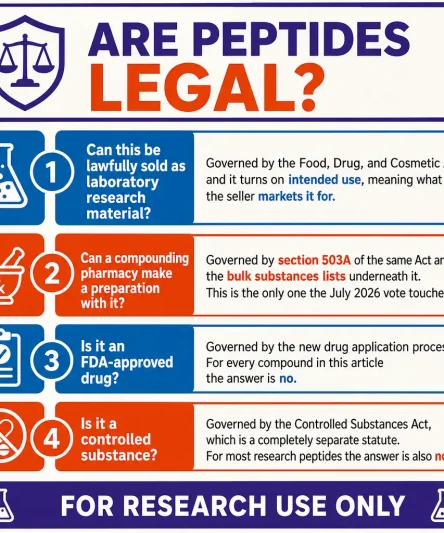
| Regulatory status | No approved human or veterinary formulation in any jurisdiction |
How Does Andarine Bind the Androgen Receptor?
Andarine is an aryl-propionamide. It occupies the ligand-binding domain of the androgen receptor, a nuclear receptor formally designated NR3C4, and published binding assays place its affinity near 4 nM. That figure sits in the same range as testosterone, so affinity alone does not explain the compound’s behaviour.
What distinguishes it is partial agonism. A full agonist drives the receptor into a conformation that recruits the complete set of coactivator proteins. A partial agonist stabilises a different conformation, and the tissue response then depends on which coregulators are locally abundant. Because coregulator expression varies between skeletal muscle, bone and prostate, the same ligand can produce markedly different transcriptional output in each.
Yin and colleagues at the University of Tennessee characterised this class in a 2003 pharmacology paper, and the tissue-selectivity concept has been the organising idea behind SARM development ever since. Andarine was among the earliest compounds where the separation was demonstrated in vivo rather than inferred from cell work.
What Is Reported for the Half-Life of Andarine?
Published pharmacokinetic characterisation of andarine in humans is thin. The compound never completed late-stage clinical development, so there is no phase III dataset to draw on, and figures circulating in non-scientific sources are frequently presented without any citation attached.
Preclinical work in rats indicates a comparatively short plasma half-life, on the order of hours rather than the multi-day profile seen with long-acting steroidal androgens. Researchers designing exposure schedules should derive their own values from the model system in use rather than importing numbers from secondary sources.
This is a genuine gap in the literature and not a detail this page can resolve. Any half-life figure quoted without a primary citation should be treated as unverified.
Why Is Visual Disturbance Associated With Andarine?
Reversible yellow-tinted vision is the most frequently discussed observation associated with andarine, and it deserves an accurate description rather than a dismissive one.
The association comes almost entirely from uncontrolled self-reported accounts circulating in non-scientific forums. It has not been characterised in a controlled published study. No mechanism has been established in peer-reviewed work, though the proposed explanations generally involve interaction with retinal proteins, reasoning from andarine’s nitro-aromatic structure.
So the honest position is this. The observation is reported consistently enough that it would be unreasonable to ignore it. The mechanism is unestablished, the incidence is unquantified, and no controlled study has measured it. Researchers working on ocular endpoints may find this a more interesting open question than a nuisance.
Is Andarine a Peptide?
No, and the question comes up often enough in search data to warrant a direct answer on the page.
Andarine is a small organic molecule with the formula C19H18F3N3O6 and a molecular weight of 441.36. It contains no amide-linked amino acid chain. Peptides are polymers of amino acids joined by peptide bonds, typically ranging from two residues to several dozen, and andarine has none of that architecture.
The confusion is understandable given that research suppliers frequently catalogue SARMs alongside peptides. They are separate chemical classes with different synthesis routes, different stability behaviour, and different analytical methods. Andarine is stable at room temperature as a dry powder, which no working peptide chemist would expect of a lyophilised peptide.
What Does Tissue Selectivity Look Like in the Published Data for S4 Andarine 25mg Capsules?
Kearbey and colleagues ran a 120-day study in 120 ovariectomised female Sprague-Dawley rats, randomised across twelve study arms, with compound exposure beginning immediately after ovariectomy (Kearbey et al., Pharmaceutical Research, 2007). They reported maintenance of whole-body and trabecular bone mineral density, preserved cortical content, increased bone strength, and reduced body fat.
The comparison that matters in this literature is between the levator ani muscle and the prostate. Both tissues express the androgen receptor. A steroidal androgen enlarges both. A tissue-selective compound enlarges the muscle while leaving prostate weight comparatively unchanged, and that ratio is the standard readout for selectivity in castrated-rat models.
Andarine showed that separation. It is worth being precise about what the finding does and does not establish: it demonstrates differential transcriptional output across two androgen-responsive tissues in a rodent model. Extrapolating that to any other species or endpoint is not supported by the data.
How Is Andarine Confirmed Analytically?
Capsule labels are claims. Confirming what is inside them is a separate exercise, and for a compound with no approved formulation there is no regulatory body doing it on anyone’s behalf.
Liquid chromatography coupled to tandem mass spectrometry is the standard method. Andarine ionises readily in negative mode, and the trifluoromethyl and nitro groups give it a distinctive fragmentation pattern that separates it cleanly from structurally similar aryl-propionamides. A reference standard run alongside the sample establishes retention time and transition ratios, and without that comparator a chromatographic peak is suggestive rather than confirmatory.
Anti-doping laboratories have driven much of the method development here, since andarine has been a listed substance since 2008. Those published methods are freely available and generally more rigorous than anything a supplier will provide, which makes them a useful starting point for laboratories building internal verification.
Two things are worth checking beyond identity. First, quantity: capsule fill tolerance is wider than most people assume, and a nominal 25 mg can vary. Second, related substances. Synthesis intermediates and degradation products can co-elute if the gradient is not resolved properly, and a purity figure derived from a poorly resolved chromatogram overstates what it measures.
Where Andarine Sits in the SARM Timeline
Context helps when choosing between compounds, and andarine occupies a specific position in the development history of this class.
The aryl-propionamide series came out of work at the University of Tennessee in the late 1990s and early 2000s, built on the observation that non-steroidal antiandrogens could be structurally modified into agonists. Andarine was among the first compounds where tissue selectivity was demonstrated in animals rather than predicted from cell work.
It never reached late-stage clinical success. Development attention within the same programme shifted toward ostarine, which had a more favourable profile on several measures and progressed further through clinical evaluation. Andarine remained a research compound.
That history explains the shape of its literature. There is a solid cluster of preclinical pharmacology from roughly 2003 to 2009, and comparatively little after. Anyone searching for recent work will find mostly analytical chemistry and anti-doping method development rather than new pharmacology.
Handling and Storage in Laboratory Practice
Andarine is supplied here in capsule form at 25 mg. For analytical work the capsule contents are typically emptied and weighed rather than assumed, since capsule fill tolerance is wider than analytical balance precision.
The compound is poorly water-soluble. DMSO and ethanol are the usual stock-solution solvents, and researchers preparing aqueous working solutions should watch for precipitation on dilution, which is the common failure mode with aryl-propionamides. Filter-sterilising a stock that has already precipitated will silently reduce the delivered concentration.
Dry powder holds well at ambient temperature when sealed and shielded from light. Organic stock solutions belong in the refrigerator, and the usable window should be set by the laboratory rather than borrowed, because no published stability dataset covers arbitrary conditions. Log the lot, the solvent, the concentration and the date of preparation.
Published Literature
Every reference below was confirmed against the publisher record or a primary index before inclusion. Titles are omitted; author, journal, year, volume and identifier are sufficient for retrieval.
- Kearbey JD, Gao W, Narayanan R, Fisher SJ, Wu D, Miller DD, Dalton JT. Pharmaceutical Research. 2007;24(2):328-335. PMID: 17063395
- Yin D, Gao W, Kearbey JD, Xu H, Chung K, He Y, Marhefka CA, Veverka KA, Miller DD, Dalton JT. Journal of Pharmacology and Experimental Therapeutics. 2003;304(3):1334-1340.
- Gao W, Dalton JT. Drug Discovery Today. 2007;12(5-6):241-248.
- Narayanan R, Mohler ML, Bohl CE, Miller DD, Dalton JT. Nuclear Receptor Signaling. 2008;6:e010.
Frequently Asked Questions
What are S4 Andarine 25mg capsules?
S4 Andarine 25mg capsules contain andarine, a non-steroidal selective androgen receptor modulator with CAS number 401900-40-1. Each bottle holds 60 capsules at 25 mg. The compound binds the androgen receptor with reported affinity near 4 nM and acts as a partial agonist. Supplied for laboratory research use only, and not approved for human or veterinary use anywhere.
Is S4 the same thing as andarine?
Yes. S-4, andarine, and GTx-007 all refer to the same compound. S-4 was the internal designation used during development at GTx Inc. Andarine became the common name. GTx-007 appears in some of the earlier pharmacology literature. All three point to CAS 401900-40-1 with molecular formula C19H18F3N3O6.
Is andarine a peptide?
No. Andarine is a small organic molecule of the aryl-propionamide class, with a molecular weight of 441.36. It contains no amino acids and no peptide bonds. The term appears in search queries because research suppliers often list SARMs and peptides in the same catalogue, but the two are chemically unrelated classes with different handling requirements.
What is the reported binding affinity of andarine?
Published binding assays place andarine at roughly 4 nM at the androgen receptor. That is comparable to endogenous androgens in affinity terms. Affinity alone does not determine the tissue response, because andarine is a partial agonist and the transcriptional output depends on which coregulator proteins are locally abundant in a given tissue.
What is the half-life of andarine?
No reliable human pharmacokinetic figure exists in the peer-reviewed literature, because andarine never completed late-stage clinical development. Rodent work indicates a comparatively short plasma half-life measured in hours. Any specific figure circulating without a primary citation attached should be treated as unverified.
Why do accounts mention yellow-tinted vision?
Reversible yellow tinting of vision is described consistently in uncontrolled self-reported accounts. It has not been characterised in any controlled published study, no incidence figure exists, and no mechanism has been established in peer-reviewed work. Proposed explanations involve interaction with retinal proteins, reasoning from the nitro-aromatic structure, but that remains an inference.
How does andarine differ from steroidal androgens?
Steroidal androgens activate the androgen receptor across all responsive tissues broadly. Andarine is a non-steroidal partial agonist that showed separation between anabolic activity in the levator ani muscle and comparatively weak activity in prostate tissue in castrated-rat models. That ratio is the standard selectivity readout in this literature.
How should the capsules be stored?
Keep the bottle sealed at ambient temperature, away from light and moisture. Andarine holds as a dry powder under those conditions, which is not true of lyophilised peptides. Refrigerate DMSO or ethanol stocks and set an internal usable window, since published stability data does not cover arbitrary storage.
Is andarine prohibited in competitive sport?
Yes. The World Anti-Doping Agency added SARMs including andarine to its prohibited list in 2008. Researchers working with athlete populations, or with samples that may be subject to anti-doping analysis, should confirm the current WADA list and any sport-governing-body requirements before beginning work.
How is andarine confirmed analytically?
Liquid chromatography with tandem mass spectrometry is standard. Andarine ionises readily in negative mode and its trifluoromethyl and nitro groups give a distinctive fragmentation pattern. A reference standard run alongside establishes retention time and transition ratios. Without that comparator, a chromatographic peak is suggestive rather than confirmatory.
Why check capsule content by weight?
Capsule fill tolerance is wider than analytical balance precision, so a nominal 25 mg varies between units. For any experiment where delivered amount matters, weighing the emptied contents is more reliable than trusting the label. Related substances from synthesis are worth resolving chromatographically at the same time.
Compliance Statement
S4 Andarine 25mg capsules is sold exclusively for laboratory research use. It is not a drug, food, or cosmetic product, and it is not a dietary product of any kind. It is not approved by the FDA or any comparable authority for human or veterinary use, and andarine is prohibited in competitive sport under World Anti-Doping Agency rules. This product is not intended to diagnose, treat, cure, or prevent any disease. It must not be given to humans or animals. Purchase is restricted to qualified researchers and institutions operating within applicable laws. All handling is the responsibility of the purchasing laboratory.


15 reviews for S4 (Andarine) (25mg/capsule) 60 Capsules