Description
What Is Noopept (Omberacetam)?
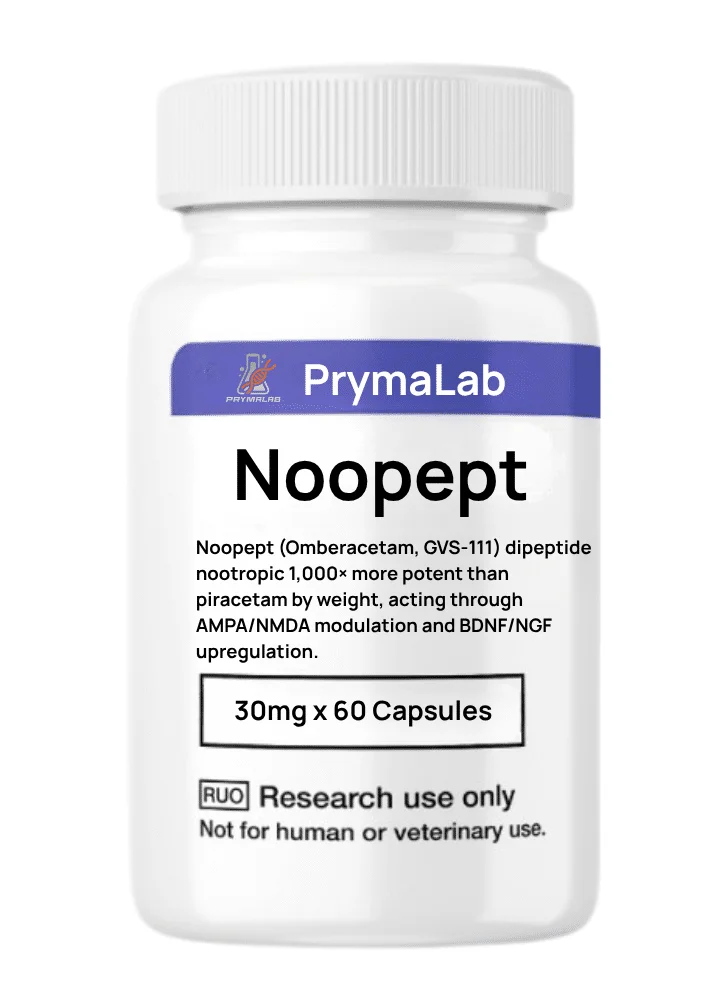
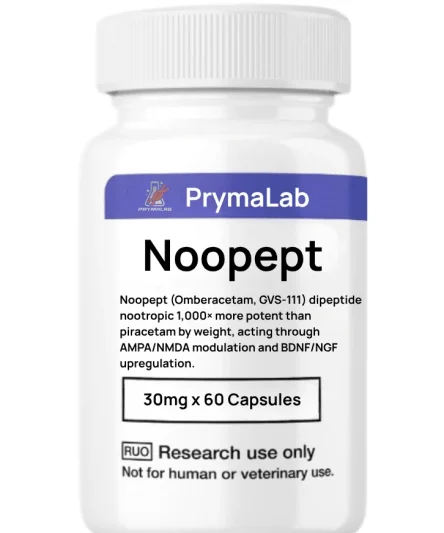
Noopept, known by its international nonproprietary name omberacetam, is a synthetic nootropic dipeptide derived from the cycloprolylglycine scaffold. Developed at the Russian Academy of Medical Sciences in the late 1990s, Noopept is estimated to be about 1,000 times more potent than piracetam on a per-milligram basis, needing doses in the low milligram range to produce measurable cognitive effects in lab and clinical models.
Noopept’s mechanism extends beyond the classical racetam framework. While structurally related to the racetam family, omberacetam operates mainly through tuning of brain-derived neurotrophic factor (BDNF) and nerve growth factor (NGF) expression, glutamatergic AMPA and NMDA receptor sensitization, and boost of alpha-wave brain activity linked with calm, focused cognition. The compound shows oral uptake with rapid blood-brain barrier penetration and a plasma half-life of about 30 to 60 minutes, though its neurotrophin-inducing effects persist well beyond the plasma elimination window. Noopept is registered as a prescription nootropic medication in Russia and several CIS countries.
Key Features and Specifications
| Specification |
Detail |
| Product Name |
Noopept (Omberacetam) |
| Dosage |
30 mg per capsule |
| Quantity |
60 capsules per bottle |
| Form |
Oral capsule |
| CAS Number |
157115-85-0 |
| Cell-level Formula |
C17H22N2O4 |
| Cell-level Weight |
318.37 g/mol |
| Purity |
≥99% (HPLC verified) |
| Testing |
Third-party HPLC and MS test |
| Storage |
Room heat, cool dry place, away from light |
| Classification |
Nootropic dipeptide |
Mechanism of Action: How Noopept Works
Noopept operates through multiple convergent mechanisms that enhance neuronal function and plasticity. Upon crossing the blood-brain barrier, omberacetam is metabolized to cycloprolylglycine, an endogenous neuropeptide that tunes AMPA receptor trafficking and glutamatergic transmission. This body pathway distinguishes Noopept from classical racetams, which mainly tune acetylcholine and glutamate through different binding mechanisms.
The compound’s most major mechanism involves upregulation of BDNF and NGF expression in the hippocampus and cerebral cortex. BDNF promotes synaptic plasticity, long-term potentiation, and neuronal survival, while NGF supports cholinergic neuron maintenance and axonal growth. These neurotrophic effects persist for days after use, explaining why Noopept’s cognitive benefits extend well beyond its short plasma half-life.
Also, Noopept sensitizes AMPA receptors through positive allosteric tuning, enhancing glutamatergic signal transmission efficiency. The compound also tunes NMDA receptor function, blocks voltage-gated calcium channels to reduce excitotoxicity, and shows antioxidant properties by scavenging reactive oxygen species in neuronal tissue. Electroencephalographic studies show increased alpha-wave coherence during Noopept use, correlating with enhanced focused attention and data processing.
Reported Research Applications and Benefits
Cognitive boost research represents the main use for Noopept. Clinical studies in patients with mild cognitive impairment and post-traumatic cognitive deficits have showed gains in memory consolidation, data retrieval, and attention span. The compound’s neurotrophic mechanism provides both acute nootropic effects and longer-term brain-safe benefits through enhanced BDNF and NGF signaling.
Brain safety studies have shown that Noopept protects neurons against oxidant stress, glutamate excitotoxicity, and amyloid-beta-induced toxicity in cell culture and animal models relevant to Alzheimer’s disease. Anxiolytic research has documented mild anti-anxiety effects at standard doses, attributed to tuning of glutamatergic and GABAergic balance in limbic structures. Memory consolidation studies consistently show that Noopept enhances both acquisition and retrieval phases of memory formation in passive avoidance, Morris water maze, and contextual fear conditioning paradigms.
Noopept Dosage Information for Research
| Protocol |
Dosage |
Duration |
Notes |
| Standard research dose |
10–30 mg/day |
4–12 weeks |
Clinical trial range |
| Beginner protocol |
10 mg/day |
4 weeks |
Assess personal response |
| Standard protocol |
20–30 mg/day (split) |
8–12 weeks |
10 mg 2–3x daily |
| Timing |
Split doses, with meals |
— |
~30–60 min plasma half-life |
Noopept vs Piracetam: Key Differences
| Parameter |
Noopept (Omberacetam) |
Piracetam |
| Class |
Nootropic dipeptide |
Racetam (2-pyrrolidone) |
| Effective dose |
10–30 mg/day |
1,200–4,800 mg/day |
| Relative potency |
~1,000x piracetam (per mg) |
Reference compound |
| BDNF/NGF effects |
Major upregulation |
Minimal |
| AMPA tuning |
Positive allosteric modulator |
Weak positive modulator |
| Brain safety |
Strong (antioxidant + neurotrophic) |
Moderate |
| Half-life |
~30–60 minutes |
~5 hours |
| Clinical status |
Registered medication (Russia) |
Registered medication (Europe) |
Storage and Handling Instructions
Store Noopept capsules at controlled room heat between 20°C and 25°C (68°F to 77°F) in the original sealed container. Protect from direct sunlight, moisture, and heat. Under recommended storage conditions, Noopept capsules keep full potency for at least 24 months from manufacture.
Why Choose PrymaLab Noopept Omberacetam Capsules
Every batch of PrymaLab Noopept undergoes independent third-party testing using HPLC for purity and mass spectrometry for identity confirmation. Each order ships with a batch-specific Certificate of Test documenting ≥99% purity, absence of heavy metals, residual solvents, and microbial contaminants. Pharmaceutical-grade encapsulation ensures precise 30 mg dosing per capsule, and free priority shipping is included on all domestic orders.
Frequently Asked Questions About Noopept
How quickly does Noopept take effect?
Noopept crosses the blood-brain barrier rapidly, with acute cognitive effects often reported within 15 to 30 minutes of oral use. However, the neurotrophic benefits mediated through BDNF and NGF upregulation develop over days to weeks of consistent use, meaning the full cognitive boost profile emerges with sustained use rather than single-dose use.
Is Noopept the same as piracetam?
No. While structurally related to the racetam family, Noopept (omberacetam) is a dipeptide with a distinct mechanism of action involving BDNF/NGF upregulation and AMPA receptor sensitization. Noopept is about 1,000 times more potent per milligram and works through neurotrophic pathways that piracetam does not greatly engage.
Does Noopept require a choline source?
While Noopept’s main mechanism involves glutamatergic and neurotrophic pathways rather than direct cholinergic tuning, co-use with a choline source such as alpha GPC is a common research protocol. Choline use supports acetylcholine synthesis, which may complement Noopept’s cognitive boost effects and reduce the incidence of headache reported in some study subjects.
What is the recommended cycle length for Noopept research?
Russian clinical rules recommend cycles of 1.5 to 3 months with intervening rest periods. Research protocols often run 8 to 12 weeks followed by a 4-week washout period. The neurotrophic effects of BDNF and NGF upregulation may persist into the washout period, providing sustained benefits beyond the active use phase.
Can Noopept be taken sublingually?
Sublingual use of Noopept powder bypasses first-pass hepatic body function and may increase uptake and speed of onset. However, capsule forms are designed for oral use and provide more consistent dosing. Researchers interested in sublingual protocols should consider PrymaLab Noopept Powder for that use.
Quality Assurance and Testing
PrymaLab keeps pharmaceutical research-grade quality standards for all Noopept products. Each batch is independently tested by accredited laboratories using HPLC purity test, mass spectrometry identity confirmation, heavy metal screening, residual solvent testing, and microbial assessment. Batch-specific Certificates of Test accompany every order.
Research Disclaimer
Noopept (omberacetam) is sold for laboratory research and scientific study purposes only. This product is not intended for human consumption or treatment use in jurisdictions where it is not approved for medical use. Purchasers must comply with all applicable local, state, and federal regulations governing research materials.
Only logged in customers who have purchased this product may leave a review.











14 reviews for Noopept (Omberacetam) 30mg Capsules