
Description
PrymaLab · Research use only
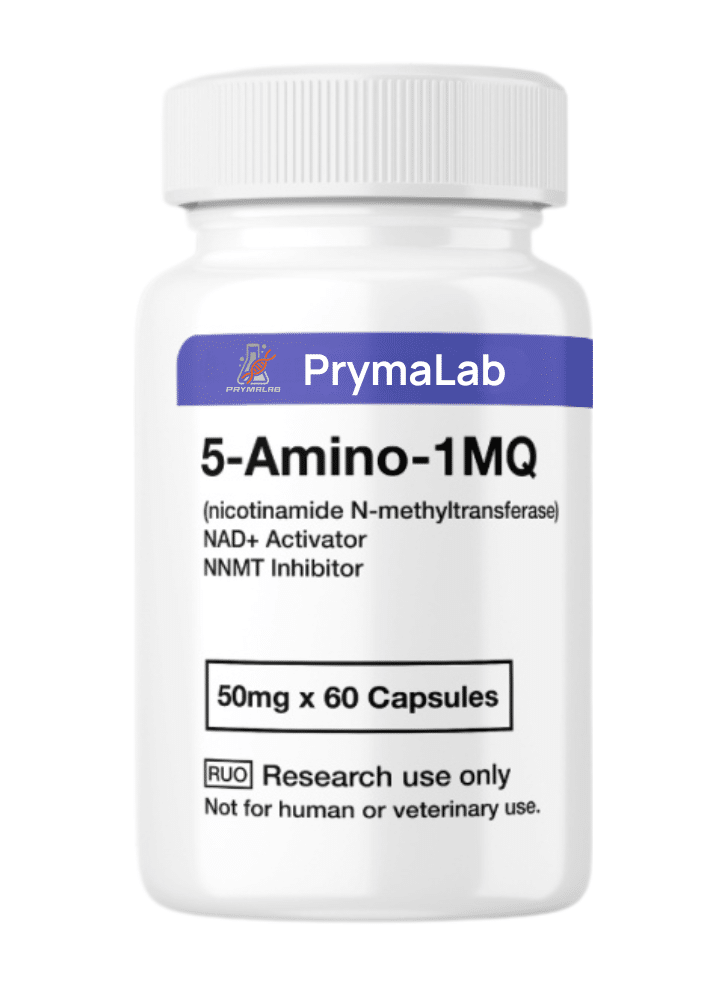
5-Amino-1MQ 50mg (60 Capsules)
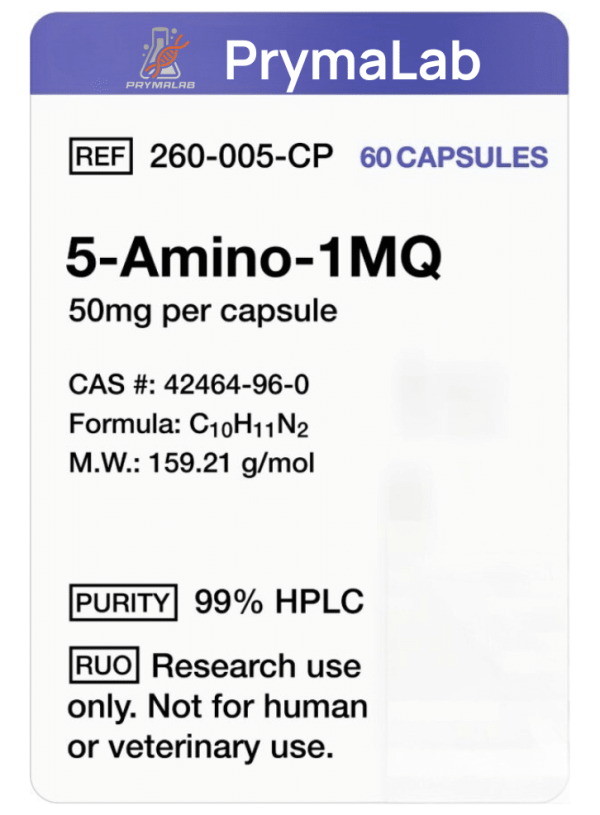
60 hard gelatin capsules, 50 mg of 5-amino-1MQ iodide in each, with cellulose filler
5-amino-1MQ, or 5-amino-1-methylquinolinium, is a small-molecule inhibitor of nicotinamide N-methyltransferase (NNMT) and not a peptide. This listing is a sealed bottle of 60 hard gelatin capsules, each stated to hold 50 mg of the iodide salt blended with microcrystalline cellulose. The published research on 5-amino-1MQ consists of enzyme assays, cultured fat cells and studies in obese mice, and none of it used capsules.
Specifications
| Property | Value |
|---|---|
| Compound | 5-Amino-1MQ 5-Amino-1-methylquinolinium iodide (NNMT inhibitor); small molecule, not a peptide |
| CAS number | 42464-96-0 |
| Molecular formula | C10H11IN2 |
| Theoretical mass | 286.1 Da |
| Contents | 5-Amino-1MQ: 50 mg per capsule |
| Form | Hard gelatin capsules containing the active substance blended with microcrystalline cellulose, packed in a sealed bottle |
| Storage, sealed | Store at room temperature (15–25 °C) in the tightly closed original container, dry and protected from light |
| Safety data sheet | PL-SDS-003 |
What is in each capsule
Each capsule contains 50 mg of 5-amino-1-methylquinolinium iodide (CAS 42464-96-0), the same salt sold in the vials, mixed with microcrystalline cellulose as a filler inside a gelatin shell. The 50 mg is the salt mass, iodide included, which is about 175 µmol of the active cation per capsule; the bottle of 60 holds 3 g of salt in all. The safety data sheet classifies 5-amino-1MQ itself as harmful if swallowed and as a skin, eye and respiratory irritant, and asks for the bottle to be stored locked up.
Unlike the vials, the capsules are kept at room temperature: 15 to 25 °C, in the tightly closed original bottle, dry and away from light. Every opening lets in room air, so recap the bottle promptly.
Capsule or vial
A capsule fixes the amount per unit in advance, but the active ingredient cannot be weighed or inspected once it is blended into the fill. How evenly it is spread depends on the blending and filling. Jakubowska and Ciepluch reviewed how powder blends segregate during transfer, hopper discharge and die filling in tablet manufacture, and how that can lead to content uniformity failures in the finished units1. Similar mechanisms can apply to any blended solid fill. For quantitative work the 5-amino-1MQ 50 mg vial holds the pure salt, which can be weighed and dissolved to a chosen concentration.
What the research covers
5-amino-1MQ inhibits nicotinamide N-methyltransferase, an enzyme first identified for methylating nicotinamide so that it can be excreted, and since linked to metabolic pathways in fat, liver and cancer cells through its use of methyl donors2. The compound came out of a 2017 structure-activity study of methylated quinoliniums, which inhibited NNMT at around 1 µM and, in docking models, sat in the enzyme’s nicotinamide-binding site3. The same group’s later cell and mouse work, summarised on the 50 mg vial page, is the basis for most of what is said about the compound.
None of that work used capsules or any form given by mouth. The only oral data in the references concern a different NNMT inhibitor, a nicotinamide analogue called compound 12, which cut formation of the enzyme’s product MNA in mice by about 80% at two hours4. That result cannot be carried over to 5-amino-1MQ, a permanently charged quinolinium with different chemistry. For a capsule, the basic questions therefore stay open: whether the cation is absorbed from the gut at all, how much of it reaches tissue, and for how long. None of the papers cited here measured any of these for 5-amino-1MQ in any species. No human data on 5-amino-1MQ in any form appear in the references, and the 5-amino-1MQ guide covers the full literature.
How each lot is tested
Every lot is tested in PrymaLab’s own laboratory in Ashland, Kentucky before release. Published certificates are listed on the results page and can be checked by number and key on the verify page. These are in-house results from PrymaLab Analytical, not an independent test, and the lab is not accredited to ISO 17025. The third-party testing guarantee on this page still applies: if any independent laboratory finds the wrong compound, or less than the stated purity or amount, the order is refunded and the cost of the test is reimbursed.
Frequently asked questions
How do the capsules differ from the 5-amino-1MQ vials?
The vials hold the pure iodide salt as a powder that can be weighed and dissolved, stored at −20 °C. Each capsule holds a fixed 50 mg of the same salt blended with cellulose in a gelatin shell, stored at room temperature. The vial is the format for work that depends on an exact amount.
Has 5-amino-1MQ been studied in capsule form?
Not in any paper cited here. The published work on this compound used enzyme assays, cultured cells and mice, with no oral or capsule studies, and the one oral NNMT result in the references concerns a different molecule.
How should the bottle be stored?
Tightly closed in the original bottle at 15 to 25 °C, dry and protected from light, and locked away as the safety data sheet asks. The capsules do not need freezing. Replace the cap promptly after opening to limit moisture.
Are the capsules for human consumption?
No. They are a laboratory research product, not a dietary supplement or a drug, and they are not approved for human or veterinary use. They must not be swallowed by, or given to, people or animals.
References
- Jakubowska E, Ciepluch N. Blend Segregation in Tablets Manufacturing and Its Effect on Drug Content Uniformity-A Review. Pharmaceutics. 2021;13(11). DOI · PubMed
- Pissios P. Nicotinamide N-Methyltransferase: More Than a Vitamin B3 Clearance Enzyme. Trends Endocrinol Metab. 2017;28(5):340-353. DOI · PubMed
- Neelakantan H, Wang HY, Vance V, et al. Structure-Activity Relationship for Small Molecule Inhibitors of Nicotinamide N-Methyltransferase. J Med Chem. 2017;60(12):5015-5028. DOI · PubMed
- Ruf S, Hallur MS, Anchan NK, et al. Novel nicotinamide analog as inhibitor of nicotinamide N-methyltransferase. Bioorg Med Chem Lett. 2018;28(5):922-925. DOI · PubMed
Research use only
For laboratory research use only. 5-Amino-1MQ 50mg (60 Capsules) is not a drug, food, cosmetic or dietary supplement, is not approved by the FDA or any comparable authority for human or veterinary use, and must not be given to people or animals. It is sold to qualified researchers and institutions, and the buyer is responsible for lawful handling and disposal.
Other formats of 5-Amino-1MQ
5-Amino-1MQ is also stocked as 5-amino-1MQ 5MG and 5-Amino-1MQ 50mg/ml preloaded 3ml pen. Each listing states its own quantity and concentration, and the pen and vial comparison explains what changes between formats.








Reviews
There are no reviews yet.