Description
PrymaLab · Research use only
PT-141 10mg
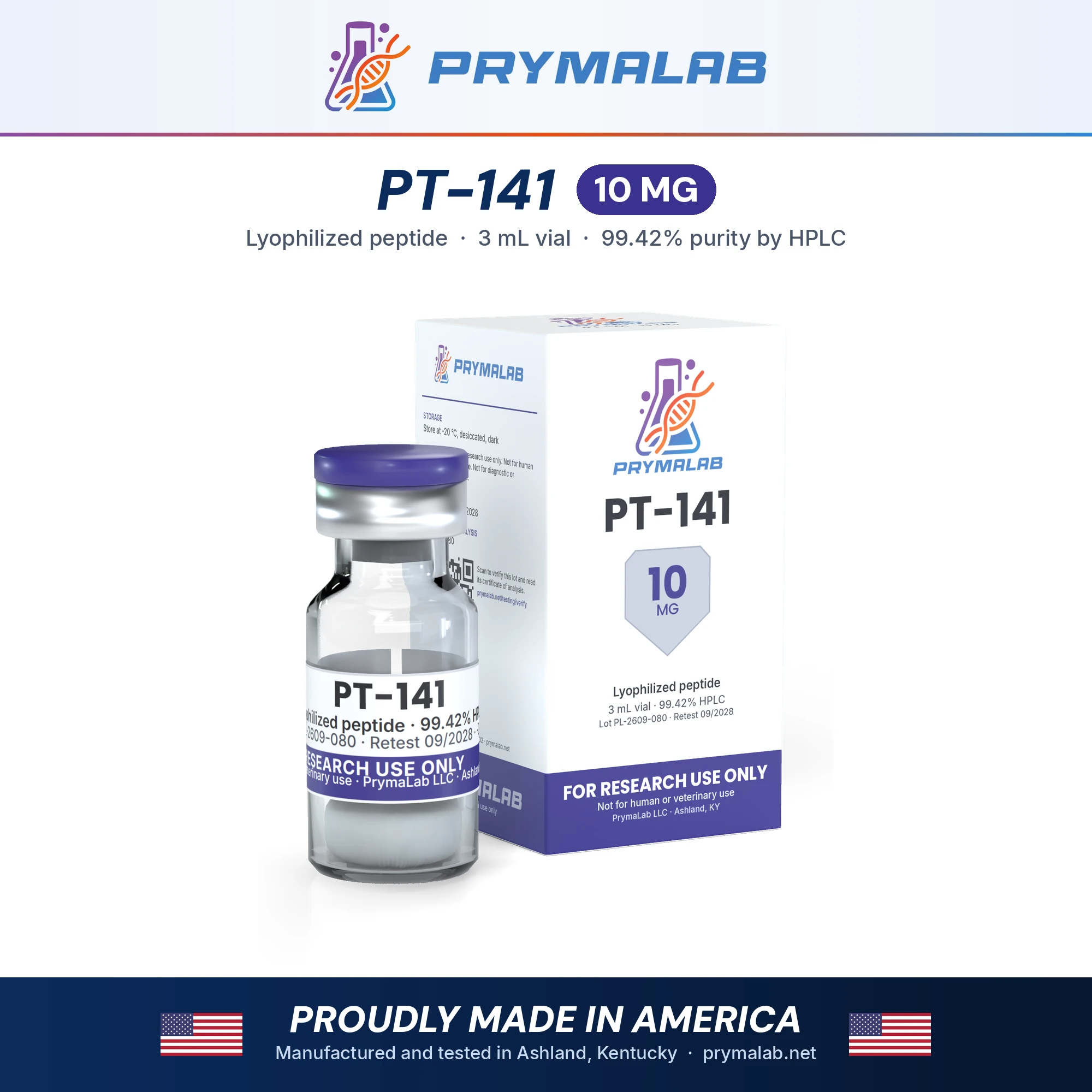
Bremelanotide (PT-141), a cyclic seven-residue melanocortin peptide, in a 10 mg vial
PT-141 is the development code for bremelanotide, a seven-residue cyclic peptide modelled on alpha-melanocyte-stimulating hormone (alpha-MSH) that binds melanocortin receptors. This listing is a sealed vial holding 10 mg of freeze-dried bremelanotide, acetylated at the N-terminus and ending in a free carboxylic acid. Research on the compound covers how its ring was designed, which receptors it reaches in the brain, animal studies of hypothalamic activation, and two phase 3 trials whose design is summarised below.
Specifications
| Property | Value |
|---|---|
| Compound | PT-141 Bremelanotide |
| CAS number | 189691-06-3 |
| Molecular formula | C50H68N14O10 |
| Theoretical mass | 1025.2 Da |
| Sequence / structure | Ac-Nle-cyclo[D-H-[D-Phe]-R-W-K]-OH (7 residues; Asp–Lys side-chain lactam; N-acetyl; free C-terminal acid) |
| Label claim | 10 mg/vial |
| Form | Lyophilized (freeze-dried) powder or cake in a sealed glass vial with a rubber stopper and aluminium crimp cap |
| Storage, sealed | −20 °C, desiccated, dark |
| Purity specification | 99.0% or higher by RP-HPLC |
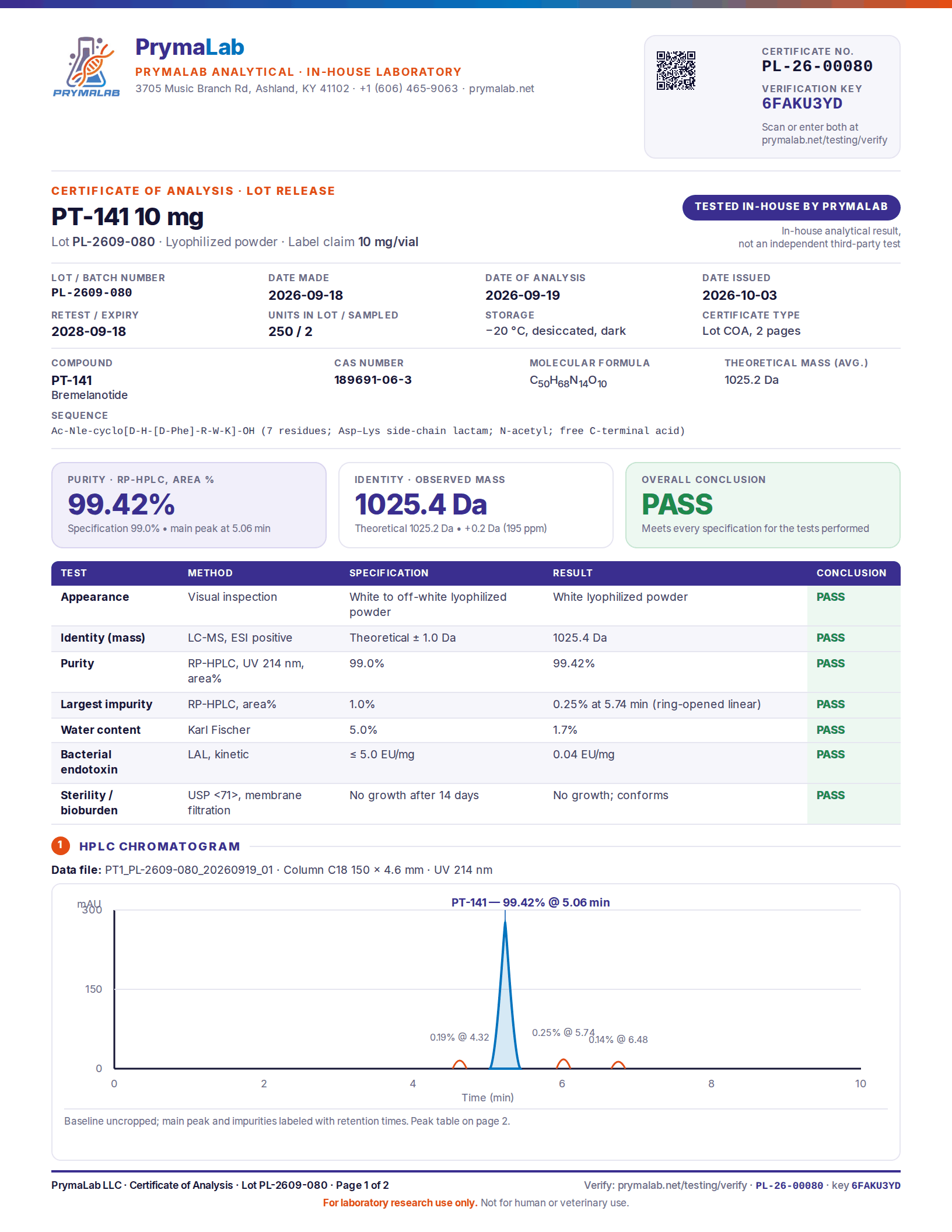
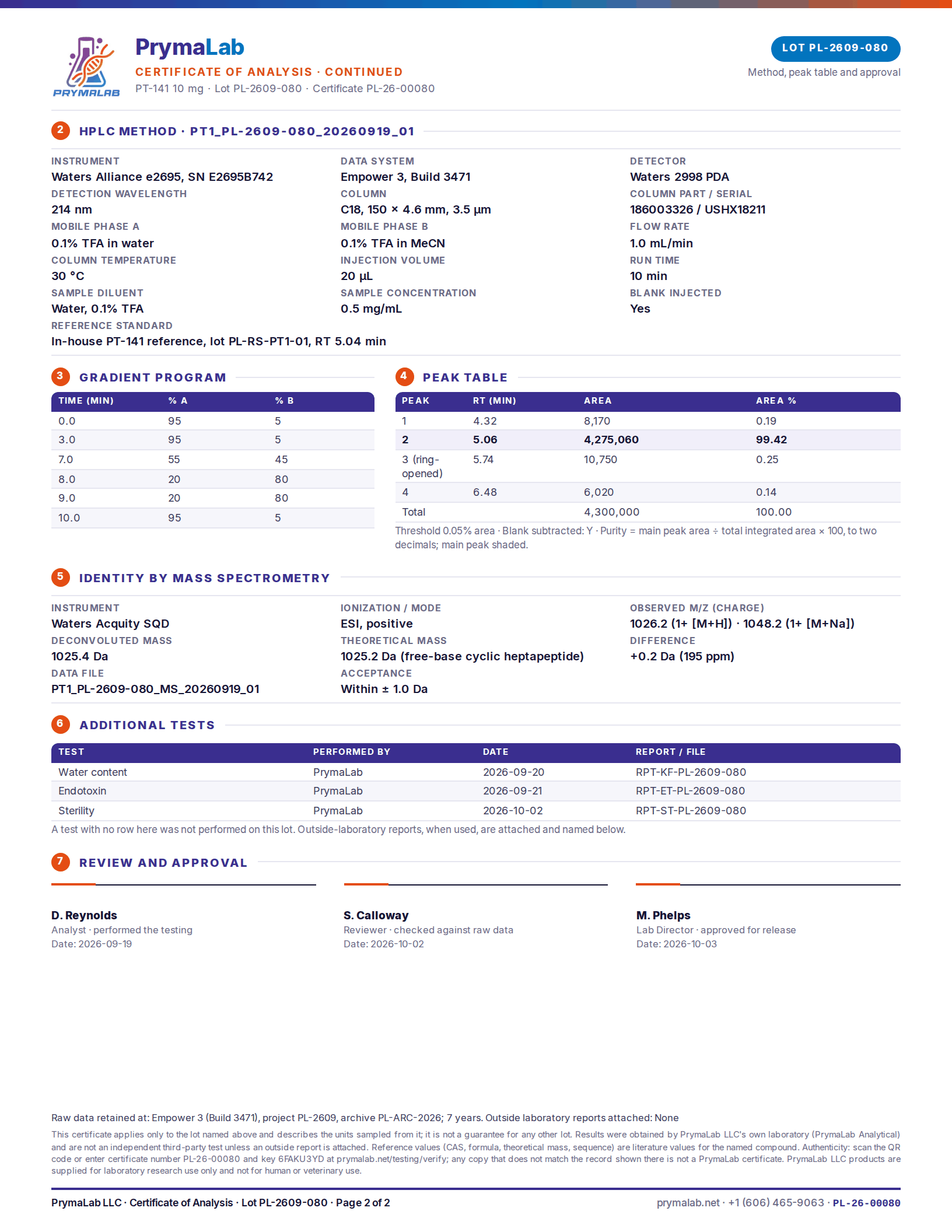
| Lot certificate | Results for the lot now shipping are in the certificate panel on this page |
| Safety data sheet | PL-SDS-135 |
Bremelanotide or melanotan II: reading the structure
Bremelanotide and melanotan II share one ring: an acetylated norleucine followed by Asp-His-D-Phe-Arg-Trp-Lys, closed by a lactam bond between the aspartate and lysine side chains. They differ only at the C-terminus. Melanotan II ends in an amide, bremelanotide in a free acid. The certificate writes the structure in one-letter code as Ac-Nle-cyclo[D-H-[D-Phe]-R-W-K]-OH, where the first D stands for aspartate and the only D-amino acid is the bracketed phenylalanine. Formula C50H68N14O10, theoretical mass 1025.2 Da.
Melanotan II has a theoretical mass of 1024.2 Da, so the two sit about one dalton apart, and the LC-MS identity result on the certificate is the number to read against 1025.2. From that mass, 10 mg is about 9.8 µmol, a little less once the certificate’s water content is allowed for. The melanotan 1 vs melanotan 2 guide places both in the wider family of alpha-MSH analogues.
What the research covers
Where the ring came from
Bremelanotide descends from structure-based work on alpha-MSH in the 1980s. Al-Obeidi and colleagues used molecular dynamics to design cyclic fragments of the hormone, each closed by a lactam bridge between two side chains, and tested seven of them in frog and lizard skin bioassays1. Ring size mattered. In the lizard assay the analogues bridged from aspartate to lysine were 90 to 100 times as potent as alpha-MSH, while the glutamate-bridged versions reached 6 to 91. The seven-residue Asp-to-Lys peptide in that series has the sequence later known as melanotan II, and a 2006 review by Hadley and Dorr described PT-141 as a newer analogue of melanotan II developed by Palatin Technologies2. The link to sexual function came by chance: Hadley wrote that the effects of melanotan II in this area were discovered accidentally while the peptide was being studied for skin pigmentation3.
Receptors and where they sit
The melanocortin system is made up of peptides cut from the proopiomelanocortin precursor, five melanocortin receptors, two endogenous antagonists and two ancillary proteins4. Gantz and Fong’s 2003 review listed pigmentation, inflammation, energy homeostasis and sexual function as the roles that pharmacological and genetic studies had confirmed for it4. Molinoff and colleagues described PT-141 as an agonist at melanocortin receptors including MC3R and MC4R, the two expressed mainly in the central nervous system5. Because bremelanotide is not confined to one receptor, an effect seen with it cannot be assigned to a single receptor without further tools. The binding order across all five receptors is set out in the PT-141 and bremelanotide guide.
Animal and early human studies
In the same paper, PT-141 given systemically to rats increased c-Fos immunoreactivity, a marker of recently active neurons, in the hypothalamus5. A tracing experiment pointed to that region as well: hypothalamic neurons picked up a pseudorabies virus tracer placed in the rat corpus cavernosum5. The authors also reported erectile responses in rats and nonhuman primates, and summarised early studies in healthy men and in men with erectile dysfunction that measured erectile activity5.
Phase 3 trials
The largest human data set in these references is the RECONNECT programme: two identical phase 3, randomised, double-blind, placebo-controlled, multicentre trials in premenopausal women with hypoactive sexual desire disorder, each lasting 24 weeks6. Of 1,267 women randomised, 1,247 formed the safety population and 1,202 the efficacy population; 96.6% were enrolled at US sites, and the mean age was 396. The co-primary endpoints were the change from baseline in the desire domain of the Female Sexual Function Index and in item 13 of the Female Sexual Distress Scale-Desire/Arousal/Orgasm6. The measured differences, the adverse events and the criticism the trials have drawn are covered in the guide.
What is not established
The central site of action rests on c-Fos mapping and tracer work in rats5, which shows where the peptide acts in rodents rather than how it produces trial endpoints in people. Hadley is an author on three of the six papers cited here, and the 2003 and 2006 reviews predate the phase 3 results2. None of the studies used PrymaLab material or tested bremelanotide stored and handled the way a research vial is.
How each lot is tested
Every lot is tested in PrymaLab’s own laboratory in Ashland, Kentucky before release: RP-HPLC for purity, LC-MS for identity, Karl Fischer titration for water, LAL for endotoxin and USP <71> for sterility. The results for the lot now shipping are in the certificate panel on this page, and the certificate number, key and QR code can be checked on the verify page. These are in-house results from PrymaLab Analytical, not an independent test, and the lab is not accredited to ISO 17025. The third-party testing guarantee on this page still applies: if any independent laboratory finds the wrong compound, or less than the stated purity or amount, the order is refunded and the cost of the test is reimbursed.
Frequently asked questions
Is PT-141 the same compound as bremelanotide?
Yes. PT-141 is the development code and bremelanotide the nonproprietary name for one molecule: Ac-Nle-cyclo[Asp-His-D-Phe-Arg-Trp-Lys]-OH, CAS 189691-06-3, formula C50H68N14O10, theoretical mass 1025.2 Da. This vial holds that peptide as freeze-dried powder.
How is bremelanotide different from melanotan II?
It has the same seven-residue ring but ends in a free carboxylic acid where melanotan II ends in an amide. That moves the mass by about one dalton, 1025.2 against 1024.2 Da. They are separate compounds, sold as separate products, and results for one should not be read across to the other.
How do I check the certificate for the vial I received?
Find the lot number on the vial label and match it to the certificate panel on this page. Earlier lots are on the testing results page, and the verify page confirms a certificate from its number and key. The LC-MS identity result should sit close to the theoretical 1025.2 Da.
How should the vial be stored?
Sealed, at −20 °C, desiccated and away from light. Let the vial reach room temperature before opening so moisture does not condense on the powder. For reconstituted solutions the safety data sheet gives 2 to 8 °C, protected from light, within a period your laboratory has established.
What does the research show, and what does it leave open?
It describes a cyclic alpha-MSH analogue from 1980s design work that acts at central melanocortin receptors, activates hypothalamic neurons in rats and was studied in two phase 3 trials in women. The mechanism in people is inferred from animal work, and no study used research-grade material.
Is this vial for human use?
No. It is sold for laboratory research only. This product is not approved by the FDA or any other authority for human or veterinary use, and it must not be given to people or animals.
References
- Al-Obeidi F, Castrucci AM, Hadley ME, et al. Potent and prolonged acting cyclic lactam analogues of alpha-melanotropin: design based on molecular dynamics. J Med Chem. 1989;32(12):2555-61. DOI · PubMed
- Hadley ME, Dorr RT. Melanocortin peptide therapeutics: historical milestones, clinical studies and commercialization. Peptides. 2006;27(4):921-30. DOI · PubMed
- Hadley ME. Discovery that a melanocortin regulates sexual functions in male and female humans. Peptides. 2005;26(10):1687-9. DOI · PubMed
- Gantz I, Fong TM. The melanocortin system. Am J Physiol Endocrinol Metab. 2003;284(3):E468-74. DOI · PubMed
- Molinoff PB, Shadiack AM, Earle D, et al. PT-141: a melanocortin agonist for the treatment of sexual dysfunction. Ann N Y Acad Sci. 2003;994:96-102. DOI · PubMed
- Kingsberg SA, Clayton AH, Portman D, et al. Bremelanotide for the Treatment of Hypoactive Sexual Desire Disorder: Two Randomized Phase 3 Trials. Obstet Gynecol. 2019;134(5):899-908. DOI · PubMed
Research use only
For laboratory research use only. PT-141 10mg is not a drug, food, cosmetic or dietary supplement, is not approved by the FDA or any comparable authority for human or veterinary use, and must not be given to people or animals. It is sold to qualified researchers and institutions, and the buyer is responsible for lawful handling and disposal.
Other formats of PT-141
PT-141 is also stocked as PT-141 10mg/ml preloaded 3ml pen and PT-141 Peptide Nasal Spray. Each listing states its own quantity and concentration, and the pen and vial comparison explains what changes between formats.








2 reviews for PT-141 10mg