
Description
PrymaLab · Research use only
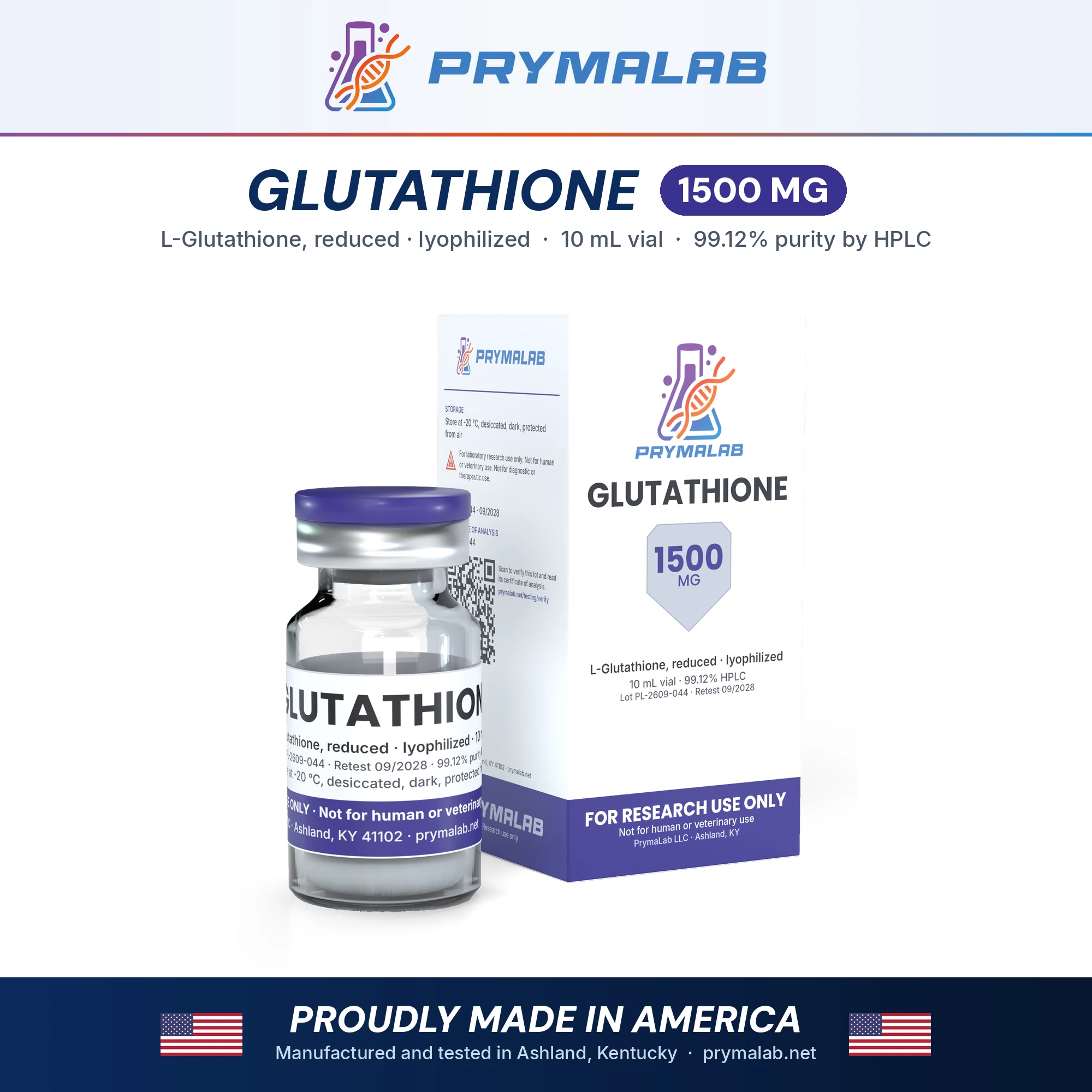
Glutathione 1500mg
Reduced glutathione (GSH), the γ-Glu-Cys-Gly tripeptide, 1500 mg in a sealed vial
Glutathione is a tripeptide of glutamate, cysteine and glycine in which the glutamate is joined through its side-chain carboxyl, and it is found in every mammalian tissue. This listing is a sealed vial holding 1500 mg of the reduced form, GSH, as a dry white solid. Research on glutathione covers how cells build and break it down, its place as the main non-protein thiol in redox balance, and a smaller set of human studies comparing ways of delivering it.
Specifications
| Property | Value |
|---|---|
| Compound | Glutathione (reduced) GSH; γ-L-glutamyl-L-cysteinyl-glycine |
| CAS number | 70-18-8 |
| Molecular formula | C10H17N3O6S |
| Theoretical mass | 307.3 Da |
| Sequence / structure | H-γGlu-Cys-Gly-OH (γ-glutamyl linkage; free thiol; free N- and C-termini) |
| Label claim | 1500 mg/vial |
| Form | Crystalline or amorphous powder in a sealed glass vial |
| Storage, sealed | −20 °C, desiccated, dark, protected from air |
| Purity specification | 99.0% or higher by RP-HPLC |
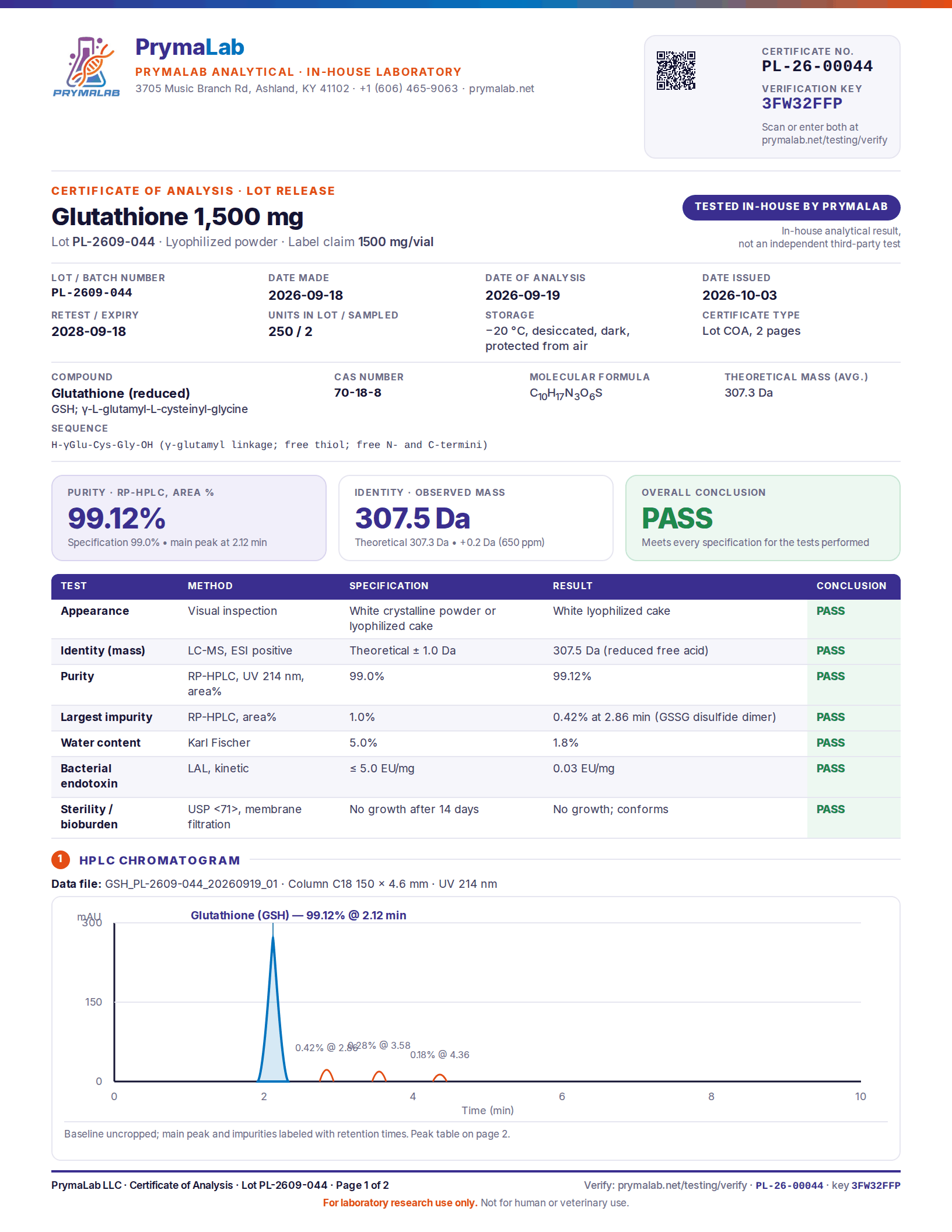
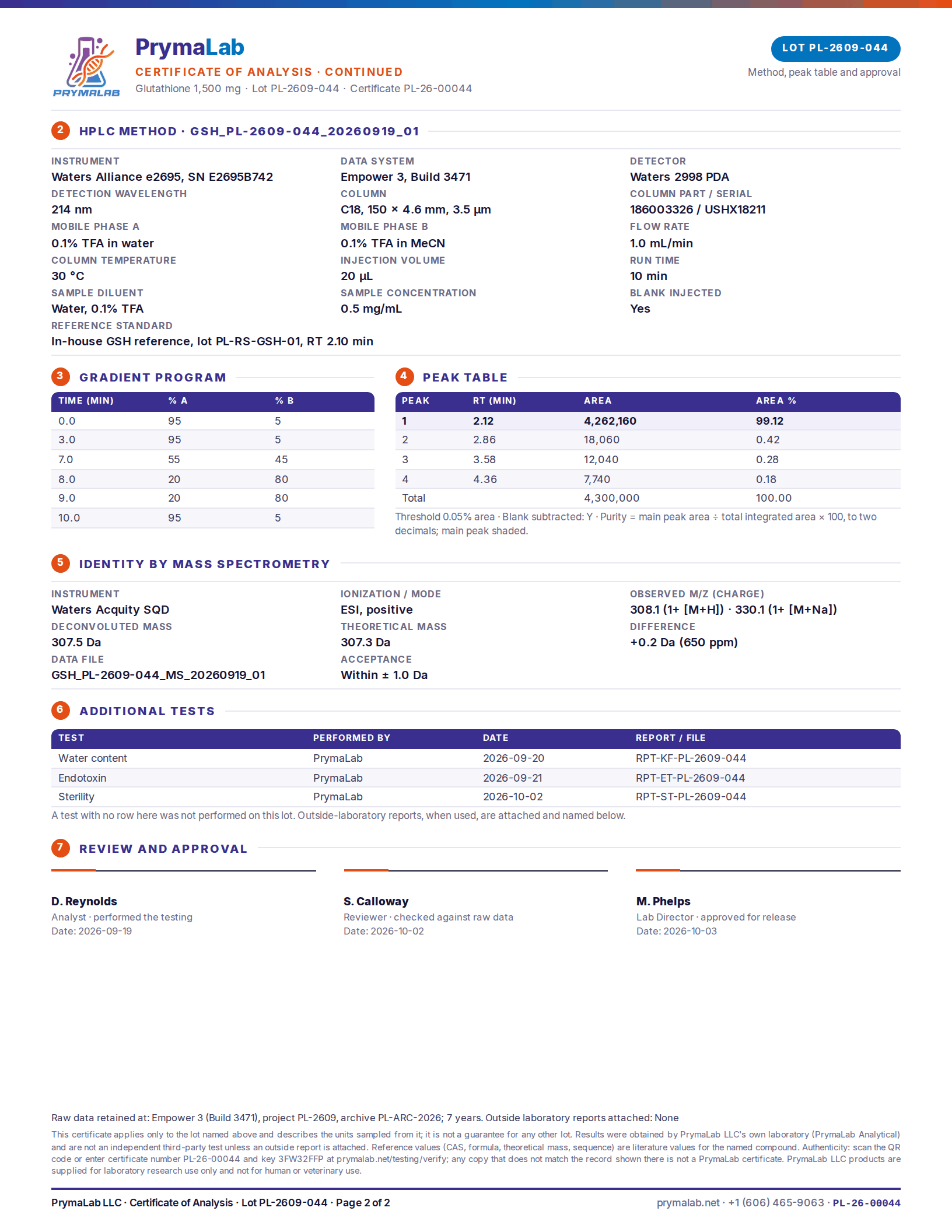
| Lot certificate | Results for the lot now shipping are in the certificate panel on this page |
| Safety data sheet | PL-SDS-072 |
Handling notes
The cysteine in glutathione carries a free thiol. That group is what makes GSH a reducing agent, and it is also the part that oxidises: two molecules joined by a disulfide bond form glutathione disulfide, GSSG, a dimer of about 612.6 Da. A sample that has been exposed to air, moisture or long periods in solution can therefore hold a mixture of the two forms. The storage line on the lot certificate follows from this: −20 °C, desiccated, dark and protected from air. Keep the vial closed except while weighing, and return it to the freezer promptly.
The certificate reports the LC-MS identity result for the reduced free acid, to compare with the theoretical mass of 307.3 Da. At that mass, 1500 mg is about 4.9 mmol of glutathione, slightly less once the residual water on the certificate is allowed for. General guidance on keeping peptides cold, dry and dark is in the peptide storage and stability article.
What the research covers
What glutathione does in cells
Glutathione is present in all mammalian tissues and is the most abundant thiol that is not part of a protein1. In a 2013 review, Lu described it as a defence against oxidative stress and a determinant of redox signalling, needed for the detoxification of foreign compounds and involved in regulating cell proliferation, apoptosis, immune function and fibrogenesis1. Cells make it in the cytosol in two enzymatic steps. The first and rate-limiting step is catalysed by glutamate cysteine ligase, an enzyme with a catalytic and a modifier subunit, and glutathione synthetase completes the molecule1. How fast synthesis runs depends mainly on the supply of cysteine, the sulfur amino acid precursor, and on the ligase’s activity1. Both enzymes are regulated at several levels, often together, and the transcription factors involved include Nrf2 acting through the antioxidant response element, AP-1 and NF-κB1. Lu linked faulty glutathione synthesis to diabetes, to pulmonary and liver fibrosis and to alcoholic liver disease, among other conditions1.
Breakdown and transport
Glutathione was discovered in 1888, and since 1970 its metabolism has mostly been drawn as the γ-glutamyl cycle2. Bachhawat and Yadav argued in 2018 that newer work on how glutathione is transported and degraded shows many parts of that cycle to be wrong, and they proposed a revised glutathione cycle in its place2. The gamma linkage is central to that story. Because glutamate is attached to cysteine through its side-chain carboxyl, ordinary peptidases do not cleave the bond, and breakdown depends on enzymes that recognise it: γ-glutamyl transpeptidase outside the cell and the ChaC enzymes inside it, as the glutathione guide explains.
Routes of delivery
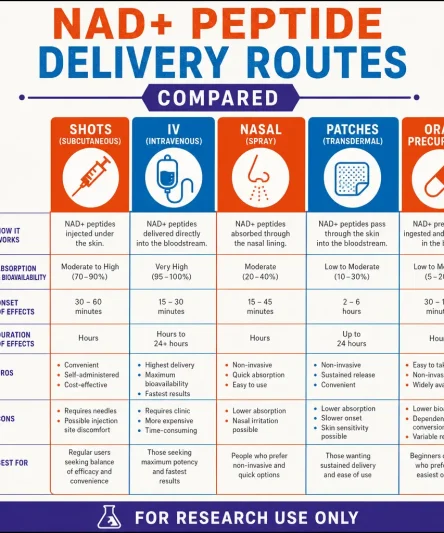
The references on this page contain no human study of glutathione given by any route. The glutathione routes guide covers that literature: two intravenous pharmacokinetic studies found a plasma half-life of about fourteen minutes, oral glutathione raised blood levels measurably only after months, and the intranasal work comes almost entirely from one research group. For the nasal route in general, Illum’s 2002 review discussed evidence that some drugs pass from the nose to the brain along the olfactory pathway, with proof-of-concept examples in humans3. That review did not study glutathione. PrymaLab also sells glutathione as a glutathione 250 mg nasal spray.
What is not established
Cells already hold glutathione at millimolar concentrations, so adding more to a culture or tissue changes a pool that is large to begin with, and the guide notes that plasma levels are far lower, in the micromolar range. The cited reviews describe synthesis and turnover. None of them measured what becomes of glutathione supplied from outside, and none used PrymaLab material.
How each lot is tested
Every lot is tested in PrymaLab’s own laboratory in Ashland, Kentucky before release: RP-HPLC for purity, LC-MS for identity, Karl Fischer titration for water, LAL for endotoxin and USP <71> for sterility. The results for the lot now shipping are in the certificate panel on this page, and the certificate number, key and QR code can be checked on the verify page. These are in-house results from PrymaLab Analytical, not an independent test, and the lab is not accredited to ISO 17025. The third-party testing guarantee on this page still applies: if any independent laboratory finds the wrong compound, or less than the stated purity or amount, the order is refunded and the cost of the test is reimbursed.
Frequently asked questions
Is glutathione a peptide?
Yes, a tripeptide of glutamate, cysteine and glycine with a theoretical mass of 307.3 Da. It is unusual because the glutamate is joined to cysteine through its side-chain (gamma) carboxyl rather than the usual alpha carboxyl, so ordinary peptidases do not cut that bond.
Is this reduced or oxidised glutathione?
Reduced glutathione, GSH, with a free thiol on the cysteine, as the lot certificate states. The oxidised form, GSSG, is two molecules joined by a disulfide bond. Keeping the vial cold, dry, dark and closed slows the conversion of one into the other.
How should the vial be stored?
Sealed at −20 °C, desiccated, dark and protected from air, per the lot certificate. Keep the vial closed between weighings and put it back in the freezer promptly, because the free thiol oxidises on contact with air.
How do I confirm the certificate matches my vial?
Find the lot number printed on the vial and compare it with the certificate panel on this page, which shows the lot now shipping. Older lots are listed on the testing results page, and the verify page confirms any certificate from its number and key.
What do the cited studies show, and what do they leave open?
The reviews describe how cells make glutathione, what controls its synthesis and how the textbook account of its breakdown has been revised. They include no human trials. Human data on routes of delivery, including a short plasma half-life after intravenous infusion, are summarised in the glutathione guide.
Is this glutathione meant for human use?
No. It is sold for laboratory research only. It is not a drug, a dietary supplement or a cosmetic, is not approved by the FDA for use in people or animals, and must not be given to either.
References
- Lu SC. Glutathione synthesis. Biochim Biophys Acta. 2013;1830(5):3143-53. DOI · PubMed
- Bachhawat AK, Yadav S. The glutathione cycle: Glutathione metabolism beyond the γ-glutamyl cycle. IUBMB Life. 2018;70(7):585-592. DOI · PubMed
- Illum L. Nasal drug delivery: new developments and strategies. Drug Discov Today. 2002;7(23):1184-9. DOI · PubMed
Research use only
For laboratory research use only. Glutathione 1500mg is not a drug, food, cosmetic or dietary supplement, is not approved by the FDA or any comparable authority for human or veterinary use, and must not be given to people or animals. It is sold to qualified researchers and institutions, and the buyer is responsible for lawful handling and disposal.







Reviews
There are no reviews yet.