
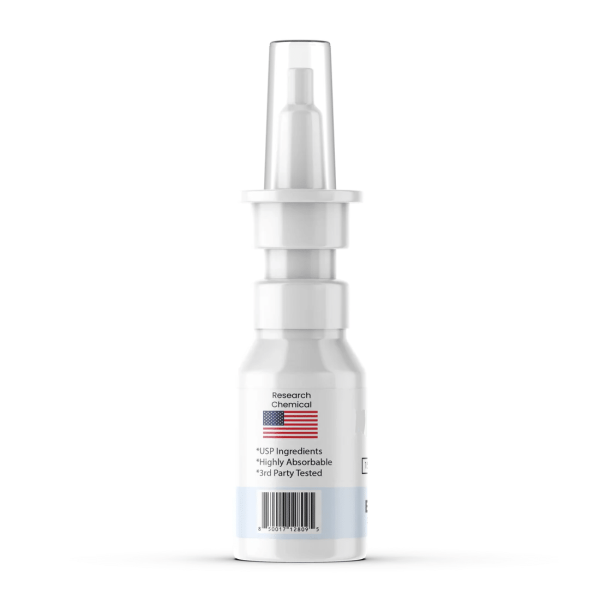
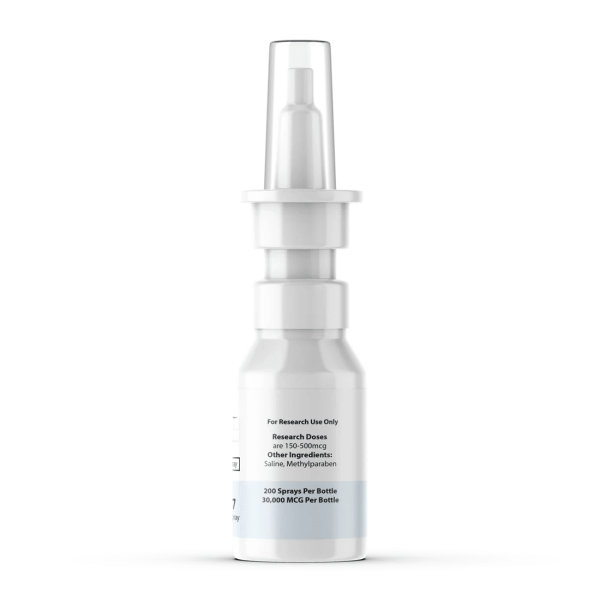
Description
PrymaLab · Research Use Only
Selank Nasal Spray
Thr-Lys-Pro-Arg-Pro-Gly-Pro · CAS 129954-34-3 · 751.88 Da
Selank nasal spray supplies the heptapeptide Thr-Lys-Pro-Arg-Pro-Gly-Pro, CAS 129954-34-3, molecular weight 751.88, in a metered spray. The sequence joins tuftsin, a tetrapeptide released from immunoglobulin G, to a Pro-Gly-Pro extension.
Specification Table
| Property | Value |
|---|---|
| Compound | Selank |
| CAS number | 129954-34-3 |
| Molecular formula | C33H57N11O9 |
| Molecular weight | 751.88 g/mol |
| Residue count | 7 |
| Single-letter sequence | TKPRPGP |
| Three-letter sequence | Thr-Lys-Pro-Arg-Pro-Gly-Pro |
| Parent tetrapeptide | Tuftsin, Thr-Lys-Pro-Arg |
| Origin of tuftsin | Residues 289 to 292 of the immunoglobulin G heavy chain |
| Extension | Pro-Gly-Pro at the carboxy terminus |
| Proline content | Three of seven residues |
| Net charge at neutral pH | Positive, from lysine and arginine |
| Proposed tuftsin receptor | Neuropilin-1. Characterisation incomplete |
| Originating programme | Institute of Molecular Genetics, Russian Academy of Sciences |
| Oxidation-prone residues | None |
| Format | Metered nasal spray, solution state |
| Appearance | Clear colourless solution |
| Purity | Per lot-specific certificate of analysis |
| Storage | 2-8°C, protected from light. Do not freeze |
| Regulatory status | No approved human or veterinary formulation in the United States |
What Selank Nasal Spray Dosage Appears in Published Work?
The figures below are amounts used in published studies, in the species each study used. They are reported here because the question is asked constantly and a page that dodges it is less useful than one that answers it precisely.
Rodent studies from the originating programme have used intranasal amounts spanning roughly 0.05 to 3 mg/kg, with behavioural work clustering near the lower end of that band. Kozlovskaya and colleagues reported effects in that range.
Russian clinical literature describes intranasal amounts in the low milligram range per exposure, typically split across the two nostrils. That literature is largely absent from PubMed and has not been replicated in Western trials, which is the single most important caveat attached to any figure from it.
Species conversion is not arithmetic on body weight. Allometric scaling using body surface area is the accepted method and the FDA publishes the conversion factors. An unscaled rodent figure does not transfer.
The spray format introduces a second layer. What a study delivered was an amount deposited on nasal mucosa. What a pump delivers is a metered volume, of which a variable fraction stays on the mucosa and the rest drains. The two numbers are not interchangeable.
What Do Selank Nasal Spray Benefits Studies Actually Measure?
This is the second most searched phrasing, and the honest answer is that the measured endpoints are narrower than the search term implies.
Published rodent work reports changes in plus-maze and open-field paradigms, which are standard anxiety-related paradigms in rodents. Those are behavioural measurements in animals, not statements about people.
Biochemical endpoints reported include changes in brain-derived neurotrophic factor expression and in monoamine turnover. Semenova and colleagues examined serotonin metabolism in rodent brain tissue.
Some published work reports effects on interleukin-6 expression, which is consistent with the tuftsin lineage given that tuftsin was characterised through interactions with immune cells.
What is absent is a well-powered independent Western clinical trial. The compound has been studied for decades within one national research tradition, and the confidence that supports is different from the confidence that convergent international work would support.
Where Does the Tuftsin Core Come From?
The first four residues are not arbitrary and their origin is unusual enough to be worth stating.
Tuftsin is Thr-Lys-Pro-Arg, corresponding to residues 289 to 292 of the immunoglobulin G heavy chain, and it is liberated from the Fc region by enzymatic cleavage rather than translated from a dedicated precursor gene.
The name comes from Tufts University, where the tetrapeptide was characterised in the 1970s. The early literature concerns phagocyte interactions, which is a considerable distance from how the compound is discussed now.
A receptor has been proposed in neuropilin-1, though the characterisation falls short of what has been established for well-defined peptide receptors, and that gap is inherited by Selank.
One practical implication follows from the immunoglobulin origin. Any system containing IgG and the relevant protease activity may generate background tuftsin, including serum-supplemented culture medium. Serum-free conditions remove that variable.
How Does Selank Spray Compare With Injection?
Route is a real experimental variable here rather than a matter of convenience, and the trade runs in both directions.
Injection places a known quantity into circulation, and bioavailability is effectively total for a subcutaneous or intravenous exposure, and the delivered amount matches the drawn amount within pipetting error.
Intranasal delivery gives lower and far more variable bioavailability. Published figures for peptides in this size range run from under one percent to the low tens of percent, and between-subject variance is wide enough to swamp modest effects.
Against that, the nasal route offers a partial path to the central nervous system that bypasses the blood-brain barrier, by transport along olfactory and trigeminal nerve routes from the roof of the nasal cavity. The fraction taking that path is small, and smaller in humans than in rodents because the olfactory region occupies proportionally less nasal surface area.
For receptor-level or concentration-response questions, the vial with a measured injection is the defensible choice. Where the intranasal route is itself the subject, the spray is the object of study rather than a delivery convenience.
What Should Selank Nasal Spray Reviews and Certificates Cover?
For a seven-residue peptide there is no analytical excuse for a thin certificate, and knowing which fields matter makes the document useful.
Mass confirmation against 751.88 by high-resolution mass spectrometry, since at this length deletion sequences resolve cleanly and a shortfall is unambiguous.
Purity by reversed-phase chromatography with a gradient that separates the closely related synthesis by-products rather than letting them shoulder the main peak.
Solution concentration determined analytically at fill, not calculated from the mass weighed into a batch. For a spray this is the field most often reported as nominal.
Counterion identity, reported alongside net peptide content. At 751.88 daltons a trifluoroacetate counterion is a meaningful share of weighed mass, and this peptide is basic enough to carry more than one.
Fill date, because degradation in a solution product runs from the moment the solution exists rather than from delivery.
What Would a Well-Controlled Selank Study Include?
Given the state of the mechanism, the controls carry more weight than the endpoint choice.
A scrambled-sequence arm comes first. Without a characterised receptor there is no binding assay to demonstrate specificity, so a peptide of identical composition in randomised order becomes the primary specificity control available. It is cheap and it is skipped constantly.
A tuftsin-only arm answers a different question: whether the Pro-Gly-Pro extension contributes anything beyond protease resistance. Running the bare tetrapeptide alongside separates the two, and nobody appears to have published that comparison systematically.
A vehicle arm matched for the full formulation, not just saline. A nasal spray carries preservative, buffer and often a viscosity agent, and benzalkonium chloride affects ciliary function on its own.
Route should be stated rather than implied. Where a design compares against published intraperitoneal work, that difference belongs in the limitations rather than in a footnote.
Concentration-response across a wide band is necessary rather than thorough here, because no receptor affinity is known and therefore no single concentration can be justified from first principles.
Why Is This Peptide Easy to Store?
Selank sits at the forgiving end of the catalogue, and the reasons are structural rather than formulation tricks.
No cysteine, so there are no disulfide bonds to scramble or reduce, and no methionine or tryptophan either, which removes the two fastest oxidation routes. No asparagine-glycine motif, so the quickest deamidation path is absent.
Three prolines out of seven mean the backbone cannot form a conventional alpha helix or beta sheet. What it can adopt is polyproline II, an extended left-handed conformation. There is no folded structure to lose, so there is no denaturation to worry about.
The practical consequence is that ordinary refrigerated storage keeps this material intact for a long time, and the usual precautions apply more as good practice than as necessity.
Freezing is still contraindicated for the spray, on mechanical grounds. A pump assembly is not built for the volume change and the seal can fail, which is a container problem rather than a peptide problem.
The one thing worth logging is the date of first actuation, written on the bottle. Elapsed in-use time is not on any label and it is what determines microbial and oxidative exposure once a pump starts drawing air.
One last note on sourcing. Because this compound comes from a single national research programme, much of the supporting literature sits in Russian-language journals and their English translations, and translation quality varies.
Reading a translated methods section against its abstract catches discrepancies that would otherwise propagate into a citation, and it also explains why the indexed citation count for Selank understates the volume of work behind it.
Where a translated figure disagrees with the original table, take the table as authoritative and the prose as secondary. That one habit heads off most of the citation errors circulating about compounds from this programme, and it costs nothing but a moment.
None of that is unique to Selank. It applies across every compound in the Khavinson and Ashmarin lineages, which between them account for a sizeable share of this catalogue.
Published Literature
References verified against the publisher record or a primary index. Much of this literature originates from the Russian programme that developed the compound, which bears on how it should be weighted.
- Najjar VA, Nishioka K. Nature. 1970;228(5272):672-673.
- Kozlovskaya MM, Kozlovskii II, Val’dman EA, Seredenin SB. Neuroscience and Behavioral Physiology. 2003;33(9):853-860.
- Semenova TP, Kozlovskaya MM, Zuikov AV, Kozlovskii II. Neuroscience and Behavioral Physiology. 2010;40(6):613-619.
- Siebert A, Gensicka-Kowalewska M, Cholewinski G, Dzierzbicka K. Expert Opinion on Therapeutic Patents. 2017;27(1):59-73.
- Illum L. Journal of Pharmacy and Pharmacology. 2004;56(1):3-17.
- Lochhead JJ, Thorne RG. Advanced Drug Delivery Reviews. 2012;64(7):614-628.
Frequently Asked Questions
What is Selank nasal spray?
A metered spray supplying the heptapeptide Thr-Lys-Pro-Arg-Pro-Gly-Pro, CAS 129954-34-3, molecular weight 751.88. The sequence joins tuftsin to a Pro-Gly-Pro extension. Supplied for laboratory research only. No approved formulation exists in the United States.
What Selank nasal spray dosage appears in the literature?
Rodent studies have used intranasal amounts of roughly 0.05 to 3 mg/kg, with behavioural work near the lower end. The Russian clinical record describes amounts in the low milligram band per exposure, and these are figures from published studies, not recommendations for anyone.
Why does the Russian literature carry a caveat?
Because it is largely absent from PubMed and has not been replicated in Western trials. Decades of work inside one national research tradition supports a different level of confidence than convergent international work would.
What do the benefits studies actually measure?
Plus-maze and open-field paradigms in rodents, which are anxiety-related measures in animals. Also brain-derived neurotrophic factor expression, monoamine turnover, and in some work interleukin-6 expression. All are measured endpoints in models.
Where does tuftsin come from?
Residues 289 to 292 of the immunoglobulin G heavy chain, liberated from the Fc region by enzymatic cleavage rather than translated from a dedicated gene. It was characterised at Tufts University in the 1970s, which is where the name comes from.
Does the immunoglobulin origin matter experimentally?
It can. Any system containing IgG and the relevant protease activity may generate background tuftsin, including serum-supplemented culture medium. Serum-free conditions remove that variable rather than leaving it unmeasured.
How does the spray compare with injection?
Injection delivers a known quantity with effectively total bioavailability. The nasal route gives lower and far more variable delivery, with published figures for peptides this size running from under one percent to the low tens of percent.
Does the nasal route reach the brain directly?
In part, though less than the usual framing suggests. Transport along olfactory and trigeminal nerve routes from the roof of the nasal cavity bypasses the blood-brain barrier, but that region is proportionally smaller in humans than in rodents, so the directly transported fraction is small.
Why is Selank chemically forgiving?
No cysteine, so no disulfide chemistry, and no methionine or tryptophan, so the fastest oxidation routes are unavailable. No asparagine-glycine motif, so the quickest deamidation path is absent. And no folded structure to denature.
Can the spray be frozen?
No, though the reason is the container rather than the peptide. A pump assembly is not built for the volume change that freezing produces and the seal can fail. The peptide itself would tolerate freezing perfectly well in an ordinary tube.
What single record matters most?
The date of first actuation, written on the bottle. Elapsed in-use time appears on no label, and it is what determines microbial and oxidative exposure once the pump starts drawing air with every use.
Compliance Statement
Selank nasal spray is sold exclusively for laboratory research use. It is not a drug, food, or cosmetic product, and it is not a dietary product of any kind. It is not approved by the FDA or any comparable authority for human or veterinary use, no approved formulation exists in the United States, and amounts cited on this page are figures from published studies in the species those studies used. This product is not intended to diagnose, treat, cure, or prevent any disease. It must not be given to humans or animals. Purchase is restricted to qualified researchers and institutions operating within applicable laws. All handling is the responsibility of the purchasing laboratory.
Other formats of Selank
Selank is also stocked as Selank 1mg/ml preloaded 3ml pen, Selank 5mg and Selank 11mg. Each listing states its own quantity and concentration, and the pen and vial comparison explains what changes between formats.











21 reviews for Selank 10mg Nasal Spray