Description
PrymaLab · Research use only
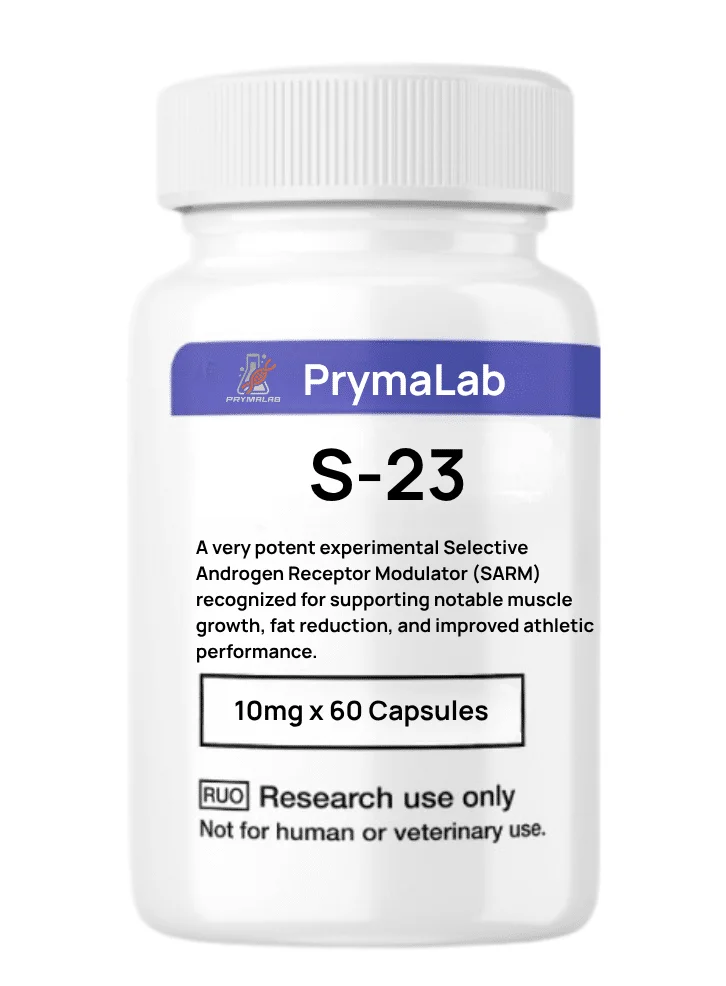
S-23 10mg Capsules
Aryl-propionamide SARM studied as a male contraceptive in rats, 10 mg per capsule
S-23 is a nonsteroidal selective androgen receptor modulator (SARM) from the aryl-propionamide family, and a small molecule rather than a peptide. This listing is a bottle of hard gelatin capsules, each holding 10 mg of S-23 blended with microcrystalline cellulose. Nearly everything published on S-23 itself comes from one 2009 study in male rats, which tested it as part of a hormonal male contraceptive, so the research centres on the reproductive axis more than on any other tissue.
Specifications
| Property | Value |
|---|---|
| Compound | S-23, selective androgen receptor modulator |
| CAS number | 1010396-29-8 |
| Molecular formula | C18H13ClF4N2O3 |
| Contents | S-23: 10 mg per capsule |
| Form | Hard gelatin capsules containing the active substance blended with microcrystalline cellulose, packed in a sealed bottle |
| Storage, sealed | Store at room temperature (15–25 °C) in the tightly closed original container, dry and protected from light |
| Safety data sheet | PL-SDS-142 |
What is in each capsule
Each capsule holds 10 mg of S-23, about 2.5% of the capsule contents by weight, in a microcrystalline cellulose fill and a gelatin shell. The safety data sheet classifies S-23 as harmful if swallowed (H302), suspected of damaging fertility or the unborn child (H361) and liable to cause long-lasting harmful effects to aquatic life (H413). The last of these means unused capsules belong in chemical waste, handled as the sheet’s disposal section describes. Store the bottle locked up, tightly closed at 15 to 25 °C, dry and protected from light.
What the research covers
The 2009 contraception study
Jones and colleagues characterised S-23 in male rats as a candidate for hormonal male contraception1. In vitro it bound the androgen receptor with an inhibitory constant of 1.7 nM and behaved as a full agonist1. In intact rats it suppressed luteinising hormone by more than half, with a smaller prostate and a larger levator ani muscle, the rodent muscle these studies use as a gauge of anabolic activity1. Paired with estradiol benzoate, which the rats needed to keep normal sexual behaviour, it suppressed LH and FSH and with them spermatogenesis1. In the main combination group, four of six animals had no sperm in the testis and none of six matings produced a pregnancy1. Fertility recovered fully once treatment stopped, with every mating producing a pregnancy after 100 days1. The same animals also showed higher bone mineral density and lean mass and lower fat mass1.
S-23 in the wider SARM literature
A 2007 review listed male contraception alongside osteoporosis, muscle wasting and diseases of the prostate as uses that SARMs might eventually serve2. That expectation has not turned into approved products: Christiansen and colleagues wrote in 2020 that no SARM had been approved by the FDA for any indication3.
What is not established
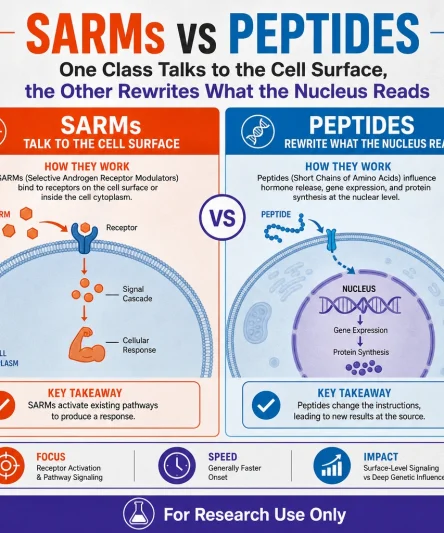
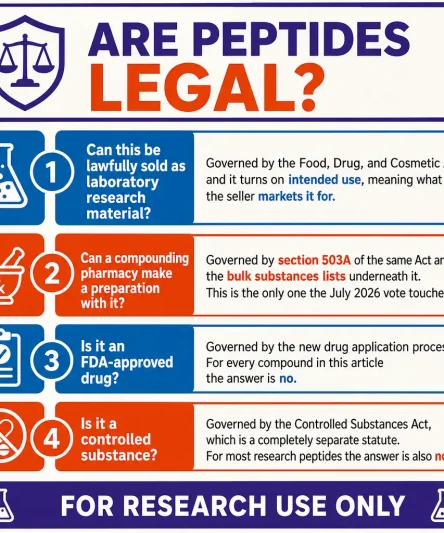
The contraception results come from one study in small groups of rats. Suppression of LH and FSH was the effect the study was designed to produce, and it shows how directly S-23 acts on the pituitary and testis axis. No human study of S-23 appears in the references here, and none of the work used capsules. The guide to SARMs versus peptides describes this kind of hormonal suppression as part of how SARMs work, and the are peptides legal guide explains what “research use only” means under US law.
How each lot is tested
Every lot is tested in PrymaLab’s own laboratory in Ashland, Kentucky before release. Published certificates are listed on the results page and can be checked by number and key on the verify page. These are in-house results from PrymaLab Analytical, not an independent test, and the lab is not accredited to ISO 17025. The third-party testing guarantee on this page still applies: if any independent laboratory finds the wrong compound, or less than the stated purity or amount, the order is refunded and the cost of the test is reimbursed.
Frequently asked questions
Why was S-23 studied as a contraceptive?
Because in rats it suppressed LH and FSH, the pituitary hormones that drive sperm production, while acting as an androgen elsewhere. Combined with an estrogen it stopped sperm production in most treated animals, and fertility returned after treatment ended. All of that work was done in rats.
Is S-23 a peptide or a steroid?
Neither. It is a nonsteroidal small molecule, a propanamide that links a cyano- and trifluoromethyl-substituted phenyl ring to a chloro-fluorophenoxy group. It binds the androgen receptor but shares no structure with testosterone, and it contains no amino acids.
What does the safety data sheet say about S-23?
It lists three hazards: harmful if swallowed, suspected of harming fertility or the unborn child, and long-lasting harm to aquatic life. It asks for the bottle to be stored locked up, and unused material should go to chemical waste, not down a drain.
Can S-23 be used in people?
No. The only study of S-23 itself used rats, and the 2020 review cited here found no SARM approved by the FDA for any use. These capsules are a laboratory reagent and must not be given to people or animals.
References
- Jones A, Chen J, Hwang DJ, et al. Preclinical characterization of a (S)-N-(4-cyano-3-trifluoromethyl-phenyl)-3-(3-fluoro, 4-chlorophenoxy)-2-hydroxy-2-methyl-propanamide: a selective androgen receptor modulator for hormonal male contraception. Endocrinology. 2009;150(1):385-95. DOI · PubMed
- Gao W, Dalton JT. Expanding the therapeutic use of androgens via selective androgen receptor modulators (SARMs). Drug Discov Today. 2007;12(5-6):241-8. DOI · PubMed
- Christiansen AR, Lipshultz LI, Hotaling JM, et al. Selective androgen receptor modulators: the future of androgen therapy?. Transl Androl Urol. 2020;9(Suppl 2):S135-S148. DOI · PubMed
Research use only
For laboratory research use only. S-23 10mg Capsules is not a drug, food, cosmetic or dietary supplement, is not approved by the FDA or any comparable authority for human or veterinary use, and must not be given to people or animals. It is sold to qualified researchers and institutions, and the buyer is responsible for lawful handling and disposal.








Reviews
There are no reviews yet.