Description
PrymaLab · Research use only
Cerebrolysin 60mg
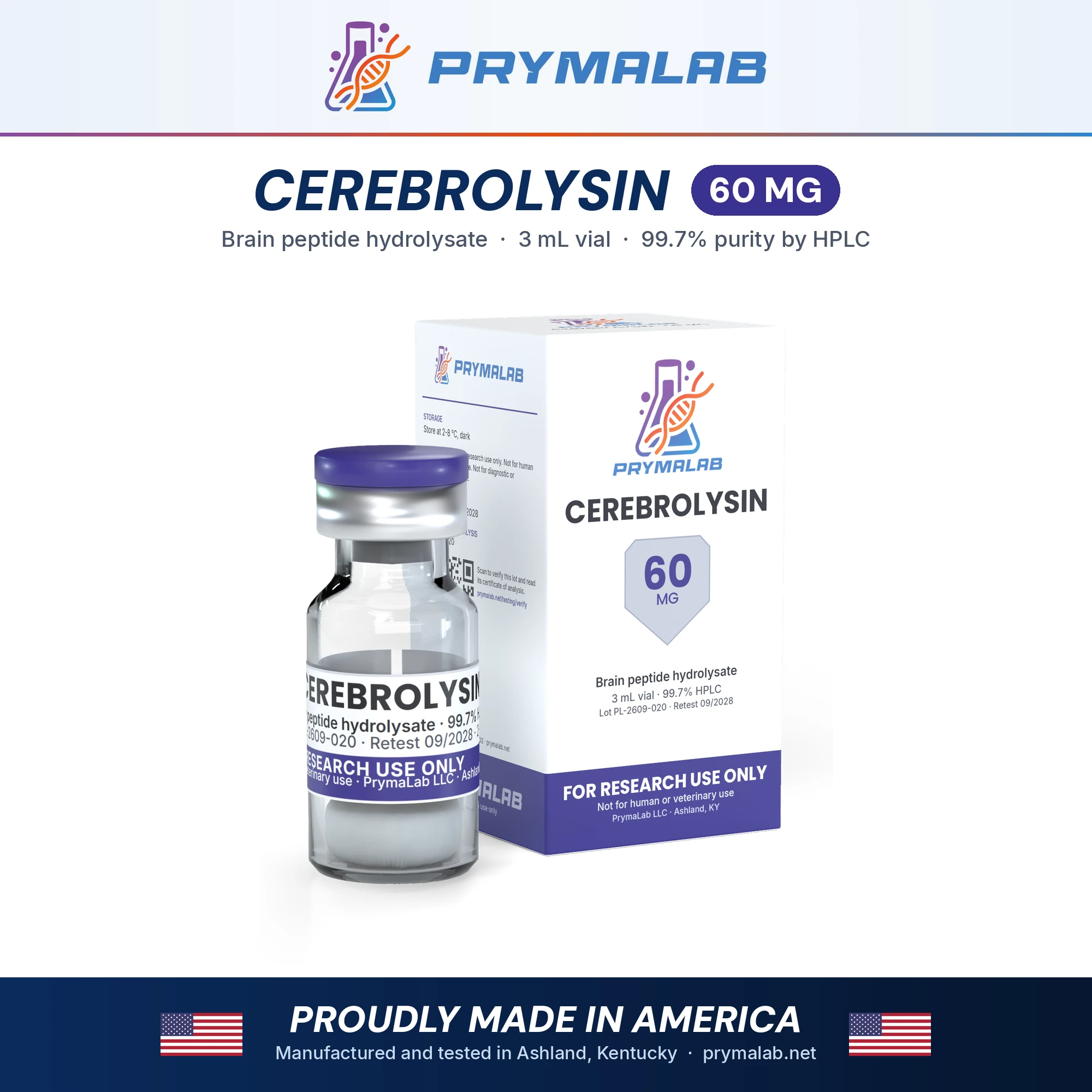
Freeze-dried porcine brain peptide hydrolysate, a mixture with no single sequence, 60 mg
Cerebrolysin is not a single compound. It is a peptide preparation made by enzymatic digestion of purified porcine brain proteins, leaving short peptides, mostly under 10 kDa, together with free amino acids. This listing is a 60 mg vial of the freeze-dried hydrolysate, identified by LC-MS peptide mapping. The research literature on Cerebrolysin, nearly all of it on the licensed medicinal solution, covers neurotrophic-like effects in cell and animal models and randomised trials after ischaemic stroke.
Specifications
| Property | Value |
|---|---|
| Compound | Cerebrolysin Porcine brain peptide hydrolysate; a peptide preparation, not a single compound |
| CAS number | 12656-61-0 |
| Molecular formula | Not applicable (mixture) |
| Theoretical mass | Peptide fraction below 10 kDa (mostly 1–5 kDa) plus free L-amino acids (about 75% of nitrogen) |
| Sequence / structure | Standardised enzymatic hydrolysate of purified porcine brain proteins: low-molecular-weight peptides plus free L-amino acids. No single sequence; identity is established by LC-MS peptide mapping against the in-house reference. |
| Label claim | 60 mg/vial |
| Form | Lyophilized (freeze-dried) powder or cake in a sealed glass vial with a rubber stopper and aluminium crimp cap |
| Storage, sealed | 2–8 °C, dark |
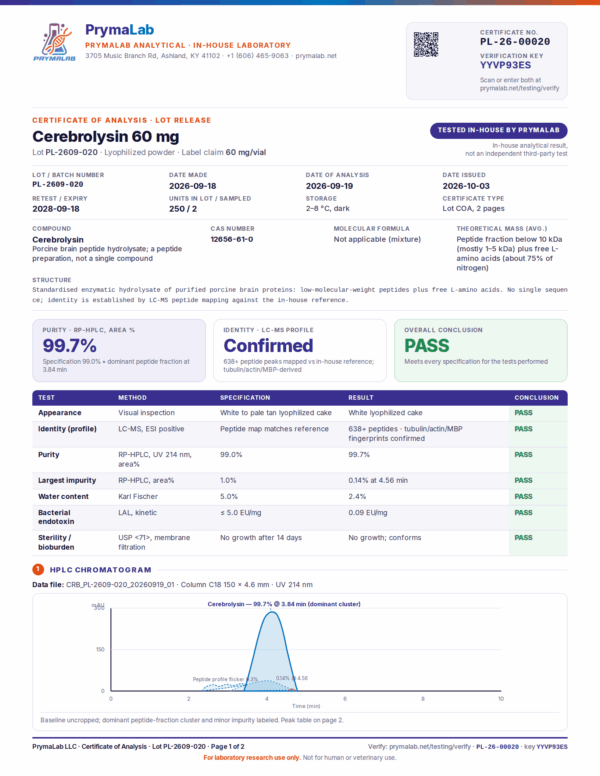
| Lot certificate | Results for the lot now shipping are in the certificate panel on this page |
| Safety data sheet | PL-SDS-034 |
What a certificate can show for a mixture
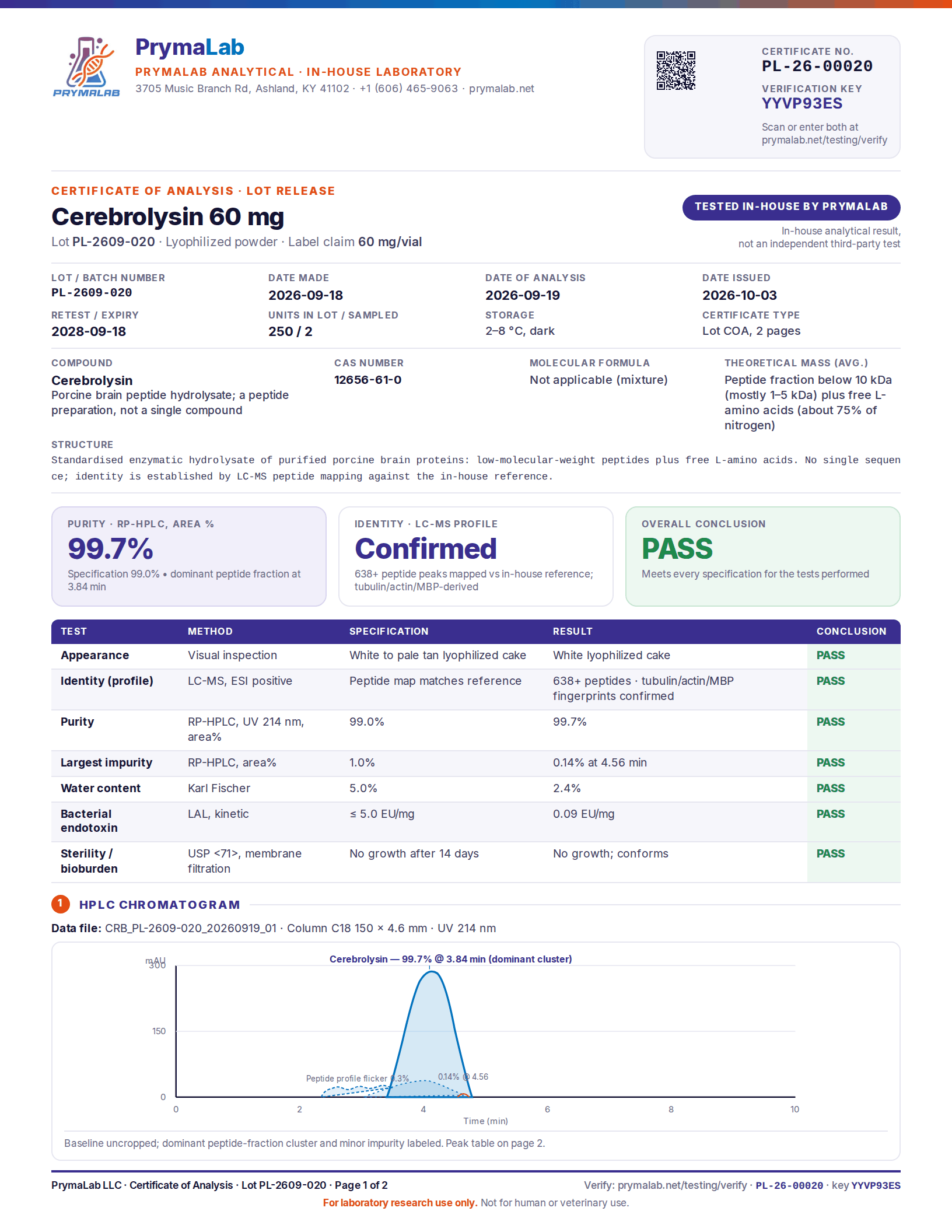
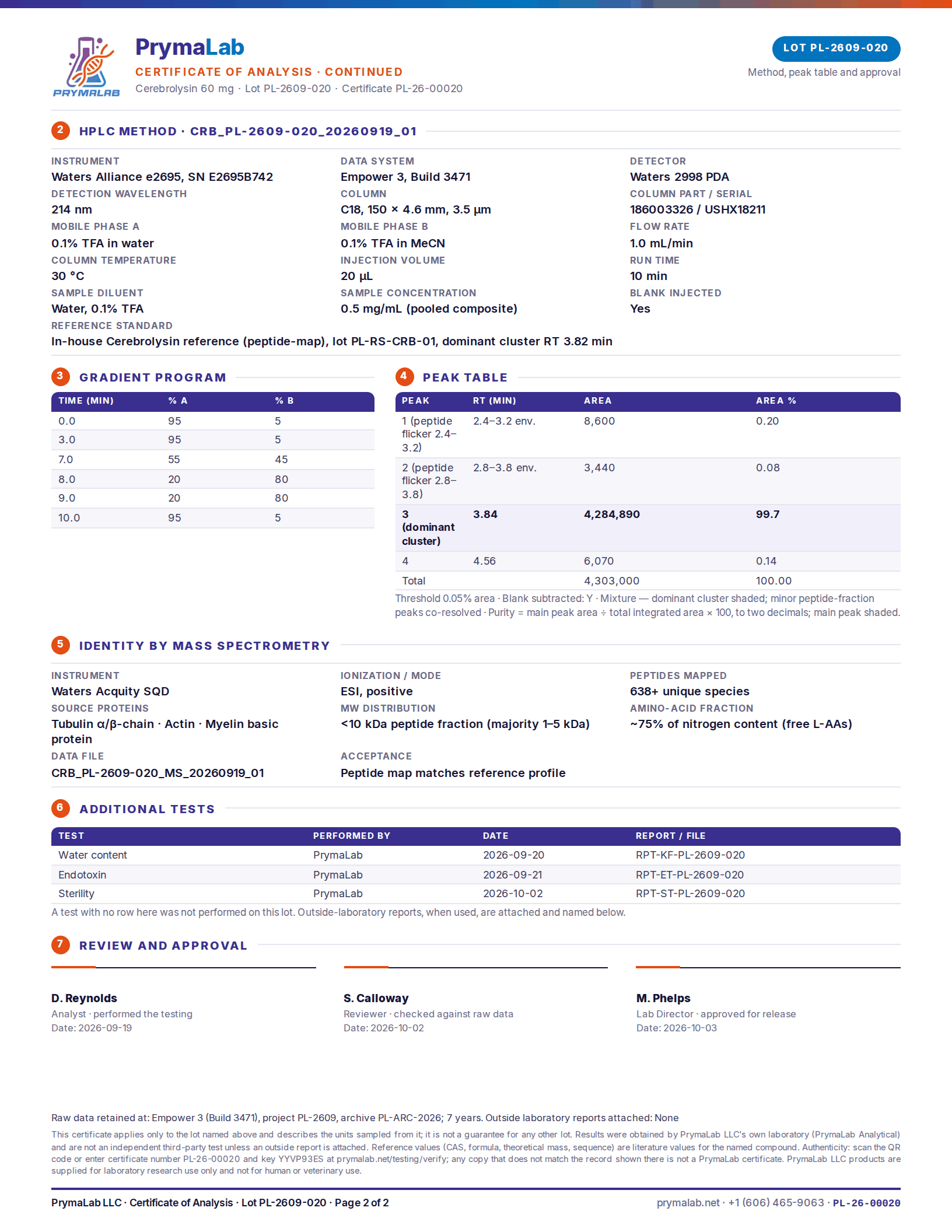
A synthetic peptide is identified by one sequence and one mass. A hydrolysate has neither, so its certificate works differently. For this material, identity is established by LC-MS peptide mapping against PrymaLab’s in-house reference: the certificate records more than 638 peptides and confirms fingerprint peptides from tubulin, actin and myelin basic protein. It also describes the size range, a peptide fraction below 10 kDa and mostly between 1 and 5 kDa, with free L-amino acids accounting for about 75% of the nitrogen.
The certificate also reports an RP-HPLC result. For a mixture of hundreds of peptides that figure describes a chromatographic profile, not the purity of one molecule, so it is best read alongside the peptide map and compared lot to lot. Water content, endotoxin and sterility are reported as for any other lot. The sealed vial is kept at 2 to 8 °C and dark, not frozen like most freeze-dried peptides in the catalogue. How to read certificates in general is covered in peptide purity testing.
Not the licensed medicine
The name Cerebrolysin also belongs to a licensed medicine: a sterile solution made by EVER Neuro Pharma in Austria and described in the trial literature as a neuropeptide preparation for parenteral use, approved for stroke1. It is widely used for acute ischaemic stroke in Russia, Eastern Europe, China and other Asian and post-Soviet countries2, and it is not approved by the FDA. This vial is different material: a freeze-dried hydrolysate characterised against PrymaLab’s own reference, not the medicinal solution in another form.
Because a hydrolysate is defined by its starting tissue and its process, results obtained with one preparation cannot be assumed to hold for another. The trials and most of the animal work below describe the manufacturer’s product; none of them tested this vial.
What the research covers
What the preparation is
The Cochrane review describes Cerebrolysin as a mixture of low-molecular-weight peptides and amino acids derived from porcine brain, with potential neuroprotective properties2. A 2012 review described it as a neuropeptide preparation that mimics the action of endogenous neurotrophic factors on brain protection and repair3. No single component has been identified as responsible.
Cell and animal models
The 2012 review summarised the preclinical record. In dementia models Cerebrolysin decreased β-amyloid deposition and tau phosphorylation by regulating glycogen synthase kinase-3β and cyclin-dependent kinase 5, increased synaptic density and increased neurogenesis in the dentate gyrus3. In stroke models it inhibited calpain, reduced the number of apoptotic cells, infarct volume and oedema, and promoted subventricular zone neurogenesis and functional recovery; in experimental spinal cord injury it prevented apoptosis of lesioned motoneurons3. Zhang, Chopp and colleagues studied rats after embolic middle cerebral artery occlusion and found more BrdU-positive progenitor cells and doublecortin-positive neuroblasts in the subventricular zone at 28 days, with TUNEL-positive cells at the ischaemic boundary cut by about half4. In one arm infarct volume did not fall significantly, yet behavioural outcomes improved, and in cultured progenitors the rise in proliferation disappeared when the PI3K/Akt pathway was blocked4.
Randomised trials of the licensed solution
CARS was a prospective, randomised, double-blind, placebo-controlled multicentre trial in people beginning rehabilitation after stroke, with upper-limb function on the Action Research Arm Test at day 90 as its primary endpoint5. It reported a difference in favour of Cerebrolysin on that endpoint and on a combined measure of 12 outcome scales, and its authors called it exploratory and said the results should be confirmed in a large trial5. A 2018 meta-analysis pooled nine randomised, placebo-controlled trials in acute ischaemic stroke, 1,879 participants in all, and reported an early difference on the NIH Stroke Scale favouring Cerebrolysin1. The 2020 Cochrane review, limited to trials starting within 48 hours of onset, included seven trials and 1,601 participants. It found moderate-quality evidence of little or no effect on all-cause death and a possible increase in non-fatal serious adverse events, and noted that the manufacturer had supported four of the multicentre studies2.
What is not established
The trial evidence points in different directions depending on the outcome and the analysis, and much of it was manufacturer supported2. None of these references reports human pharmacokinetics for any component, and the animal findings describe pathways engaged by the whole mixture, not which peptides are active. All of the work concerns the manufacturer’s preparation. Whether a different porcine brain hydrolysate behaves the same way has not been tested.
The Cerebrolysin Peptide guide covers the literature in more depth.
How each lot is tested
Every lot is tested in PrymaLab’s own laboratory in Ashland, Kentucky before release: RP-HPLC for purity, LC-MS for identity, Karl Fischer titration for water, LAL for endotoxin and USP <71> for sterility. The results for the lot now shipping are in the certificate panel on this page, and the certificate number, key and QR code can be checked on the verify page. These are in-house results from PrymaLab Analytical, not an independent test, and the lab is not accredited to ISO 17025. The third-party testing guarantee on this page still applies: if any independent laboratory finds the wrong compound, or less than the stated purity or amount, the order is refunded and the cost of the test is reimbursed.
Frequently asked questions
Is Cerebrolysin a single peptide?
No. It is a hydrolysate of porcine brain proteins: many short peptides, mostly between 1 and 5 kDa, plus free L-amino acids. There is no single sequence, formula or molecular weight, which is why the certificate identifies it by LC-MS peptide mapping and protein fingerprints.
Is this the product used in the clinical trials?
No. The trials used the licensed medicinal solution. This vial holds freeze-dried research hydrolysate characterised against PrymaLab's in-house reference, so trial findings cannot be assumed to apply to it.
How should the vial be stored?
At 2 to 8 °C and protected from light, unlike the −20 °C used for most freeze-dried peptides in the catalogue. Bring the vial to room temperature before opening, and keep any reconstituted solution at 2 to 8 °C for a period your laboratory has established.
What does the certificate report for a mixture?
Identity by LC-MS peptide mapping against PrymaLab's in-house reference, with the number of peptides detected and fingerprint peptides from tubulin, actin and myelin basic protein, plus water content, endotoxin and sterility. The lot now shipping is shown in the panel on this page.
What does the published research show?
Animal studies report more neurogenesis and less cell death after experimental stroke. Randomised trials of the licensed solution after ischaemic stroke have reached conflicting conclusions, and a Cochrane review noted a possible increase in non-fatal serious adverse events. None of the work used this vial.
Can it be used in people?
No. This vial is sold for laboratory research only, is not approved by the FDA for human or veterinary use, and must not be given to people or animals. Nothing on this page describes a clinical use.
References
- Bornstein NM, Guekht A, Vester J, et al. Safety and efficacy of Cerebrolysin in early post-stroke recovery: a meta-analysis of nine randomized clinical trials. Neurol Sci. 2018;39(4):629-640. DOI · PubMed
- Ziganshina LE, Abakumova T, Hoyle CH. Cerebrolysin for acute ischaemic stroke. Cochrane Database Syst Rev. 2020;7(7):CD007026. DOI · PubMed
- Masliah E, Díez-Tejedor E. The pharmacology of neurotrophic treatment with Cerebrolysin: brain protection and repair to counteract pathologies of acute and chronic neurological disorders. Drugs Today (Barc). 2012;48 Suppl A:3-24. DOI · PubMed
- Zhang C, Chopp M, Cui Y, et al. Cerebrolysin enhances neurogenesis in the ischemic brain and improves functional outcome after stroke. J Neurosci Res. 2010;88(15):3275-81. DOI · PubMed
- Muresanu DF, Heiss WD, Hoemberg V, et al. Cerebrolysin and Recovery After Stroke (CARS): A Randomized, Placebo-Controlled, Double-Blind, Multicenter Trial. Stroke. 2016;47(1):151-9. DOI · PubMed
Research use only
For laboratory research use only. Cerebrolysin 60mg is not a drug, food, cosmetic or dietary supplement, is not approved by the FDA or any comparable authority for human or veterinary use, and must not be given to people or animals. It is sold to qualified researchers and institutions, and the buyer is responsible for lawful handling and disposal.
Other formats of Cerebrolysin
Cerebrolysin is also stocked as Cerebrolysin 120mg Nasal Spray. Each listing states its own quantity and concentration, and the pen and vial comparison explains what changes between formats.






Reviews
There are no reviews yet.