
Description
PrymaLab · Research use only
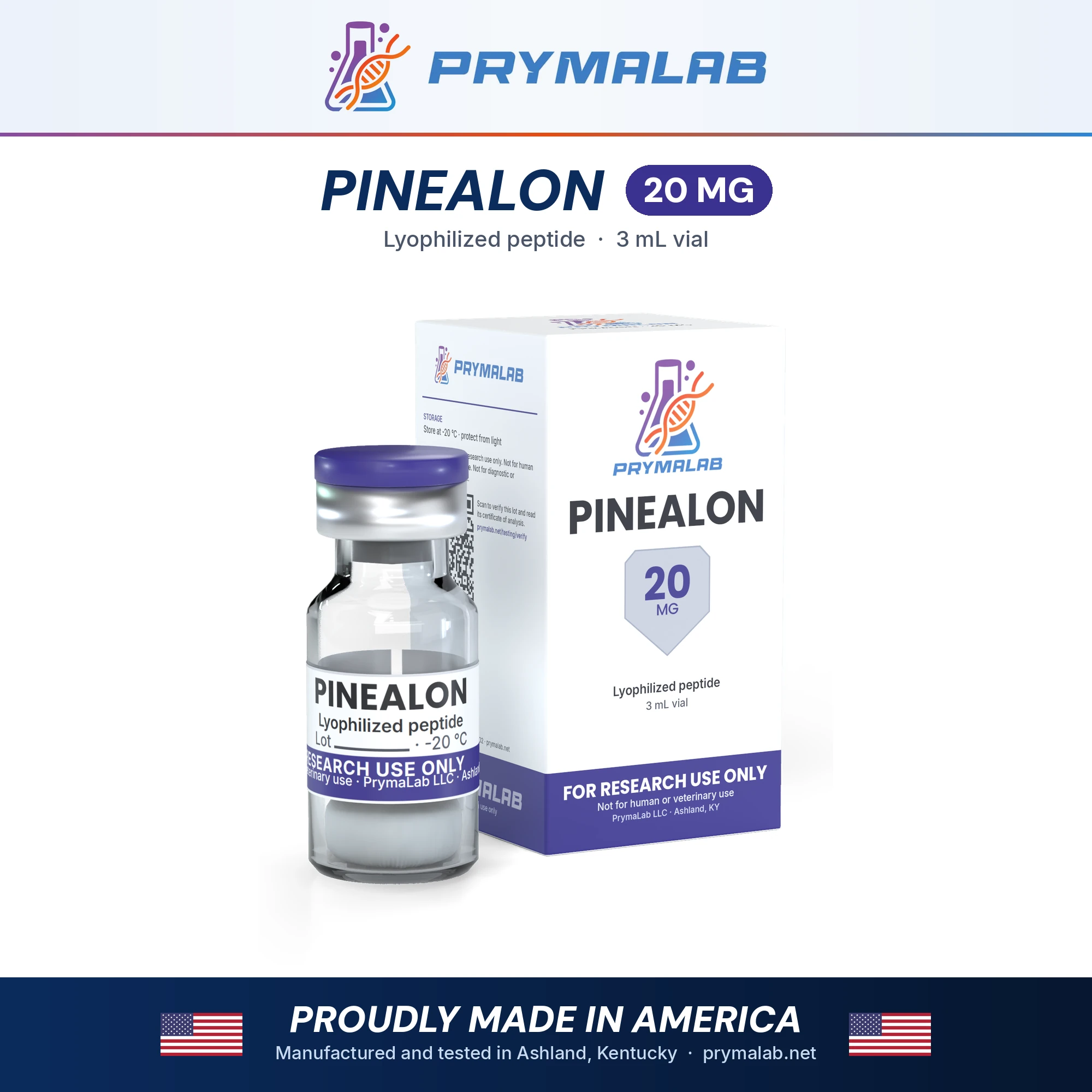
Pinealon 20mg
Glu-Asp-Arg (EDR) tripeptide, 20 mg freeze-dried, the main fill of three
Pinealon is the trade name of EDR, the synthetic tripeptide Glu-Asp-Arg, developed in Vladimir Khavinson’s bioregulator programme in St Petersburg. This listing is the 20 mg vial of freeze-dried powder, the largest of three fills. Despite the pineal name, the research on it concerns brain cells: oxidative stress and survival in neuronal cultures, serotonin in cortex cultures and a proposed interaction with DNA, almost all of it published by the developers’ own group.
Specifications
| Property | Value |
|---|---|
| Compound | Pinealon (Glu-Asp-Arg (EDR)) |
| CAS number | 175175-23-2 |
| Molecular formula | C15H26N6O8 |
| Label claim | 20 mg per vial |
| Form | Lyophilized (freeze-dried) powder or cake in a sealed glass vial with a rubber stopper and aluminium crimp cap |
| Safety data sheet | PL-SDS-128 |
Fills in this range
Pinealon is sold in 3 fills. The compound and the testing are the same in every fill; only the amount in the vial changes.
| Fill | Listing |
|---|---|
| 5 mg | Pinealon 5mg |
| 10 mg | Pinealon 10mg |
| 20 mg | Pinealon 20mg (this page) |
Handling notes
The safety data sheet lists the vial contents as Glu-Asp-Arg, CAS 175175-23-2, formula C15H26N6O8, freeze-dried in a sealed glass vial and not classified as hazardous. It gives −20 °C for the sealed vial, desiccated and protected from light, with 2 to 8 °C acceptable for short periods, and asks that the vial reach room temperature before it is opened so that moisture does not condense on the powder. Solutions belong at 2 to 8 °C, protected from light, for a period your laboratory has established.
Small amounts of peptide can also be lost to the walls of tubes and vials. Goebel-Stengel and colleagues measured the recovery of eight radiolabelled endocrine peptides from glass and plastic tubes and found large differences between surfaces; siliconising the tubes lowered recovery and adding bovine serum albumin raised it1. None of the eight was a tripeptide, so the size of the effect for EDR is unknown, but their advice to choose containers peptide by peptide applies to any work with dilute solutions1.
What the research covers
What it is and where the name comes from
EDR belongs to the family of short peptides developed by Khavinson’s group as tissue bioregulators. Despite its name, the 2011 paper that first described its effects in cells said the sequence was synthesised after analysis of bovine brain extracts and is the most common motif in Cortexin, a cerebral cortex preparation2. A 2020 review by the same group called EDR neuroprotective, stating that it activates the expression of genes and the synthesis of proteins that keep neurons working and reduces their apoptosis in cell and animal studies3.
The DNA-binding hypothesis
The group’s central idea is that short peptides enter the nucleus and act on DNA. In HeLa cells, fluorescein-labelled Epitalon, Pinealon and Testagen gave marked fluorescence in the cytoplasm, nucleus and nucleolus, and in vitro the unlabelled peptides quenched labelled DNA fragments to different degrees depending on sequence, with Pinealon favouring CNG-containing sequences, which are targets for cytosine methylation4. The 2020 review proposed that EDR binds histone proteins or RNA and so changes the MAPK/ERK pathway, caspase-3 and p53, the antioxidant enzymes SOD2 and GPX1, the transcription factors PPARA and PPARG, serotonin and calmodulin3. One study from outside the developers’ circle looked at the physical chemistry: Silanteva and colleagues used spectroscopy, NMR, viscometry and molecular dynamics and found that EDR can partly enter the major groove of DNA and affect the N7 and O6 atoms of guanine, with magnesium ions promoting the contact5.
Cell and animal studies
In the 2011 study, Pinealon limited the build-up of reactive oxygen species in a concentration-dependent way in cerebellar granule cells, neutrophils and PC12 cells under oxidative stress, and reduced necrotic cell death2. The protection came with delayed ERK1/2 activation and changes in the cell cycle. Because the effect on oxidants saturated at lower concentrations while cell-cycle changes continued at higher ones, the authors concluded that the peptide acts on the genome as well as through antioxidant activity2. In ageing cultures of brain cortex cells, Glu-Asp-Arg and Lys-Glu-Asp stimulated serotonin expression, and molecular docking placed both peptides on a CCTGCC sequence in the tryptophan hydroxylase gene6. The 2020 review also cited work in which EDR slowed the loss of dendritic spines in neurons cultured from mouse models of Alzheimer’s and Huntington’s disease, and stated that it normalised behaviour in animal studies3. A rat study in Advances in Gerontology examined short peptide geroprotectors against navigation learning and brain caspase-3 activity in animals of different ages7.
What is not established
The gene targets named for EDR come from docking models and review-level argument; the serotonin paper inferred regulation from a docking fit, and the review describes EDR as assumed to enter cells and bind histones or RNA6,3. Nearly all of the biology comes from one group and its collaborators, much of it in Russian journals or their English translations, and no randomised, placebo-controlled trial in people has been published. The telomere and lifespan claims sometimes attached to Pinealon belong to Epitalon, a different peptide from the same programme. The Pinealon (EDR) guide sets out the human record, the animal studies with their numbers and how far the cell results reach, and the peptide bioregulators overview places EDR among its relatives. None of these papers used PrymaLab material.
How each lot is tested
Every lot is tested in PrymaLab’s own laboratory in Ashland, Kentucky before release: RP-HPLC for purity, LC-MS for identity, Karl Fischer titration for water, LAL for endotoxin and USP <71> for sterility. Published certificates are listed on the results page and can be checked by number and key on the verify page. These are in-house results from PrymaLab Analytical, not an independent test, and the lab is not accredited to ISO 17025. The third-party testing guarantee on this page still applies: if any independent laboratory finds the wrong compound, or less than the stated purity or amount, the order is refunded and the cost of the test is reimbursed.
Frequently asked questions
Is Pinealon a pineal gland peptide?
Only by name. Its developers described the Glu-Asp-Arg sequence as derived from the composition of brain cortex extracts, and its research concerns neurons and cortex cultures. The pineal-derived peptide of the same programme is Epitalon (Ala-Glu-Asp-Gly), a different molecule with its own literature.
How do the 5 mg, 10 mg and 20 mg vials differ?
Only in the amount of freeze-dried peptide. All three hold Glu-Asp-Arg (CAS 175175-23-2, C15H26N6O8), and each fill is made and tested as its own lot. The 20 mg vial is the main listing, and the smaller fills point back to it for the research summary.
How can Pinealon be told apart from Epitalon or Cortagen?
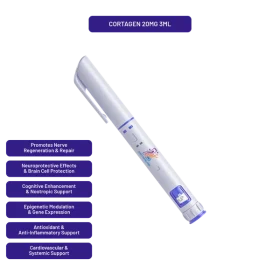
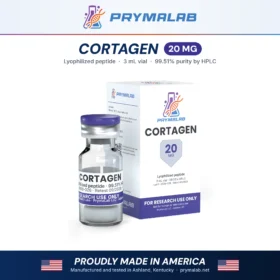
By mass. Glu-Asp-Arg has a theoretical mass of 418.4 Da, against 390.4 Da for Epitalon and 430.4 Da for Cortagen, so an LC-MS identity result separates the three easily even though all are short acidic peptides from the same programme.
What does the research show, and what does it leave open?
Cell studies report less oxidative stress and cell death in stressed neurons, raised serotonin in cortex cultures and sequence-dependent contact with DNA. The gene-regulation story rests on docking and the developers' reviews, and no controlled human trial exists. None of the studies used this product.
Can Pinealon be used in people or animals?
No. It is sold only for laboratory research, has no approval from the FDA or any other authority for human or veterinary use, and must not be given to people or animals. Its registration in Russia as a food supplement does not change that.
References
- Goebel-Stengel M, Stengel A, Taché Y, et al. The importance of using the optimal plasticware and glassware in studies involving peptides. Anal Biochem. 2011;414(1):38-46. DOI · PubMed
- Khavinson V, Ribakova Y, Kulebiakin K, et al. Pinealon increases cell viability by suppression of free radical levels and activating proliferative processes. Rejuvenation Res. 2011;14(5):535-41. DOI · PubMed
- Khavinson V, Linkova N, Kozhevnikova E, et al. EDR Peptide: Possible Mechanism of Gene Expression and Protein Synthesis Regulation Involved in the Pathogenesis of Alzheimer's Disease. Molecules. 2020;26(1). DOI · PubMed
- Fedoreyeva LI, Kireev II, Khavinson VKh, et al. Penetration of short fluorescence-labeled peptides into the nucleus in HeLa cells and in vitro specific interaction of the peptides with deoxyribooligonucleotides and DNA. Biochemistry (Mosc). 2011;76(11):1210-9. DOI · PubMed
- Silanteva IA, Komolkin AV, Morozova EA, et al. Role of Mono- and Divalent Ions in Peptide Glu-Asp-Arg-DNA Interaction. J Phys Chem B. 2019;123(9):1896-1902. DOI · PubMed
- Khavinson VKh, Lin'kova NS, Tarnovskaya SI, et al. Short peptides stimulate serotonin expression in cells of brain cortex. Bull Exp Biol Med. 2014;157(1):77-80. DOI · PubMed
- Mendzheritskii AM, Karantysh GV, Abramchuk VA, et al. Effect of peptide geroprotectors on navigation learning in rats of different ages and caspase-3 systems in their brain structures. Advances in Gerontology. 2014;4(1):37-41. DOI
Research use only
For laboratory research use only. Pinealon 20mg is not a drug, food, cosmetic or dietary supplement, is not approved by the FDA or any comparable authority for human or veterinary use, and must not be given to people or animals. It is sold to qualified researchers and institutions, and the buyer is responsible for lawful handling and disposal.
Other formats of Pinealon
Pinealon is also stocked as Pinealon 10mg Nasal Spray and Pinealon 6mg preloaded 3ml pen. Each listing states its own quantity and concentration, and the pen and vial comparison explains what changes between formats.







Reviews
There are no reviews yet.