Description
PrymaLab · Research use only
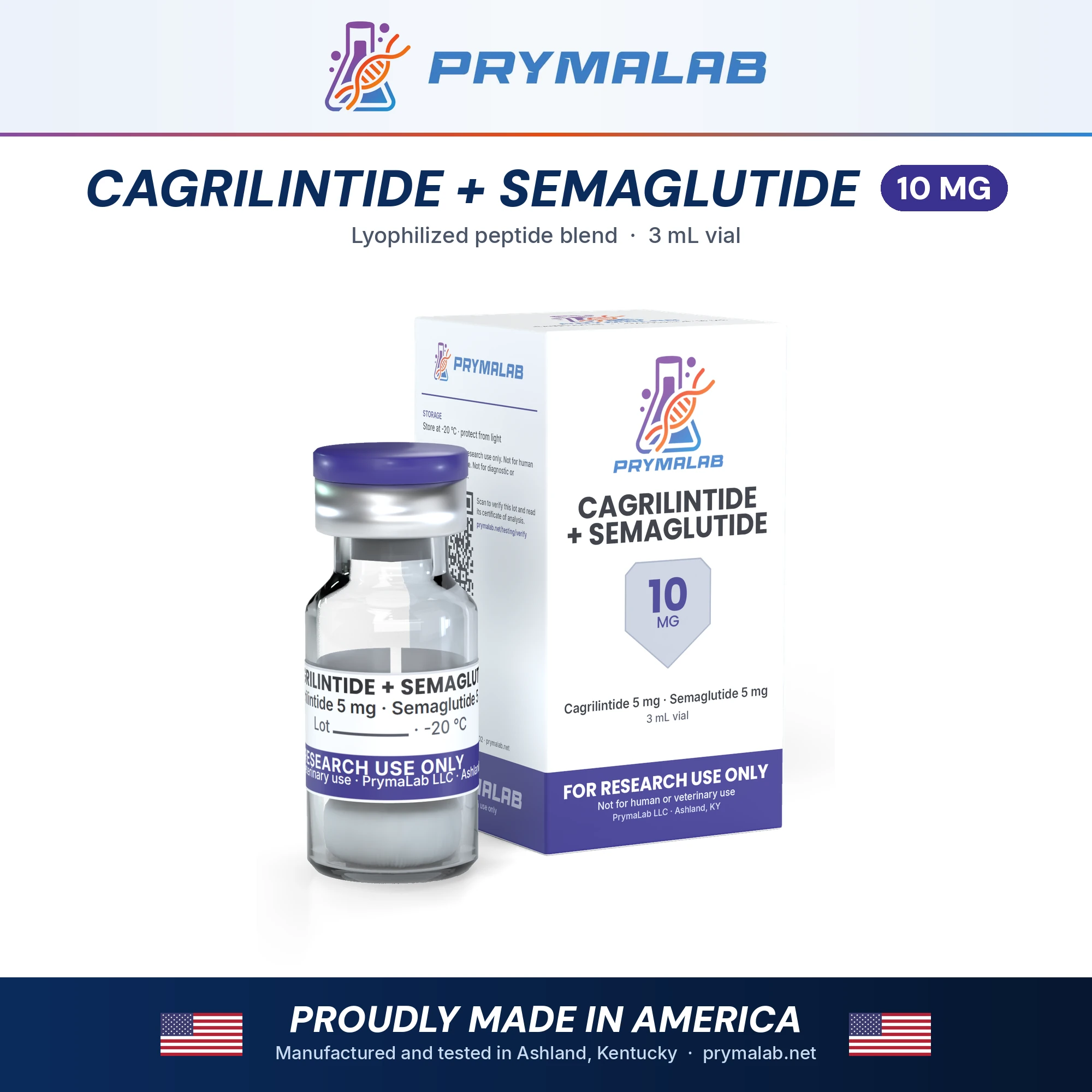
Cagrilintide 5mg + Semaglutide 5mg
Cagrilintide and semaglutide freeze-dried together, 5 mg of each in one vial
This vial holds two long-acting peptides freeze-dried together: 5 mg of cagrilintide, an amylin analogue, and 5 mg of semaglutide, a GLP-1 receptor agonist, 10 mg in total. Each carries a fatty diacid side chain for albumin binding, but they act on separate receptor systems. The pairing matches CagriSema, the combination studied in phase 1b and phase 3 trials that measured body weight in adults with overweight or obesity, with and without type 2 diabetes.
Specifications
| Property | Value |
|---|---|
| Components | Cagrilintide (AM833; long-acting acylated amylin analogue) Semaglutide (NN9535; GLP-1 receptor agonist) |
| Cagrilintide CAS number | 1415456-99-3 |
| Semaglutide CAS number | 910463-68-2 |
| Label claim | Cagrilintide 5 mg + Semaglutide 5 mg (10 mg in total) |
| Form | Lyophilized (freeze-dried) powder or cake in a sealed glass vial with a rubber stopper and aluminium crimp cap |
| Storage, sealed | −20 °C, desiccated, dark |
| Purity specification | 99.0% or higher by RP-HPLC |
| Safety data sheet | PL-SDS-028 |
Fills in this range
Cagrilintide + Semaglutide blend is sold in 2 fills. The compound and the testing are the same in every fill; only the amount in the vial changes.
| Fill | Listing |
|---|---|
| 2.5 mg + 2.5 mg | cagrilintide 2.5mg + semaglutide 2.5mg |
| 5 mg + 5 mg | Cagrilintide 5mg + Semaglutide 5mg (this page) |
Two peptides in one vial
The safety data sheet lists the contents as 50% cagrilintide and 50% semaglutide by mass, 5 mg of each. Equal mass is not equal moles. Cagrilintide’s theoretical mass is 4409.0 Da and semaglutide’s is 4113.6 Da, so the vial holds about 1.13 µmol of cagrilintide and 1.22 µmol of semaglutide, a molar ratio of roughly 1 to 1.07.
The two are easy to tell apart analytically. Cagrilintide has 37 residues, a disulfide between cysteines 2 and 7, an amidated C-terminus and a C20 diacid on its N-terminal lysine; semaglutide has 31 residues, a free C-terminal acid and a C18 diacid on lysine 26. Their masses differ by almost 300 Da, and a blend certificate reports a separate LC-MS mass for each. The sheet carries the hazard classes of both components, Repr. 2 (H361) for each peptide and Carc. 2 (H351) for semaglutide, and asks for storage under lock. For work that needs a different ratio, cagrilintide is also sold alone in Cagrilintide 10mg vials.
What the research covers
Two receptor systems
Semaglutide is a GLP-1 analogue with two amino acid substitutions and a derivatised lysine 26, designed for high albumin affinity and full stability against metabolic degradation1. Its receptor is expressed in the pancreas, gastrointestinal tract, heart, lungs, kidneys and brain, and GLP-1 receptors in the pancreas and brain have been shown to account for the effects of liraglutide and semaglutide on glycaemic control and body weight2. Amylin works through different receptors, multi-subunit complexes of a core receptor protein with receptor activity-modifying proteins, and acts mainly in the circumventricular organs of the brain3. Writing in 2015, Hay and colleagues noted that clinical studies suggested amylin agonists could be useful for weight loss, especially in combination with other agents3.
The combination in trials
The pair was first studied together in a randomised, placebo-controlled phase 1b trial at a single US centre, in adults aged 18 to 55 with a BMI of 27.0 to 39.9 who were otherwise healthy4. Six sequential cohorts were each randomised 3:1 to cagrilintide or placebo, in every case alongside semaglutide and without lifestyle intervention, with participants, investigators and sponsor masked4. The primary endpoint was the number of treatment-emergent adverse events, with pharmacokinetic endpoints secondary4.
Two 68-week phase 3a trials followed. REDEFINE 1 enrolled adults without diabetes who had a BMI of 30 or more, or 27 or more with at least one obesity-related complication, and randomly assigned them 21:3:3:7 to the combination, semaglutide alone, cagrilintide alone or placebo, with lifestyle intervention in every group5. Its coprimary endpoints were the relative change in body weight and a reduction of at least 5% from baseline to week 68, assessed with the treatment-policy estimand, and reductions of 20%, 25% and 30% or more were confirmatory secondary endpoints5. REDEFINE 2, run in 12 countries, assigned 1,206 adults with type 2 diabetes, a BMI of 27 or more and HbA1c of 7 to 10% in a 3:1 ratio to the combination or placebo, 904 and 302 participants respectively6. It used the same two body-weight endpoints, added glycaemic and safety measures, and followed a subgroup with continuous glucose monitoring6. The estimated mean change in body weight at week 68 was −13.7% with the combination and −3.4% with placebo6.
What is not established
The trials coadministered the two drugs in a clinical setting6. None of the cited papers studied a freeze-dried preparation of both peptides, or measured whether the two affect each other’s stability in one vial or one solution. The REDEFINE 1 abstract stops before its results; the single-agent arms and the questions they raise are discussed in the cagrilintide and CagriSema guide. Cagrilintide is investigational, and none of this work used PrymaLab material.
How each lot is tested
Every lot is tested in PrymaLab’s own laboratory in Ashland, Kentucky before release: RP-HPLC for purity, LC-MS for identity, Karl Fischer titration for water, LAL for endotoxin and USP <71> for sterility. Published certificates are listed on the results page and can be checked by number and key on the verify page. These are in-house results from PrymaLab Analytical, not an independent test, and the lab is not accredited to ISO 17025. The third-party testing guarantee on this page still applies: if any independent laboratory finds the wrong compound, or less than the stated purity or amount, the order is refunded and the cost of the test is reimbursed.
Frequently asked questions
How much of each peptide is in the vial?
5 mg of cagrilintide and 5 mg of semaglutide, 10 mg in all, freeze-dried together in one sealed vial. Because the two molecules differ in mass, that is about 1.13 µmol of cagrilintide and 1.22 µmol of semaglutide.
How does this vial differ from the 2.5 mg + 2.5 mg blend?
The peptides and the 1:1 mass ratio are the same; this vial holds twice as much of each. Dissolved in the same volume of diluent it gives double the concentration of both components.
Can the ratio be changed after reconstitution?
Only by adding more of one peptide from a separate vial. The blend is fixed at 1:1 by mass. Cagrilintide is sold on its own in 5 mg and 10 mg vials for work that calls for a different ratio.
How should the blend be stored?
Sealed at −20 °C, desiccated, away from light and locked up, since the safety data sheet carries reproductive toxicity classes for both peptides and a carcinogenicity class for semaglutide. After reconstitution, keep it at 2 to 8 °C, protected from light, for a period your laboratory has set.
Is the blend intended for human use?
No. The published trials studied the two drugs in a clinical setting, and this vial is not a drug product. It is a research chemical for laboratory use only and must not be given to people or animals.
References
- Lau J, Bloch P, Schäffer L, et al. Discovery of the Once-Weekly Glucagon-Like Peptide-1 (GLP-1) Analogue Semaglutide. J Med Chem. 2015;58(18):7370-80. DOI · PubMed
- Knudsen LB, Lau J. The Discovery and Development of Liraglutide and Semaglutide. Front Endocrinol (Lausanne). 2019;10:155. DOI · PubMed
- Hay DL, Chen S, Lutz TA, et al. Amylin: Pharmacology, Physiology, and Clinical Potential. Pharmacol Rev. 2015;67(3):564-600. DOI · PubMed
- Enebo LB, Berthelsen KK, Kankam M, et al. Safety, tolerability, pharmacokinetics, and pharmacodynamics of concomitant administration of multiple doses of cagrilintide with semaglutide 2·4 mg for weight management: a randomised, controlled, phase 1b trial. Lancet. 2021;397(10286):1736-1748. DOI · PubMed
- Garvey WT, Blüher M, Osorto Contreras CK, et al. Coadministered Cagrilintide and Semaglutide in Adults with Overweight or Obesity. N Engl J Med. 2025;393(7):635-647. DOI · PubMed
- Davies MJ, Bajaj HS, Broholm C, et al. Cagrilintide-Semaglutide in Adults with Overweight or Obesity and Type 2 Diabetes. N Engl J Med. 2025;393(7):648-659. DOI · PubMed
Research use only
For laboratory research use only. Cagrilintide 5mg + Semaglutide 5mg is not a drug, food, cosmetic or dietary supplement, is not approved by the FDA or any comparable authority for human or veterinary use, and must not be given to people or animals. It is sold to qualified researchers and institutions, and the buyer is responsible for lawful handling and disposal.
Other formats of Cagrilintide + Semaglutide
Cagrilintide + Semaglutide is also stocked as Cagrilintide 5mg, Cagrilintide 20mg preloaded 3ml pen, Semaglutide 5mg, Semaglutide 10mg, Semaglutide 15mg and Semaglutide 20mg. Each listing states its own quantity and concentration, and the pen and vial comparison explains what changes between formats.







Reviews
There are no reviews yet.