
Description
PrymaLab · Research Use Only
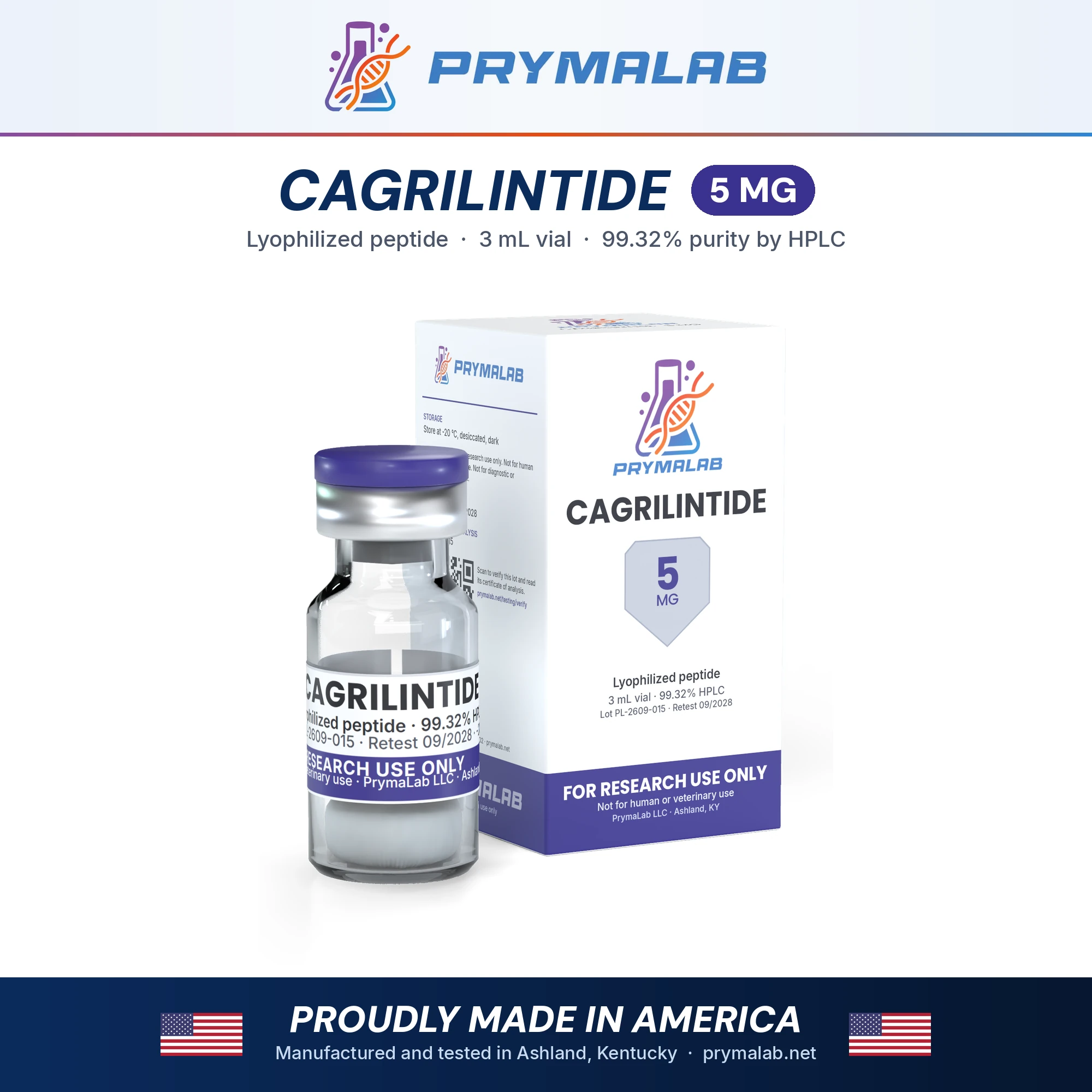
Cagrilintide 5mg
The check you should run costs a share of what you bought
Cagrilintide 5mg raises a problem the larger fill does not. The 10mg page explains why this molecule needs its physical state checked rather than assumed, and the check is size exclusion chromatography. Running it uses up peptide, and on a small fill that cost stops being trivial.
Specification Table
| Property | Value |
|---|---|
| Compound | Cagrilintide |
| Development codes | AM833 and NNC0174-0833 |
| CAS number | 1415456-99-3 |
| Molecular weight | Approximately 4409 for the free peptide |
| Declared content | 5 milligrams |
| Approximate molar content | Around 1.1 micromoles |
| Sibling fill in this catalogue | 10 milligrams |
| Parent hormone | Human amylin, one of the best characterised amyloid forming peptides |
| Why the physical state matters | Aggregation is invisible to mass and to nominal concentration |
| The check that detects it | Size exclusion chromatography, separating aggregate from monomer |
| What the check costs | Injected material. On a small fill that is a measurable share |
| Reported aggregation behaviour | A thioflavin T lag time near 45 hours at 250 micromolar in the development paper |
| Structure | Lipidated and disulfide bridged |
| Pharmacology | Covered on the 10mg page |
| Storage | Sealed at minus 20°C. Do not freeze solution and do not agitate |
Why Does a Cagrilintide 5mg Stock Need Checking?
Because on this molecule the thing that goes wrong in a cagrilintide 5mg stock does not change the mass, the appearance or the nominal concentration.
The 10mg page in this catalogue covers the reason properly: human amylin is a textbook amyloid former, this analogue was engineered specifically to resist that, and the engineering is good rather than absolute.
A stock that has partially converted to aggregate still weighs the same and still reads the same on a mass basis.
What has fallen is the amount of monomeric peptide available to engage a receptor, and that is the quantity an experiment responds to.
The failure mode is therefore a systematic underestimate of potency that looks exactly like ordinary variability, and no amount of care in the dilution series catches it.
Size exclusion chromatography catches it, by separating aggregate from monomer directly and reporting the ratio.
That is the correct check and this page is about what it costs.
What Does the Check Actually Consume?
Enough to notice on a cagrilintide 5mg fill, and the arithmetic is worth doing before you decide whether to run it.
An analytical size exclusion run typically injects somewhere in the tens of micrograms, and a laboratory wanting a result at the start of a study and again a fortnight later runs it twice.
Call that a hundred micrograms across two runs including the material lost setting up.
On a 10 milligram vial that is one percent. On this fill it is two, and if the method needs developing first because nobody in the building has run this molecule before, the setup can consume several times that.
Two percent is not catastrophic and it is not nothing, and it sits on top of the reconstitution losses every small fill carries.
Verification is a real cost on a small fill. The alternative is not verifying, which on this molecule is worse.
If I had 5 milligrams and a study that mattered, I would spend the material on the check and buy a second vial rather than skip it.
That is a more expensive answer than most pages would give and it follows from the compound rather than from anything about the format.
When Does the Smaller Fill Make Sense?
A cagrilintide 5mg vial suits a study short enough that the aggregation clock never becomes the binding constraint.
A stock prepared and consumed within a few days has had limited opportunity to associate, and the check becomes a formality rather than a live question.
For that pattern the 5 milligram fill is right, and the verification cost mostly goes with it.
It also suits a first look at the compound, where the goal is finding out whether anything happens rather than measuring how much.
What it does not suit is a study running across weeks from one reconstitution, because that is exactly the pattern where aggregation accumulates and the check matters most, and it is the pattern where the check costs the largest share.
That combination, small fill plus long study, is the one to avoid. Either shorten the study or buy the larger vial.
What Should the Certificate Show?
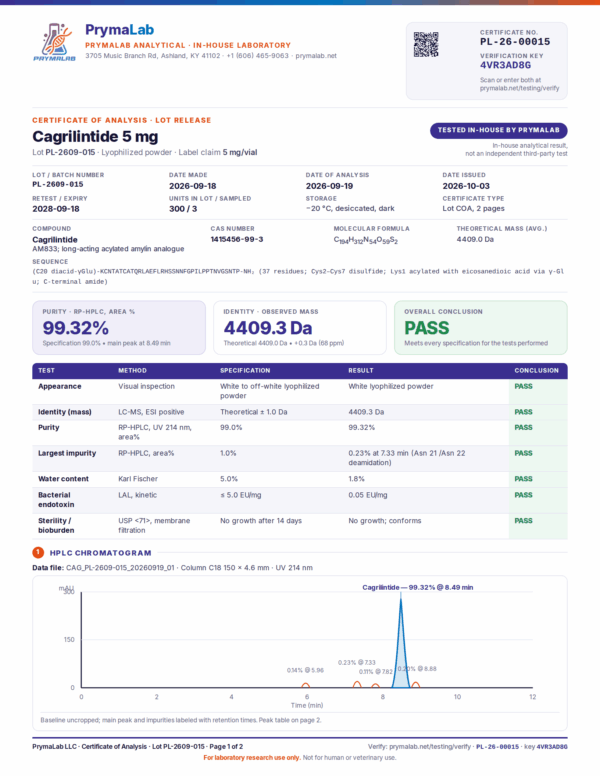
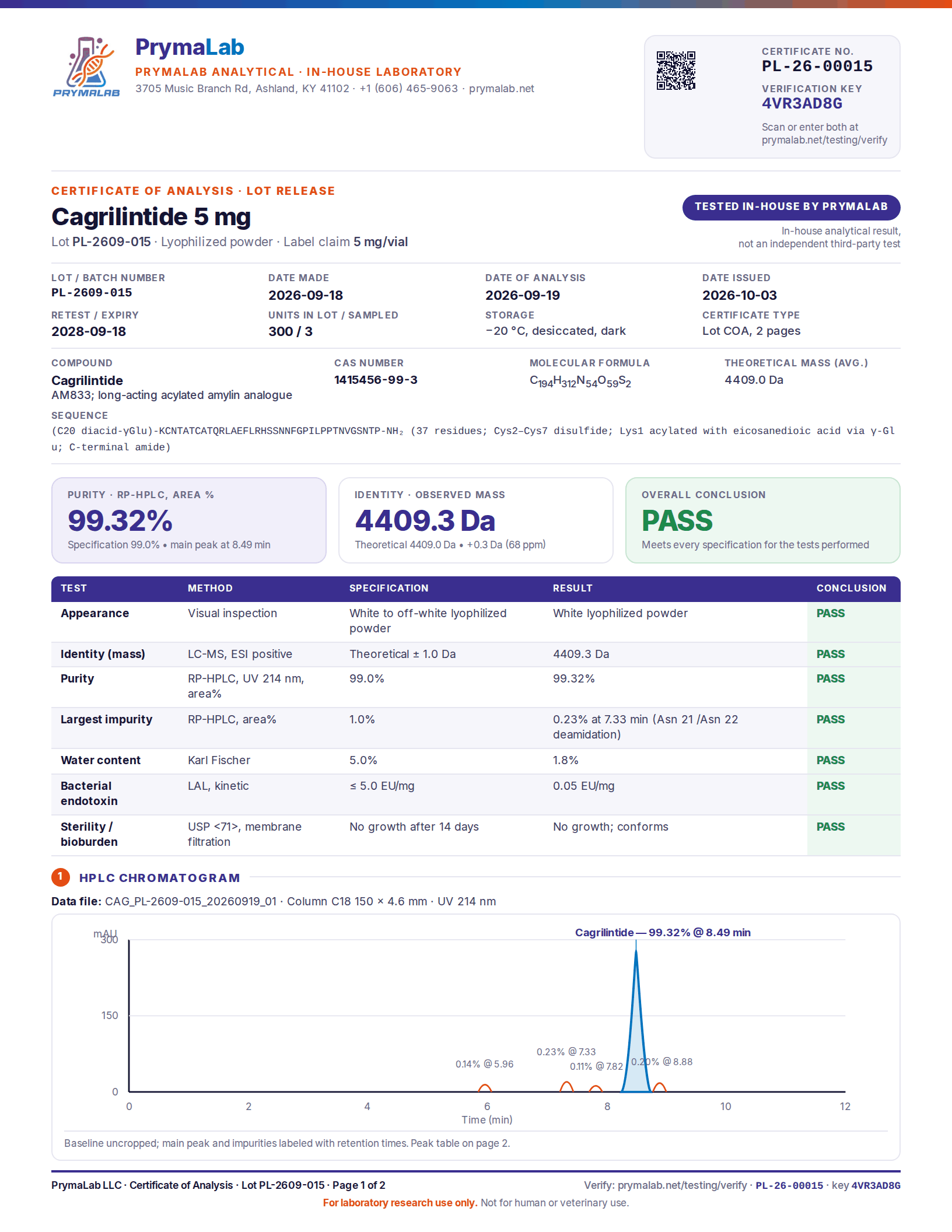
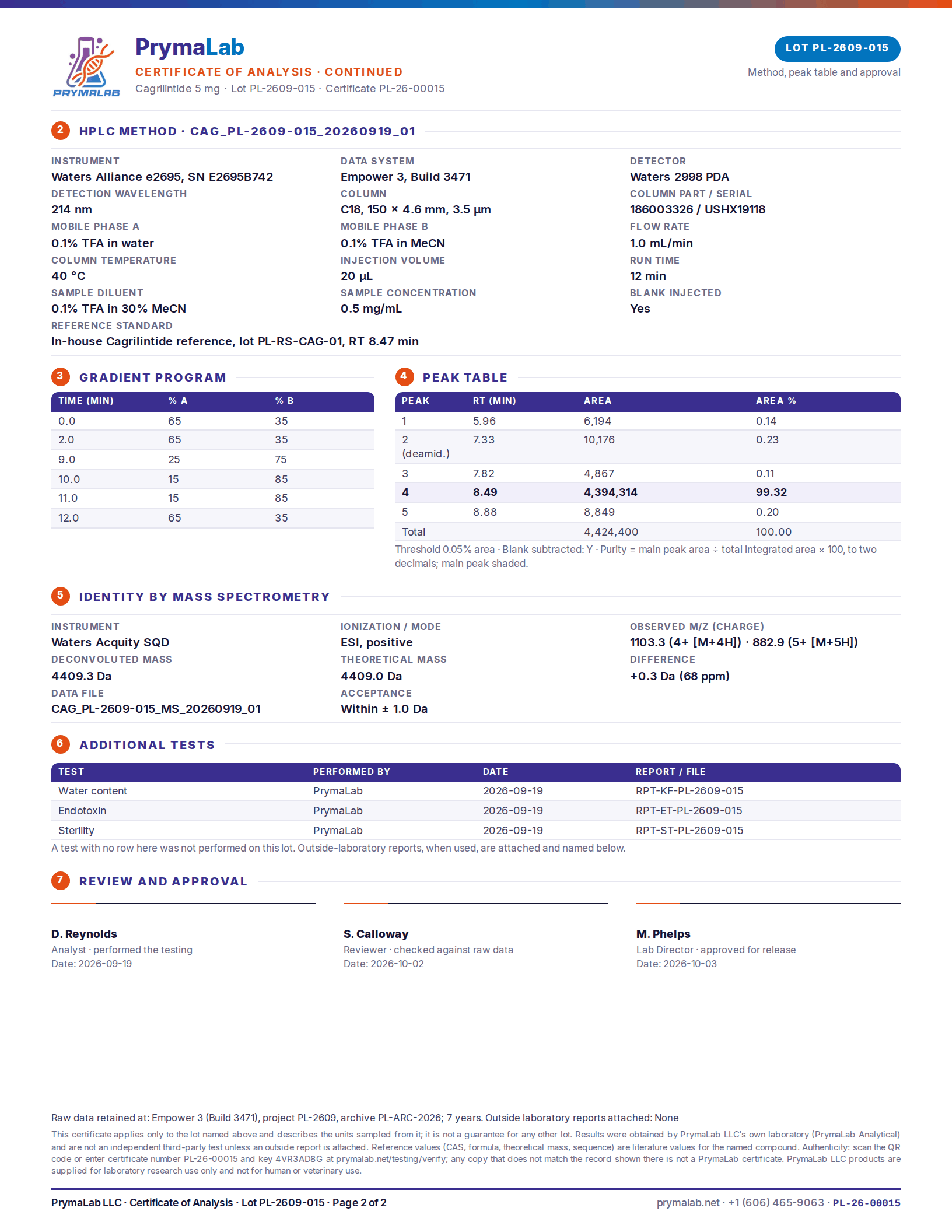
On a cagrilintide 5mg certificate, aggregate content at manufacture by size exclusion chromatography, as a number.
That figure is the baseline. Without it a later result has nothing to compare against.
The full sequence, including the position of the lipid attachment and the residues bridged by the disulfide.
Observed mass by spectrometry, since incomplete acylation is a genuine synthesis failure on this class.
Confirmation that the disulfide is formed rather than reduced.
Purity by chromatography, with the method stated.
Net peptide content and the salt form.
Appearance of the reconstituted solution, described rather than assumed.
Lot number and manufacturing date.
A certificate reporting purity without aggregate content has characterised the covalent chemistry and said nothing about the physical state, which on a molecule engineered for physical stability is the omission that matters.
What Does the Check Tell You?
A ratio, and on a cagrilintide 5mg stock the ratio is more useful than the absolute number.
A size exclusion trace on a fresh stock gives a baseline monomer fraction. The same trace two weeks later gives a second figure, and the difference between them is the rate at which your particular stock, in your particular vehicle, at your particular temperature, is converting.
That rate is not in any paper and it cannot be looked up, because it depends on conditions nobody else has.
One measurement tells you the state. Two tell you the trajectory, and the trajectory is what decides whether a stock is usable next month.
Which is the argument for spending material on two runs rather than one, and it makes the cost calculation above worse rather than better.
I would still do it. A study that discovers its stock was half aggregate after the data is collected has wasted more than two percent.
What Does the Fill Size Not Change?
The chemistry. A cagrilintide 5mg vial sometimes gets sold as though it were a gentler article and it is not.
The aggregation propensity is a property of the sequence and the lipid chain. It does not depend on how much is in the vial.
A 5 milligram stock at 1 millimolar aggregates at the same rate as a 10 milligram stock at 1 millimolar, because rate depends on concentration and not on total quantity.
What the fill changes is how much material is at risk and how long it is likely to sit.
A smaller purchase is a smaller amount exposed and usually a shorter exposure, which reduces the total loss without changing the rate.
That distinction matters when reading a supplier claim. Nobody is entitled to say a small fill is more stable. They can say a small fill is usually used faster, which is a statement about buyers rather than about chemistry.
What Would Make the Check Cheaper?
A supplier who ran it and gave you the trace. Some do.
A manufacturing aggregate figure costs the supplier a fraction of a production batch and costs you nothing. Asking for it before ordering is the single highest-value question on this compound.
The in-house runs are then measuring change from a known starting point rather than establishing one, which halves what you need to spend material on.
If a certificate already carries an aggregate number, one in-house run at the end of a study is enough for most purposes.
If it does not, you pay for two runs to learn something the manufacturer already knew.
That is the actual cost of a thin certificate on this article, expressed in milligrams rather than in inconvenience.
How Should the Vial Be Handled?
By the rules for an aggregation prone peptide, which are stricter than the general ones and which the 10mg page sets out.
Sealed lyophilised powder at minus 20 degrees Celsius. The solid state is where this molecule is most stable.
Bring the vial to ambient temperature before opening, then run diluent down the wall and let the cake dissolve without help.
No vortexing and no shaking. Agitation drives peptide to the air-liquid interface, and an interface is a nucleation site.
Never freeze a reconstituted solution. Ice formation concentrates the peptide in the shrinking liquid phase, which is the opposite of what this molecule needs.
Aliquot on first reconstitution so the working stock is opened once.
Use low-binding consumables throughout, since the reported working concentrations are low enough for adsorption to matter.
Record lot, aggregate content at manufacture, net peptide content, diluent, storage temperature, the reconstitution date and any aggregate figure you measured yourself.
The last of those is the field that separates a study that knows what it was working with from one that assumed.
A closing note on the economics, since this page has spent a while on them. Two percent of a 5 milligram vial is 100 micrograms, and at any realistic price that is a small amount of money.
The reason it feels expensive is that it comes out of a fixed quantity you already own rather than out of a budget line. That is a psychological accounting problem rather than a real one, and it is why the check gets skipped.
Reframing it helps. The hundred micrograms is not lost, it is spent on knowing what the other 4.9 milligrams are, and that is the best value available anywhere in the purchase.
A laboratory that runs the check once and finds the stock intact has bought confidence in every result that follows. One that skips it and gets an unexpected potency figure has to redo the experiment, which costs the whole vial rather than two percent of it.
Published Literature
Selected references on the design of the analogue, on the aggregation behaviour of the parent hormone, on the published clinical programme and on peptide storage generally. The 10mg page carries the same list.
- Kruse T, Hansen JL, Dahl K, Schaffer L, Sensfuss U, Poulsen C, et al. Journal of Medicinal Chemistry. 2021;64(15):11183-11194. DOI: 10.1021/acs.jmedchem.1c00565
- Westermark P, Andersson A, Westermark GT. Physiological Reviews. 2011;91(3):795-826. DOI: 10.1152/physrev.00042.2009
- Lau DCW, Erichsen L, Francisco AM, Satylganova A, le Roux CW, McGowan B, et al. Lancet. 2021;398(10317):2160-2172. DOI: 10.1016/S0140-6736(21)01751-7
- Manning MC, Chou DK, Murphy BM, Payne RW, Katayama DS. Pharmaceutical Research. 2010;27(4):544-575. DOI: 10.1007/s11095-009-0045-6
Frequently Asked Questions
Why does a stock of this compound need checking?
Because aggregation does not change the mass, the appearance or the nominal concentration. What falls is the monomeric fraction, which is the quantity an experiment actually responds to.
What does that failure look like?
A systematic underestimate of potency that resembles ordinary variability. No amount of care in the dilution series catches it.
What is the right check?
Size exclusion chromatography. It separates aggregate from monomer directly.
How much material does that consume?
Tens of micrograms per analytical run. Two runs plus setup is roughly a hundred micrograms, which is one percent of a 10mg vial and two percent of this one.
Is two percent worth worrying about?
It is not catastrophic and it is not nothing, and it sits on top of the reconstitution losses every small fill carries.
So should the check be skipped on a small fill?
No. On this compound the alternative to verifying is not verifying, which is worse. I would spend the material and buy a second vial.
When does the smaller fill suit the work?
When the study is short enough that aggregation never becomes the binding constraint, so a stock is prepared and consumed within a few days.
What pattern should be avoided?
Small fill plus long study. That is where aggregation accumulates most and where the check costs the largest share. Shorten the study or buy the larger vial.
What is the key certificate field?
Aggregate content at manufacture, given as a number rather than described. It is the baseline every later measurement is compared against.
Why can freezing not extend the solution life?
Ice formation concentrates the peptide in the shrinking liquid phase, which is the opposite of what an aggregation prone molecule needs.
Why does agitation matter so much?
Because it drives peptide to the air-liquid interface. An interface is a nucleation site.
What belongs in the record?
Lot, aggregate content at manufacture, net peptide content, diluent, storage temperature, reconstitution date, and any aggregate figure measured in-house.
Compliance Statement
Cagrilintide is sold exclusively for laboratory research use. It is not a drug, food, or cosmetic product, and it is not a dietary product of any kind. It is not approved by the FDA or any comparable authority for human or veterinary use, it is an investigational compound with no approval as a single agent, its parent hormone is an amyloid forming peptide and aggregation in a prepared solution is invisible to mass-based measurement so a nominal concentration cannot be assumed to reflect available peptide, it engages two structurally related receptors comparably so published findings cannot be attributed to one of them, and no compound in this range is offered for any human or veterinary purpose. This product is not intended to diagnose, treat, cure, or prevent any disease. It must not be given to humans or animals. Purchase is restricted to qualified researchers and institutions operating within applicable laws. All handling is the responsibility of the purchasing laboratory.
Other formats of Cagrilintide
Cagrilintide is also stocked as cagrilintide 2.5mg + semaglutide 2.5mg, Cagrilintide 5mg + Semaglutide 5mg, Cagrilintide 20mg preloaded 3ml pen, Cagrilintide 10mg, Semaglutide 5mg, Semaglutide 10mg, Semaglutide 15mg and Semaglutide 20mg. Each listing states its own quantity and concentration, and the pen and vial comparison explains what changes between formats.









18 reviews for Cagrilintide 5mg