Description
PrymaLab · Research Use Only
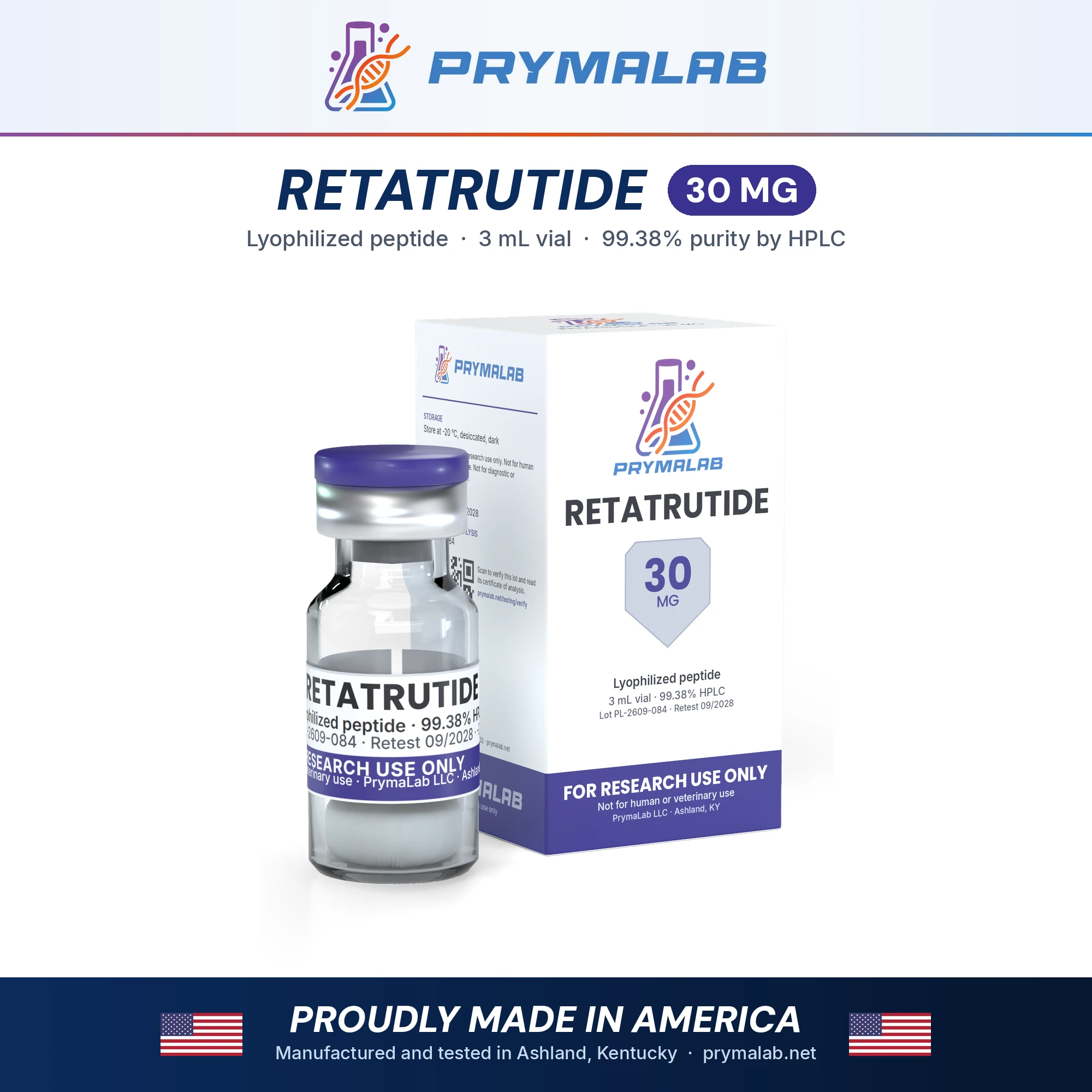
Retatrutide 30mg
LY3437943 · Aib-substituted GIP backbone · 39 residues
Retatrutide 30mg is a lyophilized vial of LY3437943, CAS 2381089-83-2. Thirty milligrams is approximately 6.13 micromoles on the higher of the two circulating molecular weight figures, and the arithmetic below shows why that qualifier matters at this scale.
Specification Table
| Property | Value |
|---|---|
| Compound | Retatrutide |
| Development code | LY3437943 |
| CAS number | 2381089-83-2 |
| Vial content | 30 mg lyophilized powder |
| Molar content at MW 4894.58 | Approximately 6.13 µmol |
| Molar content at MW 4731.33 | Approximately 6.34 µmol |
| Basic residues binding counterion | Lysine 16 and lysine 17, adjacent |
| Molecular formula | C228H350N48O66 |
| Molecular weight | Contested. 4894.58 and 4731.33 both circulate. See the note on the 5mg page |
| Residue count | 39 |
| C-terminus | Amidated |
| Peptide backbone | Based on the GIP sequence rather than GLP-1 |
| Non-coded residue, position 2 | α-aminoisobutyric acid (Aib) |
| Non-coded residue, position 13 | α-methyl-leucine |
| Non-coded residue, position 20 | α-aminoisobutyric acid (Aib) |
| Lipid conjugation | Lysine 17 side chain bears PEG2-γ-Glu-eicosanedioic acid |
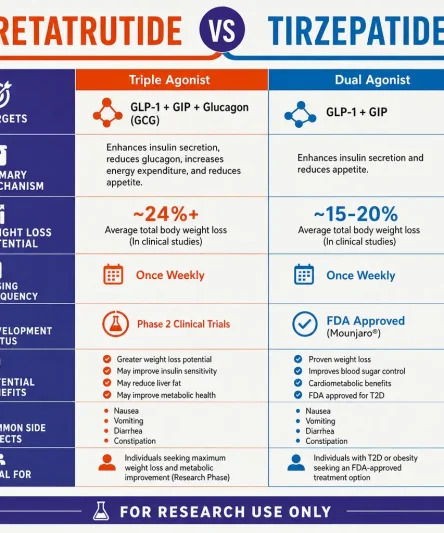
| Molecular targets | GIP receptor, GLP-1 receptor, glucagon receptor |
| Reported EC50, GIPR | 0.0643 nM |
| Reported EC50, GLP-1R | 0.775 nM |
| Reported EC50, GCGR | 5.79 nM |
| Originating organisation | Eli Lilly |
| Appearance | White lyophilized powder |
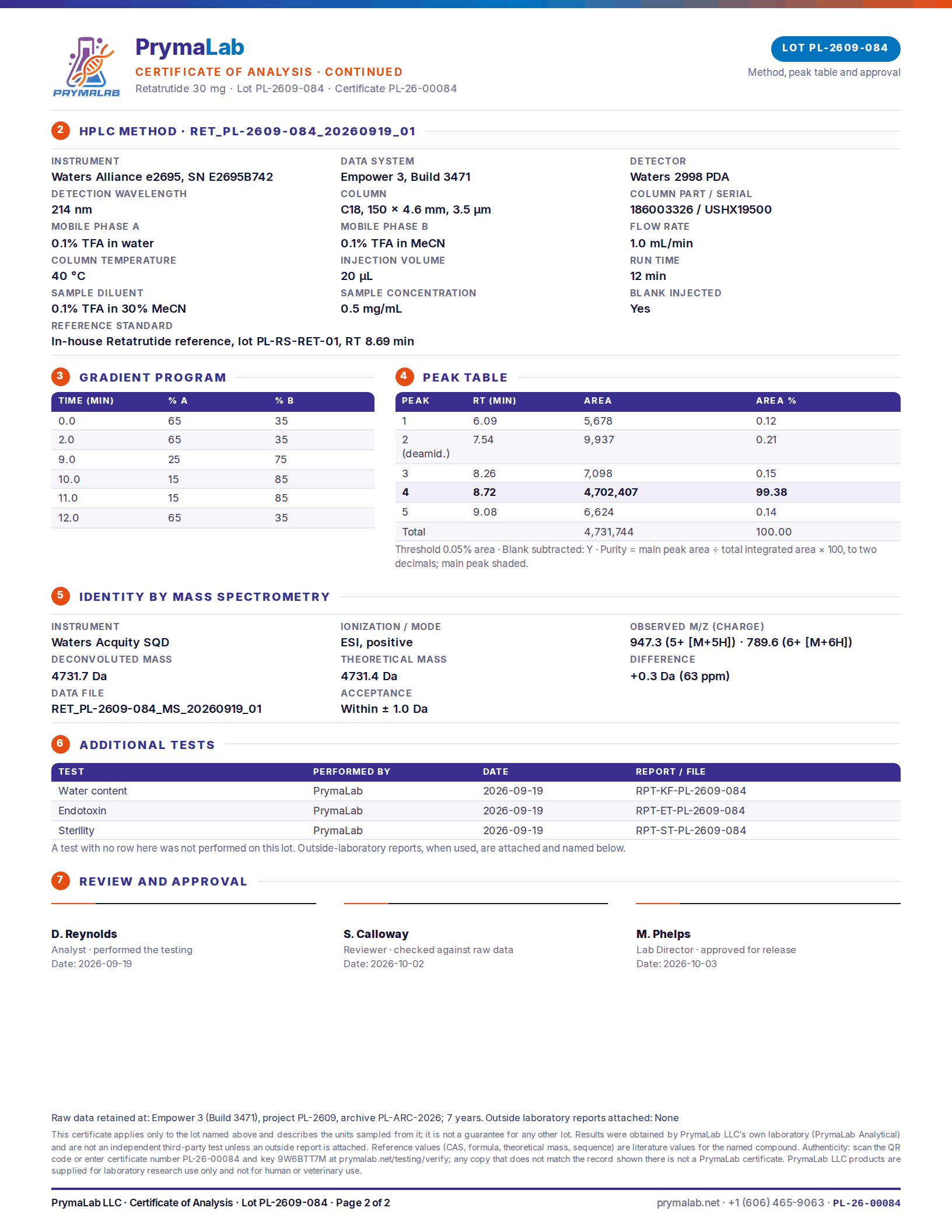
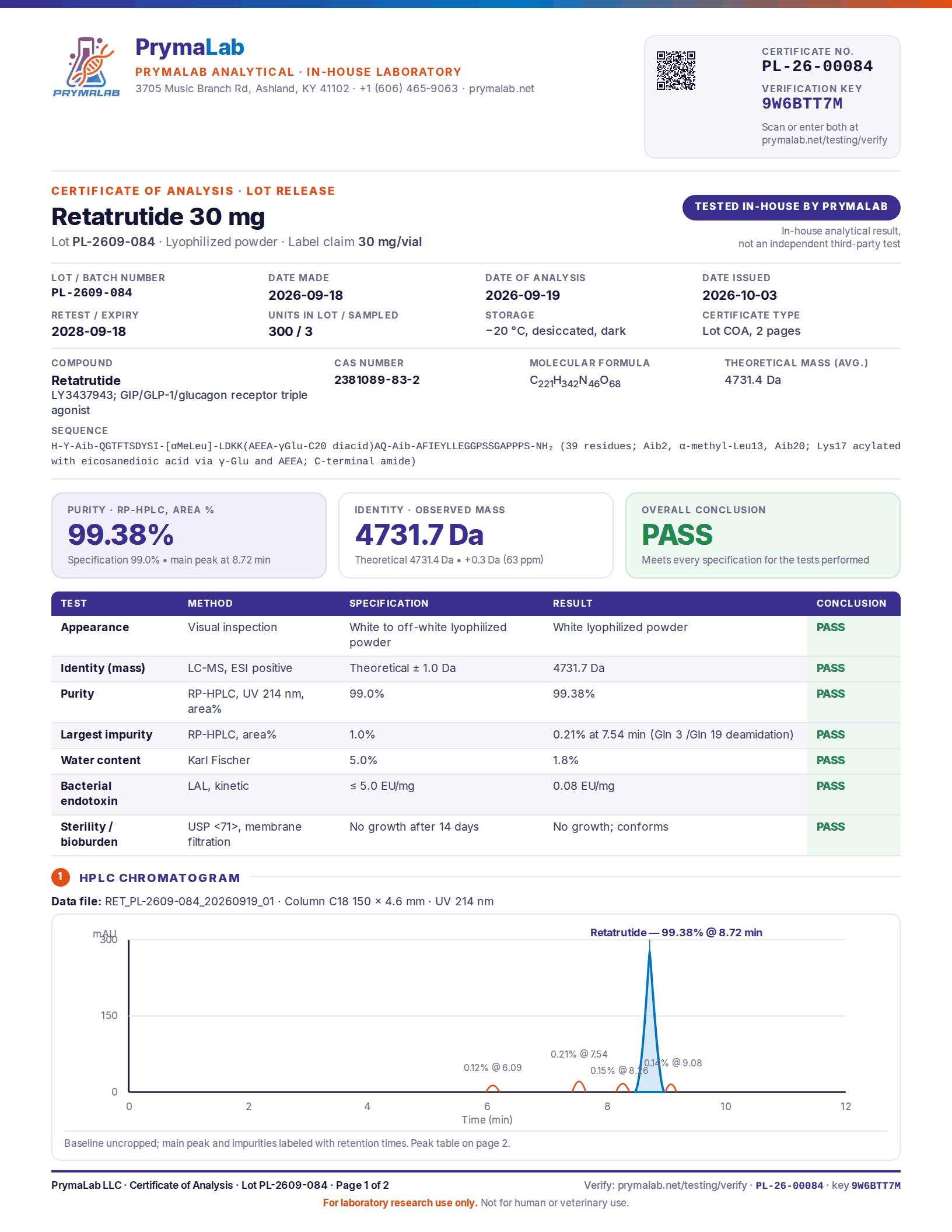
| Purity | Per lot-specific certificate of analysis |
| Solubility | Water soluble. Slightly alkaline buffer aids dissolution |
| Storage, lyophilized | -20°C, protected from light and moisture |
| Storage, reconstituted | 2-8°C, protected from light |
| Regulatory status | Investigational. No approved formulation in any jurisdiction |
How Should Retatrutide Molar Concentration Be Calculated?
For Retatrutide 30mg the arithmetic carries enough absolute error that doing it carelessly produces a visible offset rather than a rounding difference.
Retatrutide 30mg divided by 4894.58 grams per mole gives approximately 6.13 micromoles. Divided by 4731.33 it gives approximately 6.34. The 0.21 micromole gap is 3.4 percent, and at this scale it is over 200 nanomoles of material.
Reconstituted into 6 ml the vial yields roughly 1.02 mM on the first figure. That volume keeps the concentration matched to the 10mg and 20mg formats, which is worth doing if a programme uses several sizes.
The counterion correction compounds it. Trifluoroacetate from standard cleavage chemistry associates with basic residues, and this sequence has two lysines adjacent at positions 16 and 17 plus a free amine on the conjugate glutamate.
Each associated trifluoroacetate adds 114 daltons of weighed mass contributing no peptide. A preparation carrying two can be four to five percent counterion by weight, and that error runs in the same direction as an inflated molecular weight.
Net peptide content on the certificate resolves both at once. Where it is stated, calculate from that figure and record which one you used.
What Do the Non-Coded Residues Cost and Deliver?
Three positions in this sequence hold residues that do not exist in the genetic code, and each requires a non-standard synthesis building block.
Alpha-aminoisobutyric acid sits at positions 2 and 20. It is alanine bearing a second methyl group on the alpha carbon, which leaves that carbon quaternary and sharply restricts the backbone angles the residue can adopt.
That restriction favours helical geometry. A chain carrying Aib at intervals is pre-organised toward the conformation its receptors recognise, so binding costs less conformational entropy and affinity improves.
Alpha-methyl-leucine at position 13 applies the identical principle to a bulkier side chain, adding local rigidity without changing the group the receptor contacts.
Aib at position 2 does something further and more specific. Dipeptidyl peptidase-4 cleaves after position 2 across this peptide family, and a quaternary alpha carbon is geometry the enzyme active site cannot accommodate.
The synthetic cost is real. Non-coded building blocks are more expensive and couple less efficiently than standard residues, which is part of why preparations occasionally substitute coded equivalents and why confirming them is worth doing.
What Does Retatrutide Price Per Month Depend On?
Cost comparisons across suppliers are frequently made on the wrong basis, and three corrections change the answer.
Mass against molar is the first. Two vials at the same milligram price do not supply the same molar quantity if their net peptide content differs, and net peptide content varies with counterion load and residual water.
Purity is the second and it is not linear. A preparation at 95 percent purity with the remaining five percent being unconjugated peptide is a different product from one where the impurities are unrelated synthesis by-products, even though both certificates read 95.
Format is the third. Larger vials reduce cost per milligram and increase the fraction of material that sits reconstituted for longer, and for a lipidated peptide time in solution carries an aggregation cost that does not appear on any invoice.
The defensible comparison is cost per micromole of confirmed, fully modified peptide. Reaching that number requires the certificate fields listed on the 20mg page, and a supplier unwilling to provide them cannot be compared on this basis at all.
For most laboratory designs the material cost is small relative to the cost of the experiment, which is an argument for buying the better characterised product rather than the cheaper one.
Which Retatrutide Peptide Molecular Weight Should Be Recorded?
The discrepancy set out on the 5mg page has a practical resolution that is worth stating as a procedure rather than an observation.
Two figures circulate: 4894.58, usually alongside the formula C228H350N48O66, and 4731.33, frequently with no formula attached. The 163 dalton gap is far too large to be rounding.
The resolution is not to decide which is right in general. It is to measure the lot in hand by mass spectrometry and record what that measurement returned.
Where measurement is unavailable, pick one figure, write it into the method, and hold it constant for the entire programme. An internally consistent 3.4 percent offset is recoverable later. An inconsistent one is not.
This matters more at 30mg than at 5mg for a simple reason: larger vials tend to serve longer programmes, and longer programmes involve more people, which is exactly the situation where two conventions drift apart unnoticed.
Recording the figure alongside the concentration is a one-line habit that makes a discrepant result traceable instead of mysterious.
How Should a 30mg Vial Be Divided?
For Retatrutide 30mg: reconstitute once, aliquot immediately, freeze, thaw each aliquot once. The sequence is standard and the reasons are compound-specific.
Six millilitres gives approximately 1.02 mM and keeps the ladder arithmetic consistent. Larger volumes lower the concentration and reduce aggregation pressure, which is a legitimate trade if the working range permits it.
Aliquot size should match single-experiment consumption. For a lipidated peptide each freeze-thaw provides a nucleation opportunity, so the penalty for oversized aliquots is larger here than for a durable short sequence.
Low-binding consumables throughout, and consider a carrier protein where the assay tolerates one. Note that albumin is also the binding partner the conjugation targets, so adding it changes the free fraction as well as improving recovery.
Inspect aliquots for clarity before use rather than assuming. Aggregated lipidated peptide is not recoverable and it fails silently.
Hold lyophilized material at -20°C sealed and dry, and allow the vial to reach room temperature before opening to avoid condensing water onto hygroscopic powder.
What Does Retatrutide 30mg Supply in Practice?
Six point one three micromoles sits between working quantity and programme scale, and the choice of Retatrutide 30mg usually reflects a defined study rather than exploratory work.
Reconstituted into 6 ml the vial gives roughly 1.02 mM, matching every other format in this ladder and keeping dilution arithmetic transferable.
The practical argument for Retatrutide 30mg over two smaller vials is lot continuity. Two vials from different syntheses differ in the proportion of fully modified product, and that difference is invisible without analysis.
The argument against is time in solution. A fill this size invites bulk reconstitution, and a lipidated peptide held in solution aggregates on a timescale of weeks rather than months.
Dividing dry resolves the tension, provided the balance and the discipline are available.
Why Does Backbone Lineage Affect Literature Searching?
Retatrutide is built on the GIP sequence rather than GLP-1, and that classification affects where its literature sits.
Reviews of GLP-1 receptor agonists frequently omit the compound or file it as an outlier, because by lineage it does not belong to that family even though it engages that receptor.
Reviews of unimolecular multi-agonists and of incretin receptor pharmacology cover it properly, as does the diabetes and metabolic pharmacology literature that tracks the development programme.
Searching under the development code LY3437943 alongside the generic name surfaces a substantially larger body of work than either term alone, because the primary characterisation papers use the code.
For anyone building a reference list, that combination plus the Finan 2015 conceptual paper covers the intellectual lineage from the design idea through to the specific molecule.
A last note on record-keeping across a ladder. Where a laboratory holds several fill sizes, the concentration convention should be written down once and applied to all of them.
Matching every format to roughly 1.02 millimolar makes dilution schemes portable between vials and removes a recurring source of arithmetic slips when someone switches size mid-programme.
It costs one line in the method and saves a category of error that is very hard to spot afterwards.
One more point on non-coded residues and analysis. Amino acid analysis will not detect Aib substitution cleanly, because the standard hydrolysis and derivatisation workflow is built around coded residues.
Tandem mass spectrometry sequencing is the reliable confirmation, and it is worth naming that method specifically when asking a supplier rather than accepting amino acid analysis as equivalent.
Published Literature
References verified against the publisher record. The molecular weight discrepancy discussed above is a supplier-listing problem rather than a disagreement in the peer-reviewed literature.
- Coskun T, Urva S, Roell WC, Qu H, Loghin C, Moyers JS, O’Farrell LS, Briere DA, Sloop KW, Thomas MK, Pirro V, Wainscott DB, Willard FS, Abernathy M, Morford L, Du Y, Benson C, Gimeno RE, Haupt A, Coskun T. Cell Metabolism. 2022;34(9):1234-1247.
- Urva S, Coskun T, Neff LM, Yeo KP, Loghin C, Ma X, Landry J, Bray R, Milicevic Z, Haupt A. The Lancet. 2022;400(10366):1869-1881.
- Jastreboff AM, Kaplan LM, Frias JP, Wu Q, Du Y, Gurbuz S, Coskun T, Haupt A, Milicevic Z, Hartman ML. New England Journal of Medicine. 2023;389(6):514-526.
- Willard FS, Douros JD, Gabe MB, Showalter AD, Wainscott DB, Suter TM, Capozzi ME, van der Velden WJ, Stutsman C, Cardona GR, et al. JCI Insight. 2020;5(17):e140532.
- Finan B, Yang B, Ottaway N, Smiley DL, Ma T, Clemmensen C, Chabenne J, Zhang L, Habegger KM, Fischer K, et al. Nature Medicine. 2015;21(1):27-36.
Frequently Asked Questions
What is Retatrutide 30mg?
A lyophilized vial of LY3437943 under CAS 2381089-83-2, where thirty milligrams is approximately 6.13 micromoles on the higher circulating molecular weight, or 6.34 on the lower. Laboratory research use only.
How large is the molecular weight error at this scale?
About 3.4 percent, which at 30mg amounts to over 200 nanomoles of material. At 5mg the same percentage is a rounding-scale quantity. At this vial size it produces a visible offset.
What reconstitution volume keeps the ladder consistent?
Six millilitres, giving roughly 1.02 millimolar, which matches what the 10mg format gives in 2 ml and the 20mg in 4 ml. Dilution arithmetic then transfers across the whole size range without adjustment.
How does counterion compound the error?
Trifluoroacetate from standard cleavage associates with basic residues, and this sequence has two adjacent lysines at positions 16 and 17. Each associated trifluoroacetate adds 114 daltons of weighed mass contributing no peptide.
What resolves both corrections at once?
Net peptide content on the certificate. Where it is stated, calculate from that figure rather than the vial label, and record which figure you used alongside the resulting concentration.
What is Aib and where does it sit?
Alpha-aminoisobutyric acid, at positions 2 and 20. It is alanine with a second methyl group on the alpha carbon, leaving that carbon quaternary and sharply restricting the backbone angles the residue can adopt.
Why does that restriction help?
It favours helical geometry, so the chain is pre-organised toward the conformation its receptors recognise. Binding then costs less conformational entropy, which shows up directly as improved affinity.
What does Aib at position 2 do specifically?
It blocks dipeptidyl peptidase-4, which cleaves after position 2 across this peptide family. A quaternary alpha carbon is geometry the enzyme active site cannot accommodate, so one substitution removes the fastest degradation route.
Why might a preparation lack them?
Cost and coupling efficiency. Non-coded building blocks are more expensive and couple less efficiently than standard residues, which is why some preparations substitute coded equivalents and why confirming them is worth doing.
How should cost be compared across suppliers?
Cost per micromole of confirmed, fully modified peptide rather than cost per milligram. Two vials at the same milligram price do not supply the same molar quantity if net peptide content differs.
Why does backbone lineage affect searching?
Because reviews of GLP-1 receptor agonists frequently omit this compound or file it as an outlier, since by lineage it is built on GIP. Reviews of unimolecular multi-agonists cover it properly instead.
Compliance Statement
Retatrutide 30mg is sold exclusively for laboratory research use. It is not a drug, food, or cosmetic product, and it is not a dietary product of any kind. It is not approved by the FDA or any comparable authority for human or veterinary use, it is an investigational compound with no approved formulation in any jurisdiction, and material supplied as a research chemical is not a clinical product. This product is not intended to diagnose, treat, cure, or prevent any disease. It must not be given to humans or animals. Purchase is restricted to qualified researchers and institutions operating within applicable laws. All handling is the responsibility of the purchasing laboratory.


18 reviews for Retatrutide 30mg