Description
PrymaLab · Research Use Only
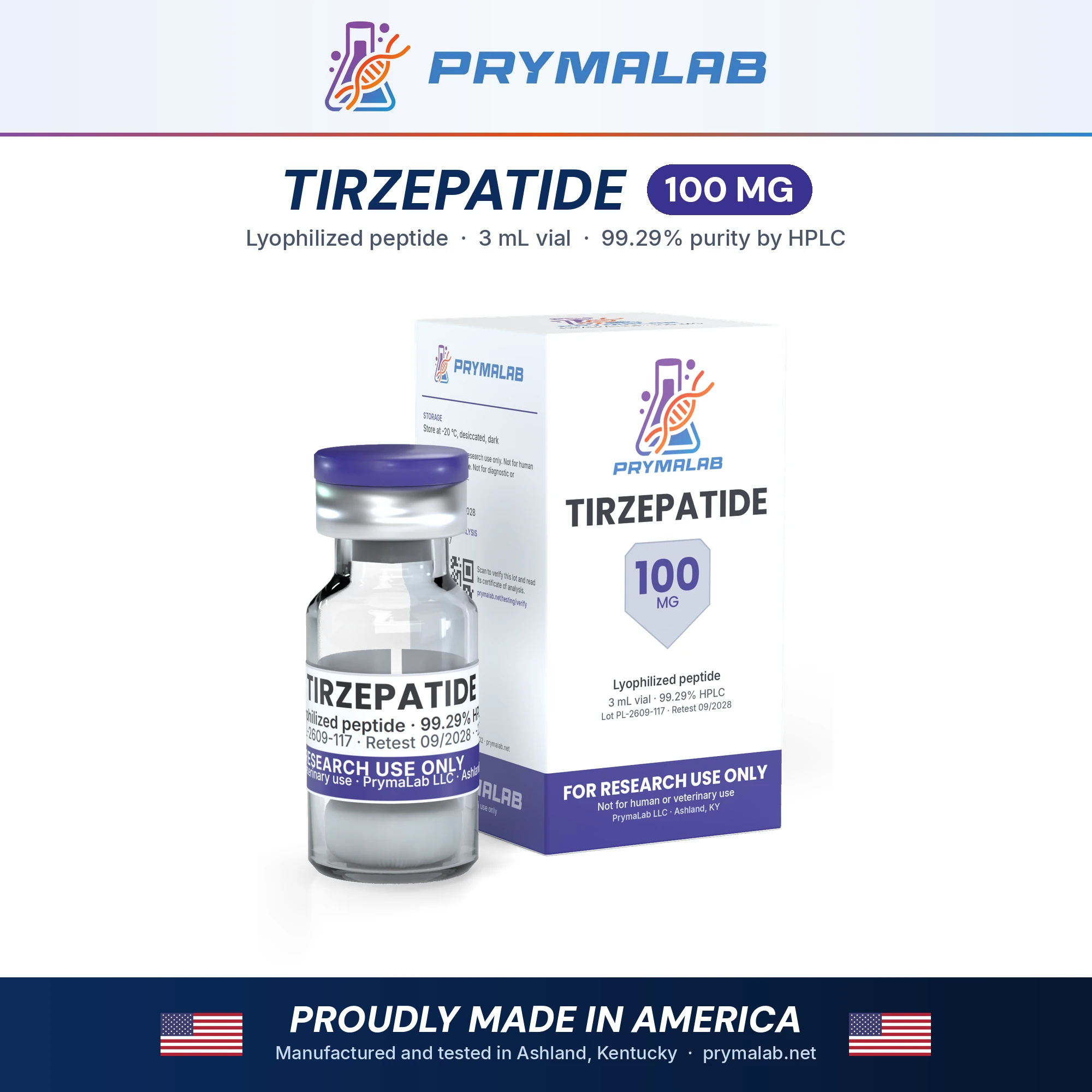
Tirzepatide 100mg
Around 20.8 micromoles · The thickest cake in the range, and what that does to drying
A tirzepatide 100mg vial is the largest fill in this range and about 20.8 micromoles. It is also the thickest cake. Freeze drying removes water from the top of a cake more readily than from the bottom, so a deeper cake finishes with a moisture gradient through it, and residual water is the largest single influence on how a peptide keeps as a solid.
Specification Table
| Property | Value |
|---|---|
| Product format | Lyophilised powder, single vial |
| Peptide content | 100 mg |
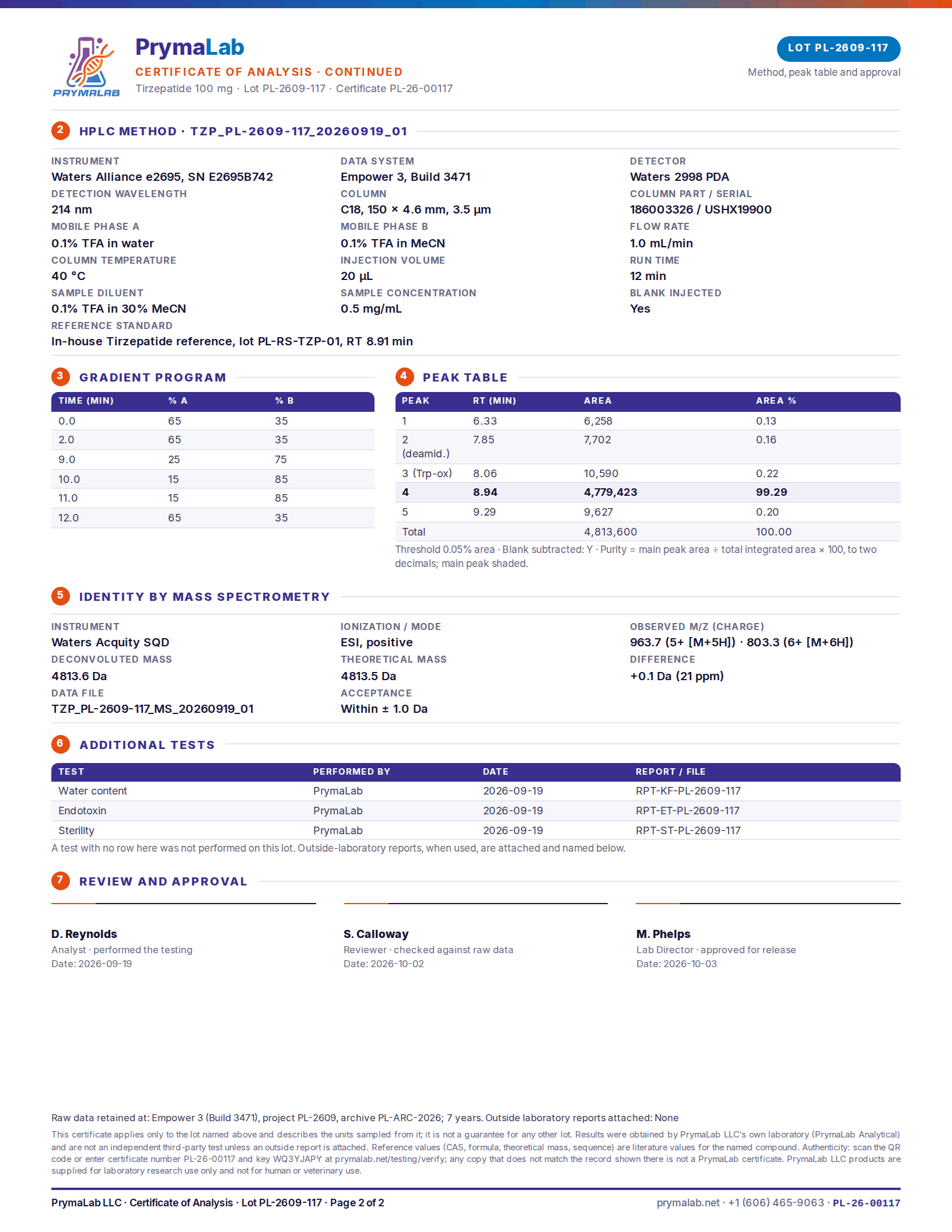
| Molar content | Approximately 20.8 µmol at roughly 4,813 g/mol |
| CAS | 2023788-19-2 |
| Backbone | GIP analogue, 39 residues, C-terminally amidated |
| Acylation | C20 fatty diacid via a linker at lysine 20 |
| Position in range | Tenth of ten. The largest fill offered |
| Cake depth | The greatest in the range for a given vial diameter |
| Why depth matters | Sublimation proceeds from the surface down. Deeper cakes dry less uniformly |
| Residual moisture | The dominant variable in solid state peptide stability, per the formulation literature |
| Typical target | Under one percent water by mass for a lyophilised peptide |
| Method that measures it | Karl Fischer titration, coulometric for small samples |
| Reported on research certificates | Rarely. Ask for it on a fill this size |
| Storage, lyophilised | -20°C, sealed, dark and dry |
| Storage, reconstituted | 2-8°C, protected from light |
| Regulatory status | No approved human or veterinary formulation is supplied here |
Why Does a Tirzepatide 100mg Cake Dry Differently?
Because sublimation in a tirzepatide 100mg cake works from the surface down, and a deeper cake gives the water vapour further to travel.
Primary drying removes ice by sublimation. The vapour has to escape through the dried layer above it, and that layer gets thicker as drying proceeds, so resistance rises as the front moves down.
On a shallow cake the front reaches the bottom quickly. On a deep one it takes longer, and if the cycle was designed for a shallower fill it may not get there properly at all.
Secondary drying then removes the water that is bound rather than frozen, and it faces the same geometry.
The result is that a thick cake can finish with more residual water at the bottom than at the top, from one cycle, in one vial.
Does the Water Actually Matter?
Water is the largest single variable in solid state peptide stability, which is the settled position in the formulation literature rather than my opinion.
Water plasticises an amorphous solid. Above a certain moisture content the glass transition temperature drops toward storage temperature, molecular mobility rises, and the chemical routes that were frozen out start running again.
Hydrolysis needs water as a reagent. Deamidation needs it. Both are slow in a properly dried cake and much less slow in a damp one.
A target under one percent by mass is the usual figure for a lyophilised peptide.
What nobody reports is the distribution. A certificate quoting a single water content is quoting one number for a sample that came from somewhere in the cake, and on a deep cake that somewhere matters.
One qualifier on all of that. Everything above is drawn from the formulation literature on proteins and peptides in general, and none of it is specific to tirzepatide.
I have not found published stability data for this compound at defined moisture contents. What is published is the general relationship, which is well established and which there is no reason to think this molecule escapes.
So read this section as the reason to ask for a number rather than as a prediction of what happens at any particular one.
The general relationship is enough to act on. A cake with two percent water in it is a different storage proposition from one with half a percent, on any peptide anybody has looked at.
That is as far as I will push it without lot-specific data.
How Would You Detect It?
Karl Fischer titration on a tirzepatide 100mg sample, and the coulometric version if the sample is small.
The method is specific for water rather than for anything volatile, which is why it is the pharmacopoeial answer and why loss on drying is not an adequate substitute.
The awkward part is sampling. Measuring a moisture gradient means taking material from more than one depth in the cake, which destroys the cake and needs several vials to do properly.
No research supplier is going to do that per lot, and I would not expect it.
A single water content figure is still worth asking for. It bounds the problem, and a supplier who has the number has run the assay at least once.
If the figure comes back above two percent on a fill this size, that is worth a conversation before the vial gets opened.
What Should the Certificate Show?
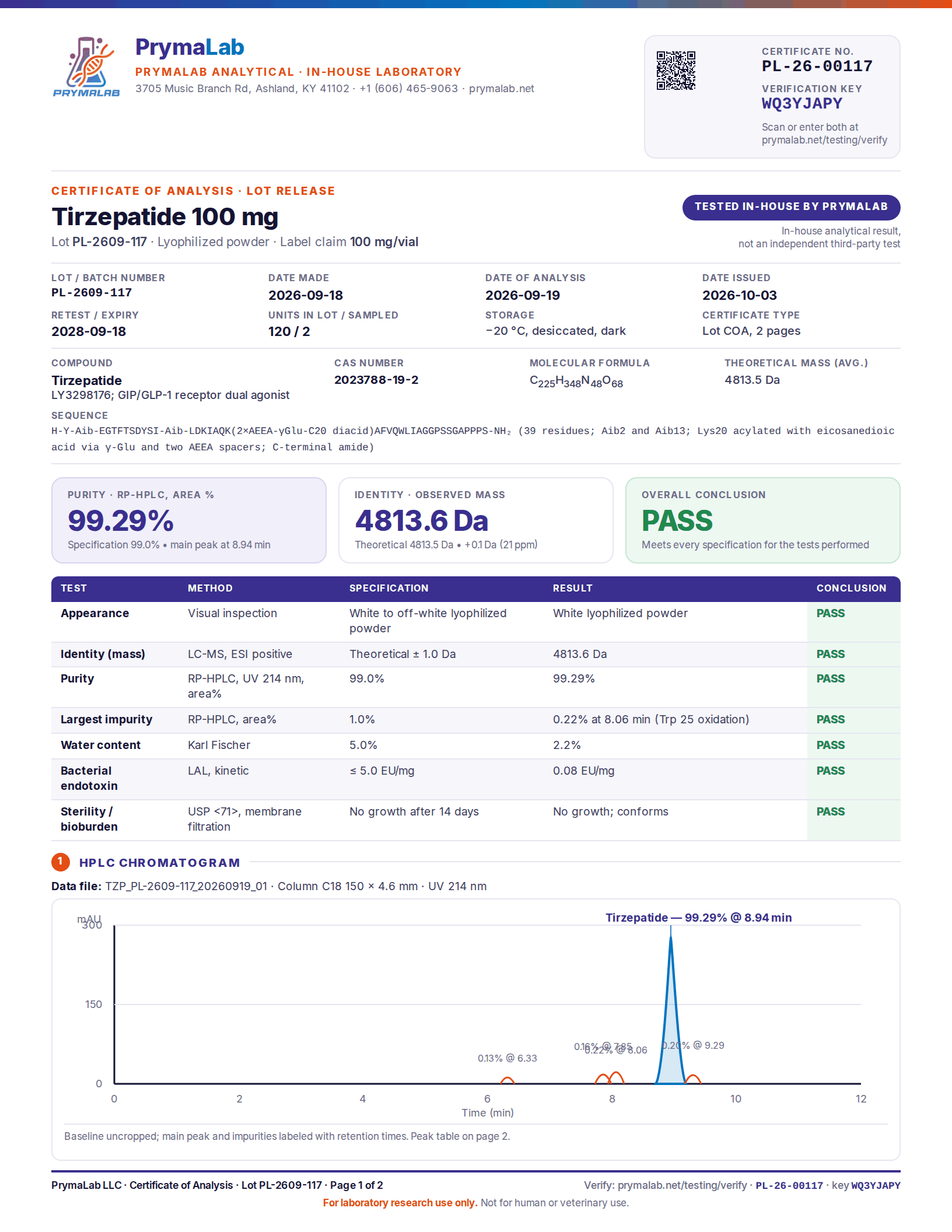
A tirzepatide 100mg certificate needs everything a smaller fill needs, and water content as an explicit row.
Net peptide content with the determination named.
The sequence, with the acylation site given.
Observed mass by spectrometry against calculated, and chromatographic purity with the method stated.
Aggregate content by size exclusion, which matters most on the largest fill because there is most material to aggregate.
Water content by Karl Fischer, with the number rather than a pass or fail.
Salt form, lot number and manufacturing date.
What Is a Tirzepatide 100mg Vial Actually For?
Animal work, or a shared facility, and I would push back on any other reason.
Twenty point eight micromoles is an enormous quantity by in vitro standards. Reconstituted into 3 millilitres it is a 33 mg/mL stock, roughly 7 millimolar, which is thousands of times any published assay concentration.
A cell biology programme buying this fill has bought several years of material and will spend those years opening the same vial.
That is the failure mode. Not the cake, not the water, but a laboratory holding a five figure quantity of an acylated peptide and treating the vial as a supply rather than as a sealed lot with a finite handling budget.
If the answer is animal work at scale, or several groups drawing from one purchase, the fill makes sense and the drying question above is the thing to ask about.
What Should Be Done on the First Opening?
Split a tirzepatide 100mg cake, and split it that day.
A hundred milligrams portioned into ten sealed vials of ten is ten independent objects with one shared lot number and one shared certificate.
Each of them can be stored separately, opened once, and reconstituted to whatever concentration the work needs rather than to whatever 3 millilitres of diluent produces.
The portioning error on a four-figure balance is a few percent per portion, weighed in one session, and every portion inherits the same lot.
Against that, leaving the cake intact means every future draw is another opening of the same glass, another equilibration to room temperature, and another chance for the room to put water into a cake you paid to have dried.
I would take the weighing error. It is one-time and quantifiable, which is more than can be said for cumulative exposure.
What Would Change My Mind About This Fill?
A supplier reporting water content per lot, and a tirzepatide 100mg cycle designed for that fill rather than borrowed from a smaller one.
Neither is unreasonable to ask for and neither is common.
The lyophilisation cycle is the part buyers never see. A freeze dryer runs a recipe: freezing rate, shelf temperature during primary drying, chamber pressure, then a secondary drying ramp. That recipe is developed for a particular fill volume in a particular vial.
Run the same recipe on a deeper cake and primary drying may not finish before the shelf temperature rises, which is how you get partially collapsed cake and trapped water.
You can sometimes see it. A cake that has shrunk away from the vial wall, or one with a glassy rather than a matte appearance, or one that has slumped, has had a cycle problem.
Look at the cake before adding anything. It is the only piece of process information a buyer gets for free.
Where the Cake Comes From
Worth knowing what a lyophilised cake actually is, because the word suggests something denser than the reality.
The solution is frozen first. Water crystallises out as ice and everything dissolved in it concentrates into the channels between the ice crystals.
Sublimation then removes the ice and leaves the solids behind as a porous scaffold with the shape of the space the ice used to occupy.
So a cake is mostly void. Its structure is a fossil of the ice crystals, and how fast the freezing step ran determines how large those crystals were and therefore how open the pores are.
Fast freezing gives small crystals and fine pores, which dry slowly because vapour has further to squeeze. Slow freezing gives large crystals and open pores, which dry faster and give a more fragile cake.
On a deep fill that trade matters more, because the vapour has more cake to get out through either way.
How Should the Vial Be Handled?
As an acylated peptide with a portioning decision that has to be made immediately.
Bring it to room temperature sealed. On a large cold cake the condensation risk is proportionally worse, because there is more surface for room air to reach.
Weigh the sealed vial and write the number down before anything else happens.
Portion the solid, in one session, with the vials and the balance ready before the stopper comes out.
For whatever is reconstituted: diluent down the wall, gentle rotation, no shaking, then aliquot into single-use volumes and refrigerate.
Do not freeze a reconstituted acylated peptide, and use low-binding consumables from the first dilution.
Published Literature
Full citations for the work named above, each confirmed against the publisher record. The lyophilisation reference is a review of solid protein pharmaceuticals rather than anything specific to this compound.
- Wang W. International Journal of Pharmaceutics. 2000;203(1-2):1-60. DOI: 10.1016/S0378-5173(00)00423-3
- Willard FS, Douros JD, Gabe MB, Showalter AD, Wainscott DB, Suter TM, et al. JCI Insight. 2020;5(17):e140532. DOI: 10.1172/jci.insight.140532
- Sun B, Willard FS, Feng D, Alsina-Fernandez J, Chen Q, Vieth M, et al. Proceedings of the National Academy of Sciences. 2022;119(13):e2116506119. DOI: 10.1073/pnas.2116506119
- Manning MC, Chou DK, Murphy BM, Payne RW, Katayama DS. Pharmaceutical Research. 2010;27(4):544-575. DOI: 10.1007/s11095-009-0045-6
Frequently Asked Questions
What is a tirzepatide 100mg vial?
The largest of ten fill sizes in this catalogue, holding 100 milligrams of tirzepatide, about 20.8 micromoles at roughly 4,813 g/mol. It is lyophilised powder supplied for laboratory research only.
Why does cake thickness matter?
Freeze drying removes water by sublimation from the surface downward, and the vapour escapes through the dried layer above. A deeper cake gives that vapour further to travel, so it dries less uniformly and can finish with more residual water at the bottom than the top.
How much residual water is acceptable?
Under one percent by mass is the usual target for a lyophilised peptide. The number that matters is the one measured on your lot, and most research certificates do not carry it.
Why does residual water affect stability?
Water plasticises an amorphous solid, lowering the glass transition temperature toward storage temperature and raising molecular mobility. It is also a reagent for hydrolysis and for deamidation. A damp cake runs chemistry a dry one does not.
How is water content measured?
Karl Fischer titration, coulometric for small samples. It is specific for water, which is why loss on drying is not an adequate substitute: loss on drying counts any volatile.
Can I measure the moisture gradient myself?
Only by destroying cakes. Sampling at more than one depth means opening and dismantling vials, and doing it properly needs several. A single water content figure from the supplier bounds the problem without answering it.
How many micromoles are in the vial?
About 20.8, taking the molecular weight as roughly 4,813 g/mol. Reconstituted into 3 millilitres that gives a 33 mg/mL stock, close to 7 millimolar.
What is a tirzepatide 100mg fill actually for?
Animal work at scale, or a shared facility supplying several groups from one purchase. For in vitro work it is several years of material, and holding it that long means opening the same vial many times.
Should I split the cake?
Yes, on the first opening, into sealed portions sized to a working period. Portioning costs a few percent weighing error once. Leaving the cake intact costs a room-temperature equilibration and a fresh headspace every single time you go back to it.
What should a tirzepatide 100mg certificate of analysis show?
Net peptide content with the method, sequence with the acylation site, observed mass against calculated, chromatographic purity with the method named, aggregate content by size exclusion, water content by Karl Fischer as a number, salt form and lot details.
How should the vial be stored?
Sealed lyophilised powder at minus 20 degrees Celsius, dark and dry. Reconstituted solution at 2 to 8 degrees, protected from light, in single-use aliquots. Do not freeze the solution.
Is this product for human use?
No. What is in this vial is research material for a laboratory. It is not a drug, food, cosmetic or dietary product, the FDA has not evaluated it, and giving it to a person or an animal is not something it is sold for.
Compliance Statement
Tirzepatide 100mg is supplied exclusively for laboratory research use. It is not a drug, food, cosmetic or dietary product of any kind. It has not been evaluated by the FDA or any comparable authority, and no approved human or veterinary formulation is supplied here. It is not intended to diagnose, treat, cure or prevent any disease, and it must not be given to humans or animals. Purchase is restricted to qualified researchers and institutions.


18 reviews for Tirzepatide 100mg