
Description
PrymaLab · Research Use Only
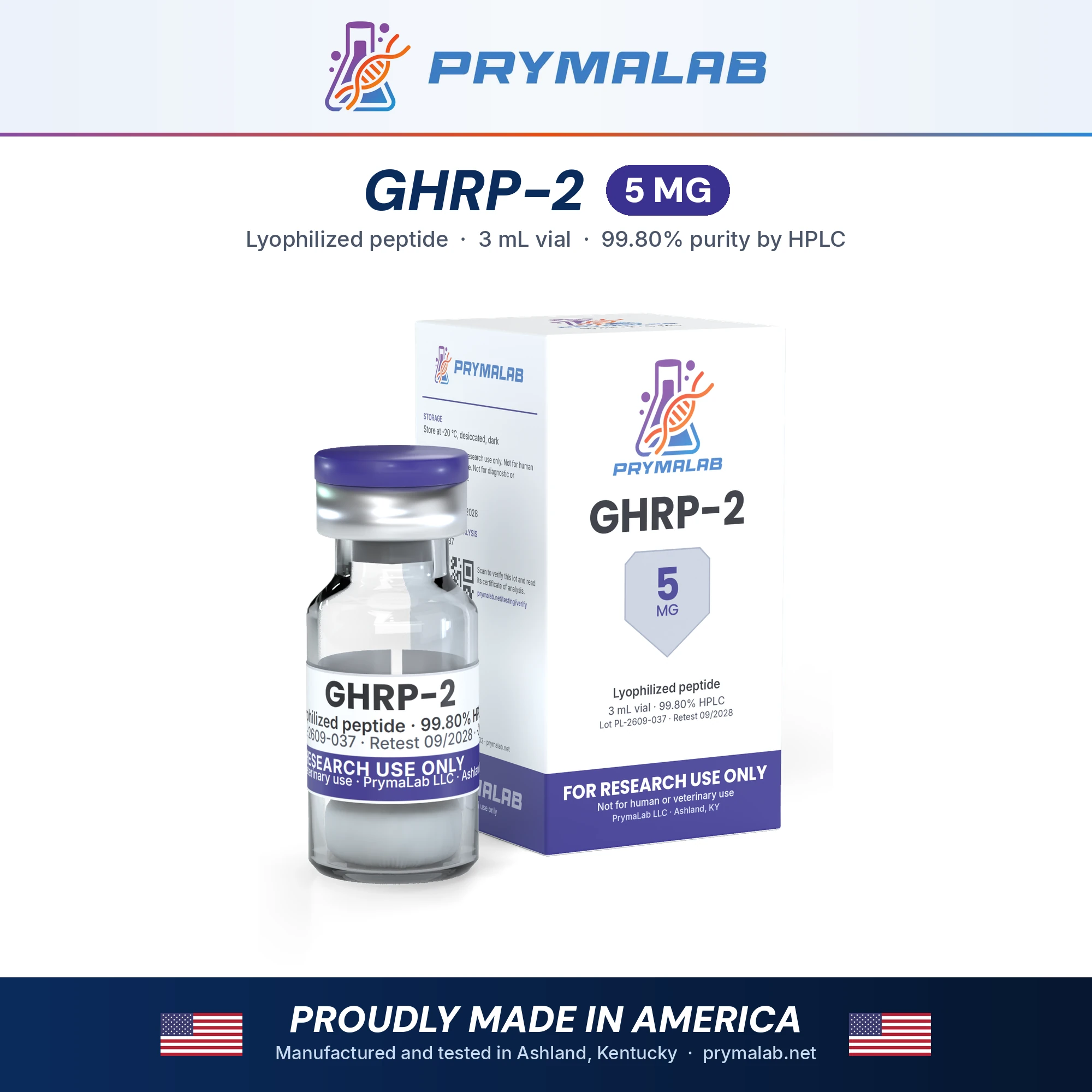
GHRP-2 5mg
About 6.1 micromoles · Amidated at the C terminus, and the impurity that hides there
GHRP-2 5mg holds about 6.1 micromoles of a hexapeptide that ends in an amide rather than a free acid. That amide is a synthesis step. When it fails, the product weighs 0.98 daltons more and looks almost identical on a column. It is the commonest defect on this class of peptide and the hardest one for a routine certificate to catch.
Specification Table
| Property | Value |
|---|---|
| Compound | GHRP-2 |
| Alternative name | Pralmorelin |
| Class | Growth hormone releasing peptide, hexapeptide |
| Nominal fill | 5 mg |
| Molecular weight, calculated | Approximately 818.0 g/mol for the free base |
| Molar content | Approximately 6.1 µmol |
| CAS | 158861-67-7 |
| Carboxy terminus | Amidated |
| Free acid impurity mass difference | 0.98 daltons heavier than the amide |
| Chromatographic separation of the two | Poor. The free acid elutes close to the parent on reverse phase |
| Instrument required to resolve it | High resolution mass spectrometry, not a routine quadrupole |
| D-configuration residues present | Three |
| Non-coded residue present | A naphthylalanine residue |
| Receptor | GHS-R1a |
| Storage, lyophilised | -20°C, sealed, dark and dry |
| Storage, reconstituted | 2-8°C, protected from light |
| Regulatory status | No approved human or veterinary formulation is supplied here |
Why Does the C Terminus Matter on GHRP-2?
Because a GHRP-2 5mg vial ends in an amide rather than a free acid, and the amide is doing work.
C-terminal amidation is a real post-translational modification in endogenous peptides, carried out by a dedicated enzyme system, and it changes the electronics at the end of the chain. The review by Eipper and colleagues cited below covers the biosynthesis.
In a synthetic peptide the amide comes from the resin chemistry rather than from an enzyme, and it either happened or it did not.
When it did not, you have the free acid: the same six residues, an extra oxygen where the nitrogen should be, and a molecule 0.98 daltons heavier.
Removing the amide removes a positive charge contribution at the terminus and adds a negative one at neutral pH, which for a peptide binding a G protein coupled receptor is not a trivial edit.
Why Is It So Hard to See?
One dalton on 818 is 0.12 percent, and most of the analysis run on a GHRP-2 5mg lot cannot resolve that.
A routine single quadrupole mass spectrometer running unit resolution reports a nominal mass. An 818 and an 819 are distinguishable in principle, but at the peak widths and isotope patterns involved a small free acid population sits inside the isotope envelope of the parent.
The carbon-13 isotope peak of the amide is already one dalton above the monoisotopic peak, and it is there in every sample at about 40 percent relative intensity for a molecule this size.
So a free acid impurity adds intensity to a peak that is supposed to be there anyway.
Chromatography does not rescue it either. The free acid is slightly more polar and elutes marginally earlier, and on the shallow gradients used for routine purity work the two are not baseline resolved.
High resolution mass spectrometry does resolve it, because 0.984 daltons is unambiguous at a resolution of tens of thousands. Very few research suppliers have one.
Worth adding that the same problem runs in reverse on any peptide where the free acid is the intended product and the amide is the impurity. The direction of the error changes and the detection difficulty does not.
Every amidated peptide in this catalogue carries it. Kisspeptin-10, semax, selank, the GHRP family and the bioregulators with amidated termini are all in the same position.
This page happens to be where the argument got written down.
If you buy amidated peptides regularly, the question is worth adding to whatever you send a new supplier. It sorts them faster than asking about purity does.
How Would You Ask About It?
Ask directly before ordering a GHRP-2 5mg vial, and the phrasing matters.
Ask whether the certificate confirms the C-terminal amide specifically, and by what method.
A supplier who answers with high resolution mass or with a method that separates the free acid has thought about it. One who says the purity is 99 percent has answered a different question.
Ask also for the observed monoisotopic mass rather than the average mass, because a monoisotopic figure implies an instrument that could resolve the difference.
Neither request costs anything, and neither is unusual for anybody who has bought amidated peptides before.
I would not expect most suppliers in this market to have the answer, and that is worth knowing before rather than after.
Does It Change the Experiment?
Probably, and I want to be careful about how strongly I put that.
The GHS-R1a literature is built on the amidated peptide. Bowers and colleagues characterised this family with the amide in place, and the receptor was cloned and characterised against amidated ligands.
A free acid population is therefore a different compound of unknown affinity present at an unknown percentage.
What I have not found is published work quantifying the affinity of free acid GHRP-2 specifically, so I cannot tell you the effect size.
What can be said without stretching is that a preparation containing both is a mixture, and a concentration calculated from vial mass counts both. So a nominal concentration overstates the amount of amidated peptide by whatever fraction is free acid.
That makes the concentration wrong rather than the compound wrong, which is the same framing the semax page in this catalogue uses for oxidation, and for the same reason.
What Does a GHRP-2 5mg Vial Support?
A GHRP-2 5mg fill is about 6.1 micromoles, which is a great deal for a compound used at nanomolar in vitro.
Reconstituted into 6.1 millilitres that gives a 1 millimolar stock, which is a convenient round number and one reason to choose that volume.
Published in vitro work on this receptor family runs several orders of magnitude below that, so a millimolar stock is a starting point for a long dilution series rather than anything to be used directly.
For animal work the arithmetic is different and 5 milligrams goes considerably faster.
The fill size question on this compound is therefore the same as on most of the catalogue: it depends entirely on whether the work is in a plate or in an animal, and the two answers are far apart.
What Should the Certificate Show?
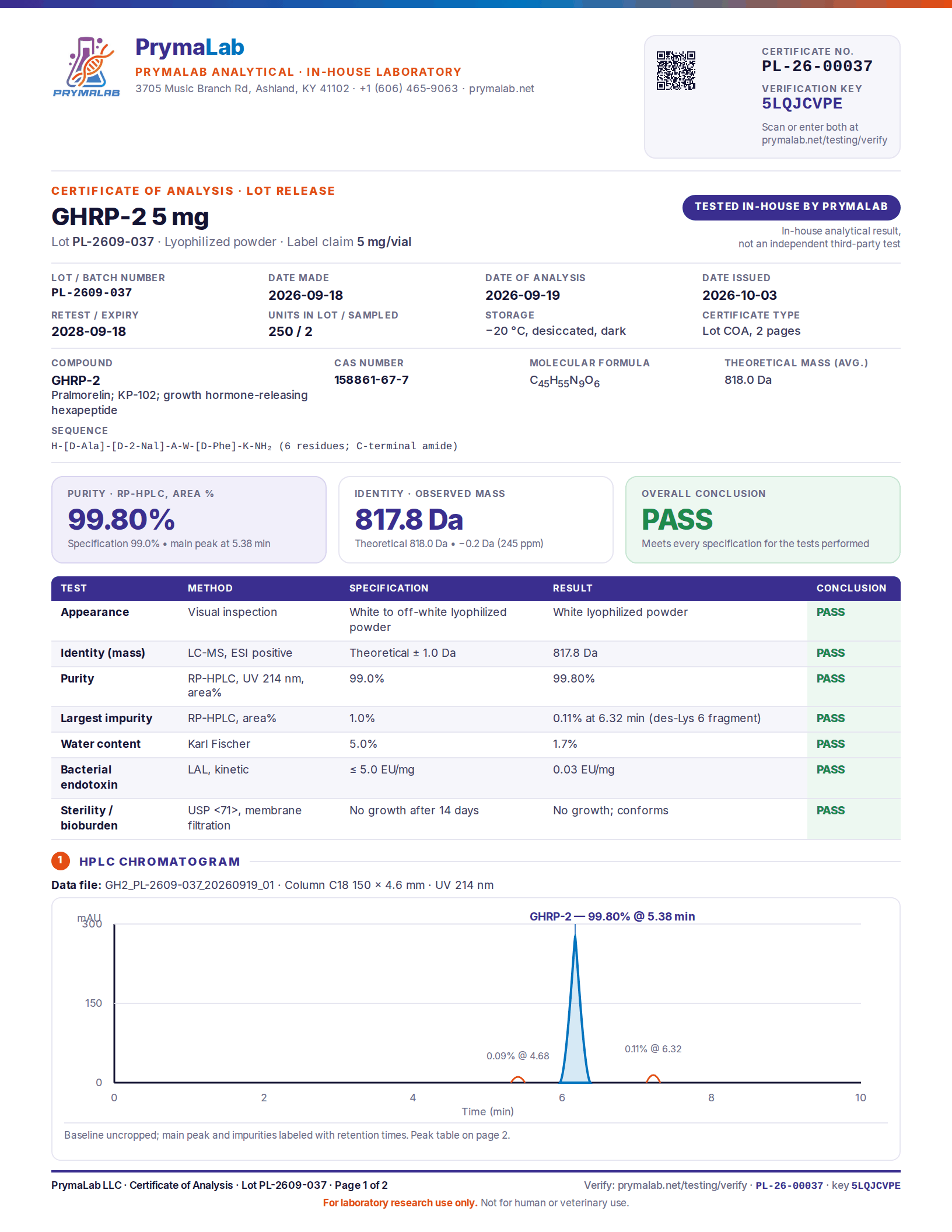
A GHRP-2 5mg certificate should carry the full six residue sequence, with the D-configuration positions and the naphthylalanine both identified.
The C-terminal amide, stated explicitly rather than implied by the compound name.
Observed mass against calculated, monoisotopic rather than average where the instrument allows it.
Purity by chromatography with the gradient and column named.
Net peptide content, and the salt form.
Lot number and manufacturing date.
What would be better than any of that is a note saying which method confirmed the amide, and I have never seen one.
Why Does This Argument Belong Here Rather Than on the 10mg Page?
Because the 10mg page is about what the compound is, and the GHRP-2 5mg page is about what the certificate does not tell you.
The parent page covers three things: the Japanese diagnostic approval, the selectivity trade against a cleaner secretagogue, and how this compound differs from GHRP-6. Those are identity questions and they belong on the page somebody lands on when they search the compound name.
The amide question is a purchasing question. It affects what you should ask before money changes hands, and it applies to every amidated peptide in this catalogue rather than only to this one.
Putting it on the smaller fill means it sits on the page a first-time buyer is more likely to reach.
That is an editorial judgement rather than a chemical one. I am stating it so the split makes sense to anyone reading both.
What About the Other Two D-Residues?
They matter for stability rather than for analysis, and they are worth separating from the amide question.
D-alanine at position one and D-phenylalanine at position five, with the D-naphthylalanine at position two, give this hexapeptide protease resistance well beyond what six residues would otherwise offer.
Aminopeptidases work from the N terminus and are stereospecific, so a D-residue in position one stops them almost completely.
None of that helps in a vial, where there are no proteases. It helps in a biological matrix, which is where the design was aimed.
For the certificate the consequence is that the stereochemistry has to be right and cannot be confirmed by mass or by ordinary chromatography. Chiral analysis after hydrolysis is the method, and it is not run.
How Should the Vial Be Handled?
Handle a GHRP-2 5mg vial as a small peptide carrying a tryptophan. That is the practical caution.
Keep it sealed at minus 20 degrees Celsius, in the dark and dry. The tryptophan is photosensitive and the vial should stay in the dark whether or not anyone is watching.
Room temperature before opening. Diluent down the wall, gentle rotation.
Aliquot the solution into single-use volumes and refrigerate, because a 1 millimolar stock is enough for a very long time and repeated draws are repeated warmings.
The three D-residues give this peptide real protease resistance, which matters in a biological matrix and not at all in a sealed vial.
Low-binding consumables are worth using at the dilute end of a series, where a hexapeptide at nanomolar is a small amount of material spread over a lot of plastic.
Published Literature
Full citations for the work named above, each confirmed against the publisher record. The amidation reference describes the biosynthesis of the modification rather than this compound, and no published work quantifying free acid GHRP-2 affinity was found.
- Bowers CY, Momany FA, Reynolds GA, Hong A. Endocrinology. 1984;114(5):1537-1545. DOI: 10.1210/endo-114-5-1537
- Howard AD, Feighner SD, Cully DF, Arena JP, Liberator PA, Rosenblum CI, et al. Science. 1996;273(5277):974-977. DOI: 10.1126/science.273.5277.974
- Eipper BA, Stoffers DA, Mains RE. Annual Review of Neuroscience. 1992;15:57-85. DOI: 10.1146/annurev.ne.15.030192.000421
- Manning MC, Chou DK, Murphy BM, Payne RW, Katayama DS. Pharmaceutical Research. 2010;27(4):544-575. DOI: 10.1007/s11095-009-0045-6
Frequently Asked Questions
What is a GHRP-2 5mg vial?
A lyophilised research vial holding 5 milligrams of GHRP-2, also called pralmorelin, which is about 6.1 micromoles at roughly 818 g/mol. It is sold strictly for laboratory research, and not for anyone to consume.
What is the C-terminal amide impurity?
The free acid form, in which the amidation step of the synthesis did not complete. It has the same six residues and weighs 0.98 daltons more, because an oxygen sits where the amide nitrogen should be.
Why can routine analysis not detect it?
One dalton on 818 is 0.12 percent. A unit resolution mass spectrometer puts a free acid population inside the carbon-13 isotope peak of the parent, which is present anyway. On reverse phase the free acid elutes only marginally earlier and is not baseline resolved on a routine gradient.
What instrument would detect it?
High resolution mass spectrometry. A mass difference of 0.984 daltons is unambiguous at a resolving power of tens of thousands. Few research peptide suppliers have that instrument.
Does the free acid still work?
I do not know, and I have not found published work quantifying its affinity. The GHS-R1a literature was built on the amidated peptide. A preparation containing both is a mixture, and a concentration calculated from vial mass counts both, so the nominal concentration overstates the amidated fraction.
What should I ask a supplier?
Whether the certificate confirms the C-terminal amide specifically and by what method, and for the observed monoisotopic mass rather than the average. Both requests are free and the answers are more informative than the purity figure.
How many micromoles are in the vial?
About 6.1, taking the molecular weight as roughly 818 g/mol. Reconstituted into 6.1 millilitres, that gives exactly 1 millimolar.
What should a GHRP-2 5mg certificate of analysis show?
The six residue sequence with the D-configuration positions and the naphthylalanine identified, the C-terminal amide stated explicitly, observed mass against calculated, chromatographic purity with the method, net peptide content, salt form and lot details.
Why does GHRP-2 contain D-amino acids?
They give protease resistance, which is substantial for a peptide only six residues long. There are three of them. That matters in a biological matrix and makes no difference to a sealed vial.
Is 5mg enough for in vitro work?
Comfortably. Six micromoles reconstituted to 1 millimolar gives 6.1 millilitres of stock, and published in vitro concentrations for this receptor family run several orders of magnitude below that. Animal work consumes it far faster.
How should the vial be stored?
Keep it sealed at minus 20 degrees Celsius, in the dark and dry. The tryptophan in the sequence is photosensitive, which is why dark is not optional here. Reconstituted solution at 2 to 8 degrees in single-use aliquots.
Is this product for human use?
No. This is material for a laboratory bench. It is not a drug, food, cosmetic or dietary product, the FDA has not assessed it, and administering it to a person or an animal is not a permitted use.
Compliance Statement
GHRP-2 5mg is supplied exclusively for laboratory research use. It is not a drug, food, cosmetic or dietary product of any kind. GHRP-2 is approved in Japan as a diagnostic agent under a different name and manufactured to pharmaceutical standards there; material supplied here is not that product and is not manufactured to those standards. It has not been evaluated by the FDA. It is not intended to diagnose, treat, cure or prevent any disease, and it must not be given to humans or animals. Purchase is restricted to qualified researchers and institutions.
Other formats of GHRP-2
GHRP-2 is also stocked as GHRP-2 Nasal Spray, GHRP-2 10mg preloaded 3ml pen and GHRP-2 10mg. Each listing states its own quantity and concentration, and the pen and vial comparison explains what changes between formats.









19 reviews for GHRP-2 5mg