Description
PrymaLab · Research Use Only
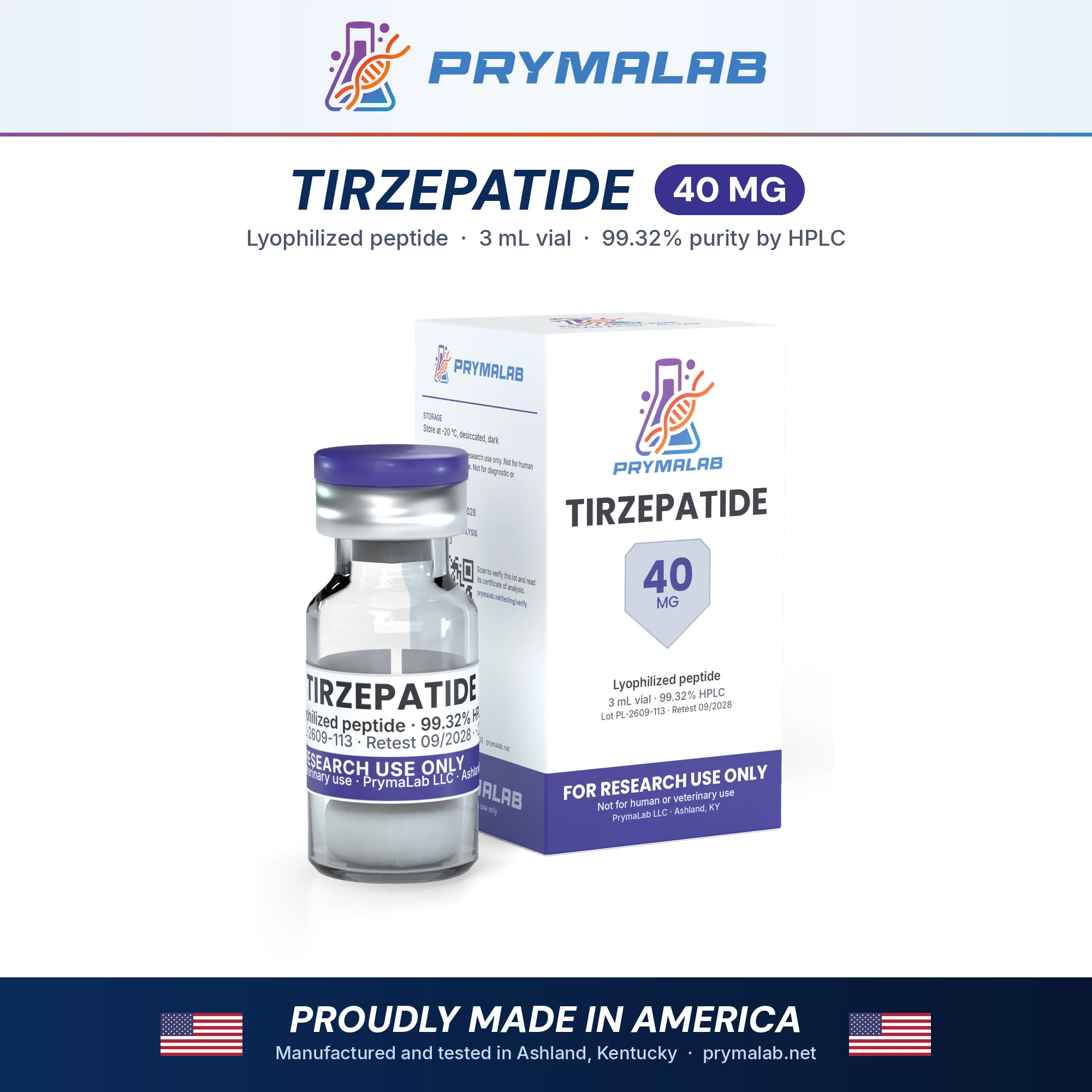
Tirzepatide 40mg
Around 8.3 micromoles · The fill that starts arguing with the vial it sits in
A tirzepatide 40mg vial contains about 8.3 micromoles of a roughly 4.8 kilodalton acylated peptide. The interesting constraint at this fill is not the peptide. It is the glass. A vial has a finite internal volume, and above a certain fill the diluent you would like to add stops fitting, which quietly sets a floor under the stock concentration you can prepare.
Specification Table
| Property | Value |
|---|---|
| Product format | Lyophilised powder, single vial |
| Peptide content | 40 mg |
| Molar content | Approximately 8.3 µmol at roughly 4,813 g/mol |
| CAS | 2023788-19-2 |
| Backbone | GIP analogue, 39 residues, C-terminally amidated |
| Acylation | C20 fatty diacid via a linker at lysine 20 |
| Typical vial format | 3 mL nominal capacity in this catalogue |
| Working volume available | Less than nominal. Headspace and stopper displacement take a share |
| Concentration at 2 mL | 20 mg/mL |
| Concentration at 3 mL | 13.3 mg/mL, and 3 mL is the nominal ceiling |
| Concentration at 4 mL | 10 mg/mL, which this vial will not hold |
| Solubility | Soluble in bacteriostatic and sterile water |
| Storage, lyophilised | -20°C, sealed, dark and dry |
| Storage, reconstituted | 2-8°C, protected from light |
| Regulatory status | No approved human or veterinary formulation is supplied here |
Why Does a Tirzepatide 40mg Vial Argue With Its Own Diluent?
Because a tirzepatide 40mg vial is a fixed volume and the peptide inside it is not.
Take a 3 millilitre vial, which is what this fill ships in, put 40 milligrams of powder in it, and then decide what stock concentration you want.
At 2 millilitres of diluent you get 20 mg/mL. At 3 you get 13.3, and 3 is the nominal ceiling, so in practice you get somewhat less because the cake occupies space and the stopper displaces more.
If the work calls for 10 mg/mL you need 4 millilitres, and there is nowhere to put it.
So the fill size has quietly decided your stock concentration, and it decided upward, which is the reverse of what anybody assumes they are buying when they buy more.
Does That Actually Cause a Problem?
Sometimes, and the cases where it does are specific enough to name.
A concentrated stock needs a bigger dilution factor to reach working concentration, and every extra dilution step adds its own error. Going from 20 mg/mL to a nanomolar assay concentration is more serial steps than going from 5.
Viscosity is the other one. Concentrated peptide solutions pipette differently. Positive displacement tips behave better than air displacement at that end of the range.
Against that, a concentrated stock is more stable per unit volume in one respect: fewer millilitres to store, fewer tubes, less surface for adsorption.
I have not seen published work comparing degradation rates for the same peptide at 5 against 20 mg/mL, so I am not going to claim one is better. What I can say is that the fill size made the choice rather than the experiment, and that is worth noticing.
What If You Split the Cake First?
That solves it completely and it is the answer this page is pointing at.
Weigh the solid into portions before any diluent goes near it. Ten milligrams into each of four vials, and each of those reconstitutes to whatever concentration the work actually wants.
The volume ceiling only applies if you insist on dissolving the whole fill in its original container.
The cost is a weighing session with a balance, a set of clean vials and a still bench, plus the portioning error that comes with it. On a four-figure balance, ten milligram portions land within a few percent of each other.
That is a real cost and it is smaller than the cost of running a study at a concentration you did not choose.
Most people do not do this, which is why the volume ceiling is a live problem rather than a theoretical one.
One more thing in favour of splitting, which has nothing to do with volume. Portions stored separately are portions that cannot all be ruined at once.
A single reconstituted vial is one object. Drop it, contaminate it, leave it out over a weekend, and the whole purchase is gone. Four sealed portions survive three of those events.
That is not a chemistry argument and it is the reason most people who have lost a vial start splitting them.
What Concentration Should a Tirzepatide 40mg Stock Be?
Whatever the assay needs, worked backwards, then checked against what a tirzepatide 40mg vial will hold.
The order most people use is to buy the vial, add a round number of millilitres, calculate what concentration that gives, and work with it. The order that avoids this problem is the reverse.
Start from the highest concentration the assay will see. Multiply by the dilution factor you are comfortable with, usually somewhere between ten and a hundred fold in one step. That is your stock.
Then divide 40 milligrams by that stock concentration and see whether the answer is less than about 2.5 millilitres of usable volume.
If it is not, you are splitting the cake. There is no third option that does not involve accepting a stock concentration you did not pick.
What Should the Certificate Show?
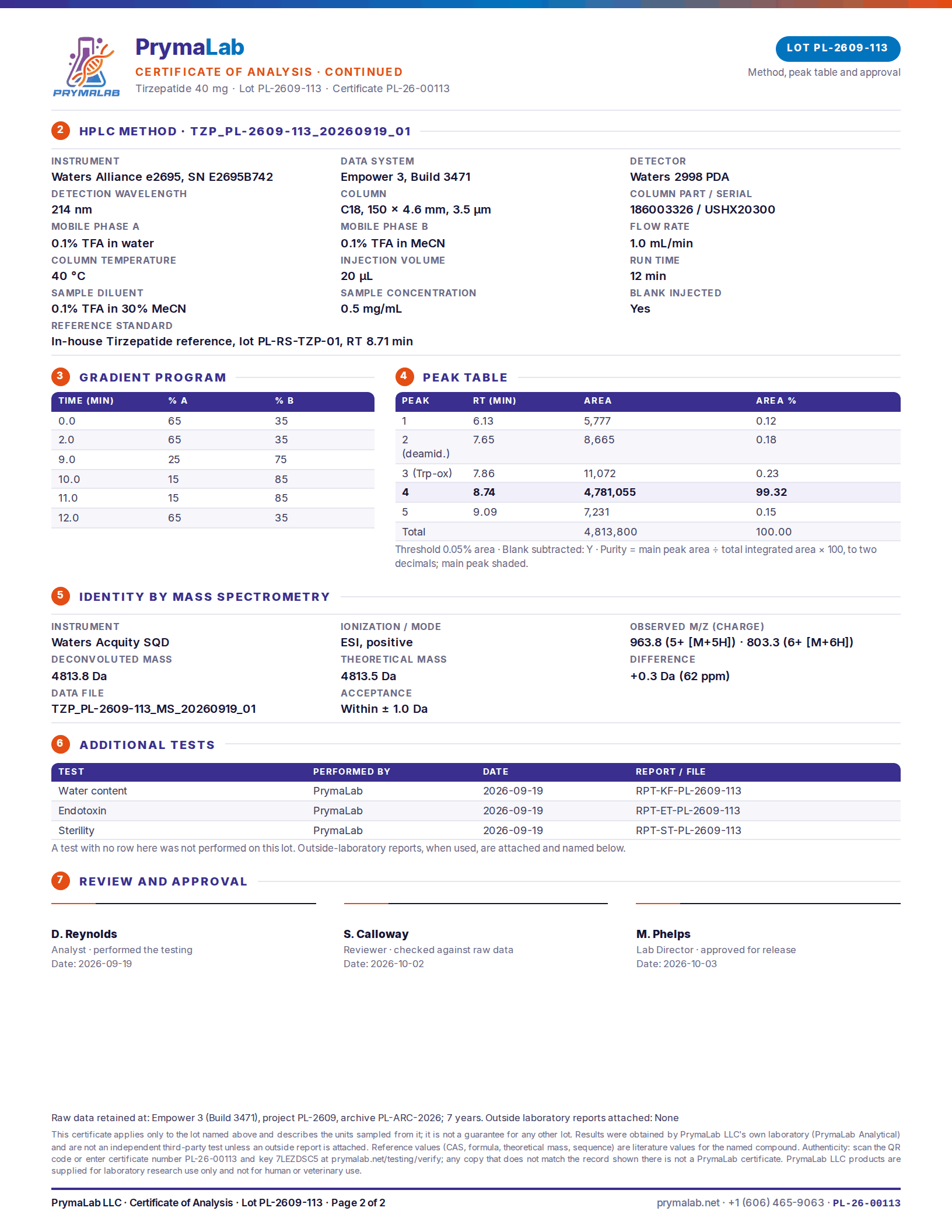
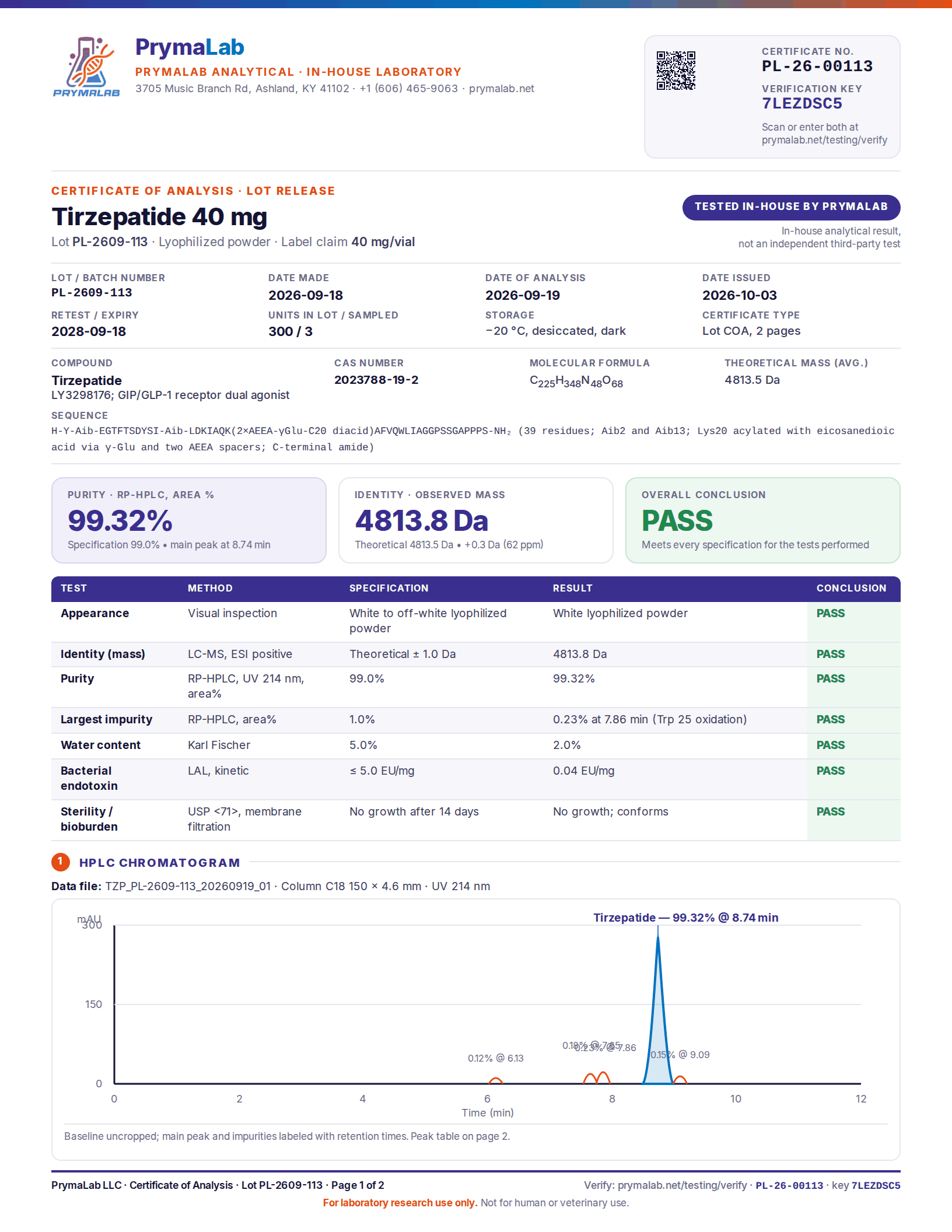
Net peptide content, with the method that determined it stated on the document.
The sequence, written out in full, with the position of the fatty acid attachment stated rather than left implicit.
Observed mass by spectrometry, against the calculated value.
Purity by chromatography. The column chemistry and the gradient both belong on the document, because a purity figure without a method is not reproducible.
Aggregate content by size exclusion, which matters more on a large fill because more material means more chances.
Salt form, and the lot number and manufacturing date.
What no certificate in this market gives you is the actual fill weight of your individual vial, which is a separate point and the 50mg page in this catalogue takes it up properly.
Where Does 40 Milligrams Sit in the Range?
Tirzepatide 40mg is seventh of ten, in the part of the range where the price curve has already flattened.
The sizes run 5, 10, 15, 20, 30, 40, 50, 60, 80 and 100: steps of five at the bottom, ten through the middle, twenty at the top.
By 40 the fixed cost of the vial, the stopper, the lyophilisation slot and the certificate has been spread thin enough that going bigger saves progressively less per milligram.
So the economic reason for choosing this size over the one below it is weaker than the reason for choosing 10 over 5.
What is left as a reason is consumption rate, and animal work is the pattern that consumes at this rate.
One consequence of the uneven spacing is that the gap above this fill is wider than the gap below it. Thirty to forty is ten milligrams. Forty to fifty is ten. Sixty to eighty is twenty.
So a requirement landing at 70 milligrams has no size that matches, and the buyer rounds to 80.
What Does the Vial Geometry Actually Cost?
Two things on a tirzepatide 40mg vial, and only one of them is obvious.
The obvious one is the volume ceiling this page opened with, and it is arithmetic rather than technique. A 3 millilitre vial cannot hold 4 millilitres.
The less obvious one is headspace. A vial filled close to the neck leaves almost no air above the liquid, which sounds efficient and makes every subsequent operation harder.
You cannot swirl a nearly full vial without wetting the stopper. You cannot invert it to draw the last of the contents without losing some to the closure. A needle entering a full vial displaces liquid rather than air, and it goes somewhere.
So the practical usable volume of a 3 millilitre vial is closer to 2.5, and the concentration arithmetic should use that number rather than the nominal one.
Forty milligrams into 2.5 millilitres is 16 mg/mL, which is the honest floor for this fill in its own container.
How Should the Vial Be Handled?
As an acylated peptide, with the portioning decision made before anything is opened.
Let it reach room temperature sealed. Cold glass pulls water straight out of room air.
Then decide, before anything else happens, whether you are splitting the solid. Do it now if so. After the first reconstitution that option has gone and it does not come back.
Run diluent down the wall rather than onto the cake, and rotate rather than shake. The fatty acid chain makes this molecule surface active and shaking makes foam.
Aliquot the solution into single-use volumes and refrigerate. Do not freeze a reconstituted acylated peptide.
Use low-binding consumables from the first dilution onward, because the same surface activity that makes foam makes it stick to plastic.
Published Literature
Full citations for the work named above, each confirmed against the publisher record. None of it concerns fill size, which is a purchasing question rather than a published one.
- Willard FS, Douros JD, Gabe MB, Showalter AD, Wainscott DB, Suter TM, et al. JCI Insight. 2020;5(17):e140532. DOI: 10.1172/jci.insight.140532
- Sun B, Willard FS, Feng D, Alsina-Fernandez J, Chen Q, Vieth M, et al. Proceedings of the National Academy of Sciences. 2022;119(13):e2116506119. DOI: 10.1073/pnas.2116506119
- Frias JP, Davies MJ, Rosenstock J, Perez Manghi FC, Fernandez Lando L, Bergman BK, et al. New England Journal of Medicine. 2021;385(6):503-515. DOI: 10.1056/NEJMoa2107519
- Manning MC, Chou DK, Murphy BM, Payne RW, Katayama DS. Pharmaceutical Research. 2010;27(4):544-575. DOI: 10.1007/s11095-009-0045-6
Frequently Asked Questions
What is a tirzepatide 40mg vial?
A lyophilised research vial holding 40 milligrams of tirzepatide, roughly 8.3 micromoles at about 4,813 g/mol. It is the seventh of ten fill sizes here, supplied for laboratory research only.
How much diluent does a tirzepatide 40mg vial take?
Less than you may want. The vial is 3 millilitres nominal, and the cake plus the stopper take a share of that, so usable volume is under 3. Forty milligrams into 2 millilitres is 20 mg/mL. Into 3 it is 13.3. A 10 mg/mL stock would need 4 millilitres, which will not fit.
What is the tirzepatide 40mg concentration if I fill the vial?
About 13.3 mg/mL at the nominal 3 millilitre mark, and somewhat higher in practice because usable volume is less than nominal. If the work requires a concentration below that, the cake has to be split before reconstitution.
Can I reconstitute in a different container?
Yes, and that is the straightforward fix if you want the whole fill in solution at a lower concentration. Transfer introduces a loss and an extra surface. Weigh that against the convenience, though splitting the solid into several vials is usually tidier than either.
Is a concentrated stock worse?
I do not know, and I have not found published work comparing degradation of the same acylated peptide at different stock concentrations. A concentrated stock needs more dilution steps to reach an assay concentration, and each step carries error. It also stores in fewer tubes with less surface area.
Why does the fill size affect concentration at all?
Because a vial holds a fixed volume. Below about 30 milligrams in a 3 millilitre vial you can pick almost any sensible stock concentration. Above that the arithmetic starts excluding the low end, and the exclusion gets worse with every step up the range.
How many micromoles are in the vial?
About 8.3, taking the molecular weight as roughly 4,813 g/mol. For comparison the 20mg fill is around 4.2 micromoles and the 100mg fill around 21.
What should a tirzepatide 40mg certificate of analysis show?
Net peptide content and the method behind it, the sequence with the acylation position, observed mass against calculated, chromatographic purity with the method stated, aggregate content by size exclusion, salt form, lot number and manufacturing date.
Should I buy this size or two smaller ones?
Two smaller vials give you two reconstitution volumes and two chances to pick a concentration. One larger vial gives you a single lot, with certainty, and a single volume constraint you did not choose. Which wins depends on whether your consumption rate finishes 40 milligrams inside the solution stability window.
Does the acylation change how it dissolves?
It makes the molecule surface active. So it foams when shaken, and it adsorbs to untreated plastic. Run diluent down the vial wall, rotate gently rather than shaking, and use low-binding consumables from the first dilution.
How should a tirzepatide 40mg vial be stored?
Sealed lyophilised powder at minus 20 degrees Celsius, dark and dry. Once reconstituted, 2 to 8 degrees, protected from light, aliquoted into single-use volumes. Do not freeze the solution.
Is this product for human use?
No. It is supplied for laboratory research only. It is not a drug, food, cosmetic or dietary product, has not been evaluated by the FDA, and must not be given to humans or animals.
Compliance Statement
Tirzepatide 40mg is supplied exclusively for laboratory research use. It is not a drug, food, cosmetic or dietary product of any kind. It has not been evaluated by the FDA or any comparable authority, and no approved human or veterinary formulation is supplied here. It is not intended to diagnose, treat, cure or prevent any disease, and it must not be given to humans or animals. Purchase is restricted to qualified researchers and institutions.


18 reviews for Tirzepatide 40mg