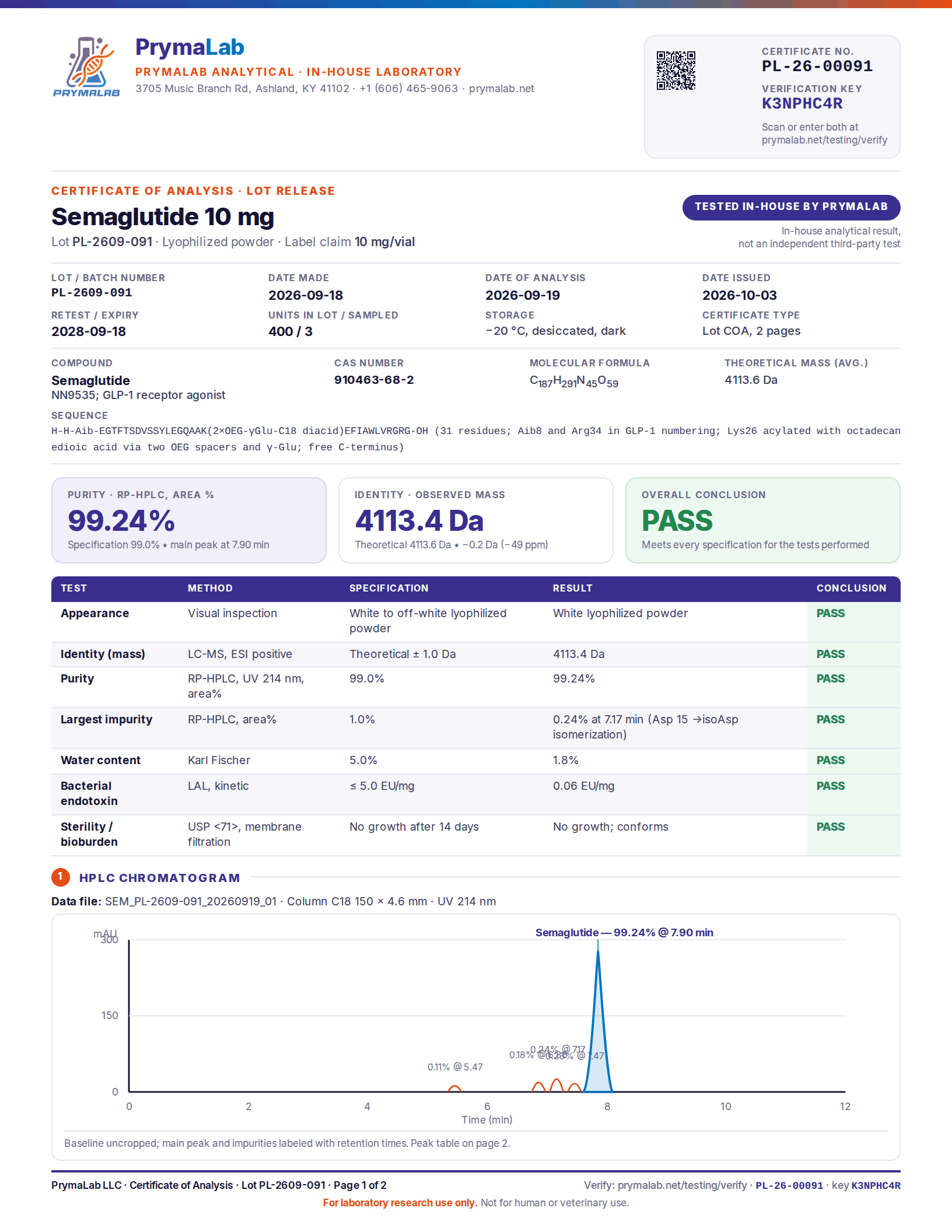
Description
PrymaLab · Research Use Only
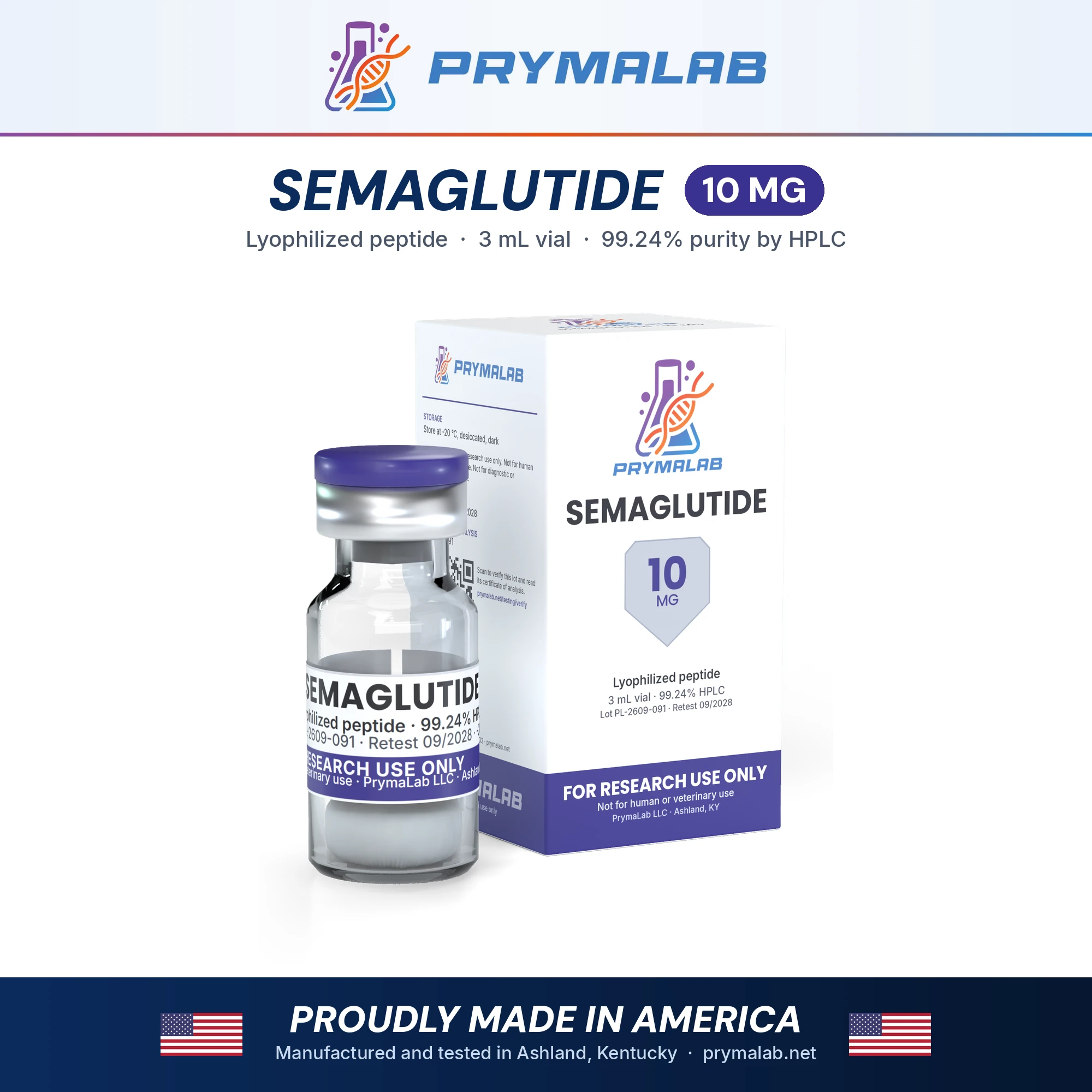
Semaglutide 10mg
One non-natural residue is the reason the molecule exists
Semaglutide peptide differs from the hormone it derives from at two positions and carries one attached side chain. Of those three changes, one is doing most of the work, and it is a residue that does not appear in any natural protein.
Specification Table
| Property | Value |
|---|---|
| Compound | Semaglutide |
| CAS number | 910463-68-2 |
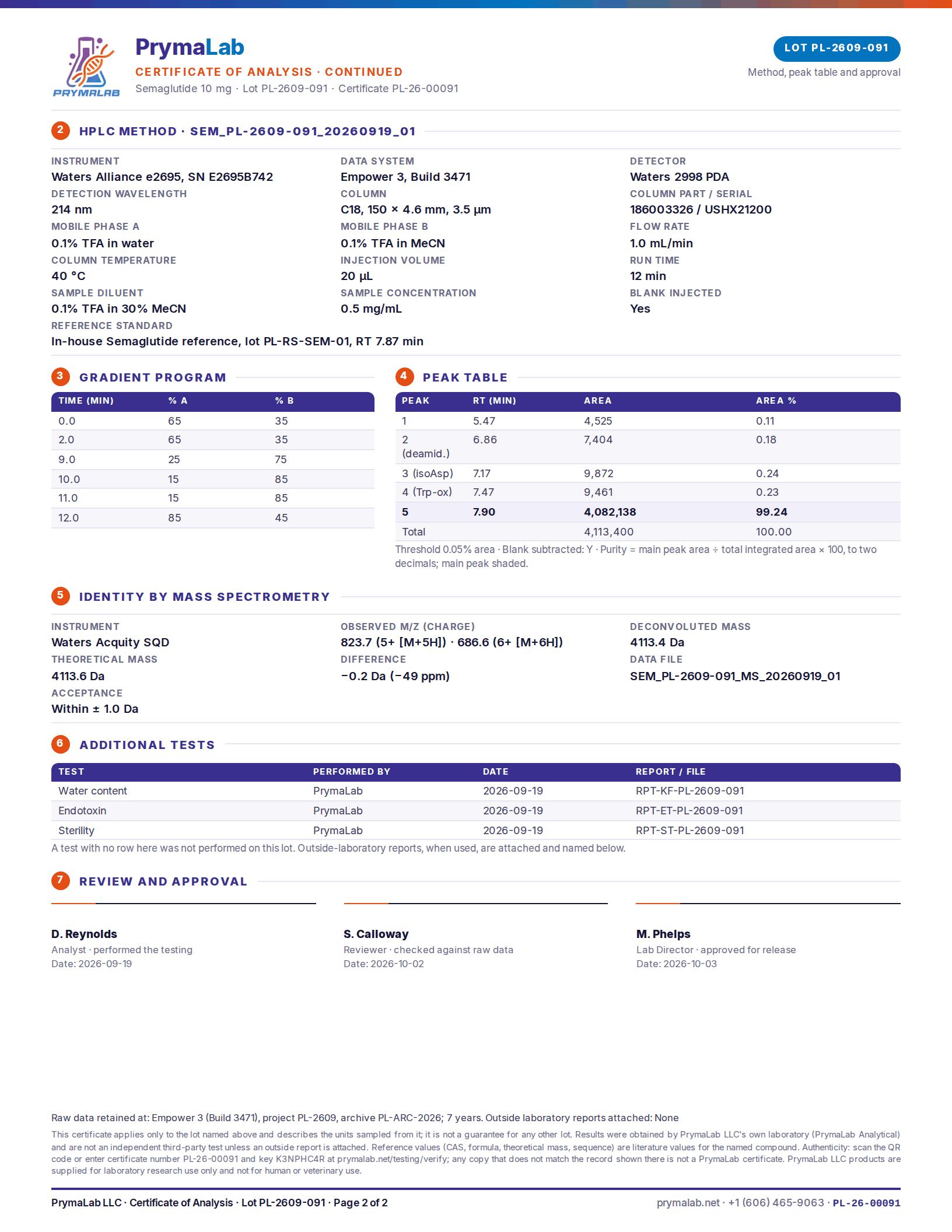
| Molecular formula | C187H291N45O59 |
| Molecular weight | Approximately 4113 |
| Residue count | Thirty-one |
| Parent hormone | Human GLP-1, in its 7 to 37 numbering |
| Substitution one | Aminoisobutyric acid replaces alanine at position 8 |
| Substitution two | Arginine replaces lysine at position 34 |
| Acylation site | The lysine at position 26 |
| Acylation chemistry | A C18 diacid attached through a glutamate and two short spacer units |
| Purpose of the Aib | Blocks dipeptidyl peptidase 4, which cleaves native GLP-1 after two residues |
| Purpose of the Arg34 | Leaves a single lysine available, so acylation goes to one defined site |
| Purpose of the acylation | Reversible albumin binding, which slows renal clearance |
| Reported target | The GLP-1 receptor |
| Vial | 10mg lyophilized |
| Related SKUs | Four other fill sizes exist. The compound is identical across all of them |
| Storage | Sealed at minus 20°C. Do not freeze reconstituted solution and do not agitate |
Why Does Position 8 Decide Everything?
The hormone semaglutide peptide derives from has a half life measured in a couple of minutes, which is short even by the standards of gut peptides.
The reason is a single enzyme. Dipeptidyl peptidase 4 removes two residues from the N terminus, and the truncated product does not engage the receptor.
The enzyme is specific about what it will cut. It requires particular residues at the first and second positions of the substrate, and position two of GLP-1 offers exactly what it wants.
Replacing that residue with something the enzyme cannot accommodate removes the cleavage route entirely.
Aminoisobutyric acid is the residue chosen for that job here. It is alanine with a second methyl group on the alpha carbon, which makes it achiral and sterically awkward in a way that natural residues are not.
It does not occur in any natural protein, because the ribosome has no codon for it and no transfer RNA carries it.
That single substitution takes the molecule from a two minute half life to something that can be extended further by other means, and without it nothing else about the design would be worth doing.
Lau and colleagues describe the reasoning across the whole molecule, and the account is unusually clear about which change bought which property.
What Do the Other Two Changes Do?
The second semaglutide peptide substitution replaces the lysine at position 34 with arginine, and its purpose is chemical rather than pharmacological.
Acylation attaches a fatty chain to a lysine side chain, and a peptide with two lysines offers two places for that to happen.
A preparation acylated at either site is a mixture of two different molecules, and separating them is difficult because they have identical mass.
Removing one of the two lysines makes the reaction site unambiguous, so the product is one compound rather than a pair.
That is a manufacturing decision with an analytical consequence, and it is the reason a certificate for this molecule can state an acylation position at all.
The third change is the acylation itself: a C18 diacid attached to the remaining lysine through a glutamate and two short spacer units.
The chain promotes reversible binding to serum albumin, and albumin-bound peptide is protected from renal filtration and from enzymatic access.
The bound and free forms exchange continuously, so albumin acts as a slow-release reservoir rather than as a permanent sink.
Taken together the three changes are a worked example of how a short-lived hormone becomes a weekly compound, and each one is doing a separate job.
Why Does Aib Complicate Verification?
The non-natural residue in semaglutide peptide creates analytical questions that a natural sequence does not.
Amino acid analysis after hydrolysis is a standard method for confirming composition, and it works by comparing against a panel of standards.
Aminoisobutyric acid is not in a default panel, so a laboratory running the standard method will either not see it or will not identify it correctly unless the method was set up for it.
Sequencing by Edman degradation has a related problem, since the chemistry was developed against natural residues.
Mass spectrometry handles it without difficulty, because the residue contributes a defined mass regardless of whether anyone has met it before.
That makes mass the primary identity method here rather than a supporting one, and it makes a certificate that reports only amino acid analysis less informative than it appears.
The related question is whether the residue is present at all. A synthesis that substituted alanine at that position would give a molecule fourteen daltons lighter with a dramatically shorter functional life, and fourteen daltons on 4113 is a third of a percent.
That is comfortably resolvable and comfortably missable, depending on the instrument.
One further consequence follows from the non-natural residue and it concerns synthesis rather than analysis.
The residue has to be introduced by chemical coupling like any other, and its second methyl group makes that coupling more sterically hindered than a natural residue at the same position.
Hindered couplings run to lower completion, and an incomplete coupling produces a deletion sequence rather than a wrong one.
A deletion at that position gives a molecule missing the residue entirely, which is a larger mass difference than a substitution and correspondingly easier to see.
That is the more reassuring of the two failure modes, and it is a reason to ask for the mass trace rather than only the purity number.
Why Is Semaglutide Peptide the Reference Compound?
Semaglutide peptide occupies an unusual position in the catalogue because it is what other compounds get compared against.
The published literature on newer incretin compounds routinely uses it as the active comparator rather than as the test article, which means a great deal of what is known about it was generated in studies designed to characterise something else.
That is a genuine advantage for anyone using it as a laboratory reference, because comparative data is abundant.
It also carries a caution that is easy to overlook.
A comparator arm is designed to be a fair benchmark rather than to explore the comparator, so the conditions chosen suit the test compound and the range covered may be narrower than the compound itself would warrant.
Reading a comparator arm as a characterisation of the comparator is a common error and it produces confident-sounding figures with less behind them than they appear to have.
Where this compound is being used as a reference in a design, the useful discipline is to source its parameters from work in which it was the subject, and to read comparator-arm figures as context.
There is a second reason this position in the literature is worth understanding rather than just noting.
A compound that appears in hundreds of papers as a benchmark accumulates a reputation that outruns its characterisation.
Figures get quoted from secondary sources, rounded, and quoted again, and the chain back to a primary measurement gets long.
On a molecule this widely referenced the discipline of checking where a number came from is worth more than it is on an obscure one, precisely because the number will look well established.
Why Do Five Fill Sizes Exist?
The catalogue lists semaglutide peptide at five quantities.
The molecule is identical in all of them and only the amount differs, which is worth stating because listings sometimes imply otherwise.
The practical difference is how long one lot covers a study.
A larger vial means one lot number, one reconstitution date and one degradation history across an entire dataset, which is good for internal consistency and concentrates the risk if that lot has a problem.
Smaller vials spread the risk and introduce lot-to-lot variation that a single vial would not have.
There is a second consideration specific to an acylated peptide, which is that a reconstituted solution has a shorter useful life than a sealed powder.
Buying more than a study will use within the solution stability window means either aliquoting and freezing, which this molecule tolerates poorly, or discarding material.
Sizing the purchase to the study rather than to the price per milligram is the version that produces usable data, and it is the opposite of what a bulk discount encourages.
How Should the Vial Be Handled?
The semaglutide peptide handling profile is that of an acylated sequence, which is stricter than that of a short unmodified one.
Sealed lyophilized cake holds at minus 20 degrees Celsius, kept dark and dry.
Bring the vial to ambient temperature before opening, then add diluent down the wall and allow the cake to dissolve without swirling hard.
Neither vortex nor shake it. Driving a surface active molecule to an air-liquid interface lets it associate there, and that association is not reliably reversible.
Reconstituted solution should not go back into a freezer.
Aliquot on first reconstitution so that a working stock is opened once.
Use low-binding consumables at every dilution step, since adsorption on an acylated peptide is large enough at assay concentrations to shift a potency figure.
Keep prepared solutions cold and use them within the window the supplier states rather than the one convention assumes.
Record lot, net peptide content, diluent, storage temperature, reconstitution date and vial size.
Reconstitution date carries particular weight on this molecule because time in solution is where an acylated peptide loses material quietly, with nothing visible changing.
Published Literature
Selected references on the design of the molecule, on the receptor pharmacology of the class, on the published comparative work and on peptide storage generally.
- Lau J, Bloch P, Schaffer L, Pettersson I, Spetzler J, Kofoed J, et al. Journal of Medicinal Chemistry. 2015;58(18):7370-7380. DOI: 10.1021/acs.jmedchem.5b00726
- Frias JP, Davies MJ, Rosenstock J, Perez Manghi FC, Fernandez Lando L, Bergman BK, et al. New England Journal of Medicine. 2021;385(6):503-515. DOI: 10.1056/NEJMoa2107519
- Willard FS, Douros JD, Gabe MB, Showalter AD, Wainscott DB, Suter TM, et al. JCI Insight. 2020;5(17):e140532. DOI: 10.1172/jci.insight.140532
- Manning MC, Chou DK, Murphy BM, Payne RW, Katayama DS. Pharmaceutical Research. 2010;27(4):544-575. DOI: 10.1007/s11095-009-0045-6
Frequently Asked Questions
What is semaglutide?
Semaglutide peptide is a thirty-one residue analogue of human GLP-1 carrying two substitutions and a C18 diacid side chain. It has CAS 910463-68-2 and a molecular weight near 4113.
What does the position 8 substitution do?
It blocks dipeptidyl peptidase 4, the enzyme that removes two residues from the N terminus of native GLP-1 and leaves a product that does not engage the receptor.
What is aminoisobutyric acid?
Alanine with a second methyl group on the alpha carbon, which makes it achiral and sterically awkward. It occurs in no natural protein because no codon or transfer RNA carries it.
Why replace the lysine at position 34?
To leave one lysine available for acylation. Two lysines would give a mixture of two molecules acylated at different sites with identical mass, which is hard to separate.
What does the acylation achieve?
Reversible binding to serum albumin, which protects the peptide from renal filtration and enzymatic access. Bound and free forms exchange, so albumin acts as a slow reservoir.
Why does the non-natural residue complicate verification?
It is absent from default amino acid analysis panels and awkward for Edman chemistry. Mass spectrometry handles it without difficulty, which makes mass the primary identity method here.
How would a wrong residue show up?
A synthesis substituting alanine at that position would give a molecule fourteen daltons lighter with a far shorter functional life. On 4113 that is a third of a percent, resolvable but missable.
Why is it used as a comparator so often?
Because newer incretin compounds are benchmarked against it. That produces abundant comparative data and means much of what is published was generated to characterise something else.
Is comparator data the same as characterisation?
No. A comparator arm is designed to be a fair benchmark, so the conditions suit the test compound and the range may be narrower than the comparator itself would warrant.
Is the compound different in different vial sizes?
No. It is identical across all five sizes here. Only the amount differs, and with it how long one lot covers a study.
How should vial size be chosen?
By the length of the study rather than by price per milligram. Buying past the solution stability window means aliquoting and freezing, which this molecule tolerates poorly, or discarding material.
What is the quiet failure mode?
Adsorption and self-association driven by the fatty chain. Neither is visible, and both reduce available peptide while the nominal concentration stays unchanged.
Compliance Statement
Semaglutide is sold exclusively for laboratory research use. It is not a drug, food, or cosmetic product, and it is not a dietary product of any kind. It is not approved by the FDA or any comparable authority for human or veterinary use, its published clinical record was generated with approved formulations that are not the article supplied here, a substantial part of that record comes from comparator arms in trials designed to characterise other compounds and should be read as context rather than as characterisation, the non-natural residue at position eight is not detected by default amino acid analysis panels so identity rests on mass rather than composition, and no compound in this range is offered for any human or veterinary purpose. This product is not intended to diagnose, treat, cure, or prevent any disease. It must not be given to humans or animals. Purchase is restricted to qualified researchers and institutions operating within applicable laws. All handling is the responsibility of the purchasing laboratory.


19 reviews for Semaglutide 10mg