Description
PrymaLab · Research Use Only
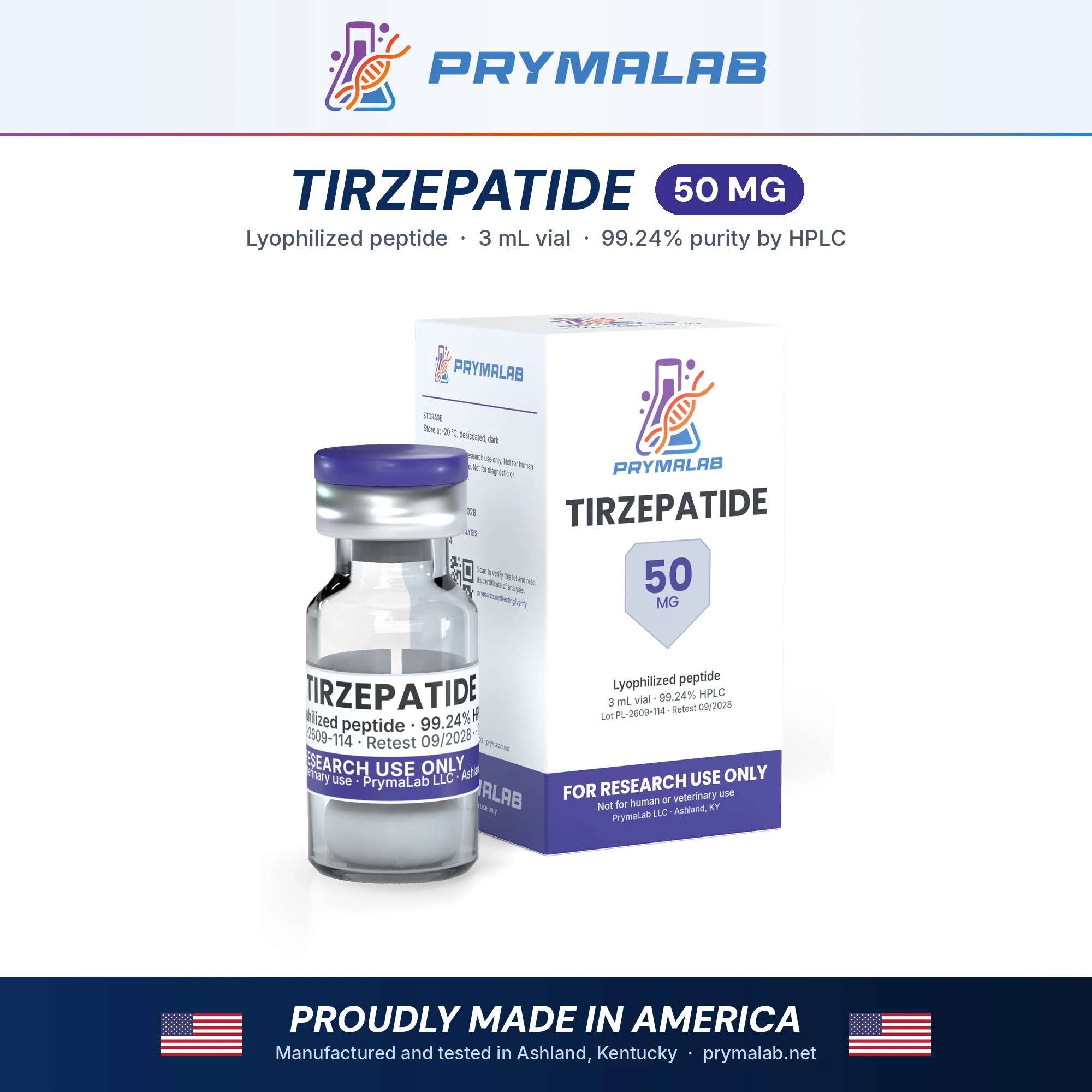
Tirzepatide 50mg
Around 10.4 micromoles · The certificate describes the lot, not your vial
A tirzepatide 50mg vial arrives with a certificate of analysis, and that certificate is not about your vial. It describes a lot, sampled before filling. The filling step that put 50 milligrams into the glass you are holding has a tolerance of its own, typically a couple of percent, and no certificate in this market reports it.
Specification Table
| Property | Value |
|---|---|
| Product format | Lyophilised powder, single vial |
| Nominal peptide content | 50 mg |
| Molar content | Approximately 10.4 µmol at roughly 4,813 g/mol |
| CAS | 2023788-19-2 |
| Backbone | GIP analogue, 39 residues, C-terminally amidated |
| Acylation | C20 fatty diacid via a linker at lysine 20 |
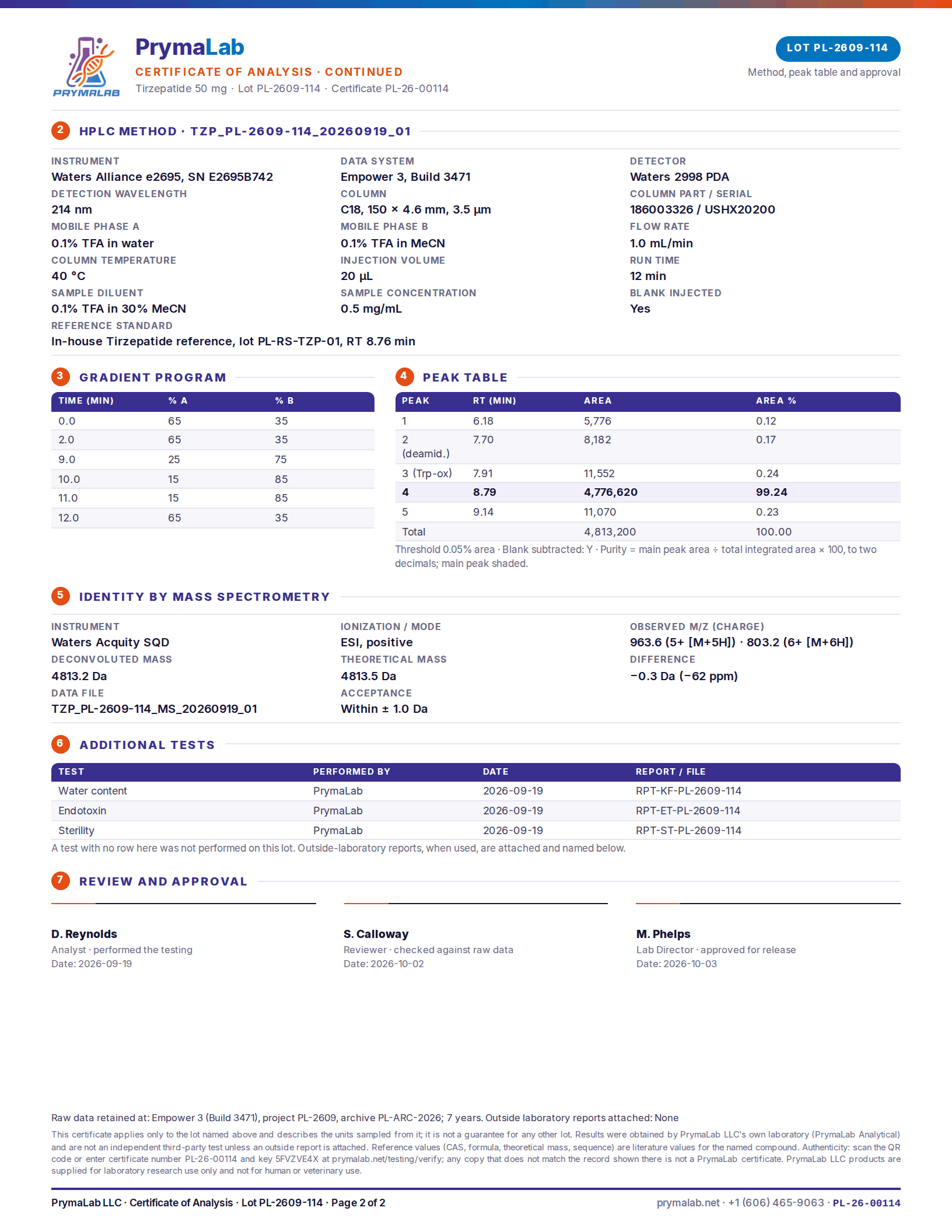
| What the certificate covers | The lot, sampled before filling |
| What the certificate does not cover | The mass actually in this individual vial |
| Typical fill tolerance | Around two percent on automated lyophilisation lines, unreported |
| Two percent of this fill | 1 mg, or about 0.2 µmol |
| Verification available to a buyer | Gravimetric, by weighing the sealed vial and the emptied vial |
| Storage, lyophilised | -20°C, sealed, dark and dry |
| Storage, reconstituted | 2-8°C, protected from light |
| Regulatory status | No approved human or veterinary formulation is supplied here |
What Does a Tirzepatide 50mg Certificate Actually Describe?
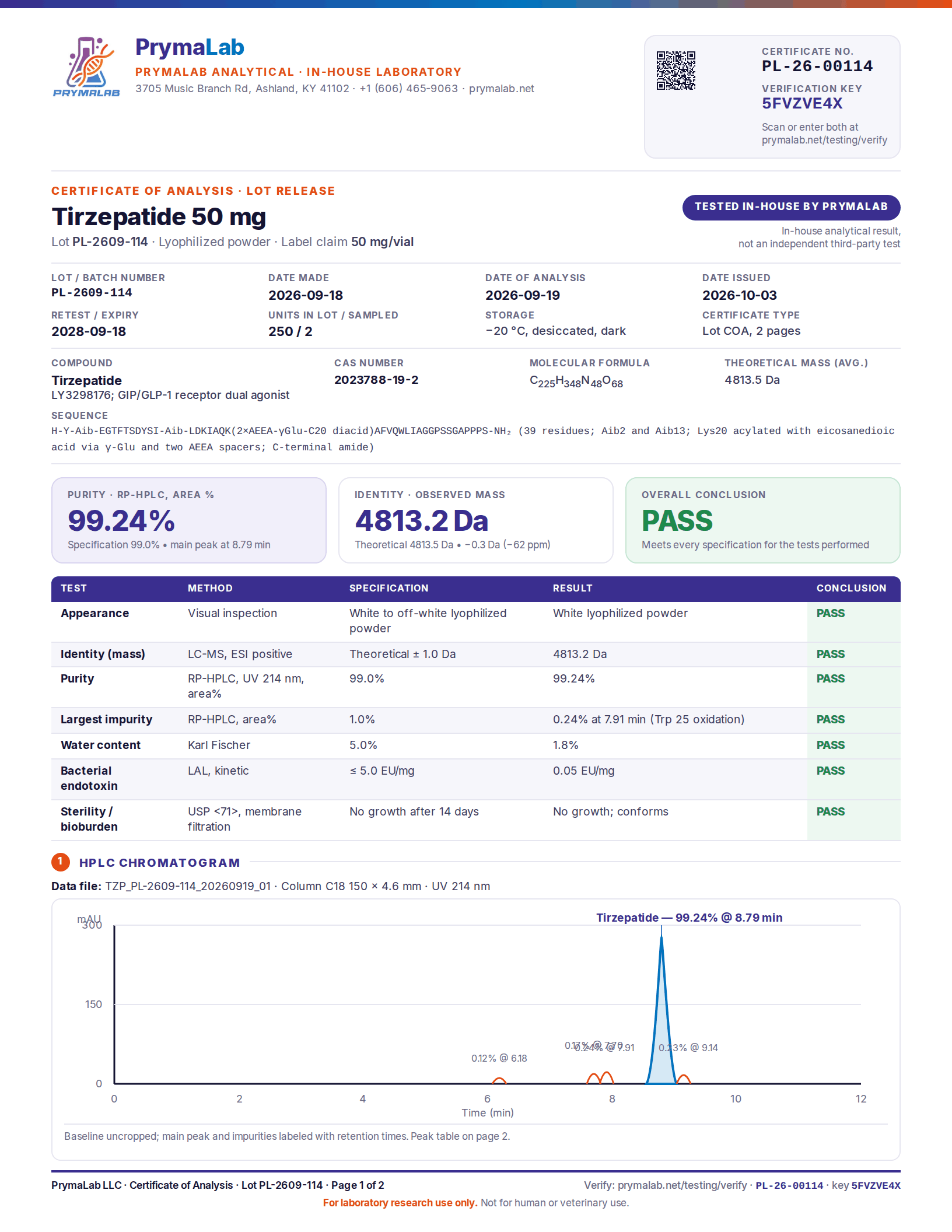
A lot. A tirzepatide 50mg certificate does not describe a vial, and specifically not your vial.
The sequence of events deserves spelling out, in order, because almost nobody bothers and the omission is where the confusion starts. Material is synthesised, purified and pooled into a lot. A sample is drawn from that pool and assayed, and the certificate reports what the sample showed. Then, afterwards, the pool is divided into vials and freeze dried.
Every number on the document, the purity, the net peptide content, the observed mass, is a property of the pool at the moment of sampling.
Nothing on that document is a measurement of the object you unpacked from the box.
This is normal practice and it is not a criticism. Assaying every vial would destroy every vial. But the gap between what people think a certificate proves and what it proves is wide, and on an expensive fill it deserves saying out loud.
How Much Does the Filling Step Vary?
On a tirzepatide 50mg fill a couple of percent is the number I would work with, and I want to be careful about how confident I sound.
Automated liquid fill before lyophilisation is well characterised, and pharmaceutical operations run it tight. Research suppliers are a mixed population. Some of them fill by hand.
I have not seen a research peptide supplier publish fill tolerance data. Nobody in this market reports it, so anyone quoting a precise figure is guessing.
What is not a guess is the arithmetic. Two percent of a 50 milligram fill is exactly one milligram of peptide. In molar terms, 0.2 micromoles.
Compare that against the errors this catalogue writes whole sections about. Net peptide content correction runs somewhere between five and fifteen percent, and it is at least disclosed on the document. Portioning on a four-figure balance is a few percent. Fill tolerance sits in the same band as those and is the only one of the three that nobody reports.
Can You Check It Yourself?
Yes, gravimetrically, and checking a tirzepatide 50mg fill costs you one vial.
Weigh the sealed vial on an analytical balance. Reconstitute, transfer everything out, rinse, dry the vial and stopper thoroughly, then weigh again. The difference is the cake mass plus whatever residue you failed to remove.
That gives cake mass rather than peptide mass, because the cake also includes counterion, residual water and whatever excipient the formulation carries. To get from one to the other you need the net peptide content figure off the certificate, which is a lot-level number again.
So the check bounds the problem rather than solving it. If the cake weighs 58 milligrams and net peptide content is 87 percent, you have about 50 milligrams of peptide and the fill was on target.
If it weighs 44, something is wrong, and you found it before it contaminated a study.
One vial of a multi-vial purchase is a reasonable price for that. On a single-vial purchase it is not, which is an argument for buying two of something if the number matters.
Two practical notes if you do it. Weigh the vial with the stopper and crimp on, both times, because removing the closure changes the tare and there is no way to put it back identically.
And dry properly. Residual water in a rinsed vial weighs, and at the milligram level a damp vial reads as if it still holds product.
Does Any of This Change the Measurement?
Only if absolute concentration matters.
A concentration-response curve run entirely from one stock is internally consistent whatever the true concentration, because every point on it inherits the same offset. The shape survives.
What does not survive is the absolute position. An EC50 quoted in nanomolar carries all three errors at once: fill, net peptide content and weighing.
That is the number people cite across papers, and it is precisely the number an unreported fill tolerance corrupts without anyone noticing.
When a published EC50 disagrees with yours by ten percent, the compound is not the first suspect.
What Should the Certificate Show?
A tirzepatide 50mg certificate needs everything a smaller fill needs, plus one row that would settle this.
Net peptide content and the method that produced it.
Sequence, written out, with the acylation position marked on it. Observed mass, against calculated. Chromatographic purity with the method named, and aggregate content measured by size exclusion.
Salt form, and the lot number with its manufacturing date.
The row that would settle it is fill tolerance, stated as a range or a standard deviation across the lot. It is a number the filler already has and nobody asks for.
I would ask for it. The worst outcome is that nobody knows, which is itself an answer worth having.
Why Does This Matter More at 50 Than at 5?
Proportionally it does not. On a tirzepatide 50mg purchase it matters more in absolute terms and in money.
On a 5 milligram vial that same two percent comes to 100 micrograms, and nobody is going to see it. That sits under the weighing resolution of most laboratory balances, so it is effectively unmeasurable.
Two percent of 50 milligrams is a milligram: comfortably weighable, and worth roughly what a milligram of this compound costs.
The proportional error is identical. The visibility is not, and the size of the purchase means a systematic problem costs more before anybody notices.
That asymmetry is what puts the verification argument on a large fill page rather than a small one, where it would be true and useless.
A purchasing consequence follows from that, and it is blunt. If the number matters to you, buy two vials of half the size rather than one of the full size, then sacrifice one of them to the gravimetric check.
You lose the lot-consistency advantage of a single vial and you gain a measurement nobody else in this market will give you.
What Would a Better Certificate Look Like?
A tirzepatide 50mg certificate needs one extra row, and that row exists already in a different industry.
Pharmaceutical fill-finish operations record fill weight statistics routinely, as a condition of operating. Mean, deviation, count. It is a routine in-process control that nobody in that industry considers exotic.
Research peptide certificates carry none of it, and the reason is that the assay data and the filling data live with different people who do not talk to each other.
A certificate line reading fill weight, mean 51.2 mg, standard deviation 0.8 mg, n equals 20 would settle everything this page is about.
It would also make suppliers comparable on something other than a purity figure, which almost every one of them reports as 98 or 99 percent regardless.
I have not seen one. If a supplier offered it I would move business to them on that basis alone, which is the strongest recommendation I can make about a row on a document.
How Should the Vial Be Handled?
Weigh it sealed before you do anything else, and write the number down.
That habit costs thirty seconds. You get a baseline that cannot be reconstructed afterwards, at any price.
After that, everything about handling it is what you would already do with any other acylated peptide in this catalogue. Warm to room temperature sealed, then diluent down the wall and gentle rotation, never shaking.
Portion the solid if the study will run past the solution stability window, and do the whole job in one session on one balance.
Split the solution into single-use volumes and refrigerate those. Never freeze it.
Low-binding consumables from the first dilution, because the C20 chain makes this molecule stick.
Published Literature
Full citations for the work named above, each confirmed against the publisher record. Fill tolerance in the research peptide market is not a published subject, which is part of the point this page is making.
- Willard FS, Douros JD, Gabe MB, Showalter AD, Wainscott DB, Suter TM, et al. JCI Insight. 2020;5(17):e140532. DOI: 10.1172/jci.insight.140532
- Sun B, Willard FS, Feng D, Alsina-Fernandez J, Chen Q, Vieth M, et al. Proceedings of the National Academy of Sciences. 2022;119(13):e2116506119. DOI: 10.1073/pnas.2116506119
- Frias JP, Davies MJ, Rosenstock J, Perez Manghi FC, Fernandez Lando L, Bergman BK, et al. New England Journal of Medicine. 2021;385(6):503-515. DOI: 10.1056/NEJMoa2107519
- Manning MC, Chou DK, Murphy BM, Payne RW, Katayama DS. Pharmaceutical Research. 2010;27(4):544-575. DOI: 10.1007/s11095-009-0045-6
Frequently Asked Questions
What is a tirzepatide 50mg vial?
A lyophilised research vial, nominal content 50 milligrams of tirzepatide, which is about 10.4 micromoles at roughly 4,813 g/mol. Eighth of ten fill sizes here, supplied for laboratory research and nothing else.
What does a certificate of analysis actually cover?
The lot, sampled before filling. Purity, net peptide content and observed mass are all properties of that one pooled sample. No number on the document is a measurement of the individual vial you received.
What is tirzepatide fill tolerance?
The variation between the nominal mass printed on a vial and the mass actually in it, introduced by the filling step. No research peptide supplier publishes it. A couple of percent is a reasonable working assumption, and it remains an assumption rather than a measurement.
How much is two percent of a 50mg fill?
One milligram, or about 0.2 micromoles. That is the same order as the portioning error from a four-figure balance and smaller than a typical net peptide content correction, which runs five to fifteen percent.
How can I verify what is in my vial?
Gravimetrically. Weigh the sealed vial. Reconstitute, transfer everything out, rinse and dry both vial and stopper, then weigh it again. The difference is cake mass. Convert to peptide mass using the net peptide content figure from the certificate.
Does fill variation affect a dose-response curve?
Not its shape. Every point taken from one stock inherits the same offset, so the curve is internally consistent. What it affects is the absolute position, which is what an EC50 in nanomolar reports and what gets compared across published work.
How many micromoles are in the vial?
About 10.4, taking the molecular weight as roughly 4,813 g/mol. For comparison, the 40mg fill in this range holds around 8.3 micromoles and the 60mg holds about 12.5.
Should I ask the supplier for fill tolerance?
Yes. Whoever ran the filling line already has that number. Asking for it costs nothing at all. If the answer is that they do not know, that tells you something about the operation.
What should a tirzepatide 50mg certificate show?
Net peptide content with the method, sequence with the acylation position, observed mass against calculated, chromatographic purity with the method named, aggregate content by size exclusion, salt form, lot number and manufacturing date.
Why does this argument appear on the 50mg page?
Because the proportional error is the same at every fill but the absolute error only becomes weighable on a large one. A hundred micrograms of variation on a 5mg vial is below the resolution of most balances. A milligram on a 50mg vial is not.
How should a tirzepatide 50mg vial be stored?
Powder stays sealed at minus 20 degrees Celsius, dark and dry, until the day it is needed. Reconstituted solution at 2 to 8 degrees, protected from light, in single-use aliquots. Do not freeze the solution.
Is this product for human use?
No. This vial is laboratory research material. It is not a drug, a food, a cosmetic or a dietary product, the FDA has not evaluated it, and it must never be administered to a person or an animal.
Compliance Statement
Tirzepatide 50mg is supplied exclusively for laboratory research use. It is not a drug, food, cosmetic or dietary product of any kind. It has not been evaluated by the FDA or any comparable authority, and no approved human or veterinary formulation is supplied here. It is not intended to diagnose, treat, cure or prevent any disease, and it must not be given to humans or animals. Purchase is restricted to qualified researchers and institutions.


18 reviews for Tirzepatide 50mg