
Description
PrymaLab · Research Use Only
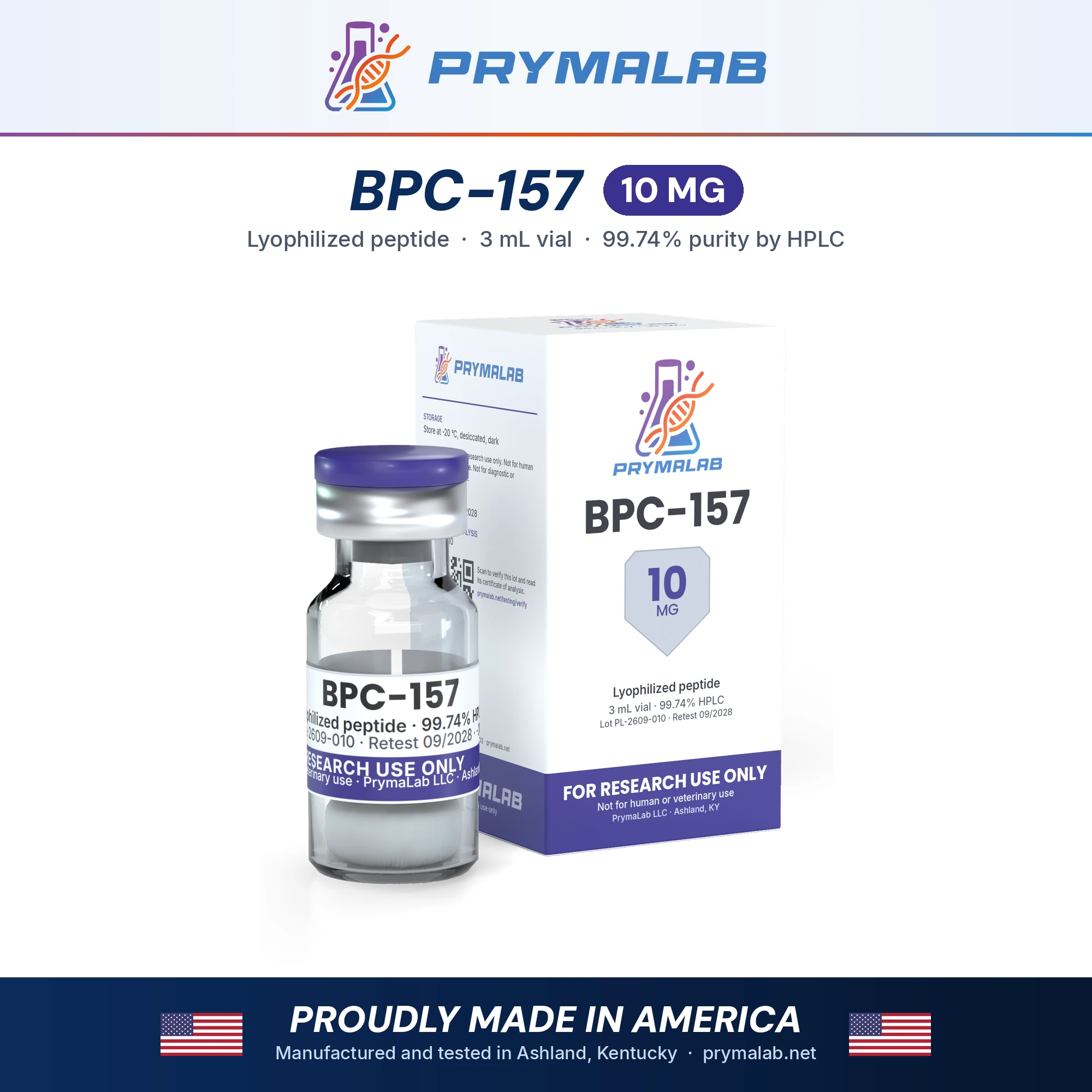
BPC-157 10mg
Two analytical blind spots · and neither is on most certificates
BPC-157 peptide is fifteen residues long, which sounds like an easy molecule to check. Two features of the sequence make it harder. Four of those fifteen residues are proline, and not one of them is aromatic.
Specification Table
| Property | Value |
|---|---|
| Compound | BPC-157 |
| Class | Synthetic pentadecapeptide |
| Residue count | 15 |
| Sequence | Gly-Glu-Pro-Pro-Pro-Gly-Lys-Pro-Ala-Asp-Asp-Ala-Gly-Leu-Val |
| Molecular weight, calculated | Approximately 1,419.5 g/mol for the free base |
| CAS | 137525-51-0 |
| Proline residues | Four, including a run of three consecutive |
| Aromatic residues | None. No tryptophan, no tyrosine, no phenylalanine |
| Consequence of that | Absorbance at 280 nanometres is effectively blind to this molecule |
| Cysteine residues | None, so no disulfide and no scrambling route |
| Carboxy terminus | Free acid |
| Sequence origin | A partial sequence attributed to a protein described in gastric juice |
| Regulatory status | No approved human or veterinary formulation in any jurisdiction |
| Appearance | White lyophilized powder |
| Purity | Per lot-specific certificate of analysis |
| Storage, lyophilized | 2-8°C short term, -20°C for extended storage, protected from light and moisture |
Why Does BPC-157 Peptide Give an Awkward Chromatogram?
Proline is the one residue that behaves differently from the other nineteen, and this sequence contains four of them including three in a row.
Every other amino acid forms a peptide bond that is effectively locked in one geometry, because the nitrogen carries a hydrogen and the trans arrangement is so heavily favoured that the alternative barely exists.
Proline has no such hydrogen, because its side chain loops back and bonds to its own backbone nitrogen.
That removes the energetic penalty on the cis arrangement, so a proline bond interconverts between two forms that are both populated at ordinary temperatures.
Interconversion is slow on the timescale of a chromatographic run, which is the part that matters analytically.
A molecule with one proline can therefore present as two species to a column. Four prolines means the number of possible combinations is considerably larger.
What that produces on a trace is peak broadening, shoulders on the main peak, and in some gradients a partly resolved second peak that is the same molecule in a different conformation.
An analyst who has not met this before reads those features as impurity and reports a lower purity figure than the material deserves.
The opposite error is also available. A genuine impurity hiding inside a broadened proline peak is harder to see than it would be on a sharp one.
Neither error is detectable from a percentage. Both are obvious on the trace, which is why the chromatogram matters more on BPC-157 peptide than on almost anything else in this catalogue.
Running the column at raised temperature speeds the interconversion and sharpens the peak, and a certificate that states the column temperature is telling you the analyst knew that.
Why Is Ultraviolet Quantification a Problem Here?
The second blind spot is simpler and it catches more people.
Peptide concentration is routinely measured by ultraviolet absorbance at 280 nanometres, and that measurement works because tryptophan and tyrosine absorb strongly there.
This sequence contains neither. It contains no phenylalanine either, so there is no aromatic side chain of any kind.
A 280 nanometre reading on BPC-157 peptide is therefore close to a measurement of the buffer.
The method that does work is absorbance at 214 nanometres, which reads the peptide bond itself rather than a side chain.
That works on any peptide and it is considerably less convenient, because 214 nanometres is a region where many buffers, solvents and plasticisers also absorb.
A clean 214 measurement therefore requires a clean matrix, which is a real constraint rather than a formality.
Amino acid analysis is the reference method and it is destructive and slow, so most laboratories use it once on a new lot rather than routinely.
What none of this permits is trusting a nominal fill weight, which is what happens by default when the easy measurement is unavailable.
So the practical position on this compound is that the certificate net peptide content figure is doing more work than usual, because independently checking it is harder than usual.
What Is Known About the Sequence Origin?
The name refers to a body protection compound described in gastric juice, and the relationship between that description and this molecule is worth stating precisely.
BPC-157 peptide is a synthetic fifteen-residue sequence presented as a partial sequence of that larger protein.
The parent protein has not been characterised in the mainstream protein databases to the standard that would let a third party verify the derivation independently.
That is a gap in the public record rather than an accusation. It does mean the compound is best described as a defined synthetic peptide with a stated provenance, rather than as a fragment of a well-characterised protein.
The distinction has one practical consequence. A researcher cannot look up the parent and check the numbering.
For most purposes that does not matter. The article being bought is the fifteen residues on the certificate, and those can be verified directly.
It matters for anyone planning to describe the compound in a publication, where provenance claims attract more scrutiny than product copy does.
Calling it a synthetic pentadecapeptide with the sequence stated is accurate and complete, and it is the description that survives scrutiny. Describing it as a fragment of a characterised gastric protein claims more than the public record supports.
What Should a BPC-157 Certificate Show?
Seven fields, and two of them follow directly from the two blind spots above.
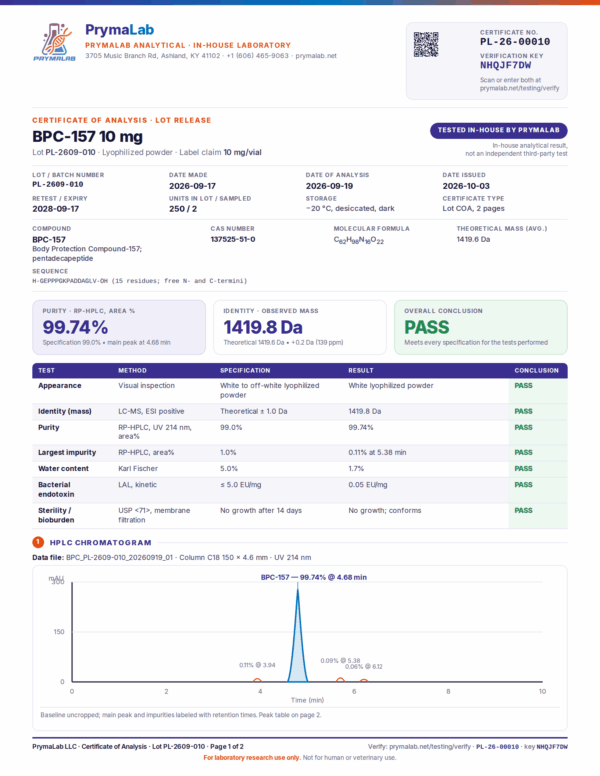
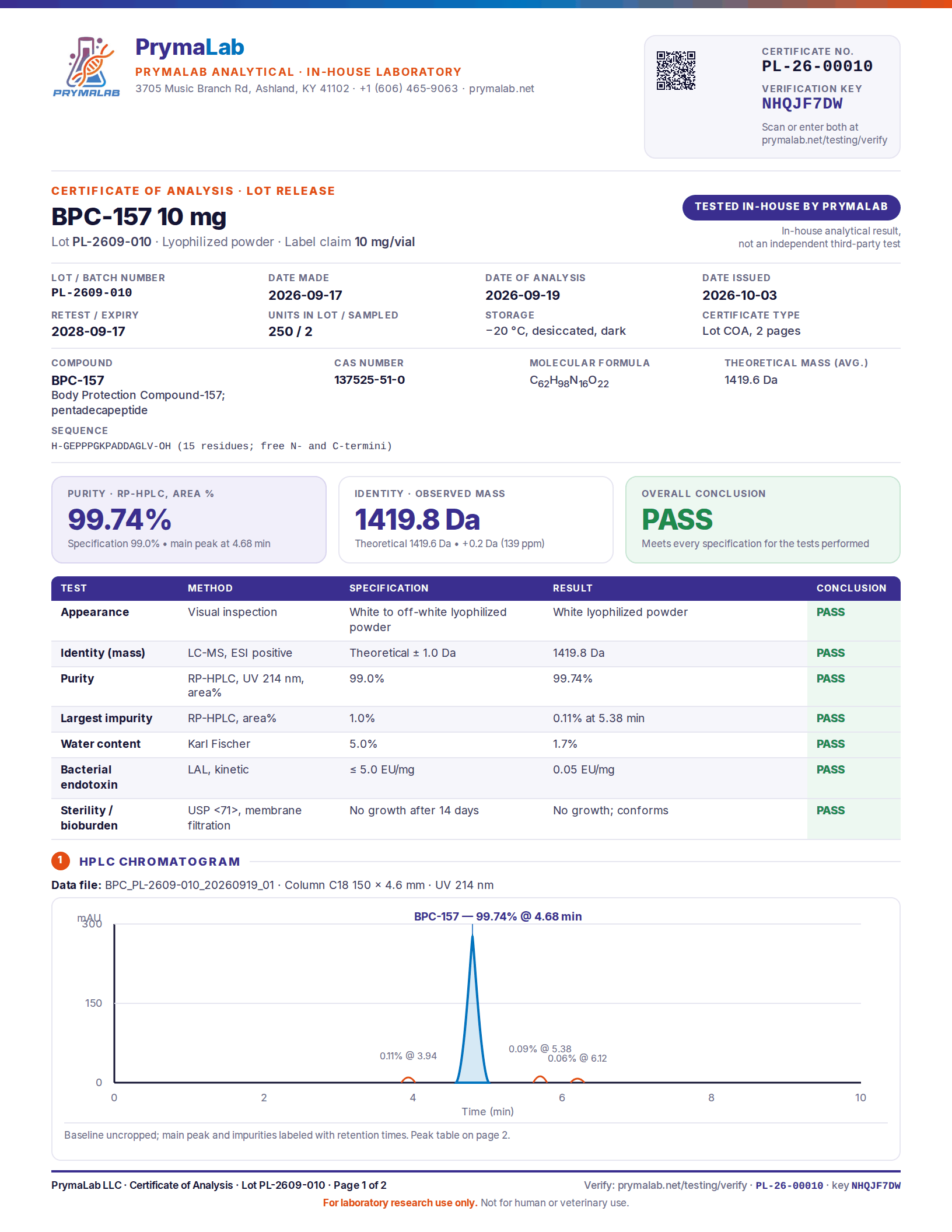
The sequence written out in full. Fifteen residues is short enough to print and long enough that a substitution is easy to hide behind a name.
Observed mass against calculated mass, with the calculated figure stated, and approximately 1,419.5 is the correct value for the free acid.
The detection wavelength used for purity, which should be 214 nanometres. A certificate quoting 280 nanometres here has measured something other than the peptide.
The chromatogram itself rather than a summary percentage, because proline broadening makes the number harder to interpret than the picture.
Column temperature, ideally. It is an unusual field to see and it tells you whether the analyst understood the proline behaviour.
Counterion identity and net peptide content. This sequence carries a lysine and two aspartates, so the salt form is not obvious and should be stated rather than assumed.
Lot number and synthesis date.
A supplier who supplies a 214 nanometre trace with the column temperature stated has done the analysis properly, and that is a reasonable proxy for the rest of the document.
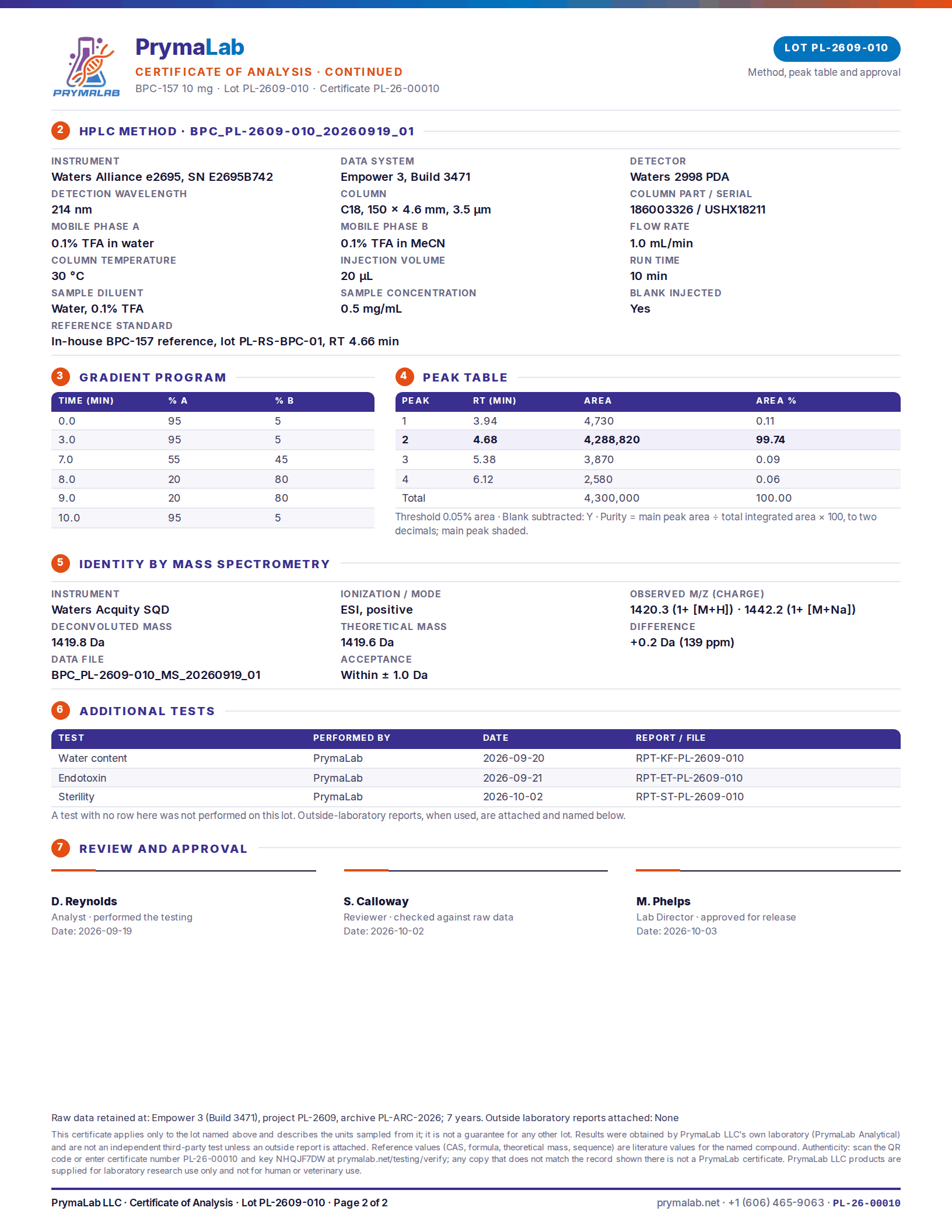
One further field is worth requesting even though almost no supplier volunteers it: the gradient used for the purity determination.
A shallow gradient resolves closely eluting species that a steep one runs together, and on a molecule with proline broadening the difference is larger than usual.
Two certificates quoting the same purity figure from different gradients are not reporting the same measurement.
What Does the Published Record Actually Cover?
The literature on this compound has a shape that is worth understanding before reading any of it.
It is large by the standards of this catalogue and unusually concentrated.
A single research group in Croatia accounts for the substantial majority of it, across decades and across a wide range of models.
That concentration is a fact rather than a criticism, and it has two consequences that pull in opposite directions.
The first is depth. One group working on one compound for that long accumulates methodological familiarity that scattered work does not.
The second is that independent replication is thinner than the paper count suggests, because replication means a different group with different hands and different reagents reaching the same result.
Counting papers overstates the evidence base when most of them share authors, and counting independent groups understates it when the work is genuinely detailed.
The honest description is that a large and internally consistent body of work exists, largely from one source, with limited independent confirmation.
What follows for a researcher is a design question rather than a verdict. Work intended to extend the existing findings can build on that literature directly.
Work intended to test whether the findings hold outside the originating programme is a different project and needs to be designed as one.
How Should the Vial Be Handled?
This is an unusually hardy peptide in the dry state, and the reasons are worth knowing because they are all absences.
There is no cysteine, so no disulfide can form, break or rearrange.
There is no methionine, so the oxidation route that limits many peptides is absent.
There is no asparagine. The aspartates are not followed by glycine either, so the isomerisation route that ruins bioregulator solutions has nothing to act on.
Sealed lyophilized powder therefore holds well at 2 to 8 degrees Celsius for short periods and at minus 20 for extended storage, protected from moisture.
Bring the vial to ambient temperature before opening, since the powder is hygroscopic and cold glass condenses atmospheric water onto the cake.
Reconstitute down the vial wall and swirl rather than shake, which is the standard precaution against interface aggregation.
Aliquot on first reconstitution. In solution the limiting factors here are physical and microbiological rather than chemical, so bacteriostatic diluent is the sensible default.
Use low-binding consumables at working dilutions, since adsorption removes a measurable fraction of dilute peptide into ordinary plastics.
Record lot, net peptide content, diluent volume and date. On this compound the net peptide content figure carries extra weight, for the reasons set out above.
One habit worth adopting on any peptide with this analytical profile.
Where the easy quantification route is unavailable, the number of vial openings belongs in the record alongside the date, because moisture uptake is the correction nobody measures.
PrymaLab stocks the same peptide in two solution-state formats where moisture uptake is not the relevant clock. The BPC-157 nasal spray and the BPC-157 preloaded pen at 5mg/ml both arrive already dissolved, so the fill date replaces the vial-opening count as the number worth recording. The BPC-157 and TB-500 combined vial is the other lyophilised option in the range.
Published Literature
Selected references on this compound and on the proline behaviour that governs its analysis.
- Sikiric P, Seiwerth S, Rucman R, Turkovic B, Rokotov DS, Brcic L, et al. Current Pharmaceutical Design. 2011;17(16):1612-1632. DOI: 10.2174/138161211796196954
- Chang CH, Tsai WC, Lin MS, Hsu YH, Pang JH. Journal of Applied Physiology. 2011;110(3):774-780. DOI: 10.1152/japplphysiol.00945.2010
- Sikiric P, Seiwerth S, Rucman R, Kolenc D, Vuletic LB, Drmic D, et al. Current Pharmaceutical Design. 2018;24(18):1972-1989. DOI: 10.2174/1381612824666180712110447
- Dugave C, Demange L. Chemical Reviews. 2003;103(7):2475-2532. DOI: 10.1021/cr0104375
Frequently Asked Questions
What is BPC-157 peptide?
A synthetic fifteen-residue peptide with the sequence Gly-Glu-Pro-Pro-Pro-Gly-Lys-Pro-Ala-Asp-Asp-Ala-Gly-Leu-Val, calculated at approximately 1,419.5 daltons for the free acid.
Why do the prolines matter?
Proline bonds interconvert between cis and trans forms that are both populated at ordinary temperatures, and the interconversion is slow on the timescale of a chromatographic run.
What does that do to a chromatogram?
It broadens the main peak, produces shoulders, and in some gradients gives a partly resolved second peak that is the same molecule in a different conformation rather than an impurity.
How does that mislead an analyst?
Two ways. Reading the conformational features as impurity understates purity, and a genuine impurity hiding inside a broadened peak is harder to see than on a sharp one.
Can anything sharpen the peak?
Running the column at raised temperature speeds the interconversion. A certificate that states the column temperature is telling you the analyst knew about the proline behaviour.
Why is 280 nanometre detection useless here?
Because the measurement depends on tryptophan and tyrosine, and this sequence has neither. No phenylalanine either, so there is no aromatic side chain of any kind anywhere in the fifteen residues.
What should be used instead?
Absorbance at 214 nanometres, which reads the peptide bond rather than a side chain. It is less convenient because many buffers and solvents also absorb in that region.
Is amino acid analysis an option?
Yes, and it is the reference method. Being destructive and slow, it is usually run once on a new lot rather than routinely.
Where does the sequence come from?
It is presented as a partial sequence of a body protection compound described in gastric juice. That parent has never been characterised in the mainstream databases well enough for anyone outside the originating programme to verify the derivation.
Does that matter?
Not for verifying the vial, since the article is the fifteen residues on the certificate. It matters for anyone describing the compound in a publication, where provenance claims attract more scrutiny.
Is it stable in the dry state?
Unusually so. There is no cysteine, no methionine, no asparagine, and no aspartate followed by glycine, so the four routes that limit most peptides in this catalogue are all absent.
What limits a reconstituted solution then?
Physical and microbiological factors rather than chemical ones. Adsorption removes peptide into container walls, and unpreserved water is a growth medium, so bacteriostatic diluent is the sensible default.
Compliance Statement
BPC-157 peptide is sold exclusively for laboratory research use. It is not a drug, food, or cosmetic product, and it is not a dietary product of any kind. It is not approved by the FDA or any comparable authority for human or veterinary use, the parent protein from which this sequence is said to derive has not been characterised in the mainstream protein databases to a standard permitting independent verification, and no compound in this range is offered for any human or veterinary purpose. This product is not intended to diagnose, treat, cure, or prevent any disease. It must not be given to humans or animals. Purchase is restricted to qualified researchers and institutions operating within applicable laws. All handling is the responsibility of the purchasing laboratory.
Other formats of BPC-157
BPC-157 is also stocked as BPC-157 Capsules (60/500mcg), BPC-157 5MG, BPC-157 + TB500 (10mg/10mg) "Wolverine Blend", TB-500 5mg/ml preloaded 3ml pen and Wolverine Stack (BPC-157 + TB-500) 20mg preloaded 3ml pen. Each listing states its own quantity and concentration, and the pen and vial comparison explains what changes between formats.











8 reviews for BPC-157 10MG