Description
PrymaLab · Research Use Only
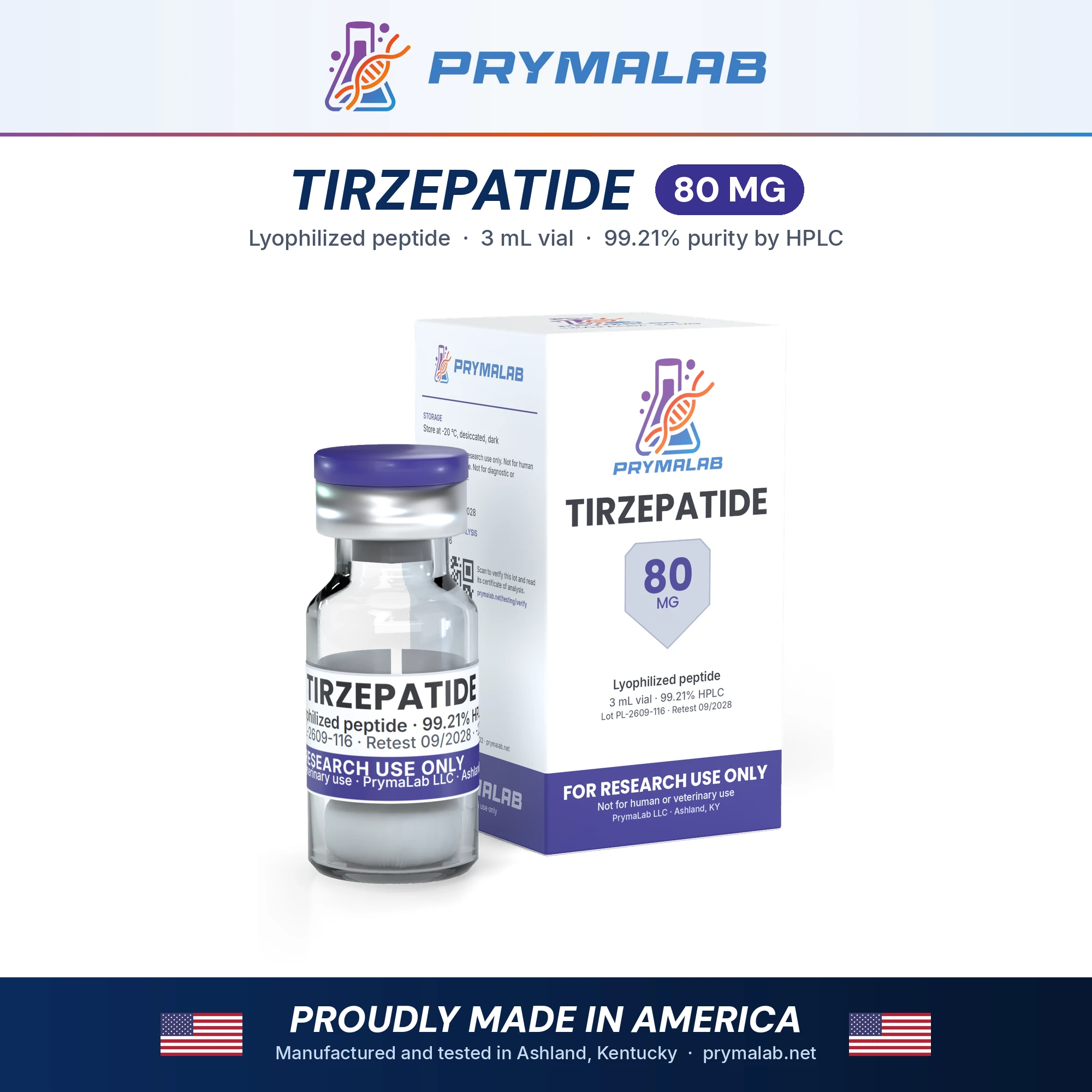
Tirzepatide 80mg
About 16.6 micromoles · The most arbitrary number in a ten-size range
A tirzepatide 80mg vial holds about 16.6 micromoles. It sits ninth in a range of ten sizes running from 5 to 100 milligrams, and there is no experiment anywhere in the published record that calls for eighty milligrams of this compound. The number exists because a price ladder needed a rung between sixty and a hundred.
Specification Table
| Property | Value |
|---|---|
| Product format | Lyophilised powder, single vial |
| Peptide content | 80 mg |
| Molar content | Approximately 16.6 µmol at roughly 4,813 g/mol |
| CAS | 2023788-19-2 |
| Backbone | GIP analogue, 39 residues, C-terminally amidated |
| Acylation | C20 fatty diacid via a linker at lysine 20 |
| Position in range | Ninth of ten |
| Full range offered | 5, 10, 15, 20, 30, 40, 50, 60, 80, 100 mg |
| Step pattern | Five apart at the bottom, ten through the middle, twenty at the top |
| Published protocols specifying 80 mg | None found |
| What changes with fill size | Price per milligram, cake depth, and how long the vial stays open |
| What does not change with fill size | The compound, the certificate rows, and every degradation route |
| Storage, lyophilised | -20°C, sealed, dark and dry |
| Storage, reconstituted | 2-8°C, protected from light |
| Regulatory status | No approved human or veterinary formulation is supplied here |
Why Does a Ten-Size Range Exist at All?
Because a catalogue with more price points sells to more budgets, and a tirzepatide 80mg vial is one of those points.
A supplier offering one size forces every buyer into the same purchase. A supplier offering ten lets a first-time buyer spend a little and a well-funded programme spend a lot, without either feeling badly served.
That is ordinary merchandising and there is nothing wrong with it. What deserves noticing is that none of it is downstream of any scientific requirement.
The published record describes concentrations. A paper reports that the compound was used at some nanomolar figure in some assay, and says nothing at all about what size vial the material arrived in, because the vial has no bearing on the result.
So the ten sizes encode purchasing behaviour rather than experimental need, and choosing between them is a budgeting exercise dressed up as a technical one.
What Would a Range Designed Around Use Look Like?
Fewer sizes, with the gaps in different places, and probably no tirzepatide 80mg rung at all.
If sizes were chosen to match consumption patterns you would expect two or three: a small one sized to a single in vitro programme, a large one sized to an animal study, and possibly one in between.
What you would not expect is ten, with steps of five at the bottom and twenty at the top, because consumption does not cluster that way.
The step pattern tells you what it is. Fine gradations at the cheap end, where a few milligrams changes the price by an amount a small buyer notices. Coarse gradations at the expensive end, where the differences are large and the buyers few.
That is a price curve sampled at intervals somebody chose, and the intervals get wider as the curve flattens.
I am not claiming this is unusual or that anyone is being misled. Every supplier in this market does it. Naming it matters because eight other pages in this catalogue argue about which fill to choose, and all of them argue inside a frame that was set commercially.
So How Should You Choose?
Choose a tirzepatide 80mg vial, or any other, by consumption rate first and then by rounding down rather than up.
Work out how much material the study needs and over what period, which is the arithmetic every fill page here recommends and almost nobody does.
Then pick the smallest size that covers it, rather than the one just above.
Rounding up feels safer and it is systematically wrong, because the excess sits in a vial getting opened. The failure mode of buying too little is one more purchase. The failure mode of buying too much is material degrading in a container that keeps being reopened.
One of those is an inconvenience and the other is a quiet loss you never measure.
If your requirement lands at seventy milligrams and the range offers sixty and eighty, that is exactly the case this page exists for, and I would take two sixties over one eighty if the lot argument does not apply.
The record that makes this easy takes a line per vial: fill size, date opened, date finished or discarded, and roughly what fraction got used.
A year of that tells you your actual consumption rate, which is the only number the whole decision turns on.
Without it everybody estimates from memory. Memory is generous.
What Actually Changes Between Fills?
Three things separate a tirzepatide 80mg vial from a 5mg one, and the compound is not among them.
Price per milligram falls as the fill rises, steeply at the bottom of the range and barely at all at the top, because the fixed cost of a vial and a certificate gets spread thinner.
Cake depth rises, which affects how evenly the material dried and is the argument the 100mg page in this catalogue takes up properly.
How long the vial stays open rises, because more material means more draws, and every draw is a warming and a fresh headspace.
Everything else is identical. Same lot chemistry, same certificate rows, same degradation routes, same handling.
A page claiming that a particular fill of an acylated peptide is chemically different from another fill of the same lot is selling you something.
One thing does change chemically, and separating it from the rest keeps the claim above honest.
Cake depth is a physical property of the fill, and it affects how evenly the material dried. Two vials from the same lot, filled at 5 and at 80 milligrams, went through the same cycle with different geometry.
So they are the same compound, from the same pool, with potentially different residual water.
That is not the fill being chemically different. It is the drying being different, which is a manufacturing variable rather than a molecular one.
The distinction is fine and it matters, because one is a real effect somebody can measure and the other is marketing.
What Should the Certificate Show?
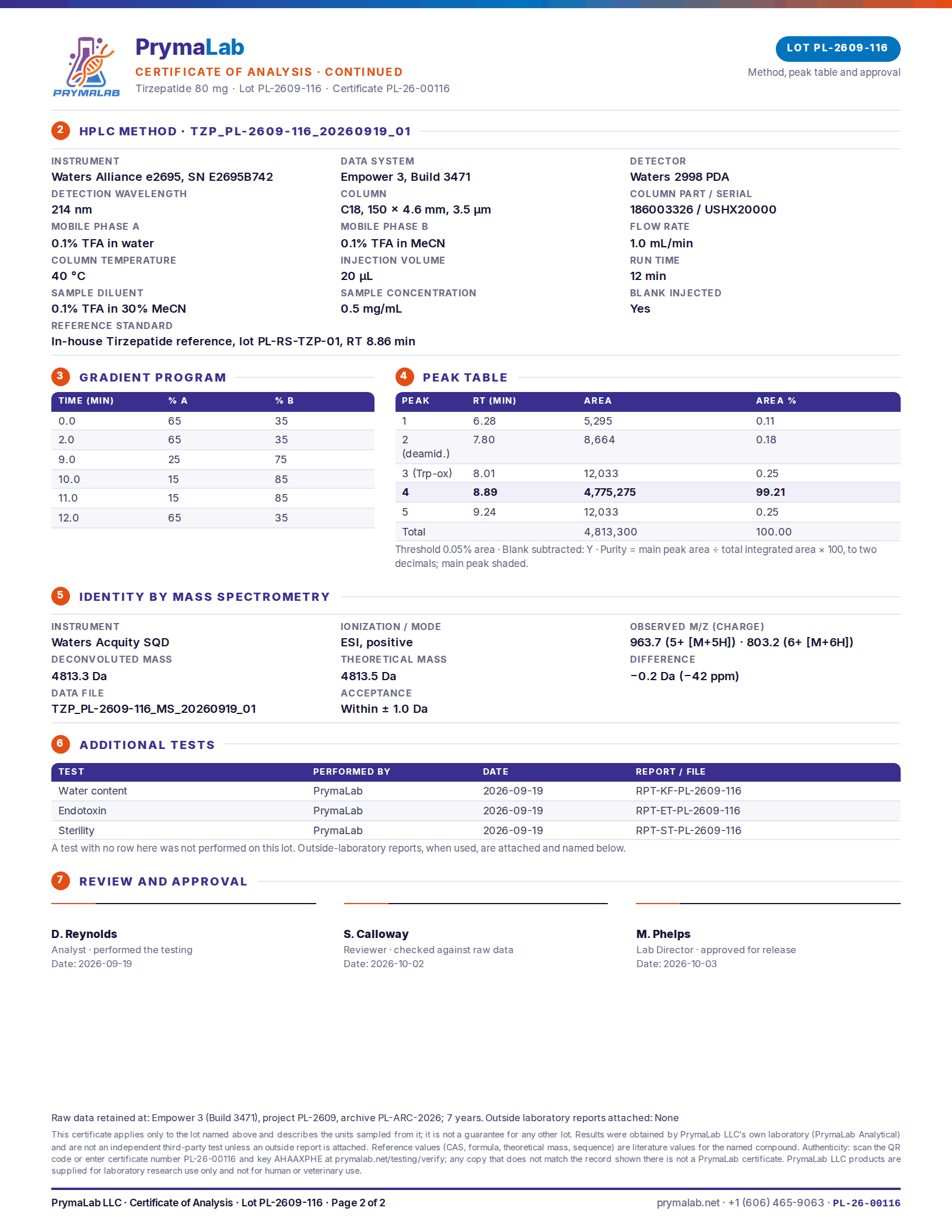
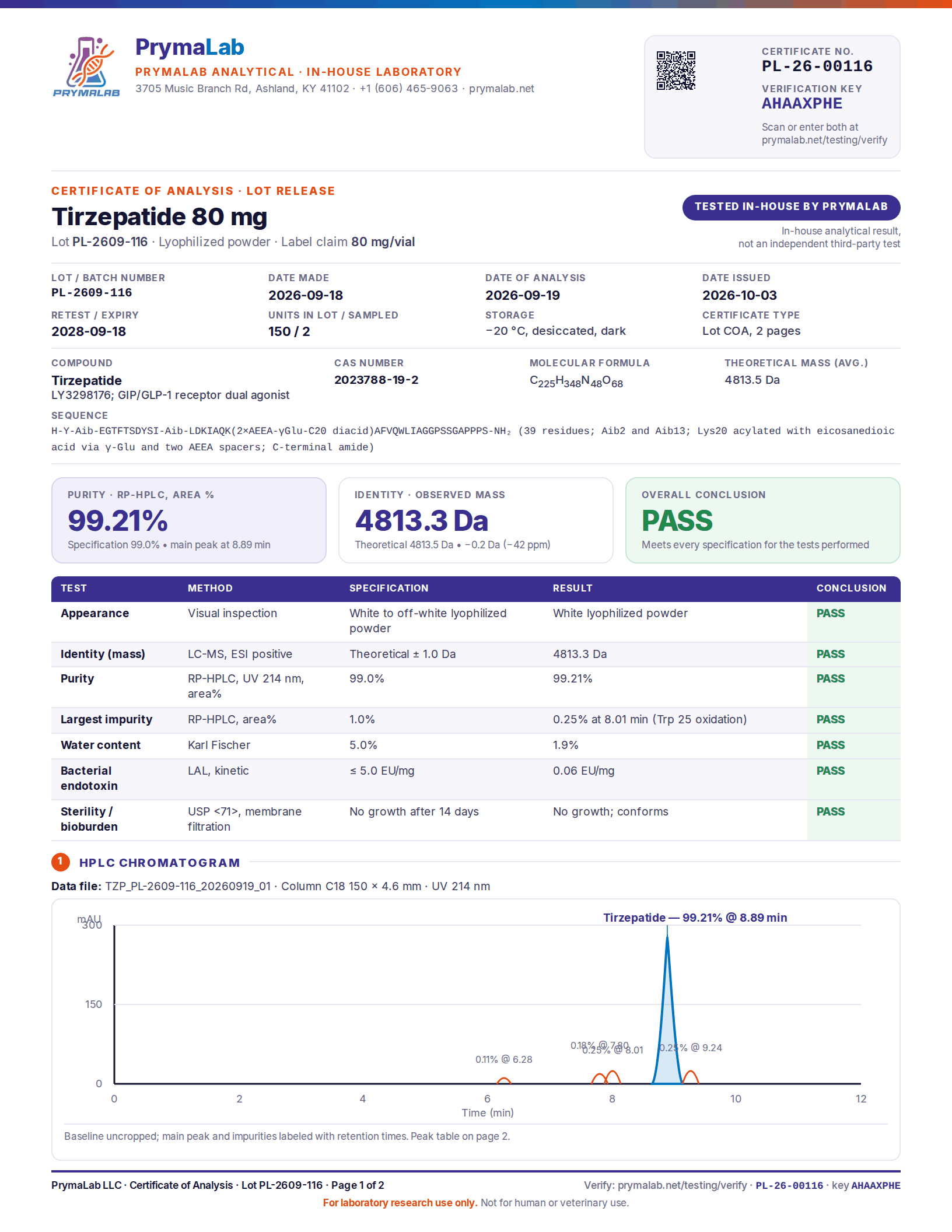
A tirzepatide 80mg certificate shows exactly what a 5 milligram certificate shows, because the material is the same.
Net peptide content, with the method that determined it.
The sequence, with the position of the acylation named on it rather than left implied.
Observed mass against calculated, and chromatographic purity with the method stated.
Aggregate content by size exclusion.
Salt form, lot number and manufacturing date.
Water content, which matters more as the cake gets deeper and is the one row that genuinely earns extra attention at this end of the range.
What Does a Tirzepatide 80mg Vial Support?
About 16.6 micromoles. Four times a 20 milligram vial, four fifths of a 100.
Reconstituted into 3 millilitres that is 26.7 mg/mL, or about 5.5 millimolar, which is thousands of times any published in vitro working concentration.
The realistic buyer is an animal facility or a group supplying several projects from one purchase.
For a cell biology programme this is years of material, and years is longer than an opened vial should be in service.
That is the same conclusion the 100mg page reaches, for the same reason, and the two fills are close enough that the distinction between them is mostly about price.
What Does This Say About the Other Fill Pages?
That the tirzepatide 80mg page and its nine siblings all argue inside a frame somebody else drew, and that the arguments are still worth having.
Nine other tirzepatide fill pages in this catalogue take a different angle each: the error budget on a small fill, the solution clock against one lot, range spacing, price per milligram, lot saturation, the reconstitution volume ceiling, fill tolerance against certificate scope, cake geometry.
Every one of those is true, and every one is a way of choosing between rungs on a ladder that was built commercially.
The useful reading: those arguments are about buying well inside a given range.
If a supplier offered three sizes chosen around consumption patterns, most of those pages would be shorter and the buying decisions would be easier. Nobody offers that, because three price points sells less than ten.
How Should the Vial Be Handled?
Handle a tirzepatide 80mg vial as an acylated peptide, with the portioning decision made before the seal breaks.
Room temperature before opening, sealed, so cold glass does not collect water.
Split the cake into sealed portions if the study will not finish it quickly, and do it in one weighing session.
Diluent down the wall for whatever gets reconstituted, gentle rotation rather than shaking, because the C20 chain makes this molecule foam.
Aliquot the solution into single-use volumes and hold them at 2 to 8 degrees. Do not freeze a reconstituted acylated peptide.
Low-binding consumables from the first dilution onward.
Published Literature
Full citations for the work named above, each confirmed against the publisher record. None of it addresses fill size, which is rather the point.
- Willard FS, Douros JD, Gabe MB, Showalter AD, Wainscott DB, Suter TM, et al. JCI Insight. 2020;5(17):e140532. DOI: 10.1172/jci.insight.140532
- Sun B, Willard FS, Feng D, Alsina-Fernandez J, Chen Q, Vieth M, et al. Proceedings of the National Academy of Sciences. 2022;119(13):e2116506119. DOI: 10.1073/pnas.2116506119
- Manning MC, Chou DK, Murphy BM, Payne RW, Katayama DS. Pharmaceutical Research. 2010;27(4):544-575. DOI: 10.1007/s11095-009-0045-6
Frequently Asked Questions
What is a tirzepatide 80mg vial?
A lyophilised research vial holding 80 milligrams of tirzepatide, about 16.6 micromoles at roughly 4,813 g/mol. It is ninth of ten fill sizes offered here and it is supplied for laboratory research only.
Why does this catalogue offer ten fill sizes?
Because more price points reach more budgets. The sizes encode purchasing behaviour rather than any experimental need that anybody has written down. No published work on this compound specifies a vial size, only concentrations.
Is 80 milligrams a standard research quantity?
No. I have not found any published protocol that calls for eighty milligrams of this or any compound. It is a rung on a price ladder, sitting between the sixty and the hundred.
How should I choose between fill sizes?
Work out consumption rate first, then pick the smallest size that covers it. Rounding up feels safer and is systematically wrong: buying too little costs one more order, buying too much costs material degrading in a vial that keeps being reopened.
What actually differs between a 5mg and an 80mg vial?
Price per milligram, cake depth and how long the vial stays open. The compound, the lot chemistry, the certificate rows and every degradation route are identical.
How many micromoles are in the vial?
About 16.6 at roughly 4,813 g/mol. Reconstituted into 3 millilitres that gives 26.7 mg/mL, close to 5.5 millimolar, which is far above any published in vitro concentration.
Should I buy one 80mg vial or two 40mg vials?
Two smaller vials give two reconstitution volumes, two independent objects and half the exposure per vial. One larger vial gives a single lot with certainty. If lot consistency across the whole study is not the constraint, I would take the two.
What should a tirzepatide 80mg certificate of analysis show?
The same rows a 5 milligram certificate shows, because it is the same material: net peptide content with the method, sequence with the acylation position, observed mass against calculated, chromatographic purity, aggregate content by size exclusion, salt form and lot details.
Does water content matter more on a large fill?
Yes. The cake is deeper, and deeper cakes dry less evenly than shallow ones do. The 100mg page in this catalogue covers the lyophilisation geometry in detail. On an 80 milligram fill the same argument applies slightly less strongly.
Who realistically buys this size?
An animal facility, or a group supplying several projects from one purchase. For cell work it is several years of material, and several years is longer than an opened vial should stay in service.
How should the vial be stored?
Sealed lyophilised powder at minus 20 degrees Celsius, dark and dry. Reconstituted solution at 2 to 8 degrees, protected from light, in single-use aliquots. Do not freeze the solution.
Is this product for human use?
No. It is laboratory research material. It is not a drug, food, cosmetic or dietary product, the FDA has not evaluated it, and it must not be given to a person or an animal.
Compliance Statement
Tirzepatide 80mg is supplied exclusively for laboratory research use. It is not a drug, food, cosmetic or dietary product of any kind. It has not been evaluated by the FDA or any comparable authority, and no approved human or veterinary formulation is supplied here. It is not intended to diagnose, treat, cure or prevent any disease, and it must not be given to humans or animals. Purchase is restricted to qualified researchers and institutions.


18 reviews for Tirzepatide 80mg