

Vesugen Peptide: How It Is Thought to Work and What Studies Show
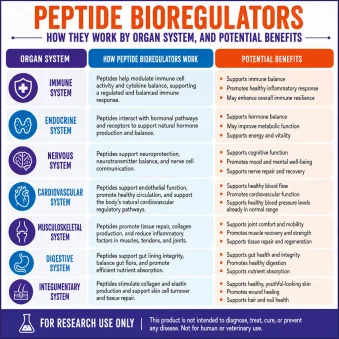
The vesugen peptide is a short synthetic peptide bioregulator from the Khavinson research tradition, proposed as a blood vessel bioregulator. This guide explains what Vesugen is, how it is thought to work on the endothelium, what has been measured in cell studies, the role of vesugen acetate, safety reports, and how to check a supplier's documentation.
Editorial & research disclaimer: This article is for educational purposes only and is not medical advice. Vesugen is a peptide bioregulator and has not been evaluated by the FDA to diagnose, treat, cure, or prevent any disease, including cardiovascular disease. PrymaLab supplies Vesugen for laboratory research use only; verify local regulations before purchase.

Quick Answer
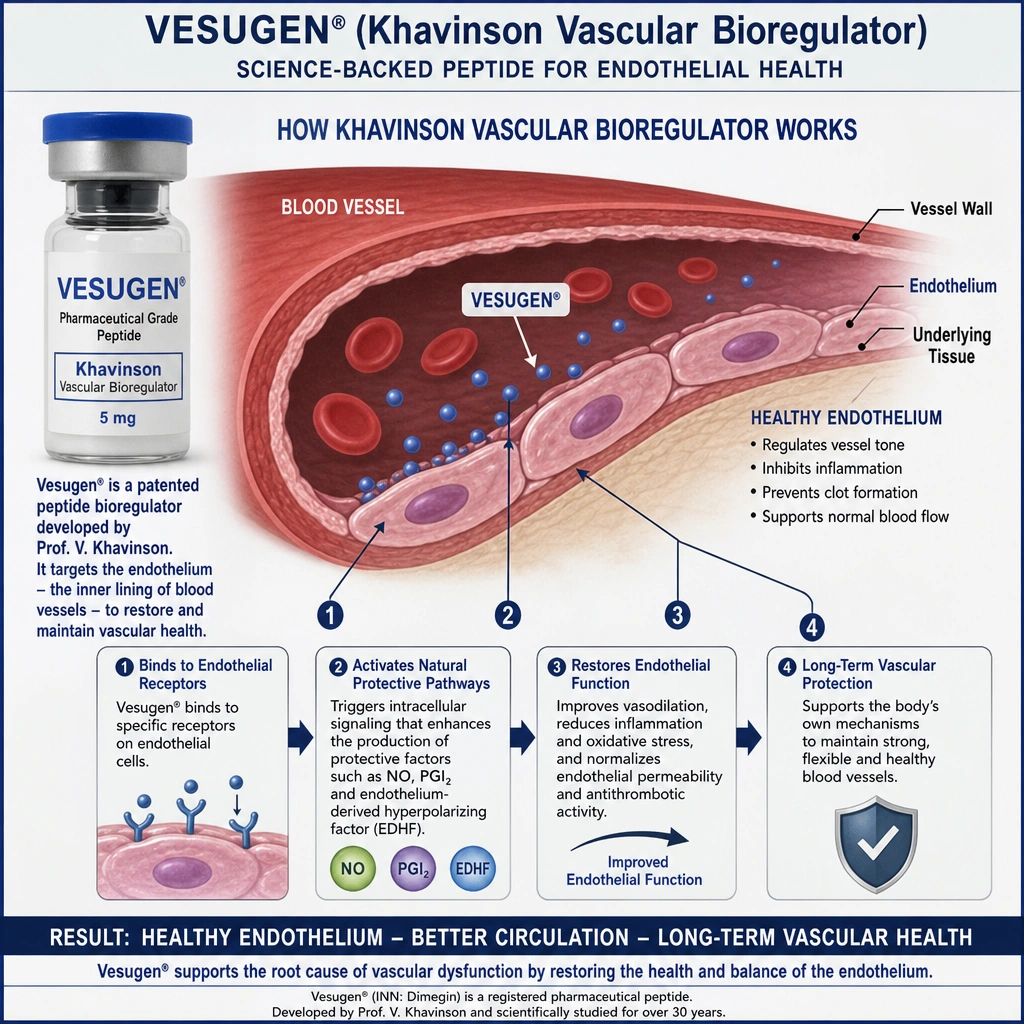
What is Vesugen peptide? Vesugen is a synthesized peptide bioregulator (a "cytogen") formulated to target the vascular system. It is the tripeptide Lysine-Glutamic acid-Aspartic acid (Lys-Glu-Asp / KED). In the Khavinson model it acts as an epigenetic switch for epigenetic regulation — entering vascular cells, reaching the nucleus, and modulating gene expression to maintain vascular health, vascular integrity, blood-vessel structure, and the extracellular matrix, especially the endothelium.
As a blood vessel peptide bioregulator it is sold as oral capsules or sublingual drops (often as vesugen acetate, the stabilized salt form). Evidence is largely preclinical and from its originating research school, so treat Vesugen as an educational, research-grade compound rather than an approved medicine.
Vesugen is a Khavinson-class blood vessel bioregulator — the tripeptide Lys-Glu-Asp studied for vascular support, not an approved drug.
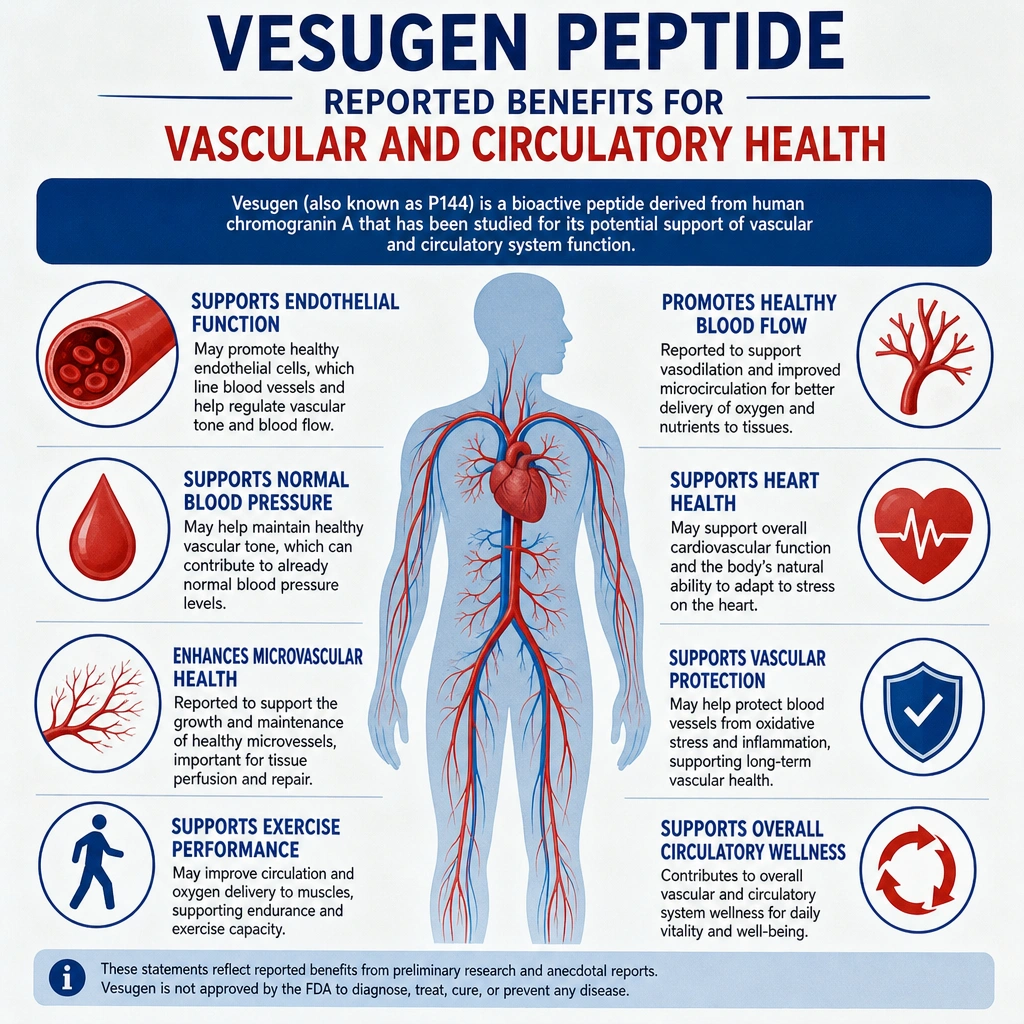
Mechanism is epigenetic by hypothesis: it is proposed to restore endothelial function and nitric-oxide production, improve vessel-wall elasticity, and strengthen capillaries.
Measured evidence is cell culture work: KED changed the expression of differentiation and ageing-related genes in non-vascular human cell cultures; none of these studies used vascular cells.
No human dose exists. Vesugen is not an approved medicine, and PrymaLab supplies it for laboratory research only.
Buy on proof. Check that the certificate matches the lot number on your vial and can be verified, and that the label states the Lys-Glu-Asp sequence; confirm legality in your region.
What Is the Vesugen Peptide?
At its core, the vesugen peptide is a synthesized bioregulator formulated to target the vascular system — a true blood vessel bioregulator. Because it is a "cytogen," Vesugen is made in a laboratory as a short synthetic peptide, and in the Khavinson model it is proposed to act on blood-vessel cells and on cellular aging. It belongs to the family of Khavinson bioregulators.
The Chemical Structure: Lys-Glu-Asp Tripeptide
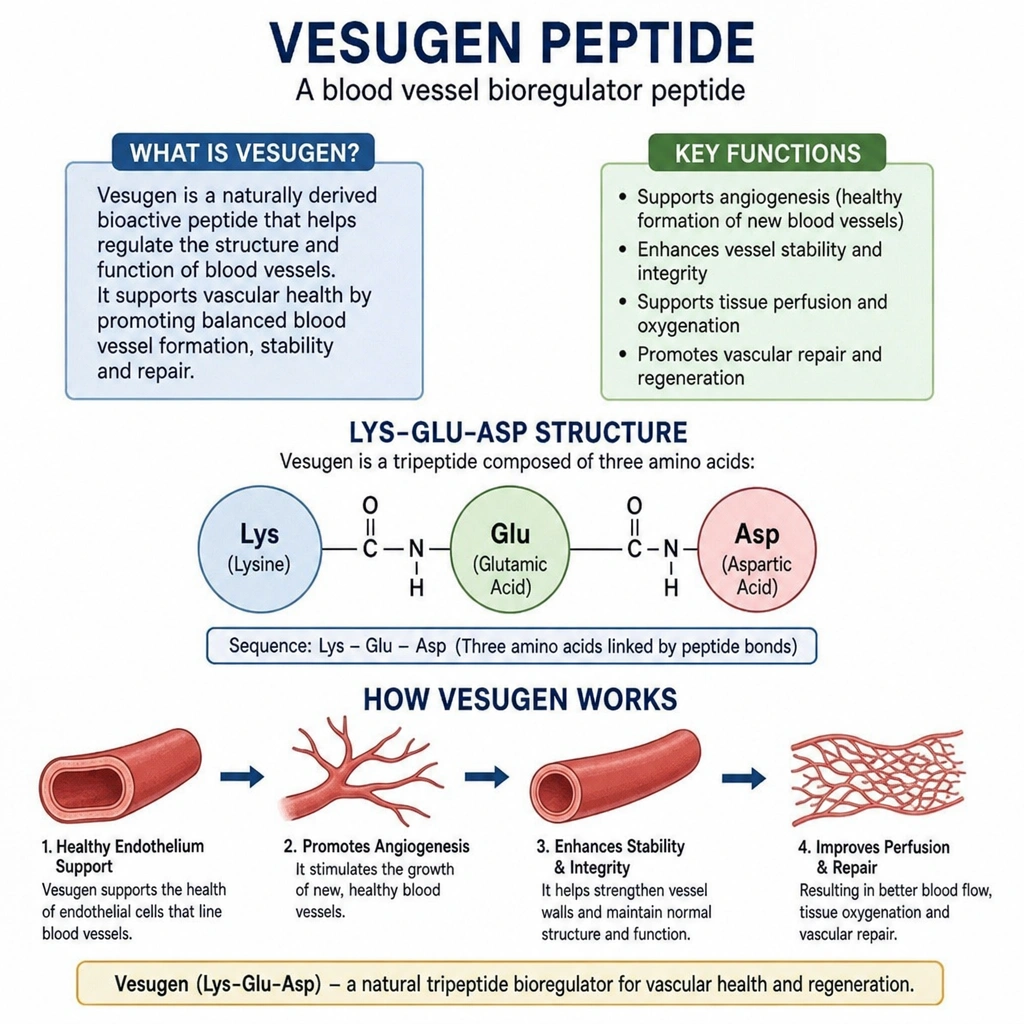
Vesugen is very small — a tripeptide with the sequence Lysine, Glutamic acid, Aspartic acid (Lys-Glu-Asp / KED) that may interact with pathways like SIRT1 and has a specific molecular formula designed for high cellular permeability. Its small size is the basis of the proposal that it can pass through the digestive tract, penetrate vascular-cell membranes, and enter the nucleus, where the sequence is proposed to act as a key that unlocks genes governing blood-vessel integrity. This is why it is often described as a blood vessel peptide bioregulator, or a vesugen peptide bioregulator for blood vessels.
What Is Vesugen Acetate?
You will often see the compound listed as vesugen acetate. Peptides are commonly bonded with an acetate salt to stabilize the molecule, which extends shelf life.
How Does Vesugen Work?
Vesugen is not a temporary vasodilator like a blood-pressure pill; in the Khavinson model it is proposed to structurally support the vascular system from the inside out. Three mechanisms are emphasized:
- Repairing the endothelium: the single-cell lining that releases nitric oxide (which relaxes vessels) and regulates vasoconstrictors like endothelin-1. Vesugen is proposed to stimulate protein synthesis and endothelial cell proliferation in vascular endothelial cells and regulate apoptosis, supporting nitric-oxide production while potentially modulating endothelin-1 levels and reducing oxidative stress or harmful prooxidant activity.
- Improving vessel-wall elasticity: by normalizing metabolism in vascular smooth muscle and the extracellular matrix, it is proposed to support youthful flexibility against age and glycation.
- Strengthening capillary walls: reinforcing the microvasculature that delivers oxygen and nutrients to skin, eyes, and brain.
These are proposals from the originating research school, not proven outcomes; none of the published KED cell studies used vascular cells.
What Is Claimed for Vesugen
Claims for Vesugen from its originating research school centre on vascular function: vessel elasticity, microcirculation, plaque formation, blood pressure and cerebral blood flow. The published KED studies, described in the next section, used non-vascular cell cultures, so these vascular claims are unproven.
Cell culture studies of the KED tripeptide
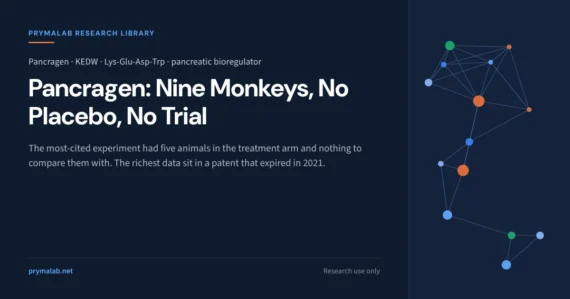
Most of the measured evidence on KED comes from human cell cultures rather than from animals or people. In 2012 Khavinson's group reported that differentiation factors fall in late-passage, ageing cultures and that three short peptides raised them in a tissue-specific way: Pancragen in pancreatic cells, Bronchogen in bronchial epithelial cells and Vesugen (KED) in prostatic fibroblasts, where CXCL12 and WEGC1 were measured (Khavinson et al. 2012). The effect was stronger in the aged cultures (Khavinson et al. 2012).
Ashapkin and colleagues compared KED with AED and KE in human embryonic bone marrow mesenchymal stem cells aged either by serial passage or in stationary culture (Ashapkin et al. 2020). All three peptides raised IGF1 expression 3.5 to 5.6 fold and stimulated NFκB; KED lowered FOXO1 expression 1.6 to 2.3 fold and had opposite effects on TNKS2 in the two ageing models (Ashapkin et al. 2020). In human periodontal ligament stem cells, KED alone and a mixture of four short peptides increased GAP43 and nestin, proteins associated with neuronal differentiation (Caputi et al. 2019). A 2021 review from the group drew these and other findings together, describing KED as regulating p16 and p21, the neuronal differentiation genes NES and GAP43, and SUMO, APOE and IGF1, genes involved in Alzheimer's disease, and calling for studies in animal models (Khavinson et al. 2021).
None of these studies used vascular cells, and all of them measured changes in expression over a culture period rather than a change in tissue function.
Vesugen vs. Ventfort: Cytogen vs. Cytomax
The two products differ in origin: Vesugen is a synthetic cytogen, and Ventfort is a natural vascular extract (a cytomax).
| Factor | Vesugen (Cytogen) | Ventfort (Cytomax) |
|---|---|---|
| Type | Synthetic tripeptide (Lys-Glu-Asp) | Natural vascular extract |
| Target | Blood vessels / endothelium | Blood vessels / vascular tissue |
| Form | Capsules / sublingual (vesugen acetate) | Capsules |
Vesugen and human use
Vesugen is not an approved medicine anywhere and has no official human dose. Capsule products sold as supplements in Russia carry a label regimen; that is a supplement label, not a trial result, and it concerns a different product from the research peptide sold here. The Khavinson group's published work on this peptide is cell and animal research. PrymaLab supplies Vesugen for laboratory research only.
Vesugen and Related Bioregulators (Chelohart & Pinealon)
Vesugen is often sold and discussed alongside other bioregulators: Ventfort (a vascular extract), Chelohart (a heart-muscle peptide), and Cerluten or Pinealon (brain peptides).
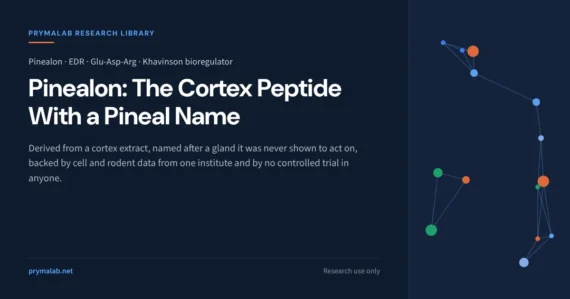
What is Pinealon? Pinealon is a brain/CNS bioregulator from the same research school, the tripeptide Glu-Asp-Arg. Its literature discusses cognitive function and neuroprotection.
Safety and Side Effects
Research from the St. Petersburg Institute (Professor Vladimir Khavinson's work) reports a low incidence of adverse effects for bioregulatory peptides as a class. Independent, large-scale human trials are limited, so these reports are not definitive.
Personal health questions belong with a healthcare provider; this page covers laboratory research only.
Where to Find Vesugen for Sale Safely
Rising popularity has brought counterfeit and under-dosed products. When navigating vesugen for sale, buy on documentation.
| Factor | High-Quality (Verified) | Low-Quality / Risky |
|---|---|---|
| Testing / COA | Lot-specific Certificate of Analysis that can be verified | Missing or generic |
| Sourcing | Authorized Khavinson distributor | Unknown origin |
| Labeling | States Lys-Glu-Asp sequence | Vague ingredient list |
| Contaminants | Tested (heavy metals, microbes) | Untested |
| Price | Reflects real synthesis cost | Suspiciously cheap (filler risk) |
PrymaLab's bioregulator catalog is one reference point for the transparency standards a trustworthy supplier should meet.
Related reading: MOTS-c research and side effects.
Researching vascular bioregulators? Start with verified material.
PrymaLab focuses on US-handled research peptides with transparent documentation and careful handling.
Explore PrymaLab BioregulatorsFrequently Asked Questions
What is Vesugen and what does it do?
Vesugen is a synthetic peptide bioregulator (a cytogen) made of the tripeptide Lys-Glu-Asp that targets the vascular system. In the Khavinson model it is proposed to act as a blood vessel bioregulator; the published cell studies of KED used non-vascular cells. It is used as an educational, research-grade compound rather than an approved medicine.
What has been claimed for Vesugen?
Claims from its originating research school centre on vessel elasticity, microcirculation, plaque formation, blood pressure and cerebral blood flow. The published KED studies used non-vascular cell cultures, so these claims are unproven.
Has Vesugen been tested in people?
Not in a controlled published trial. Vesugen has no approved human use; capsule supplements sold in Russia carry a label regimen, but that is a supplement label, not a trial result. PrymaLab supplies Vesugen for laboratory research only.
What is vesugen acetate?
Vesugen acetate is the acetate-salt form of the Vesugen peptide. Peptides are frequently bonded with an acetate salt to stabilize the molecule, which extends shelf life. Functionally it is the same Lys-Glu-Asp vascular bioregulator in a stabilized form.
What safety data exist for Vesugen?
Research from the St. Petersburg Institute reports a low incidence of adverse effects for bioregulatory peptides as a class. Independent human trial data are limited.
How does Vesugen relate to Pinealon?
Both are Khavinson short-peptide bioregulators: Vesugen is proposed as a vascular peptide and Pinealon (Glu-Asp-Arg) as a brain peptide, and sellers often pair them. The pairing rests on the proposed roles of each peptide, and Pinealon's originating literature reports minimal side effects.
Where can I find Vesugen for sale safely?
Look for suppliers whose Certificate of Analysis matches the lot number on the vial and can be verified, who test for contaminants, and who clearly label the Lys-Glu-Asp sequence. Avoid suspiciously cheap or unlabeled products, and confirm the legal status of the compound in your region before buying.
References & Further Reading
- Khavinson, V.Kh. (2002). Peptides and Ageing. Neuroendocrinology Letters, 23(Suppl 3), 11–144.
- Khavinson, V.Kh., & Malinin, V.V. (2005). Gerontological Aspects of Genome Peptide Regulation. Karger, Basel.
- Anisimov, V.N., & Khavinson, V.Kh. (2010). Peptide bioregulation of aging: results and prospects. Biogerontology, 11(2), 139–149.
- Review literature on short peptide bioregulators, endothelial function, and the Lys-Glu-Asp (KED) vascular peptide.
- U.S. Food and Drug Administration. Dietary Supplements: Questions and Answers. FDA.gov. Accessed 2026.
PrymaLab resources: Bioregulator peptides · Research Hub · Peptide calculator · FAQ.
Final disclaimer: This article is for educational purposes only. Vesugen and the other compounds discussed have not been evaluated by the FDA or comparable agencies to diagnose, treat, cure, or prevent any disease, and statements about their effects have not been evaluated by the FDA.
Verify the legal status of any compound in your jurisdiction. PrymaLab does not endorse any specific third-party peptide vendor mentioned in this article and assumes no responsibility for third-party products.
Formats stocked for the compounds in this article
Vesugen: Vesugen 20mg and Vesugen 20mg preloaded 3ml pen. Every listing is supplied for laboratory research use with a batch certificate of analysis.