Description
PrymaLab · Research Use Only
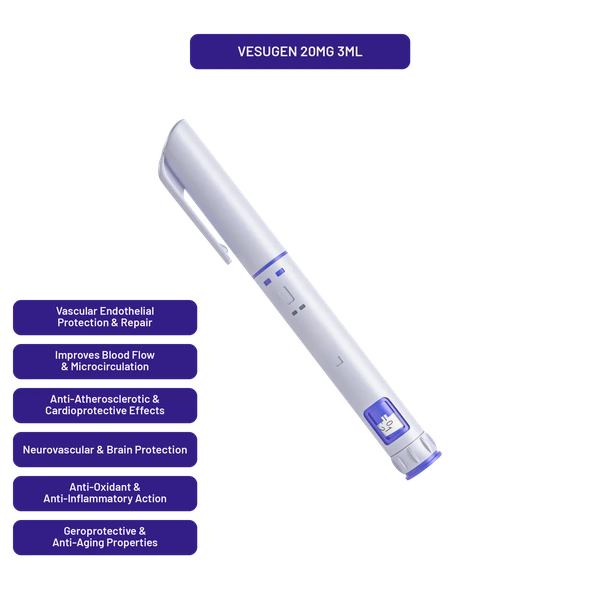
Preloaded Autoinjector | Vesugen | 3ml Pen | 20mg
KED tripeptide in solution · 3ml at 20/3 mg/ml · No reconstitution step
The Vesugen pen is a preloaded 3ml research autoinjector holding 20mg of the synthetic tripeptide H-Lys-Glu-Asp-OH in solution, which puts the concentration at 20/3 mg/ml. Its first two residues are the whole of the dipeptide Vilon, so the ring-closure chemistry that degrades that compound can clip this one in two, leaving a 257.3 and a 133.1 fragment where a 390.4 peak used to be.
Specification Table
| Property | Value |
|---|---|
| Device format | Preloaded autoinjector pen, glass cartridge |
| Fill volume | 3 ml |
| Concentration | 20/3 mg/ml |
| Total compound in device | 20 mg |
| Molar concentration | 20 × 0.854 mM |
| Compound | Vesugen, H-Lys-Glu-Asp-OH, written KED in the indexed literature |
| CAS number | 204271-66-9. Catalogued from a secondary source only and unverified against a chemistry database |
| Molecular formula | C15H26N4O8 |
| Molecular weight | 390.4 g/mol average, 390.18 Da monoisotopic |
| Amino acid sequence | Lys-Glu-Asp (KED), three residues, all L-configuration |
| Solution appearance | Clear and colourless, free of visible particulate |
| Reconstitution required | None. Supplied as solution |
| Excipient system | Not published on the product record. Confirm against certificate of analysis |
| Solution pH | Not published on the product record |
| Storage | 2-8°C, protected from light, do not freeze |
| Light sensitivity | Negligible. No aromatic or otherwise photolabile residue |
| Solution stability | Not established over device shelf life in published data |
| Likely covalent routes | Acid-catalysed cleavage at the aspartyl residue, and N-terminal cyclisation clipping the Lys-Glu pair |
| Net charge at pH 7 | Approximately -1. Two positive centres against three carboxylates |
| Adsorption risk | Low. Small, hydrophilic and net negative, so little affinity for anionic glass |
| Salt form | Acetate on the research market. Counter-ion in any given device unverified |
| Purity | Per lot-specific certificate of analysis |
| Regulatory status | No approved formulation under FDA, EMA, PMDA, TGA or Health Canada |
What Changes When Vesugen Ships in Solution?
Dissolving this tripeptide activates two chemistries that a dry cake keeps switched off, and both of them are backbone reactions rather than the side-chain oxidation and deamidation that dominate stability talk elsewhere.
Start with what is absent, because it is most of the usual list. There is no asparagine or glutamine, so classical deamidation cannot happen. There is no methionine, cysteine, tryptophan, tyrosine or histidine, so there is no oxidation hotspot, no disulfide to scramble and no near-UV chromophore. Protection from light is therefore ordinary prudence rather than a mechanism, which is the reverse of the situation for a peptide carrying tryptophan.
The first live route is the aspartyl residue. Aspartate is the residue most associated with succinimide formation and with backbone cleavage at the Asp-Xaa bond, and acid conditions catalyse the cleavage. Here the aspartate sits at the C-terminus, which limits classical aspartimide chemistry, since that reaction needs a following residue to cyclise onto. Acid-catalysed cleavage at the Glu-Asp bond is not similarly limited.
The second route is the more interesting one, and it comes from what the first two residues are. Lys-Glu is the entirety of the dipeptide sold as Vilon, and dipeptide units with a free N-terminal amine cyclise to their 2,5-diketopiperazine in aqueous solution. In a tripeptide that same reaction becomes a clipping reaction: the ring closes on the first two residues and the third leaves. The products are cyclo(Lys-Glu) at roughly 257.3 g/mol and free aspartic acid at 133.1 g/mol, and those two sum to 390.4, the mass of the intact tripeptide, because the water lost in forming the ring is the water gained in cleaving the amide.
That arithmetic is a gift to anyone verifying a lot. Most peptide degradation is hard to see: deamidation moves mass by 1 dalton, oxidation by 16. Here the parent peak at 390.4 gives way to peaks at 257.3 and 133.1, which no instrument will miss. Neither of these routes has been characterised specifically for this compound, so both are inference from general peptide chemistry rather than published measurement, and the page says so rather than implying otherwise.
Physical behaviour is quiet. Two positive centres against three carboxylates leave the molecule net negative at neutral pH, and a small, hydrophilic, net-negative species has little affinity for anionic borosilicate glass and no reason to self-associate. Aggregation is not a concern and adsorptive loss is a minor one, which is the opposite of the profile a large cationic peptide presents. No Western-approved product of this compound exists, so there is no manufacturer’s formulation whose buffer and pH could be read as an answer to any of this.
What Is Known About Vesugen Solution Stability?
Nothing specific has been published. No compound-specific aqueous stability study and no preloaded-solution formulation study was located, which makes Vesugen solution stability an inference from the structure rather than a measured shelf life.
The direction of the inference is at least clear. Both plausible routes are backbone reactions accelerated by temperature, and the N-terminal ring closure speeds up further at neutral to basic pH while aspartyl cleavage is acid-catalysed. Those two run in opposite directions with respect to pH, so no single pH shuts both down, and cold with mild acidity is the conventional compromise.
What a stability protocol should measure is unusually well defined for a compound with no stability data. The question is the ratio of the 390.4 peak to the 257.3 and 133.1 fragments over time at the storage temperature, run alongside a reversed-phase separation to catch anything the mass measurement lumps together. Anyone treating Vesugen solution stability as answered by a certificate showing correct mass at release is answering a question about the fill date rather than about the device in front of them.
What Does the Vesugen Pen Deliver Per Increment?
Concentration is 20 mg divided by 3 ml, and every figure below follows from that division and the molecular weight of 390.4 g/mol.
Molar concentration is (20/3 divided by 390.4) multiplied by 1000, which reduces to 20 × 0.854 mM. Mass per 0.01 ml, the smallest increment most pen mechanisms resolve, is (20/3) × 0.01 mg; per 0.1 ml it is (20/3) × 0.1 mg. At a 10 mg fill: 3.333 mg/ml, 8.54 mM, 33.3 micrograms per 0.01 ml, 333 micrograms per 0.1 ml.
The low molecular weight raises the molar figure relative to what people expect from larger peptides. The same 10 mg of a 1300 g/mol decapeptide gives about 2.6 mM; this tripeptide gives 8.54 mM, roughly 3.3 times as many moles for identical mass. Anyone planning an experiment in moles from a milligram figure needs that correction rather than a rule of thumb carried over from another compound.
Against the published work the arithmetic cannot be anchored to anything. The developer-group in vitro studies use low concentrations, commonly nanomolar to micromolar in culture, so reaching 1 micromolar from an 8.54 mM fill is about an 8,500-fold dilution. No human dose has been established in a controlled study, which means there is no research figure for a device increment to be measured against, and any listing that implies one is unverified.
Does Vesugen Come in a Pen, and How Does It Compare With a Vial?
Yes: this product is that device, and the Vesugen pen vs vial comparison turns on a single variable, which is how long the tripeptide has been dissolved before it is drawn.
Anyone asking does Vesugen come in a pen is usually comparing against the norm in the source literature, where material of this class is supplied as lyophilized powder and reconstituted immediately before use. Freshly prepared solution is what the developer-group experiments used. A cartridge held for weeks is a presentation that literature never tested.
What the format removes is set out on the pen versus vial comparison and across the preloaded autoinjector range. Against a lyophilized vial presentation, which keeps the material dry until the day of use and allows the cake to be inspected, the Vesugen pen vs vial trade is preparation variance against time in water.
For a device used across days that trade favours the cartridge, because preparation variance dominates and the backbone reactions have had little time to run. For one drawn on across months it favours the vial. Since nobody has published a rate constant for either degradation route, where the crossover sits is a matter of judgement rather than data.
Vesugen Pen Storage in Practice
Refrigerate at 2-8°C, do not freeze, and minimise time at ambient temperature, because both plausible degradation routes here are thermally accelerated and temperature is the only variable a laboratory controls.
Vesugen pen storage is simpler than for most compounds in this catalogue for a reason worth stating: there is nothing to protect from light in any chemical sense. No aromatic residue means no chromophore in the near-UV or visible range, so bench illumination is not driving photochemistry. Keeping the device in its packaging is still sensible, and it is not the control that matters.
Freezing risks the cartridge and offers nothing, since this molecule has no aggregation liability a frozen state would suppress. Record the date of first actuation and the interval before each subsequent draw; for a device in service across weeks, that interval is an experimental variable rather than a housekeeping detail.
The one lever storage cannot pull is formulation pH, which is not disclosed. Since the two candidate routes respond to pH in opposite directions, that omission removes any way of reasoning about which one dominates.
What the Product Record Does Not State
Four fields are missing, and for a compound whose degradation chemistry is pH-split, one of them removes most of the ability to predict anything.
Solution pH is unpublished. N-terminal cyclisation accelerates at neutral to basic pH and aspartyl cleavage is acid-catalysed, so the formulation pH decides which route dominates and how fast. Without the number, no degradant estimate is possible even in principle.
The excipient system is unpublished. Whatever buffer sets that pH also enters any assay the solution is added to, and for a molecule of 390.4 g/mol used at low concentration the excipients may outweigh the compound in the assay by a wide margin.
The counter-ion and the net peptide content are unpublished. Acetate is the usual research salt, and for a molecule this small the counter-ion is a larger fraction of the total mass than it would be for a large peptide, so a gravimetric fill at nominal 20 mg contains meaningfully less peptide than the label implies. Fill date and shelf-life data are absent as well. Ask for each of those on the certificate of analysis, together with the handling checks in peptide storage and stability.
Verifying a Vesugen Pen and Confirming Its Contents
Inspect the solution against a white background before each draw and expect clear, colourless liquid with no particulate, then accept that the inspection has told you little, because the intact tripeptide and both of its likely fragments are colourless and freely soluble.
Mass spectrometry does the real work here, and the numbers are unusually favourable. Intact mass against 390.4 g/mol average or 390.18 Da monoisotopic confirms the parent. Clipping at the Glu-Asp bond produces cyclo(Lys-Glu) near 257.3 and free aspartic acid at 133.1, so a degraded lot shows two new peaks rather than a 1 dalton nudge. Measuring the ratio of the 390.4 peak to the 257.3 peak in a drawn aliquot gives a direct read on how far the fill has travelled.
Chromatography supplies the quantitation. The cyclic dipeptide is less polar than the net-negative parent and separates from it on reversed phase, and free aspartic acid elutes early. Run the separation against a freshly prepared reference on the same day rather than against a literature retention time, since retention depends on the buffer conditions of the run.
Quantitation cannot use absorbance at 280 nanometres, because none of these species contains tryptophan or tyrosine. Use the peptide bond at 205 to 214 nanometres, a colourimetric assay, or amino acid analysis, which has a second advantage here: it reports the Lys, Glu and Asp ratio, and that departs from 1:1:1 once clipping has occurred.
Warm the device to room temperature first. A cold solution is more viscous, and viscosity changes what a spring mechanism delivers per stroke. One gravimetric check of delivered volume onto a tared vessel establishes what the mechanism actually does across several actuations.
What the Literature Reports and Where It Comes From
The published record is small, recent, and traces almost entirely to one research lineage, which is the first thing a reader should weigh before reading any single result.
In indexed journals the molecule appears as KED rather than under its trade name, which is why searching the trade name returns so little. It was developed by V. Kh. Khavinson and colleagues at the St Petersburg Institute of Bioregulation and Gerontology and described by them as vasoprotective and neuroprotective.
Khavinson, Linkova and Umnov reviewed in 2021 the molecular-genetic aspects of neurogenesis regulation attributed to this tripeptide in Alzheimer’s disease models. Khavinson and colleagues reported in 2012 that short peptides stimulated cell differentiation tissue-specifically during ageing. Ashapkin and colleagues reported in 2020 on modulation of gene expression, including FOXO1, senescence markers and telomerase-related genes, in ageing human mesenchymal stem-cell cultures, and Caputi and colleagues in 2019 on neuronal differentiation of stem cells. Several concern the short-peptide class rather than this molecule alone.
The proposed mechanism is not a classical receptor interaction. The developer-group hypothesis, set out in a 2021 systematic review in Molecules, is that short peptides enter cells, reach the nucleus, bind DNA sequence-selectively and modulate gene expression. It comes from one lineage, has little independent confirmation, and should be read as a hypothesis rather than as established pharmacology. Background on how the compound is described sits in the product research overview and in the wider bioregulator research overview.
What has not been studied deserves equal space. There is no controlled human trial of the injected route for any endpoint, no independent replication of the vascular claims, no pharmacokinetic data, and no solution-stability data for a device. Rapid peptidase clearance would be expected of a tripeptide, but that is inference rather than measurement.
Safety and Regulatory Position
Few adverse effects appear in the published studies, and those studies are small and not powered to detect harm, so the absence of reported findings is not evidence of safety.
No drug approval exists for it with the FDA, the EMA, PMDA, TGA or Health Canada. It was developed and patented in Russia, where a patent covers a capillary-resistance peptide of this class, and while some peptides from that group are registered as medicines or sold as parapharmaceuticals within the Russian Federation, the precise Russian status of this tripeptide is unverified here. In Western markets it is a research chemical.
No FDA-approved labelling exists, so there is no reference specification against which a supplier certificate can be compared. Whether it appears on the FDA 503A or 503B bulk drug substance lists could not be confirmed from the sources used, so that remains open. The WADA Prohibited List carries no entry under this name, and the live list was not opened during this work. Safety of chronic self-administration is unstudied.
Why Is Vesugen Described as a Vascular Peptide?
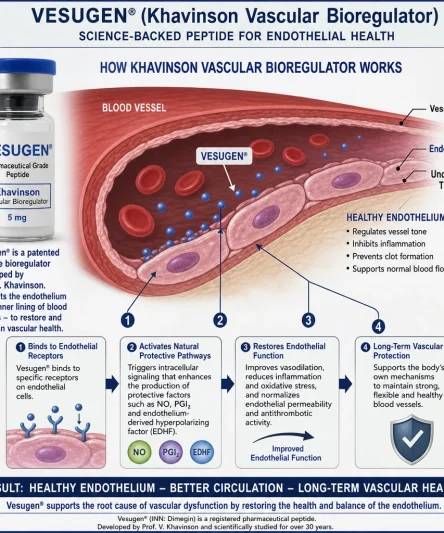
Because KED was assigned to blood vessels in the organ-mapping scheme that produced the whole family of peptide bioregulators, and the assignment came before the experiments. Vladimir Khavinson’s group synthesised the Vesugen peptide as a defined replacement for a vascular tissue extract, and the vascular system claims that follow the name are inherited from that source material rather than derived from the sequence.
The published work is small and mostly in-house. Reports describe changes to cultured endothelial cells taken from blood vessels, altered expression of adhesion and growth factor genes, and improved histology in vessel walls from aged rats. The endothelium is the single cell layer those experiments are about. Angiogenesis appears as an endpoint in some cell work, measured as tube formation in matrix assays. Nothing in that record measures blood flow in a living animal, and no study reports blood pressure, which is the endpoint most readers assume when they see vascular health language. Circulation, in the sense of blood moving through vessels at a measurable rate, has never been an endpoint for this compound.
The gap between what is measured and what is claimed is wide here. Circulation and vascular health are outcome words, and the experiments produce marker words. Blood flow through a vascular bed is measurable, and it has not been measured here. Atherosclerosis, restenosis and metabolic syndrome all appear in secondary descriptions of this compound, and none of the three has been studied with KED in any published model. Endothelium behaviour in a dish is a long way from any of them, and the endothelium of a culture flask is not the endothelium of a blood vessel under pressure. Anti-aging framing sits on top of the same thin base, since the rodent studies that support the anti-aging language measured tissue appearance rather than function or survival.
What Should a Purity Figure and a CoA Actually Tell You?
Purity on a peptide certificate is an area-percentage from a chromatogram, and it means nothing without the method that produced it. A purity figure of 98 per cent from a fast generic gradient and the same purity figure from a shallow gradient designed to resolve a Lys-Glu deletion from intact KED are different statements about the same material. Ask which gradient, which column and which detection wavelength, and note that at 214 nm every peptide bond absorbs while at 280 nm this molecule is invisible, having no aromatic residue.
The mass figure is the other half. This research compound has an average molecular weight of 390.39 g/mol, and an accurate-mass result matching that is a real identity check. Glutamic acid at position two and the aspartate at position three differ by fourteen daltons from one another, so a synthesis error transposing them is detectable by mass only if the instrument is resolving properly. Ask for a lot-specific CoA rather than a representative one, and for one written against a solution rather than a powder if the format is a pen. A representative certificate describes a batch nobody can now locate.
Format changes what the certificate should cover. A Vesugen 20mg vial ships dry, is brought into solution with bacteriostatic water at the bench, and its CoA describes a solid. This device ships as a solution, so the certificate should state concentration, pH, excipient system and the date the fill was made. That last date is when this material started degrading, and it is not on the product record.
How Does Vesugen Compare With Others in the Family?
Its first two residues are the whole of Vilon, which makes it the clearest example in the catalogue of how these sequences were built: take a shorter bioregulator and extend it. Pinealon, a different tripeptide from the same programme, was assigned to the central nervous system by the same logic. Each research peptide in the set carries the same claim shape and a comparable weight of evidence, which is modest.
No side effects have been reported for KED, and no study has been designed to detect them. There is no toxicology in any species, no pharmacokinetic data and no registered clinical trial anywhere, so the absence of reported side effects reflects the absence of looking. Tissue repair claims made for this molecule rest on the same in-house histology as everything else here. This pen is supplied for laboratory research only.
Published Literature
Five entries, each confirmed against a primary index before listing here. All concern the compound or its short-peptide class; the device format has no literature of its own.
- Khavinson VKh, Linkova NS, Umnov RS. Peptide KED: molecular-genetic aspects of neurogenesis regulation in Alzheimer’s disease. Bull Exp Biol Med. 2021;171(2):190-193. DOI: 10.1007/s10517-021-05192-6 PMID: 34173097
- Khavinson VKh, Linkova NS, Polyakova VO, et al. Peptides tissue-specifically stimulate cell differentiation during their aging. Bull Exp Biol Med. 2012;153(1):148-151. DOI: 10.1007/s10517-012-1664-1 PMID: 22808515
- Ashapkin V, Khavinson V, Shilovsky G, et al. Gene expression in human mesenchymal stem cell aging cultures: modulation by short peptides. Mol Biol Rep. 2020;47(6):4323-4329. DOI: 10.1007/s11033-020-05506-3 PMID: 32399807
- Caputi S, Trubiani O, Sinjari B, et al. Effect of short peptides on neuronal differentiation of stem cells. Int J Immunopathol Pharmacol. 2019;33:2058738419828613. DOI: 10.1177/2058738419828613 PMID: 30791821
- Khavinson VKh, Popovich IG, Linkova NS, et al. Peptide regulation of gene expression: a systematic review. Molecules. 2021;26(22):7053. DOI: 10.3390/molecules26227053 PMID: 34834147
Frequently Asked Questions
What is the Vesugen pen?
A preloaded 3ml research autoinjector holding 20mg of the tripeptide H-Lys-Glu-Asp-OH in solution at 20/3 mg/ml, with no reconstitution step. Supply is strictly for laboratory research, and no Western regulator has approved a formulation of this compound.
Does Vesugen come in a pen, and is the compound the same as in a vial?
It does; this product is that device. The molecule is identical, but the physical state is not: a cartridge holds it dissolved from the fill line onward, while a vial holds it dry until reconstitution. That difference is the whole of the stability argument on this page.
What degrades this tripeptide in solution?
Two backbone routes rather than side-chain chemistry. Acid-catalysed cleavage at the aspartyl residue is one. The other is ring closure on the N-terminal Lys-Glu pair, which clips the molecule and releases cyclo(Lys-Glu) plus free aspartic acid. Neither has been characterised specifically for this compound.
Why do the fragment masses matter?
Because they are easy to see. Clipping gives cyclo(Lys-Glu) near 257.3 g/mol and aspartic acid at 133.1, which sum to the parent mass of 390.4 because the water lost in ring closure is regained in cleaving the amide. Two new peaks are far more visible than a 1 dalton shift.
What is known about Vesugen solution stability?
No compound-specific aqueous stability study or preloaded-solution formulation study was located, so Vesugen solution stability is inferred from structure rather than measured. Both candidate routes accelerate with temperature, and they respond to pH in opposite directions, so no single pH suppresses both.
Is deamidation or oxidation a concern?
Neither. There is no asparagine or glutamine, so classical deamidation cannot occur, and no methionine, cysteine, tryptophan, tyrosine or histidine, so there is no oxidation hotspot and no disulfide to scramble. That absence is what leaves the backbone routes as the only live chemistry.
Is this compound light-sensitive?
Not in any chemical sense. Lysine, glutamate and aspartate carry no aromatic ring and absorb nothing useful in the near-UV or visible range, so there is no chromophore for photochemistry to work through. Protection from light is ordinary practice here rather than a response to a known route.
Does it aggregate or adsorb to the cartridge?
Barely. Two positive centres against three carboxylates leave the molecule net negative at neutral pH, and a small, hydrophilic, net-negative species has little affinity for anionic borosilicate glass and no tendency to self-associate. Surface losses are a minor concern relative to large cationic peptides.
What does one 0.01 ml increment deliver?
(20/3) multiplied by 0.01 mg. At a 10 mg fill that is 33.3 micrograms per 0.01 ml and 333 micrograms per 0.1 ml, from a 3.333 mg/ml solution at 8.54 mM. Substitute the actual strength once the client sets it.
Why is the molar concentration higher than expected for the mass?
Because the molecular weight is only 390.4 g/mol. The same 10 mg of a 1300 g/mol decapeptide gives about 2.6 mM, while this tripeptide gives 8.54 mM, roughly 3.3 times as many moles for the same mass. Planning in moles from a milligram figure needs that correction.
Can pen increments be matched to a published dose?
No. No human dose has been established in any controlled study, and the developer-group in vitro work runs at nanomolar to micromolar concentrations in culture. Reaching 1 micromolar from an 8.54 mM fill is roughly an 8,500-fold dilution, which is arithmetic rather than guidance.
How does the Vesugen pen vs vial comparison come out?
It depends on service life. Over days the Vesugen pen vs vial trade favours the cartridge, since preparation variance dominates. Over months it favours the lyophilized vial, because the backbone reactions have had that long to run. No published rate constant exists to locate the crossover precisely.
What should Vesugen pen storage look like?
Refrigeration at 2-8°C, no freezing, and as little time at ambient temperature as the work allows. Recording the date of first actuation and the interval before each draw matters more than light protection, because both candidate degradation routes are thermally accelerated and neither is photochemical.
What is not stated on the product record?
Solution pH, the excipient system, the counter-ion, the net peptide content and the fill date. Solution pH is the consequential omission, because the two candidate degradation routes respond to pH in opposite directions. Request all five against the lot-specific certificate of analysis.
Can absorbance at 280 nm quantify the contents?
No. Neither the intact tripeptide nor its fragments contains tryptophan or tyrosine, so extinction at 280 nanometres is effectively zero. Use the peptide bond at 205 to 214 nanometres, a colourimetric assay, or amino acid analysis, which also reports the Lys, Glu and Asp ratio.
How trustworthy is the CAS number?
Less than the rest of the record. The value 204271-66-9 is catalogued for this tripeptide but the source consulted here was secondary rather than a chemistry database, so it is flagged as unverified and should be re-checked against a primary registry before the listing goes live.
What does the published literature actually show?
Cell and gene-expression work from one research lineage: tissue-specific stimulation of cell differentiation in 2012, gene expression in ageing mesenchymal stem-cell cultures in 2020, neuronal differentiation of stem cells in 2019, and a 2021 review of neurogenesis regulation in Alzheimer’s disease models.
What is the regulatory position?
No Western regulator has authorised any formulation of it. Developed and patented in Russia, where the status of this particular tripeptide is unverified here. Presence on the FDA 503A or 503B bulk drug substance lists was not confirmed, nor was status against the current WADA Prohibited List.
Why is Vesugen called a vascular peptide?
Because KED was assigned to blood vessels in the organ-mapping scheme behind the peptide bioregulators, before any experiment on the synthetic version. Vladimir Khavinson’s group made it as a defined replacement for a vascular tissue extract, so the vascular system claims are inherited from the source material rather than derived from the sequence.
What has actually been measured for this compound?
Changes in cultured endothelial cells, altered gene expression, tube formation as an angiogenesis endpoint, and histology in vascular tissue from aged rats. Nothing has measured blood flow in a living animal and no study reports blood pressure. Atherosclerosis, restenosis and metabolic syndrome appear in secondary descriptions and have never been studied with KED, so the circulation and vascular health language runs ahead of the record.
What makes a purity figure meaningful?
The method behind it. Purity is an area percentage from a chromatogram, so 98 per cent from a fast generic gradient and 98 per cent from a gradient that resolves a deletion sequence are different statements. Ask which gradient, column and wavelength: at 214 nm every peptide bond absorbs, and at 280 nm this molecule is invisible because it has no aromatic residue.
Which mass should an identity check return?
390.39 g/mol average for this research compound, 390.18 monoisotopic. Glutamic acid and aspartate differ by fourteen daltons, so a transposition error is detectable only if the instrument resolves properly. Ask for a lot-specific CoA written against a solution, stating concentration, pH, excipients and the fill date, rather than a powder certificate from a Vesugen 20mg vial reconstituted with bacteriostatic water.
What side effects are known for Vesugen?
None have been reported and none have been sought. There is no toxicology in any species, no pharmacokinetics and no registered clinical trial. Tissue repair claims rest on the same in-house histology as the rest of the family, and this pen is supplied for laboratory research only.
Compliance Statement
The Vesugen pen is sold exclusively for laboratory research use. It is not a drug, food, or cosmetic product, and it is not a dietary product of any kind. It is not approved by the FDA or any comparable authority for human or veterinary use. This product is not intended to diagnose, treat, cure, or prevent any disease. It must not be given to humans or animals. Purchase is restricted to qualified researchers and institutions operating within applicable laws. All handling is the responsibility of the purchasing laboratory.


Reviews
There are no reviews yet.