Thymalin Peptide: A Calf Thymus Extract, Not a Sequence, and What the Russian Trials Actually Report
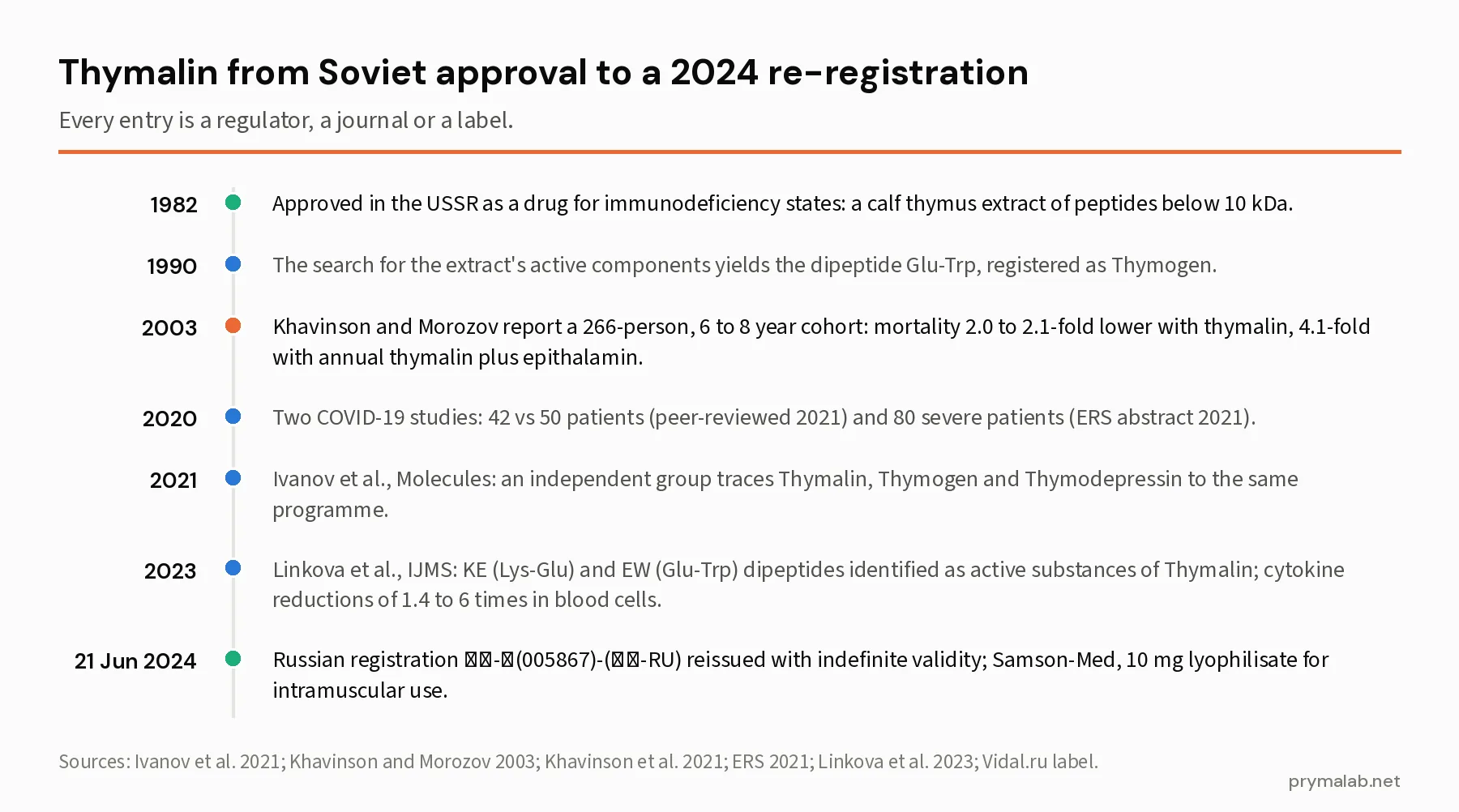
Thymalin (Тималин), the product people search for as a "thymalin peptide", is not a single peptide. It is a complex of low-molecular-weight polypeptides, below 10 kDa, extracted from the thymus of calves and young cattle, approved in the Soviet Union in 1982 and still registered in Russia as a prescription immunomodulator: a 10 mg lyophilisate for intramuscular injection, labelled for immunodeficiency states. The search for its active components produced the synthetic dipeptide Glu-Trp, registered in 1990 as Thymogen, and a 2023 analysis names the dipeptides Glu-Trp and Lys-Glu as its active substances. Its human evidence is a 266-person, 6 to 8 year cohort reporting 2.0 to 2.1-fold lower mortality, two small Russian COVID-19 studies, and forty years of label use, none of it independently replicated in the West. It is not approved by the FDA or EMA and is not on the WADA list. PrymaLab supplies thymalin 10 mg vials and the defined dipeptide Thymogen for laboratory research use only.
- Sequences: None to give. Thymalin is a mixture of thymus polypeptides below 10 kDa, standardised by activity rather than by sequence. Its identified active dipeptides are Glu-Trp (EW, sold separately as Thymogen) and Lys-Glu (KE, sold separately as Vilon). The Russian label lists 10 mg thymus extract with 20 mg glycine per vial.
- Class: Thymic polypeptide extract; peptide bioregulator of the Khavinson school; labelled as an immunomodulator that regulates T- and B-lymphocyte populations, cellular immunity and phagocytosis. Not thymosin alpha-1 (a defined 28-residue peptide) and not thymosin beta-4 (TB-500).
- Studied for: Immunodeficiency states, chronic infections, post-chemotherapy and radiation immunosuppression (label indications); longevity in elderly cohorts (2003); COVID-19 (2020 to 2021); T-cell differentiation of haematopoietic stem cells in vitro.
- Study designs in the literature: The Russian label covers a prescription product for intramuscular use under medical supervision; the two COVID-19 studies were randomised, open-label hospital studies that added thymalin to standard care. Label and design facts, not guidance.
- Storage: Label: 2 to 25 °C as the dry lyophilisate. Research practice: refrigerated, dry, away from light; reconstituted solution refrigerated and used within days, because a mixture of unprotected peptides has no single stability profile.
- Forms and sizes at PrymaLab: Thymalin 10 mg vial; the defined dipeptide Thymogen (Glu-Trp) as a vial and a nasal spray. Sold for laboratory research use only.
- Regulatory: Registered in Russia (ЛП-№(005867)-(РГ-RU), reissued 21 June 2024, indefinite validity; Samson-Med). Not approved by the FDA, EMA or any Western regulator; not on FDA's 503A or 503B lists; not named on the WADA Prohibited List. Not a controlled substance.
| Thymalin | Thymogen (Glu-Trp) | Thymosin alpha-1 | |
|---|---|---|---|
| Composition | Extract; peptides below 10 kDa | One dipeptide, 333 Da | One 28-residue peptide, about 3.1 kDa |
| How identity is checked | Bioassay and profile of a mixture | Mass spectrometry, one mass | Mass spectrometry, one mass |
| Where registered | Russia (1982) | Russia (1990) | China, Italy and others; not the US |
| Best human evidence | 266-person 6 to 8 year cohort; 42 vs 50 COVID-19 study | Russian clinical use; small studies | Randomised trials in hepatitis B and as a vaccine adjuvant |
| Independent Western replication | None | None | Some |
| WADA | Not listed | Not listed | Not listed |
Read the Thymogen reference for the dipeptide that came out of thymalin, the bioregulator overview for the Khavinson series as a whole, and the purity testing guide for why an extract cannot carry a sequence certificate.
Also known as: Тималин, thymalin extract, thymus polypeptide extract, thymic peptide complex, thymus peptides, Khavinson thymus bioregulator, timalin. Not the same as Thymogen, Thymodepressin, thymosin alpha-1, thymosin beta-4 or TB-500.
Every other article in this library begins with a sequence, a formula and a mass. This one cannot, and that is the most important thing to know about thymalin. The thymalin peptide people search for is an extract: the low-molecular-weight fraction of ground calf thymus, standardised the way a 1980s Soviet biological was standardised, by what it does to lymphocytes rather than by what it is. Out of it came a defined dipeptide, Thymogen, and from the same programme a mirror-image dipeptide that suppresses immunity instead. Its human record is a 266-person longevity cohort with a striking mortality figure and no independent replication, two small COVID-19 studies, and a Russian label that has been renewed as recently as June 2024. If you buy a vial labelled thymalin, the certificate will tell you whether you have the extract or something else entirely, and this reference explains how to read it.
Research-use-only disclaimer: Thymalin supplied by PrymaLab is intended strictly for laboratory research use and is not intended for human or veterinary use. The clinical studies and label information described below concern a prescription drug product registered in Russia and given under medical supervision; they do not describe or support any use of research-grade material. Label and trial regimens are not reproduced here. No dosing or administration guidance appears here. Nothing here is medical advice.

TL;DR
Thymalin, sold as a thymalin peptide, is a calf thymus extract of polypeptides below 10 kDa, not a single peptide, approved in the USSR in 1982 and still registered in Russia (re-registered 21 June 2024) as a 10 mg intramuscular immunomodulator for immunodeficiency states. The search for its active components produced Glu-Trp, registered as Thymogen in 1990, and a 2023 analysis names Glu-Trp and Lys-Glu as its active dipeptides. Its human evidence is a 266-person cohort followed 6 to 8 years, reporting mortality 2.0 to 2.1-fold lower with thymalin and 4.1-fold lower with annual thymalin plus epithalamin, written by the developers and never independently replicated; a 42 versus 50 patient open-label COVID-19 study with faster falls in IL-6, CRP and D-dimer and zero deaths in either arm; and an 80-patient congress abstract reporting 19.4% versus 40.9% mortality. It is not FDA- or EMA-approved and not on the WADA list. A research vial with a single-sequence certificate is not thymalin. Research use only.
Identity: A polypeptide extract of calf and young-cattle thymus, below 10 kDa, 10 mg per vial with 20 mg glycine on the Russian label. No sequence, no single mass; identity is by activity and profile.
Family: Thymalin is the parent; Thymogen (Glu-Trp, 1990) and Vilon (Lys-Glu) are its identified active dipeptides; Thymodepressin (D-Glu-D-Trp) from the same programme is an immunosuppressant. Thymosin alpha-1 and TB-500 are unrelated molecules with similar names.
Label: Registered in Russia since 1982 for immunodeficiency states, chronic infections and post-chemotherapy or radiation immunosuppression; contraindicated in pregnancy and breastfeeding; allergic reactions are the listed side effect.
Longevity cohort: 266 elderly people, bioregulators in years 1 to 3, followed 6 to 8 years: mortality 2.0 to 2.1-fold lower with thymalin, 2.5-fold with thymalin plus epithalamin, 4.1-fold with both annually for six years. Developer-authored, allocation not described, no replication.
COVID-19: Randomised open-label study, 42 thymalin plus standard care versus 50 standard care: lymphocytes up 55%, CD4 up 88.9%, IL-6 down 5.5-fold versus 1.41-fold, zero deaths in both groups. ERS abstract, 80 severe patients: mortality 19.4% versus 40.9%.
Verification: An extract cannot have a sequence certificate. If a thymalin lot's certificate shows one peak and one mass, the vial holds a synthetic dipeptide, probably Glu-Trp, and should be labelled Thymogen.
Status: research use only.
What thymalin is: an extract, not a peptide sequence
The Russian label is the best description of thymalin there is, and it is short. Active substance: thymus extract, 10 mg, obtained from the thymus glands of calves and young cattle up to one year old. Excipient: glycine, 20 mg. Form: lyophilisate for the preparation of a solution for intramuscular injection, in 5 mL glass vials. Manufacturer: Samson-Med, St Petersburg. Registration ЛП-№(005867)-(РГ-RU), reissued 21 June 2024, indefinite validity.[1]
Notice what is missing: a sequence, a molecular weight, a formula. Thymalin is what regulatory scientists call a complex biological. An independent group at the Shemyakin-Ovchinnikov Institute, reviewing the history in 2021, describes it as 'another extract of cattle thymus predominantly containing low molecular weight (below 10 kDa) peptides' that 'was approved in Russia as a drug, Thymalin' in 1982 in the Soviet Union, for 'various immunodeficiency states and diseases'.[2] The developers' own COVID-19 paper calls it a 'complex of peptides isolated from the thymus of calves with a molecular weight of up to 10 kDa'.[3]
That has two consequences a buyer should hold onto. The first is that thymalin's potency is defined by what a batch does in a bioassay, not by how much of one molecule it contains, which is normal for a tissue extract and unusual for anything sold in a peptide catalogue. The second is that the phrase 'thymalin peptide', the one most people type, is a category error of the opposite kind from the tesofensine and AICAR errors elsewhere in this library: those are small molecules sold as peptides; thymalin is a mixture of many peptides sold as one. The what counts as a peptide reference gives the definition; thymalin contains hundreds of things that meet it and is not itself one of them.
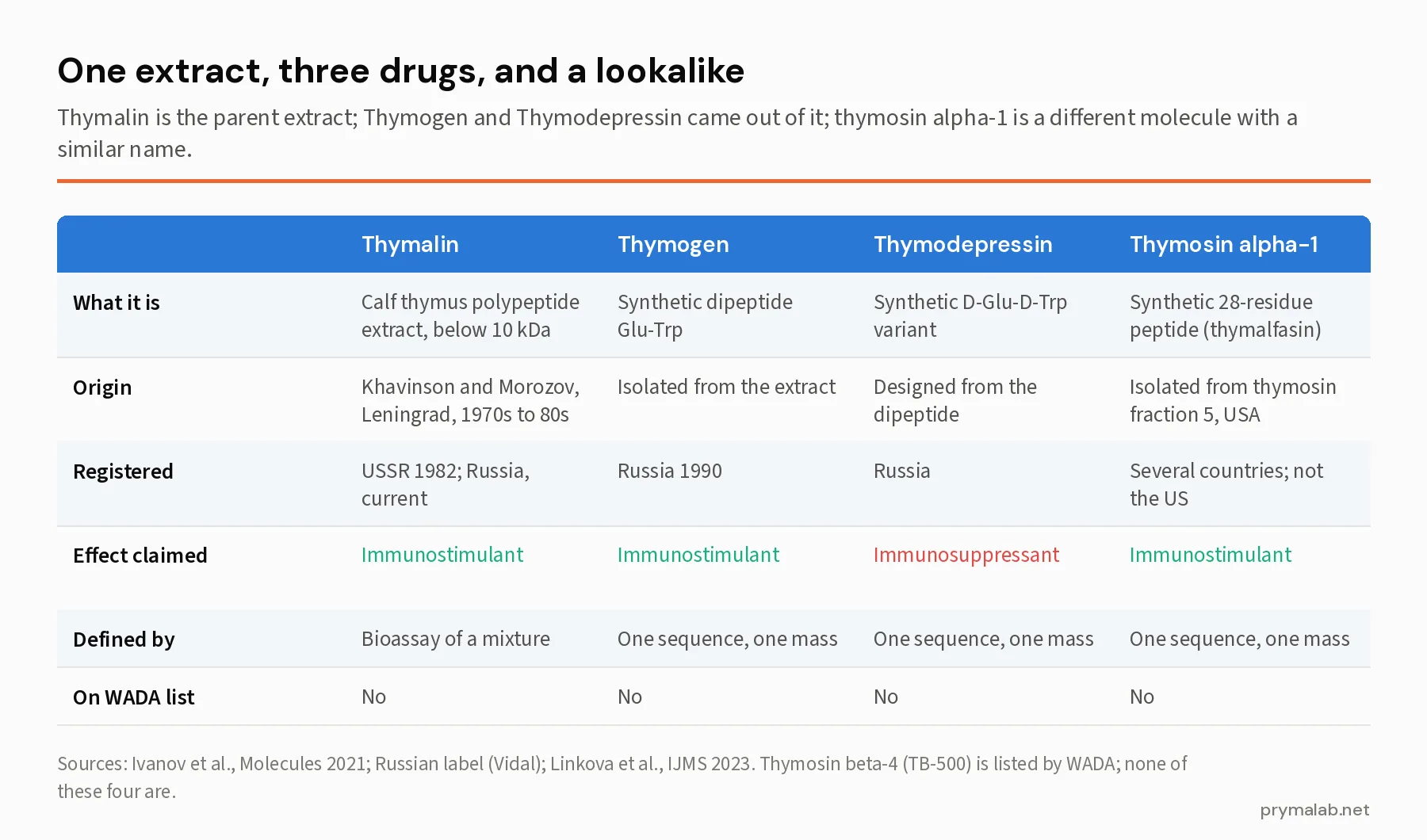
Thymalin vs Thymogen: one extract, three drugs, and a lookalike
Thymalin was developed in Leningrad in the 1970s and 1980s by Vladimir Khavinson and Vyacheslav Morozov, the founders of what became the bioregulator school covered in the bioregulator overview. The extract came first; the defined molecules came out of it. In the words of the 2021 review, 'the search for active components of the extract led to the dipeptide GluTrp, which displayed a broad range of immunoprotective effects and was registered in 1990 as a drug Thymogen'.[2] A 2023 paper from the developers' institute names two dipeptides as the 'active substances of Thymalin': EW, which is Glu-Trp, and KE, which is Lys-Glu, the molecule sold as Vilon.[4] PrymaLab sells the extract as thymalin and the dipeptide as Thymogen, and the Thymogen reference covers the dipeptide on its own terms.
The same programme produced a drug that does the opposite. Thymodepressin is a synthetic dipeptide built from the D-forms of the same two amino acids, D-Glu-D-Trp, and it suppresses rather than stimulates immune function; the 2021 review's title calls it an 'unforeseen immunosuppressor'.[2] Two mirror-image dipeptides from one thymus extract, one an immunostimulant and one an immunosuppressant, is a fact worth knowing before assuming that 'thymus peptide' means one thing.
Then there are the lookalikes. Thymosin alpha-1, thymalfasin, is a defined 28-residue peptide isolated in the United States from thymosin fraction 5, registered in several countries but not the US, with randomised trials in hepatitis B and as a vaccine adjuvant; the thymosin reference covers it. Thymosin beta-4, sold as TB-500, is a 43-residue peptide with nothing to do with immunity claims and a place on the WADA list. Neither is thymalin, and a catalogue that files them together is filing by prefix.
What the Russian label says
Because thymalin is a registered drug in Russia, it has something most research peptides lack: an official label with indications, contraindications and side effects, written by a regulator rather than a vendor. Everything in this section is a label fact about a prescription product given under medical supervision, reported here so the reader knows what the compound's home regulator actually approved.[1]
| Field | As labelled |
|---|---|
| Form and strength | Lyophilisate for intramuscular solution, 10 mg thymus extract with 20 mg glycine per vial; boxes of 5 or 10 |
| Pharmacological action | Restores impaired immunological reactivity by regulating T- and B-lymphocyte populations; stimulates cellular immunity and phagocytosis; supports regeneration and haematopoiesis when suppressed |
| Indications | Immunodeficiency states in adults and children from 6 months: infectious and septic processes, chronic viral and bacterial infections, radiation injury, thymic disorders, immunosuppression after chemotherapy or radiotherapy |
| Contraindications | Hypersensitivity, pregnancy, breastfeeding |
| Side effects | Allergic reactions possible |
| Storage | 2 to 25 degrees C |
| Registration | ЛП-№(005867)-(РГ-RU), issued 21 June 2024, indefinite validity |
Two readings of that label are fair at once. It shows a product that a national regulator has kept on the market for over forty years with a single listed side effect. It also shows a label built on a Soviet-era dossier, for a biological whose composition is described in one phrase, and the label makes no claim about longevity, athletic recovery or anything else the research market attaches to the name.
The 266-person longevity cohort
The paper that made thymalin a longevity compound is Khavinson and Morozov, 'Peptides of pineal gland and thymus prolong human life', Neuroendocrinology Letters, 2003. The abstract reports 266 elderly and older people who received thymalin, the pineal extract epithalamin, or both, during the first two to three years of a six to eight year observation. Mortality was reported 2.0 to 2.1-fold lower with thymalin alone, 1.6 to 1.8-fold lower with epithalamin alone, 2.5-fold lower with both, and 4.1-fold lower in the group that received annual courses of both for six years. Acute respiratory disease incidence was 2.0 to 2.4-fold lower, and the authors describe normalisation of cardiovascular, endocrine, immune and nervous-system indices with fewer clinical manifestations of heart disease, hypertension and osteoarthrosis.[5]
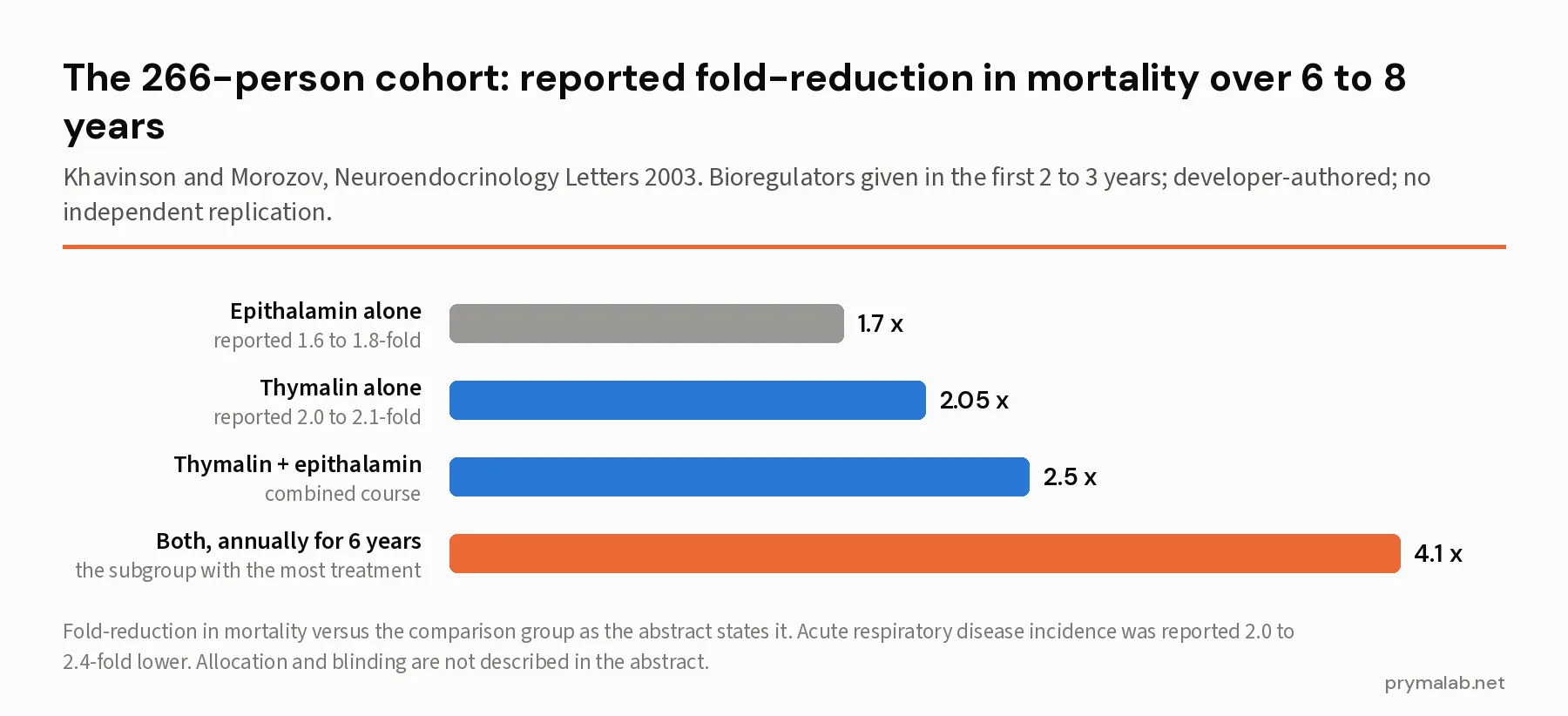
Those are large effects, and the reasons for caution are the usual ones, stated plainly. The study was run and written by the people who developed both products. The abstract does not describe how patients were allocated to groups, whether anyone was blinded, or what the comparison group received. The regimen is not stated in the abstract. In 23 years no independent group in any country has published an attempt to reproduce the mortality result, and none has published a failure, so the finding sits exactly where it sat in 2003: a striking observation from one laboratory. That is not the same as a refutation, and it is not the same as evidence.
The COVID-19 studies
The pandemic produced the only recent human data on thymalin, and it is more useful than the longevity cohort because the designs are described. Khavinson, Kuznik, Trofimova and colleagues ran a single-centre, open-label, prospective, randomised, controlled study in 2020: 42 patients received thymalin on top of standard care, and 50 received standard care alone. In the thymalin group, lymphocytes rose 55%, T lymphocytes 63.8% and CD4 cells 88.9%; interleukin-6 fell 5.5-fold against 1.41-fold with standard care, C-reactive protein 9.7-fold against 1.7-fold, and D-dimer 5.7-fold against 2.1-fold. There were no deaths in either group, and hospital stay was 12 plus or minus 4 days in both.[3] The authors' reading is that the faster fall in D-dimer 'helped reduce the risk of blood clots'; the cautious reading is that the drug moved laboratory markers in a population that was going to survive anyway, and length of stay did not change.
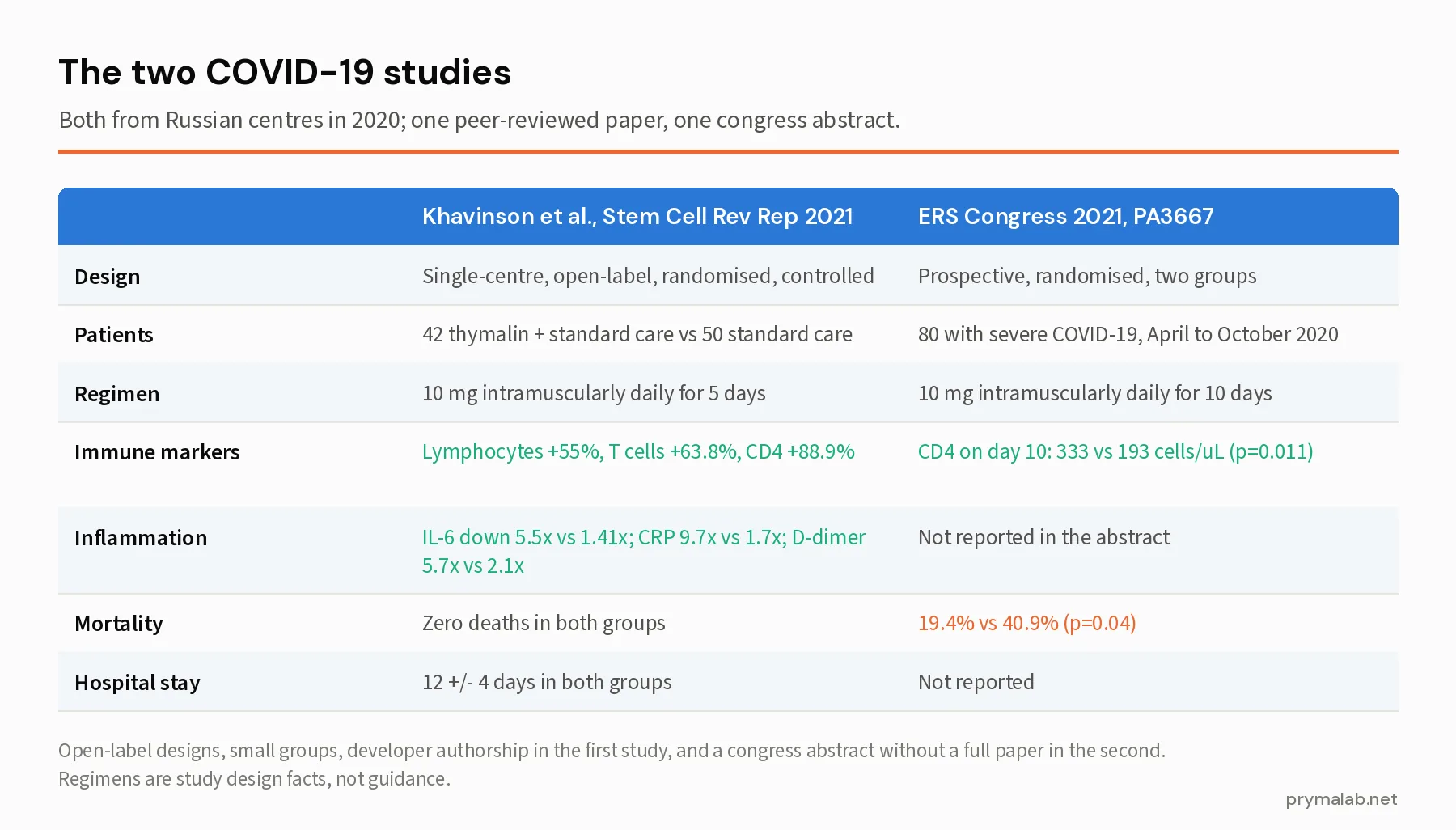
The second study exists only as a congress abstract. At the 2021 European Respiratory Society congress, a Russian group reported 80 patients with severe COVID-19 enrolled between April and October 2020 and randomised to thymalin plus standard care, or standard care alone. In-hospital mortality was 7 of 36 (19.4%) with thymalin against 18 of 44 (40.9%) without (p=0.04), and CD4 counts on day 10 were 333 against 193 cells per microlitre (p=0.011). The authors concluded that thymalin 'can probably improve T-cells level and the clinical outcomes'.[6] A halving of mortality in severe COVID-19 would be a major result; an 80-patient open study reported in an abstract, without a full paper five years later, is a reason to run the trial, not a result.
The mechanism proposed for both studies is T-cell differentiation. In vitro, thymalin reduced the stem-cell markers CD44 and CD117 on human haematopoietic stem cells two to threefold and raised the mature T-cell marker CD28 more than sixfold,[3] and the 2023 paper reports that thymalin and its two dipeptides reduced IL-1beta, IL-6 and TNF-alpha synthesis in human blood mononuclear cells by 1.4 to 6 times, with in-silico work pointing at AKT1 and AKT2 as shared targets.[4]
What is proposed to happen, and what a mixture makes hard to say
Three layers of mechanism are on offer, and they get less specific as they get older. The label says the extract regulates T- and B-lymphocyte populations, stimulates cellular immunity and phagocytosis, and supports regeneration and haematopoiesis when they are suppressed.[1] The 2021 paper says it pushes haematopoietic stem cells toward T-cell fate, on the strength of surface-marker changes in culture.[3] The 2023 paper says the two dipeptides bind promoter regions of genes in the cytokine-storm pathway and reduce cytokine synthesis in blood cells.[4]
What none of them can say is which molecule in the extract does what, at what concentration, through which receptor. That is not a criticism of the researchers; it is what an extract is. The Khavinson school's general claim, that short peptides enter the nucleus and regulate gene expression, is applied to thymalin's dipeptides as it is to every product in the series, and the evidence for it is the same in-silico docking and cell-culture work the bioregulator overview discusses. There is no receptor for thymalin, no pharmacokinetic profile of thymalin, and no dose-response curve for thymalin, because 'thymalin' is not one thing.
Where thymalin stands outside Russia
Thymalin is a registered prescription drug in Russia and has been, in one form or another, since 1982; the current registration was reissued on 21 June 2024 with indefinite validity.[1] It has never been submitted to or approved by the FDA, the EMA or any other Western regulator. It is not on FDA's 503A or 503B bulk substance lists, so no US compounder can make it, and it is not named on the WADA Prohibited List, unlike thymosin beta-4.[7] It is not a controlled substance anywhere I could find.
In the United States it therefore sits where most research compounds sit: legal to sell and hold for laboratory research, not legal to market for human use, with the framework set out in the legal status guide. One difference from a synthetic peptide is worth stating. Thymalin is an animal-tissue product, so the quality questions that matter are the ones that apply to any bovine-derived biological: the source herd and country, the controls for viral and prion contamination, and batch-to-batch consistency of a mixture. A synthetic dipeptide raises none of those and a sequence certificate answers everything; an extract raises all of them and a sequence certificate answers nothing.
Research-grade thymalin: what a certificate can and cannot show
Here is the test that matters more for thymalin than for any other product in this library. Ask to see the lot's certificate of analysis and look at what it measures. An extract should be characterised as an extract: total peptide content, a molecular-weight profile showing material below 10 kDa, an activity or identity assay against a reference batch, and safety testing appropriate to a bovine tissue product. A certificate that instead shows a single HPLC peak at 99% purity and a single mass by mass spectrometry is describing a synthetic molecule, and the most likely synthetic molecule sold under the thymalin name is the dipeptide Glu-Trp, molecular weight 333 Da, which is Thymogen. That is not a worse product; it is a different one, and it should be labelled as what it is. PrymaLab sells both, the thymalin 10 mg vial and Thymogen, and documents each on its own basis; ask the same of any supplier.
| Test on the certificate | What it means for an extract | What it means if the vial is a synthetic dipeptide |
|---|---|---|
| HPLC | Many peaks: a profile to compare against a reference batch | One peak at high purity |
| Mass spectrometry | A distribution below 10 kDa, no single parent ion | One mass: 333 Da for Glu-Trp (Thymogen), 275 Da for Lys-Glu (Vilon) |
| Total peptide content | Should be stated per vial (label: 10 mg extract with 20 mg glycine) | Net peptide content after counter-ion and water |
| Identity or activity assay | Required; the only way to say a batch is thymalin | Not needed; the mass is the identity |
| Bovine-source safety | Herd source, country, viral and prion controls | Not applicable |
| Correct label | Thymalin | Thymogen or Vilon, not thymalin |
Practical handling follows from the label. The dry lyophilisate is stable at 2 to 25 °C on the Russian label,[1] and refrigerated storage away from light is the sensible research default. Reconstituted solution of a peptide mixture should be refrigerated and used within days rather than weeks; the storage and stability guide and the reconstitution guide cover the general practice, and the peptide calculator converts a 10 mg vial and its diluent into a concentration for bench work.
The version of the story the record supports: a Soviet thymus extract that a national regulator has kept on the market for forty years with one listed side effect; the parent of a defined dipeptide drug and, by mirror image, of an immunosuppressant; a 266-person cohort with a mortality figure that no second laboratory has tested in twenty-three years; two small Russian COVID-19 studies with promising markers and, in one abstract, a mortality result that deserves a real trial; and a product name that, in the research market, may or may not describe what is in the vial.
What this article does not settle
What is in the extract. No published peptide-by-peptide map of thymalin exists. The 2023 identification of Glu-Trp and Lys-Glu as active substances is the developers' own analysis.
The longevity result. Allocation, blinding and the comparison group are not described in the abstract, and no independent replication has been attempted in 23 years.
The COVID-19 mortality signal. The 80-patient abstract has not become a paper. The peer-reviewed 92-patient study had no deaths to compare.
Any pharmacokinetics. A mixture of peptides below 10 kDa has no single half-life, and none has been published for the product.
What research vials contain. Without a certificate that characterises an extract, a vial labelled thymalin may hold the extract, a synthetic dipeptide, or neither.
Bovine-source controls. The label does not state the herd source, country of origin or the prion and viral testing applied, and I could not establish them from any source.
What is well established: the label composition, indications and registration; the 1982 and 1990 dates; the relationship between thymalin, Thymogen and Thymodepressin; the reported numbers of the 2003 cohort and the two COVID-19 studies as their authors state them; and thymalin's absence from FDA lists and the WADA list.
Thymalin (Тималин): what the name refers to
Thymalin is the trade and generic name of a Russian prescription drug, written Тималин in Cyrillic and sometimes transliterated timalin, whose active substance is listed on the label simply as thymus extract: a preparation of low-molecular-weight polypeptides from the thymus glands of calves and young cattle.[1] The name carries no sequence and no molecular weight because the product has neither. It is one of the first two peptide bioregulators of the Leningrad school, alongside the pineal extract epithalamin, and it is the source from which the synthetic dipeptide Glu-Trp (Thymogen, 1990) and later the D-amino-acid analogue Thymodepressin were derived.[2] Vendors also list it as thymalin extract, thymus peptide complex or thymic bioregulator. It is not thymosin alpha-1, thymosin beta-4, TB-500 or Thymogen, and a product sold as thymalin with a single peptide sequence on its certificate is one of those other things.
Four thymic factors that share a prefix and share nothing else
Thymalin sits in a family of names that get used interchangeably and refer to four unrelated substances. Sorting them is the single most useful thing a reader can do before evaluating any claim made for any of them.
Thymulin is a nonapeptide, pGlu-Ala-Lys-Ser-Gln-Gly-Gly-Ser-Asn, C33H54N12O15, about 859 Da. Jean-Francois Bach's group isolated it from pig serum in the mid-1970s and named it facteur thymique serique, which is why it still appears in the literature as FTS. Its sequence was published in 1977. The defining fact about thymulin is metallic: its biological activity is strictly dependent on zinc being coupled to the molecule, which is why zinc deficiency depresses thymulin activity and why the two are studied together. Thymulin is produced only by thymic epithelial cells and is implicated in intrathymic and extrathymic T-cell differentiation. It is a defined single peptide with a sequence. Thymalin is a cattle thymus extract with none. They are not the same substance and the names are not variants of each other.
Thymopoietin is a 49-residue polypeptide of about 5,562 Da, isolated from bovine thymus and originally called thymin, sequenced by Schlesinger and Goldstein in 1975. Its best-known fragment is thymopentin, residues 32 to 36, Arg-Lys-Asp-Val-Tyr, which became a drug in its own right. There is a second complication worth knowing: the gene now named thymopoietin, TMPO on chromosome 12q22, encodes nuclear LEM-domain proteins rather than a secreted thymic hormone, and one of them is lamina-associated polypeptide 2. So the word means one thing in the 1975 literature and something unrelated after 1995.
Thymosin alpha-1, thymalfasin, sold as Zadaxin, is a 28-residue acetylated peptide isolated in the United States from thymosin fraction 5 and published in 1977. It is approved in more than thirty countries for hepatitis B and C and as a vaccine adjuvant. It is not approved in the United States, where it holds orphan designations only, and there is no European Union-wide authorisation, though it does hold an Italian national marketing authorisation as an adjuvant to influenza vaccination in immunocompromised patients, first granted in April 1993. That detail is reported wrongly in both directions.
Thymalin is the subject of this article: a cattle thymus extract, not a sequence. Of the four, thymosin alpha-1 has the most clinical evidence and the clearest identity, thymulin has the best-defined chemistry and almost no modern clinical programme, thymopoietin is largely of historical interest, and thymalin has forty years of registered use in one country and no independent replication anywhere. A product sold as any one of them with a certificate naming a different molecule is a different product.
What the immune vocabulary around thymalin does and does not mean
Immune support, immune health, immune regulation and immune resilience are the phrases this compound is sold under, and none of them is a measurable endpoint. The Russian label is more specific than the marketing: it describes a drug that regulates T- and B-lymphocyte populations, cellular immunity and phagocytosis, indicated for immunodeficiency states, chronic infections, and immunosuppression after chemotherapy or radiation, in adults and children from six months.
The mechanistic claims behind that are about T-cell maturation. A thymic factor is, by definition, something the thymus gland releases to drive thymocytes toward functional T cells, and the whole class of thymic hormone preparations was developed on the premise that supplying one externally could restore T-cell function in people whose thymus gland had involuted. Age-related immune decline, immunosenescence in the technical literature, is the condition that premise was aimed at.
What has been reported for thymalin specifically is in vitro T-cell differentiation of haematopoietic stem cells, plus label-level claims about lymphocyte populations. What has not been reported is a controlled measurement of T-cell activity or any immune outcome in a Western trial, because no such trial exists. Anti-inflammatory properties are described in the Russian literature, chiefly as reductions in interleukin-6 and C-reactive protein in the COVID-19 papers, which is an inflammatory marker result rather than a demonstrated anti-inflammatory mechanism.
The COVID-19 record: two full papers, and the abstract everyone cites
Two peer-reviewed papers exist and are worth naming, because the congress abstract usually cited is the weakest of the three sources. Khavinson and colleagues published in Stem Cell Reviews and Reports in 2021, reporting that adding thymalin to standard therapy accelerated the decline in interleukin-6, C-reactive protein and D-dimer and shifted T-cell indices. Kuznik and colleagues published in Advances in Gerontology in 2022, comparing three groups of severe COVID-19 patients and reporting hospital mortality of 40.9 per cent on standard therapy, 28.4 per cent with tocilizumab and 20.6 per cent with thymalin.
That last figure needs a caveat the published record itself creates. The Russian-language abstract of the same 2022 paper gives 16.2 per cent for the thymalin group rather than 20.6 per cent. One paper, two numbers, and no way to tell from the indexed record which is correct. Quoting either without saying so misrepresents the strength of the evidence.
The structural problem is larger than any single number. No thymalin trial of any kind is registered on ClinicalTrials.gov. The published designs are small, open-label, single-centre comparisons, mostly from Chita State Medical Academy and the St. Petersburg Institute of Bioregulation and Gerontology, with authors from the school that developed the drug. The 2023 Molecular Sciences paper naming Lys-Glu and Glu-Trp as thymalin's active substances states that as background rather than as a finding, and its own data are molecular docking, bioinformatics and a lipopolysaccharide-stimulated blood-cell model using samples from four donors.
Epithalamin, Epitalon and the mortality figures people quote
The 266-person cohort is the headline human result for this compound, and the companion compound in it is routinely misidentified. Khavinson and Morozov followed 266 elderly subjects for six to eight years, giving bioregulators only during the first two to three years, and reported mortality reductions against control of 2.0 to 2.1-fold for thymalin, 1.6 to 1.8-fold for Epithalamin, 2.5-fold for the two together, and 4.1-fold in a group given both annually for six years.
Epithalamin is a pineal gland extract, the pineal counterpart to thymalin, and it is not Epitalon. Epitalon, also written epithalon, is the defined synthetic tetrapeptide Ala-Glu-Asp-Gly that came out of the search for Epithalamin's active component, in the same way Thymogen came out of the search for thymalin's. Attributing the 1.6 to 1.8-fold figure to the tetrapeptide, which happens constantly, attributes an extract result to a molecule that was not in the study. The same paper is indexed in PubMed as a randomised controlled trial while its abstract describes no randomisation, allocation or blinding method, which is worth knowing before citing the tag.
Why the Russian label does not transfer to research material
The Russian label sets out use of a prescription medicine given under medical supervision in Russia, and the COVID-19 studies were hospital studies. Neither describes a protocol or a recommendation for anything sold as a research preparation.
Two reasons the label does not carry across. First, a label is calibrated to a specific registered product manufactured to a specific standardisation, and a thymus extract is standardised by activity rather than by sequence, so one supplier's 10 mg and another's are not interchangeable quantities in the way 10 mg of a defined peptide would be. Second, peptide therapy providers who list thymalin alongside defined single peptides present an undefined mixture as though it had the same kind of identity, and the regimens circulating for it derive from the Russian label rather than from any trial of the material being sold.
Frequently asked questions
What is thymalin peptide?
A Russian prescription immunomodulator: a calf thymus extract of polypeptides below 10 kDa, 10 mg per vial, approved in the USSR in 1982 and still registered. Not a single peptide; its active dipeptides are Glu-Trp (Thymogen) and Lys-Glu.
Is thymalin the same as Thymogen?
No. Thymalin is the thymus extract; Thymogen is the synthetic dipeptide Glu-Trp isolated from it and registered separately in 1990. One is a mixture, the other a single 333 Da molecule.
Is thymalin the same as thymosin alpha-1?
No. Thymosin alpha-1 is a defined 28-residue peptide from the US thymosin programme; thymalin is a Soviet calf thymus extract with no defined sequence. Same prefix, different products.
What is thymalin approved for?
In Russia: immunodeficiency states, chronic infections, radiation injury and post-chemotherapy immunosuppression, in adults and children from six months. Not approved outside the former Soviet states.
What did the thymalin longevity study show?
A 266-person, 6 to 8 year developer-authored cohort reported mortality 2.0 to 2.1-fold lower with thymalin and 4.1-fold lower with annual thymalin plus epithalamin. Allocation and blinding are not described and nobody has replicated it in 23 years.
Was thymalin studied in COVID-19?
Yes: a 42 vs 50 patient open-label study showed faster falls in IL-6, CRP and D-dimer with no deaths in either arm, and an 80-patient congress abstract reported mortality of 19.4% vs 40.9%. Neither has been replicated or, in the second case, fully published.
What are the side effects of thymalin?
The Russian label lists possible allergic reactions, with pregnancy, breastfeeding and hypersensitivity as contraindications. No Western safety assessment exists; as a bovine extract the batch and source controls are the real questions.
Is thymalin FDA approved or legal in the US?
Not FDA- or EMA-approved, not on FDA's compounding lists, not controlled, and not on the WADA list. Registered only in Russia. In the US it is research use only.
How do I know whether a vial is really thymalin?
Read the certificate: an extract is characterised by peptide content, a sub-10 kDa profile and an activity assay. One peak and one mass means a synthetic dipeptide, probably Thymogen, not thymalin.
Why does this article not give a thymalin dose?
Because the material is sold for laboratory research only, and the only regimens on record are a Russian prescription label and two hospital studies, which are not reproduced here. No literature describes research-grade use.
How should thymalin be stored?
Dry, refrigerated, away from light (the label allows 2 to 25 degrees). Reconstituted solution should be refrigerated and used within days; a peptide mixture has no single stability profile.
Related reading
Is thymalin the same as thymulin?
No. Thymulin is a defined nonapeptide, pGlu-Ala-Lys-Ser-Gln-Gly-Gly-Ser-Asn, about 859 Da, isolated from pig serum by Bach's group in the 1970s and originally called facteur thymique serique, or FTS. Its activity is strictly zinc-dependent. Thymalin is a cattle thymus extract with no sequence. The names are not variants of one another.
What is thymopoietin, and is it related?
A separate 49-residue polypeptide of about 5,562 Da from bovine thymus, sequenced in 1975, whose fragment thymopentin became a drug. Confusingly, the modern gene called TMPO encodes nuclear LEM-domain proteins rather than a secreted thymic hormone, so the word means two different things before and after 1995. It is neither thymulin nor thymalin.
Is thymosin alpha-1 approved in Europe?
There is no European Union-wide authorisation, but it is nationally authorised in Italy as an adjuvant to influenza vaccination in immunocompromised patients, first granted in April 1993. It is approved in more than thirty countries overall and is not approved in the United States, where it holds orphan designations only.
What do the COVID-19 studies on thymalin report?
Two peer-reviewed papers exist, and the congress abstract usually cited is the weakest of the three sources. A 2021 paper reported faster declines in interleukin-6, C-reactive protein and D-dimer, and a 2022 paper reported hospital mortality of 40.9 per cent on standard therapy, 28.4 per cent with tocilizumab and 20.6 per cent with thymalin. The Russian abstract of that same 2022 paper gives 16.2 per cent instead, an inconsistency in the published record. No thymalin trial is registered on ClinicalTrials.gov.
Was the longevity study about Epitalon?
No, and this is the commonest error attached to it. The companion compound was Epithalamin, a pineal gland extract, which reduced mortality 1.6 to 1.8-fold against control. Epitalon is the defined synthetic tetrapeptide Ala-Glu-Asp-Gly that came out of the search for Epithalamin's active component, and it was not in the study.
Can the Russian label be applied to research material?
No. The label describes a registered prescription medicine given under medical supervision, standardised by activity rather than by sequence, so one supplier's 10 mg of extract is not an interchangeable quantity with another's. The label is reported as a fact, not guidance.
References
- Vidal.ru. Тималин (Thymalin), lyophilisate for the preparation of a solution for intramuscular administration, 10 mg; Samson-Med. Composition, pharmacological action, indications, regimen, contraindications, side effects, storage and registration ЛП-№(005867)-(РГ-RU) of 21 June 2024. Vidal.ru
- Ivanov VT, et al. Thymodepressin: unforeseen immunosuppressor. Molecules. 2021;26(21):6550. doi:10.3390/molecules26216550. The 1982 approval, the below-10 kDa description, the 1990 registration of Glu-Trp as Thymogen, and Thymodepressin. MDPI
- Khavinson VK, Kuznik BI, Trofimova SV, et al. Results and prospects of using activator of hematopoietic stem cell differentiation in complex therapy for patients with COVID-19. Stem Cell Rev Rep. 2021;17:285-290. doi:10.1007/s12015-020-10087-6. The 42 versus 50 study and the in-vitro stem-cell markers. Springer
- Linkova N, Khavinson V, Diatlova A, et al. The influence of KE and EW dipeptides in the composition of the Thymalin drug on gene expression and protein synthesis involved in the pathogenesis of COVID-19. Int J Mol Sci. 2023;24(17):13377. doi:10.3390/ijms241713377. MDPI
- Khavinson V, Morozov V. Peptides of pineal gland and thymus prolong human life. Neuro Endocrinol Lett. 2003;24(3-4):233-240. PMID 14523363. Neuroendocrinology Letters
- Thymalin as an immunomodulation option in severe COVID-19. European Respiratory Society International Congress 2021, abstract PA3667. doi:10.1183/13993003.congress-2021.PA3667. 80 patients; mortality 19.4% versus 40.9%; CD4 on day 10. Congress abstract; no full paper located. ERS
- World Anti-Doping Agency. The 2026 Prohibited List, International Standard. Thymosin beta-4 and its derivatives (TB-500) are listed under S2; thymalin, Thymogen and thymosin alpha-1 are not named. WADA
Figures come from the Russian product label, the published papers and the congress abstract named above, current to 23 September 2026. Where a result exists only as an abstract, or was reported by the product's developers without independent replication, the text says so.
Final disclaimer: This article is an educational research reference on the composition, history, clinical record and regulatory status of thymalin. Compounds supplied by PrymaLab are sold for laboratory research use only and are not approved by any regulator for human or veterinary use. Statements have not been evaluated by the FDA. Nothing here is medical advice or a treatment claim.
Label regimens and trial regimens are reported as design facts about a prescription drug registered in Russia and given under medical supervision, and do not describe or support any use of research-grade material. Always verify the legal status of any research compound in your jurisdiction before purchase or use.