
Description
PrymaLab · Research use only
Vesugen 20mg
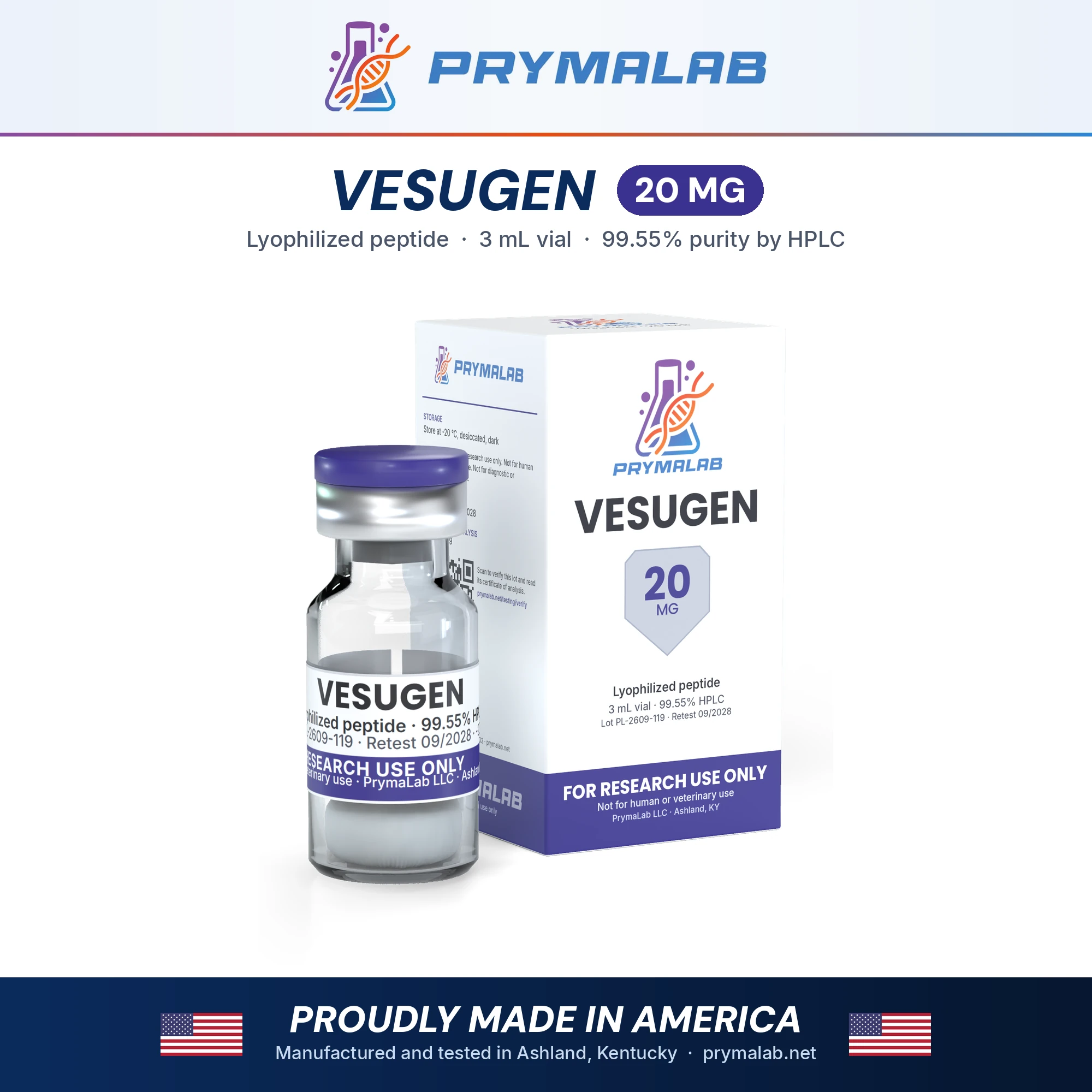
Lys-Glu-Asp (KED) tripeptide bioregulator, 20 mg freeze-dried per vial
Vesugen is the tripeptide Lys-Glu-Asp (KED, also coded T-38), a synthetic bioregulator from Vladimir Khavinson’s St Petersburg programme that its developers assigned to blood vessels. This listing is a 20 mg vial of freeze-dried Vesugen with a lot certificate. The published work on KED is mostly cell culture: gene expression and differentiation markers in ageing fibroblast and stem cell cultures, plus a review of KED in Alzheimer’s disease models. None of the studies cited here looked at blood vessels.
Specifications
| Property | Value |
|---|---|
| Compound | Vesugen Lys-Glu-Asp (KED; T-38); Khavinson vascular peptide bioregulator |
| CAS number | 204271-66-9 |
| Molecular formula | C15H26N4O8 |
| Theoretical mass | 390.4 Da |
| Sequence / structure | H-KED-OH (3 residues; free N- and C-termini) |
| Label claim | 20 mg/vial |
| Form | Lyophilized (freeze-dried) powder or cake in a sealed glass vial with a rubber stopper and aluminium crimp cap |
| Storage, sealed | −20 °C, desiccated, dark |
| Purity specification | 99.0% or higher by RP-HPLC |
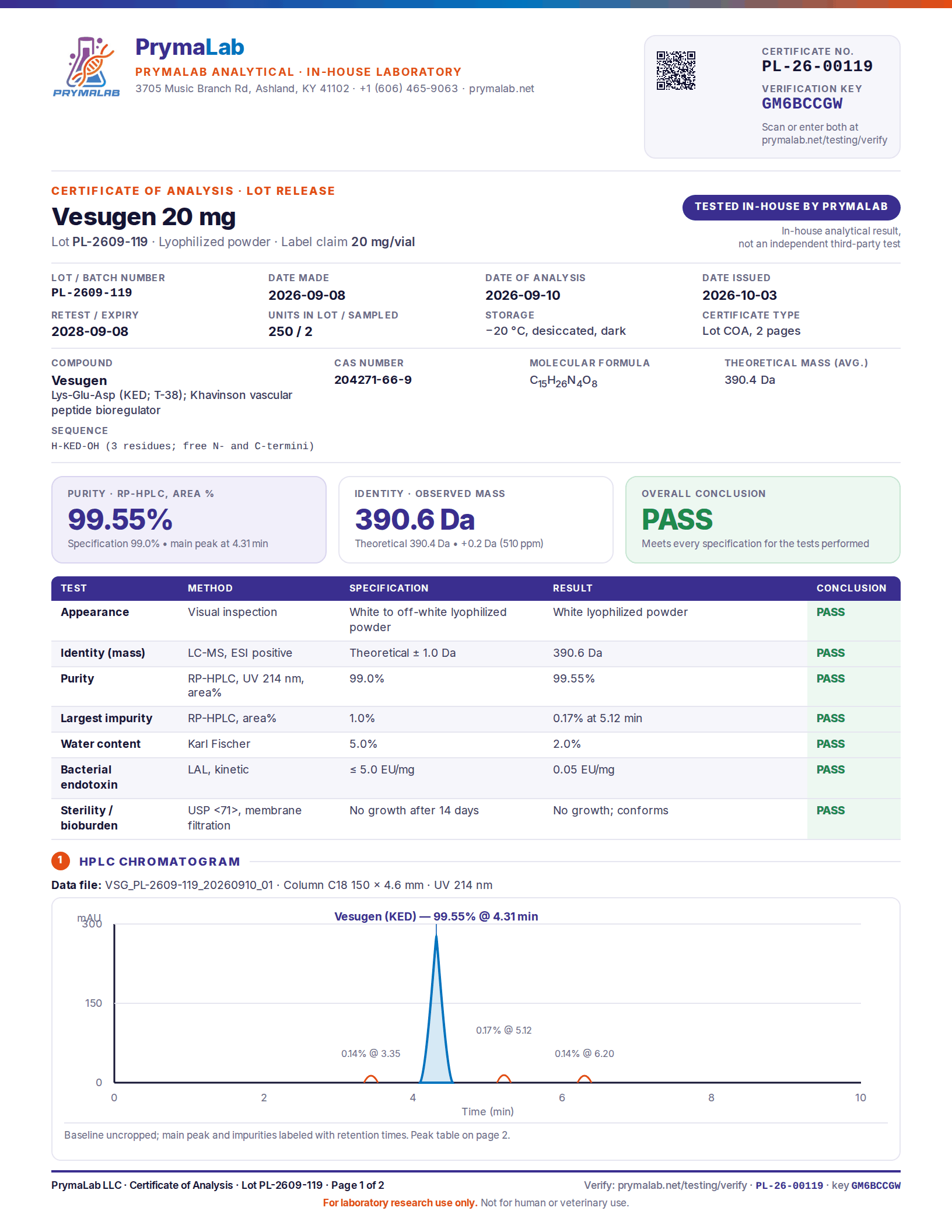
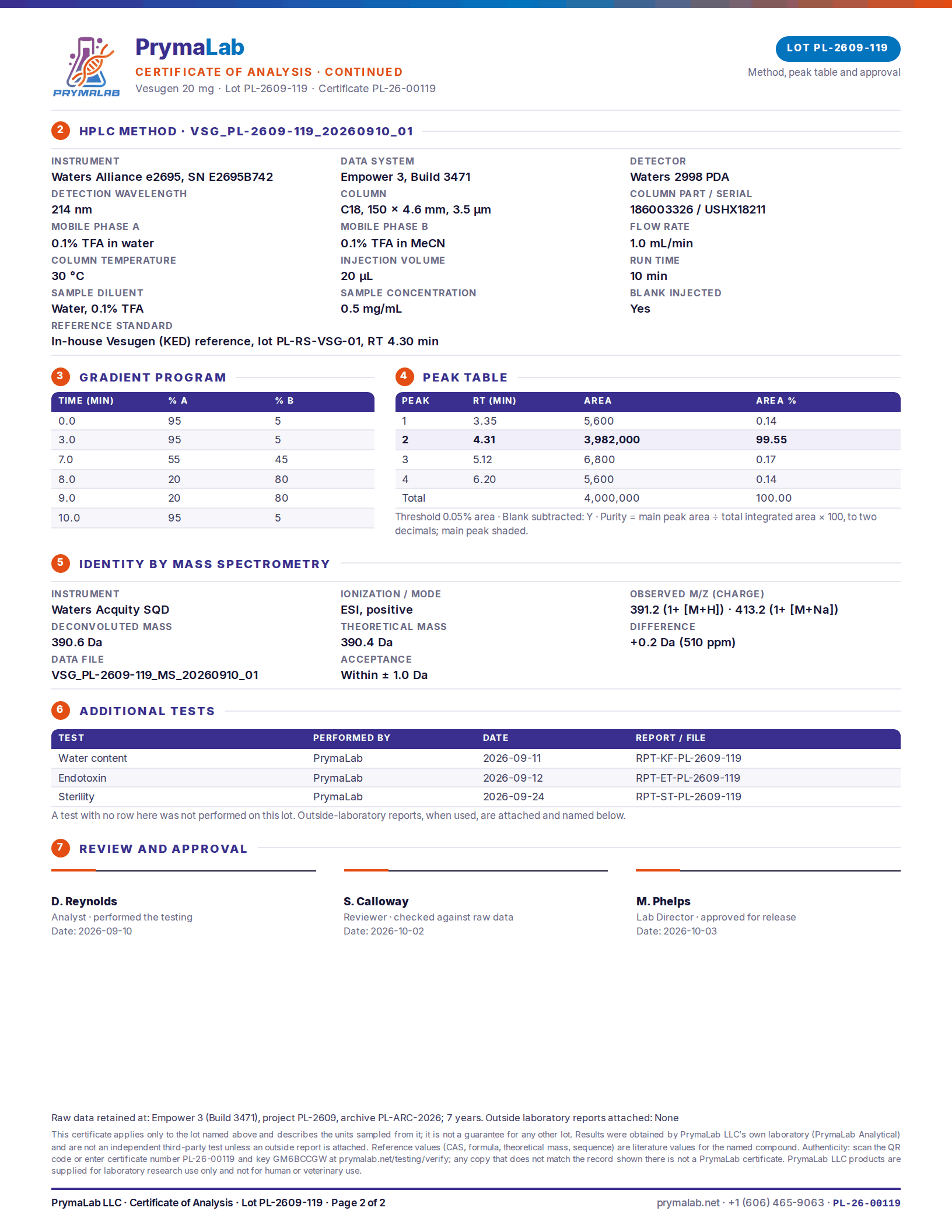
| Lot certificate | Results for the lot now shipping are in the certificate panel on this page |
| Safety data sheet | PL-SDS-179 |
The KED core and what the vial holds
The certificate identifies the peptide as H-Lys-Glu-Asp-OH: three residues with a free amino end and a free carboxyl end, formula C15H26N4O8, CAS number 204271-66-9 and theoretical mass 390.4 Da. Lys-Glu-Asp is also the core of several tetrapeptides in the same series. Prostamax adds proline to it, Pancragen tryptophan and Testagen glycine, while its first two residues on their own are Vilon. Each of those differs from Vesugen by a whole residue, so the LC-MS identity result on the certificate separates them without difficulty.
Twenty milligrams of a 390.4 Da peptide is about 51 µmol, slightly less after the residual water the certificate reports. A ready-made solution of the same tripeptide is sold as the Vesugen preloaded pen.
What the research covers
A vascular label, cell culture evidence
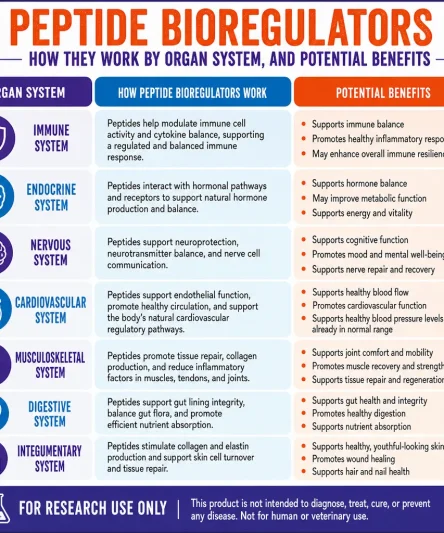
Vesugen comes from the bioregulator programme that Vladimir Khavinson ran at the St Petersburg Institute of Bioregulation and Gerontology, which assigned each of its synthetic peptides to an organ. KED was assigned to the vascular wall. The group’s general model, set out in a 2021 systematic review, is that peptides of two to seven residues enter the nucleus and nucleolus, interact with histones and DNA, and regulate gene expression, partly by changing DNA methylation1. The KED papers in this list test pieces of that model in cultured human cells, and none of them uses vascular tissue.
Gene expression in ageing cell cultures
In a 2012 study, Khavinson’s group measured differentiation factors in human cell cultures and found their expression lower in late-passage, ageing cultures2. Three peptides each raised expression in a particular cell type: Pancragen in pancreatic cells, Bronchogen in bronchial epithelium, and Vesugen in prostatic fibroblasts, where the markers measured were CXCL12 and WEGC12. The effect was larger in the older cultures2.
Ashapkin and colleagues in 2020 compared KED with two other short peptides, AED and KE, in human embryonic bone marrow mesenchymal stem cells aged in two ways, by repeated passage or by long stationary culture3. All three peptides raised IGF1 expression 3.5 to 5.6 fold and stimulated the NFκB gene3. KED lowered FOXO1 expression 1.6 to 2.3 fold, and its effect on TNKS2 depended on the model: it suppressed the gene in passaged cells and stimulated it in stationary ones3.
Neuronal differentiation markers
Caputi and colleagues cultured human periodontal ligament stem cells with AED, KED, KE, AEDG or a mixture of all four in a 2019 study4. GAP43, a protein involved in neurotransmission and neuroplasticity, rose with the mixture and with KED alone, and so did nestin, a marker of early neuronal precursors4. A 2021 review by Khavinson, Lin’kova and Umnov drew together the group’s findings that KED regulates genes of cell ageing and apoptosis (p16, p21), of neuronal differentiation (NES, GAP43) and of Alzheimer’s disease pathways (SUMO, APOE, IGF1), and described tests in animal models of the disease as an important next step5.
What is not established
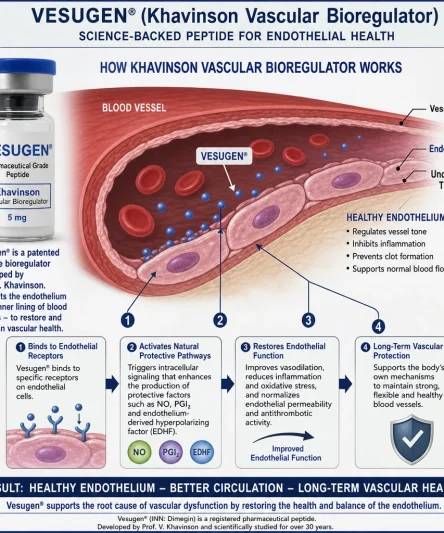
None of the papers cited here studied blood vessels, endothelial cells or a vascular endpoint, so the vascular role assigned to Vesugen is not tested by them. The cell studies measured fold changes in gene or protein expression over a culture period; they did not show a change in how a tissue works. Most of the work comes from Khavinson’s group, much of it in the Bulletin of Experimental Biology and Medicine, the English edition of a Russian journal. The 2020 stem cell paper appeared in an international journal, but Khavinson is one of its authors3. No study used PrymaLab material. The Vesugen guide and the peptide bioregulators research overview place KED in the wider programme.
How each lot is tested
Every lot is tested in PrymaLab’s own laboratory in Ashland, Kentucky before release: RP-HPLC for purity, LC-MS for identity, Karl Fischer titration for water, LAL for endotoxin and USP <71> for sterility. The results for the lot now shipping are in the certificate panel on this page, and the certificate number, key and QR code can be checked on the verify page. These are in-house results from PrymaLab Analytical, not an independent test, and the lab is not accredited to ISO 17025. The third-party testing guarantee on this page still applies: if any independent laboratory finds the wrong compound, or less than the stated purity or amount, the order is refunded and the cost of the test is reimbursed.
Frequently asked questions
What is Vesugen, chemically?
Vesugen is the tripeptide H-Lys-Glu-Asp-OH, abbreviated KED, with free amino and carboxyl ends. Its formula is C15H26N4O8, its CAS number 204271-66-9 and its theoretical mass 390.4 Da. This vial holds 20 mg of it as white freeze-dried powder.
Is Vesugen the same as Vesilute or Vilon?
No. They are separate peptides from the same series. Vilon is the dipeptide Lys-Glu and Vesilute is listed as the dipeptide Glu-Asp, while Vesugen joins all three residues as Lys-Glu-Asp. Their masses differ, so the certificate's LC-MS result tells them apart.
How should the Vesugen vial be stored?
Keep it sealed at −20 °C, dry and dark. Allow it to warm to room temperature before opening so condensation stays off the powder. Store any solution made from it at 2 to 8 °C away from light, for no longer than the period your laboratory has established.
Where is the certificate for my vial?
The certificate panel on this page shows the lot now shipping. Compare its lot number with the one on your vial label; certificates for earlier lots are on the testing results page, and any certificate can be confirmed by number and key on the verify page.
Has Vesugen been studied in blood vessels?
Not in the papers cited on this page. Those used prostatic fibroblasts, mesenchymal stem cells and periodontal ligament stem cells, and measured gene and protein expression. The vascular assignment comes from the developers' programme rather than from a vascular experiment in these references.
Can Vesugen be used in people or animals?
No. It is sold for laboratory research only, has no FDA or other regulatory approval for human or veterinary use, and must not be given to people or animals.
References
- Khavinson VK, Popovich IG, Linkova NS, et al. Peptide Regulation of Gene Expression: A Systematic Review. Molecules. 2021;26(22). DOI · PubMed
- Khavinson VKh, Linkova NS, Polyakova VO, et al. Peptides tissue-specifically stimulate cell differentiation during their aging. Bull Exp Biol Med. 2012;153(1):148-51. DOI · PubMed
- Ashapkin V, Khavinson V, Shilovsky G, et al. Gene expression in human mesenchymal stem cell aging cultures: modulation by short peptides. Mol Biol Rep. 2020;47(6):4323-4329. DOI · PubMed
- Caputi S, Trubiani O, Sinjari B, et al. Effect of short peptides on neuronal differentiation of stem cells. Int J Immunopathol Pharmacol. 2019;33:2058738419828613. DOI · PubMed
- Khavinson VK, Lin'kova NS, Umnov RS. Peptide KED: Molecular-Genetic Aspects of Neurogenesis Regulation in Alzheimer's Disease. Bull Exp Biol Med. 2021;171(2):190-193. DOI · PubMed
Research use only
For laboratory research use only. Vesugen 20mg is not a drug, food, cosmetic or dietary supplement, is not approved by the FDA or any comparable authority for human or veterinary use, and must not be given to people or animals. It is sold to qualified researchers and institutions, and the buyer is responsible for lawful handling and disposal.






Reviews
There are no reviews yet.