

PT-141 (bremelanotide): what two phase 3 trials, an FDA label and a cancelled men's programme actually show
PT-141 peptide is the development code for bremelanotide, a cyclic seven-residue melanocortin agonist (Ac-Nle-cyclo[Asp-His-D-Phe-Arg-Trp-Lys]-OH, C50H68N14O10, 1,025.2 g/mol) that differs from melanotan II by a single carboxylic acid at its C-terminus. It is the active ingredient of Vyleesi, approved by the FDA on 21 June 2019 for premenopausal women with acquired, generalised hypoactive sexual desire disorder (HSDD). In the two identical 24-week RECONNECT trials (1,267 women randomised), the drug beat placebo on both co-primary questionnaire scores by about 0.3 to 0.4 points on a 1.2-to-6 desire scale and 0.3 points on a 0-to-4 distress scale, and showed no difference in the number of satisfying sexual events. Nausea affected 40% of treated women, 18% stopped for adverse reactions against 2% on placebo, and the label contraindicates it in uncontrolled hypertension or known cardiovascular disease. The men's programme was halted in 2007 after FDA raised blood-pressure concerns; the label states the drug is not indicated for men, and no trial of it for any sexual indication in men is registered on ClinicalTrials.gov. PrymaLab supplies the compound for laboratory research only; it is not Vyleesi, and nothing here describes any use of it in people.
- Approval: NDA 210557, 21 June 2019, to AMAG Pharmaceuticals; rights reverted to Palatin in July 2020 and were sold to Cosette in December 2023. No approval found outside the United States: no EMA application found, and Health Canada lists no product.
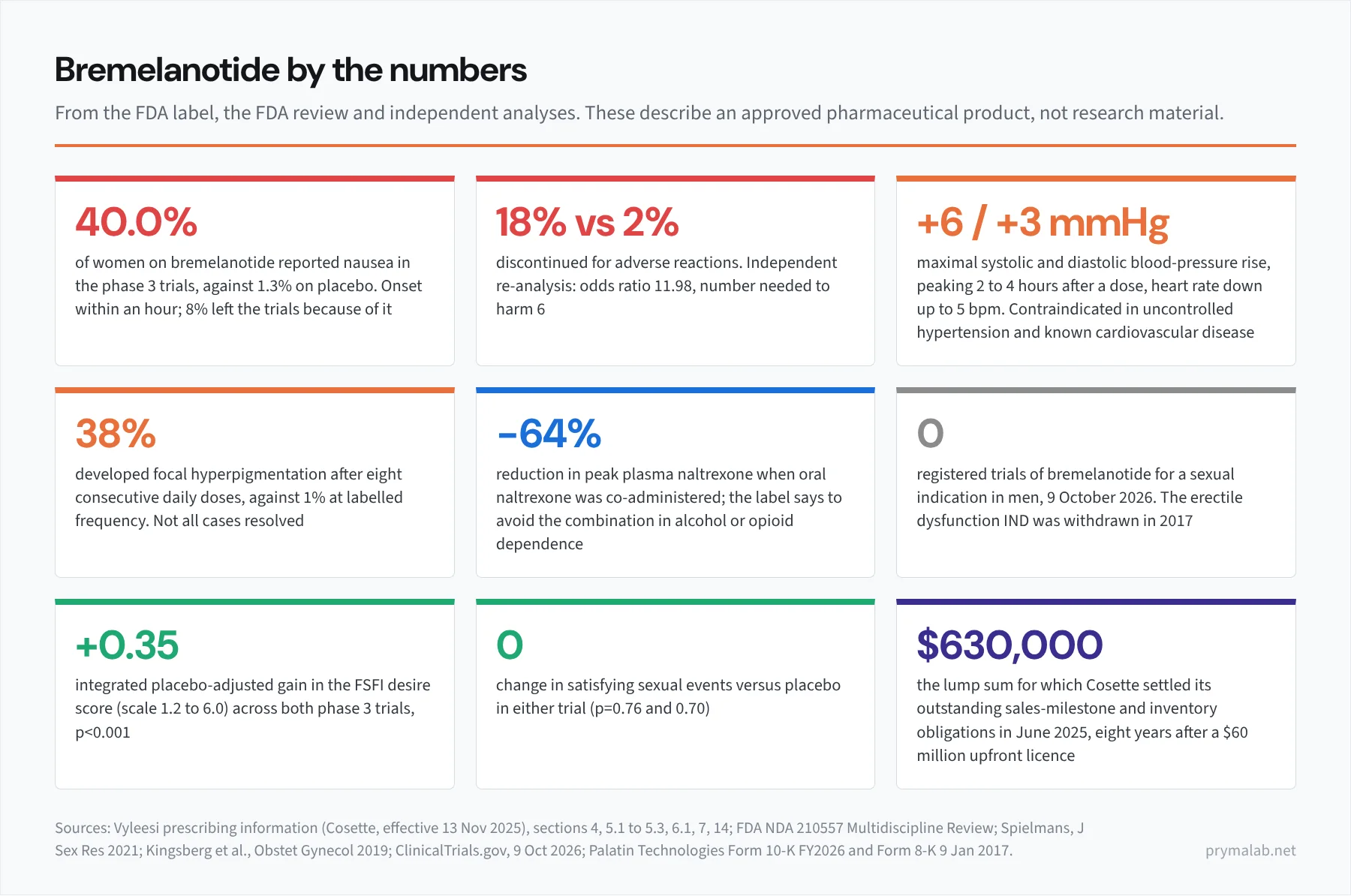
- Effect size in women: integrated placebo-adjusted change +0.35 in FSFI desire score and −0.33 in distress item 13 (both p<0.001); label medians +0.6 versus 0 and −1 versus 0; satisfying sexual events unchanged (p=0.76 and 0.70).
- Dropout: 40% versus 13% (Study 301) and 39% versus 25% (Study 302) did not complete 24 weeks; of 684 women who entered the open-label extension, 272 finished it.
- Side effects (label, n=627 versus 620): nausea 40.0% versus 1.3%, flushing 20.3% versus 0.3%, headache 11.3% versus 1.9%, vomiting 4.8% versus 0.2%; systolic blood pressure up to +6 mmHg peaking 2 to 4 hours after a dose; focal hyperpigmentation in 1% at labelled frequency and 38% after eight consecutive daily doses.
- Men: the only large published trial (342 men, intranasal, Iran, 2008; 33.5% versus 8.5% response) carries a 2023 expression of concern and the first author's separate 2008 paper in women was retracted; Palatin's 1,020-patient intranasal phase 2B results exist only in SEC filings; the erectile dysfunction IND was withdrawn in 2017.
- Regulatory: not a DEA-controlled substance; not on the WADA 2026 Prohibited List (melanotan II is not named either, but as a never-approved substance it falls under the S0 catch-all and is prohibited at all times); named as an unapproved new drug in five FDA warning letters to research peptide vendors dated 24 August 2026.
| Property | Bremelanotide (PT-141) | Melanotan II |
|---|---|---|
| Structure | Ac-Nle-cyclo[Asp-His-D-Phe-Arg-Trp-Lys]-OH (free acid) | Ac-Nle-cyclo[Asp-His-D-Phe-Arg-Trp-Lys]-NH2 (amide) |
| Regulatory status | FDA-approved drug (Vyleesi, 2019); no approval found elsewhere | Never approved by any regulator |
| Controlled trials | 43 completed studies, about 3,500 participants; two phase 3 trials | Sexual-function trials: two 10-man crossover studies (1998, 2000); no phase 2 or 3 for any indication |
| Carcinogenicity testing | Two-year studies in rats and mice, negative | None |
| Safety record | Label: nausea 40%, transient BP rise, hyperpigmentation 1% at labelled frequency | Case reports: melanoma, PRES, sympathomimetic toxidrome, priapism (FDA list); rhabdomyolysis (case report) |
| WADA 2026 | Not listed | Prohibited at all times under S0 (non-approved substance) |
For the sibling compound, see the melanotan 1 versus melanotan 2 comparison; for the broader class, the peptides for men reference and the oxytocin circuitry article. The laboratory material and its testing are covered in the PrymaLab section below.
Also known as: bremelanotide, bremelanotide acetate, PT-141, PT141, Vyleesi and Rekynda (trade names of the approved product, not of research material), Ac-Nle-cyclo[Asp-His-D-Phe-Arg-Trp-Lys]-OH, N-acetyl-L-norleucyl-L-alpha-aspartyl-L-histidyl-D-phenylalanyl-L-arginyl-L-tryptophyl-L-lysine (2-7)-lactam, CAS 189691-06-3, PubChem CID 9941379, UNII 6Y24O4F92S (free base) and PV2WI7495P (acetate), DrugBank DB11653, ChEMBL CHEMBL2070241, KEGG D06569. Related: melanotan II (MT-II), melanotan 1 (afamelanotide), alpha-MSH, melanocortin 4 receptor agonist, MC4R agonist.
The page that stood here from April 2026 was called "PT-141 peptide (bremelanotide): mechanism, dosage and research". It had a dosage section, a reconstitution calculator and a storage guide, and in three months Google showed it 2,500 times and sent six people to it. I took the calculator out of this version and I would have taken it out regardless of the traffic, because the FDA letters of 24 August 2026 cite exactly that kind of content, on exactly this compound, as evidence that a vendor is selling a drug. What is left is the record. Bremelanotide is unusual among the peptides I write about: it is approved, so there is a label, an FDA review, two phase 3 trials, an extension study, independent re-analyses and twenty years of SEC filings from the company that made it. Most of what the internet says about PT-141 is either copied from the men's programme that was cancelled in 2007 or is about melanotan II. I have tried to keep them apart.
Research-use-only disclaimer: This article describes published clinical trials and regulatory documents for an approved pharmaceutical product (Vyleesi) used under medical supervision, and the absence of such evidence in men. PrymaLab supplies bremelanotide for laboratory research only; the research-grade compound is not Vyleesi and nothing here describes or supports any use of it in people. Trials are described by design and measured outcomes, the way a methods section reports them, without doses or schedules. This version removes the dosing, reconstitution and storage content the earlier version of this page carried. Nothing here is medical advice.

TL;DR
Bremelanotide (PT-141) is the free-acid analogue of melanotan II and the active ingredient of Vyleesi, FDA-approved in June 2019 for premenopausal women with hypoactive sexual desire disorder. Two 24-week phase 3 trials in 1,267 women found a statistically significant but small gain in desire scores (+0.35 points placebo-adjusted on a 1.2-to-6 scale) and distress scores, and no change in satisfying sexual events. Forty percent of treated women had nausea and 18% stopped for adverse reactions. An independent re-analysis put the number needed to harm at six and found participants "preferred placebo". Blood pressure rises transiently by up to 6 mmHg, so the drug is contraindicated in uncontrolled hypertension and known cardiovascular disease. For men, there is no approved indication and no registered trial for a sexual indication: FDA raised blood-pressure concerns in 2007, the partner walked away, and the ED IND was withdrawn in 2017. Bremelanotide is not WADA-prohibited or DEA-controlled, but FDA's August 2026 warning letters name "PT-141 (Bremelanotide)" sold by research vendors as an unapproved new drug. Melanotan II, by contrast, has never been approved anywhere and carries case reports of melanoma and systemic toxicity. Research use only.
Identity: bremelanotide is melanotan II with a C-terminal carboxylic acid in place of the amide; C50H68N14O10, 1,025.2 g/mol, CAS 189691-06-3. Non-selective melanocortin agonist; label potency order MC1R, MC4R, MC3R, MC5R; MC4R Ki about 14 nM. The label states the mechanism in HSDD is unknown.
Women: RECONNECT (Studies 301 and 302; 1,267 randomised; 24 weeks): FSFI desire +0.5/+0.6 versus +0.2; distress item 13 −0.7 versus −0.4; satisfying sexual events no different. Early discontinuation 40% versus 13% and 39% versus 25%. Approval 21 June 2019.
Critique: Spielmans 2021: 72.7% of protocol outcomes unreported, adverse-event discontinuation odds ratio 11.98, number needed to harm 6. Mintzes 2021: one extra "enjoyable sexual experience" every two months for flibanserin, "bremelanotide to none".
Men: intranasal phase 2B in 1,020 men never published; FDA concerns August 2007; King terminated December 2007; IND 61706 withdrawn 2017; label excludes men; no registered trial for a sexual indication in men as of 9 October 2026.
Safety: nausea 40%; flushing 20%; headache 11%; discontinuation for adverse reactions 18% versus 2%; SBP +6 mmHg peak 2 to 4 h; contraindicated in uncontrolled hypertension and known cardiovascular disease; oral naltrexone exposure cut by 64% (Cmax); hyperpigmentation 1% as labelled, 38% with daily use.
Commercial: AMAG paid $60 million upfront in 2017 and handed the drug back in 2020; Cosette paid $12 million in 2023 and settled the outstanding sales-milestone obligations for $630,000 in 2025. Highest annual net sales Palatin disclosed: $4.9 million (FY2023).
Regulatory: not DEA-controlled; not on the WADA 2026 list; named in five FDA warning letters of 24 August 2026 to research peptide vendors. Melanotan II: never approved, WADA S0, FDA safety-risk listing, TGA fines.
Status: research use only.
What is PT-141, and how is it related to melanotan II?
PT-141 is Palatin Technologies' code for bremelanotide, a synthetic cyclic heptapeptide that activates melanocortin receptors. It is the carboxylic-acid form of melanotan II, the tanning peptide, and it became a drug because of a side effect: volunteers in melanotan II tanning studies at the University of Arizona reported spontaneous erections.
Mac Hadley, who ran those studies, wrote in 2005 that the sexual effects of melanotan II "were discovered accidentally while studying the effects of the peptide and related analogs on human skin pigmentation (tanning)".[1] Wessells and colleagues then gave melanotan II to ten men with psychogenic erectile dysfunction in a double-blind crossover: eight developed erections, with penile tip rigidity above 80% for 38.0 minutes against 3.0 on placebo (p=0.0045), along with nausea, stretching and yawning.[2] A second ten-man study in organic erectile dysfunction produced erections after 12 of 19 injections against 1 of 21 on placebo, and severe nausea after 4 of 19.[3] In the review of both studies, increased desire was reported after 13 of 19 melanotan II doses against 4 of 21 placebo doses.[4]
The molecule Palatin took forward differs by one change. King and colleagues described PT-141 in 2007 as "the carboxylate derivative of MT-II", meaning the C-terminal amide of melanotan II is replaced by a free carboxylic acid.[5] Everything else in the ring is the same. That one functional group's difference matters legally far more than it matters pharmacologically: bremelanotide went through a full development programme, 43 completed studies and about 3,500 participants by the sponsor's count, two-year carcinogenicity studies and an FDA review, and melanotan II went through none of it.[6][7] The two compounds are routinely confused online, and the confusion runs in both directions: melanotan II is marketed as a substitute for PT-141, and PT-141 is credited with melanotan II's tanning effects, which it does produce at the receptor level (hyperpigmentation is on the Vyleesi label) but was never developed for.
What is the structure of bremelanotide?
Bremelanotide is Ac-Nle-cyclo[Asp-His-D-Phe-Arg-Trp-Lys]-OH: an acetylated norleucine followed by a six-residue ring closed by a lactam bond between the aspartate side chain and the lysine side chain, ending in a free carboxylic acid. Molecular formula C50H68N14O10, molecular weight 1,025.2, CAS 189691-06-3.
PubChem records the compound as CID 9941379 with InChIKey FFHBJDQSGDNCIV-MFVUMRCOSA-N and lists its identifiers: UNII 6Y24O4F92S for the free base, ChEMBL CHEMBL2070241, DrugBank DB11653, KEGG D06569.[8] The Vyleesi label describes the drug substance as "a synthetic, cyclic heptapeptide with a free acid at the carboxyl terminus and an acetylated amino group at the amino terminus", supplied as the acetate salt (UNII PV2WI7495P), with one to two acetate equivalents per molecule, in a prefilled autoinjector.[7][9] The FDA pharmacology review notes a convenient coincidence: at a molecular weight of 1,025, "1 ng/mL ~ 1 nM", so plasma concentrations in ng/mL read directly as nanomolar.[10]
The D-phenylalanine at position 4 and the lactam ring are what make this family "superpotent" relative to the natural hormone alpha-MSH: the ring locks the pharmacophore His-D-Phe-Arg-Trp into its receptor-binding conformation and the D-amino acid resists proteolysis.[5] Melanotan II has the identical ring and ends in -NH2; afamelanotide (melanotan 1) is a linear 13-residue alpha-MSH analogue and is a different molecule altogether.[11] A 2026 analytical paper mapped the degradation products of bremelanotide acetate by high-resolution mass spectrometry, including epimerisation at the chiral centres, which is the kind of impurity profile an identity test on research material has to resolve.[12]
How does PT-141 work, and why does the label say the mechanism is unknown?
Bremelanotide activates several melanocortin receptors, in the label's order of potency MC1R, MC4R, MC3R, MC5R and then MC2R, and the effect on desire is attributed to MC4R in the hypothalamus. The label states plainly that "the mechanism by which VYLEESI improves HSDD in women is unknown". The receptor pharmacology is measured; the link from receptor to behaviour is a hypothesis with mixed animal support.
The FDA review gives the numbers. In competitive binding against radiolabelled NDP-alpha-MSH, bremelanotide bound MC1R and MC4R most tightly, then MC3R, then MC5R, and, by the sponsor's statement (FDA received no source data), negligible binding at MC2R, the adrenal ACTH receptor (Kd above 1,000 nM). In MC4R-transfected cells it raised cAMP with an EC50 of 1.1 nM, reaching 68% of the maximal response to alpha-MSH, and its binding Ki at MC4R is about 14 nM.[10] Free plasma concentration after a labelled dose is roughly 63 nM, above the Ki for both MC1R and MC4R, which is why the label says binding at those two receptors is "most relevant" at therapeutic levels.[10][7] The MC1R binding is what produces pigmentation. The MC3R binding may be what produces nausea, in the FDA reviewer's reading. The MC4R binding is credited with the desire effect, the blood-pressure rise and the slowed gastric emptying that underlies the drug interactions below.[10]
The behavioural hypothesis, laid out in an industry-authored review, is that MC4R agonism on presynaptic neurons in the medial preoptic area of the hypothalamus increases dopamine release, and that this shifts the balance toward excitation in a circuit that is inhibited in HSDD.[13] Rat data support part of it: systemic PT-141 produced erections in rats and primates and activated hypothalamic neurons in the same region that projects to the penis.[14][15] A 31-woman crossover fMRI study at Imperial College found that a single dose increased self-reported desire for up to 24 hours and changed activity in the cerebellum, supplementary motor area and amygdala-insula connectivity in response to erotic stimuli.[16] Against that, a 2025 study in female Syrian hamsters found bremelanotide did not alter MC3R or MC4R expression in the mesolimbic dopamine system and "failed to enhance sexual reward" in a conditioned-place-preference test, which led the authors to conclude it does not act on the ventral tegmental area to nucleus accumbens circuit.[17] In mice, FDA noted, the peptide crosses the blood-brain barrier "with a significant delay", with brain radioactivity peaking at about 10% of plasma, so central MC4 receptors "might be only partially activated".[10] The honest summary is the label's: the receptor is known, the mechanism is not.
One more piece of mechanism belongs here because it explains the safety profile. MC4R agonists raise blood pressure: FDA's review summarised that subcutaneous infusion of an MC4R agonist raises blood pressure in humans and that people with loss-of-function MC4R mutations have less hypertension.[10] MC4R agonism also reduces food intake, which is why Palatin later tested bremelanotide in obesity: in the first of two phase 1 trials in obese women it cut intake by about 400 kcal a day and weight by 1.3 kg against placebo over 16 days, and a 2024 to 2025 phase 2 of low-dose bremelanotide with tirzepatide reported 4.4% weight loss against 1.6% over eight weeks, after which Palatin said it would not fund further development on its own and was looking for a partner.[18][19]
How is PT-141 different from sildenafil and tadalafil?
Sildenafil and tadalafil are PDE5 inhibitors: they act on the blood vessels of the penis and require sexual stimulation to produce an erection. Bremelanotide acts on melanocortin receptors in the brain and, in the early men's studies, produced erections without stimulation along with increased desire. The two classes were tested together once, in 19 men, in 2005. Bremelanotide is approved for women with low desire; it is not approved for erectile dysfunction in anyone.
The 2005 study randomised 19 men with PDE5-responsive erectile dysfunction to a crossover of low-dose sildenafil plus low-dose intranasal PT-141, sildenafil alone and placebo, and found the combination's erectile response "significantly greater" than sildenafil alone, with no new adverse events.[20] That is the whole of the head-to-head literature. It is a 19-man RigiScan study, it used the intranasal formulation that was later abandoned, and it was never followed up. The Vyleesi label adds a limitation of use that answers the comparison from the regulator's side: the drug "is not indicated to enhance sexual performance".[7] The question people are usually asking when they type "PT-141 vs Viagra" is whether PT-141 is a better erectile drug for men, and the record's answer is that it was never shown to be one and its development for that purpose was stopped by its own sponsor.
What did the RECONNECT phase 3 trials show for PT-141 in women?
Two identical 24-week trials randomised 1,267 premenopausal women with acquired, generalised HSDD to bremelanotide or placebo. On the co-primary endpoints, desire score rose by 0.5 to 0.6 points against 0.2 on placebo and distress fell by 0.7 against 0.4. The number of satisfying sexual events did not change. About 40% of treated women left before 24 weeks.
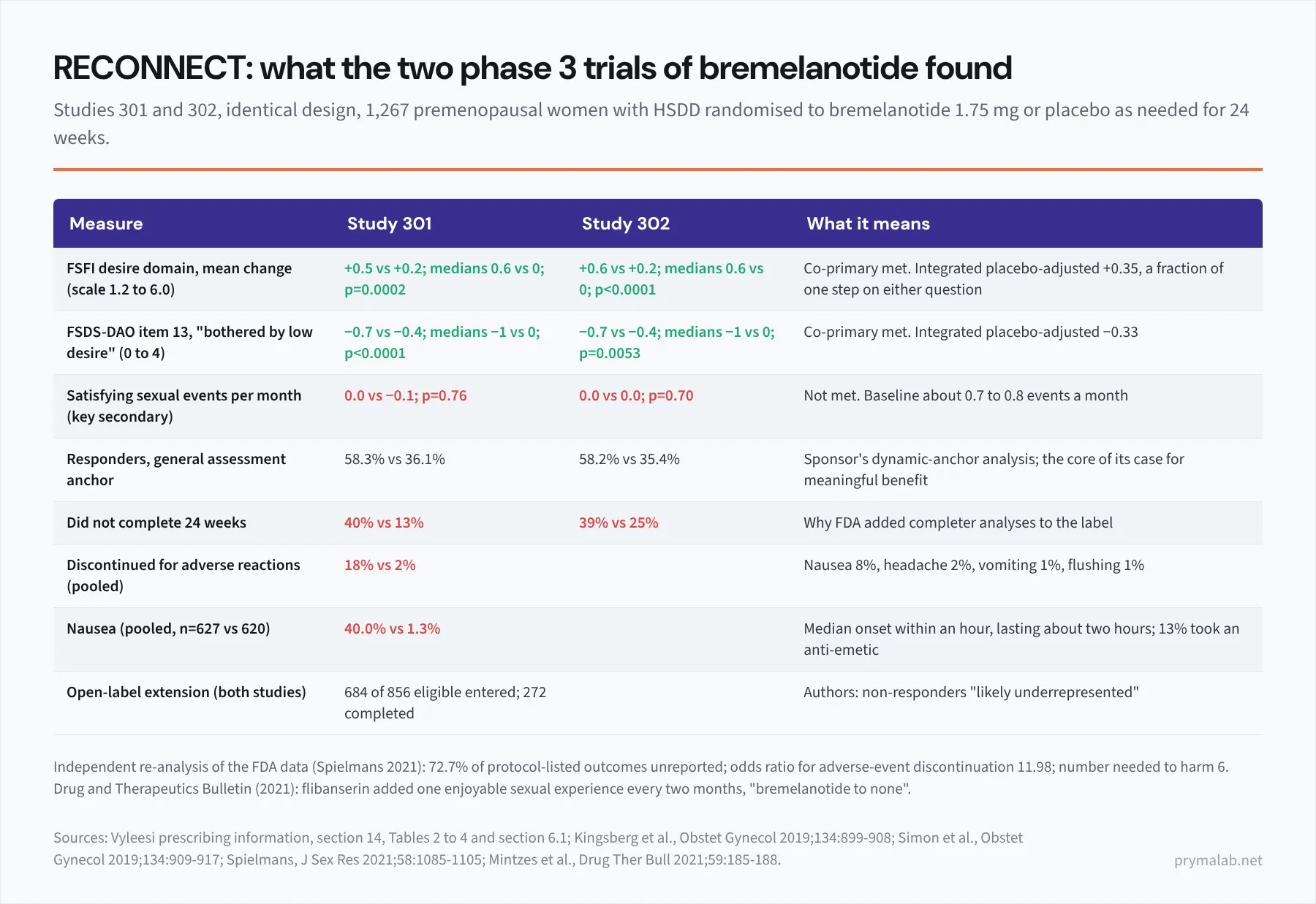
Kingsberg and colleagues published the two trials together in 2019. Study 301 ran from 7 January 2015 to 26 July 2016 and Study 302 from 28 January 2015 to 4 August 2016; 1,247 women were in the safety population and 1,202 in the modified intention-to-treat population; 85.6% were white, 96.6% were at US sites, mean age was 39.[21] A majority (74% in Study 301, 67% in Study 302) also reported decreased arousal.[7]
| Measure | Study 301, bremelanotide vs placebo | Study 302, bremelanotide vs placebo | Note |
|---|---|---|---|
| FSFI desire domain (range 1.2 to 6.0), mean change | +0.5 vs +0.2 (p=0.0002); medians 0.6 vs 0 | +0.6 vs +0.2 (p<0.0001); medians 0.6 vs 0 | Baseline 2.1 vs 2.0 (Study 301), 2.0 vs 2.1 (Study 302). Integrated placebo-adjusted +0.35[7][21] |
| FSDS-DAO item 13, "bothered by low sexual desire" (0 to 4), mean change | −0.7 vs −0.4 (p<0.0001); medians −1 vs 0 | −0.7 vs −0.4 (p=0.0053); medians −1 vs 0 | Baseline 2.9 vs 2.8 (Study 301), 2.9 vs 2.9 (Study 302). Integrated placebo-adjusted −0.33[7][21] |
| Satisfying sexual events per month (key secondary) | 0.0 vs −0.1 (p=0.76) | 0.0 vs 0.0 (p=0.70) | Baseline about 0.7 to 0.8 per month. "No significant difference"[7] |
| Responders on the general assessment anchor | 58.3% vs 36.1% | 58.2% vs 35.4% | Sponsor's dynamic-anchor analysis, p<0.001[21] |
| Did not complete the 24-week period | 40% vs 13% | 39% vs 25% | Reason FDA presented completer analyses in the label[7] |
| Discontinued for adverse reactions (pooled) | 18% vs 2% | Nausea 8%, headache 2%, vomiting 1%, flushing 1%[7] | |
| Entered the 52-week open-label extension | 684 of 856 eligible; 272 completed | Adverse events the commonest reason for leaving (21.2%)[22] | |
The scales matter for reading the table. The FSFI desire domain is two questions about frequency and intensity of desire over 28 days, scored 1.2 to 6.0; a change of 0.5 is a fraction of one step on either question. The distress item asks how often, over 30 days, the woman was bothered by low desire, scored 0 to 4; a change of 0.7 against 0.4 is a difference of 0.3 of a step.[7] The minimal clinically important differences the sponsor set in advance were +0.6 and −1.0, derived from the phase 2b responder analysis, and the label's own responder thresholds were +1.2 and −1.0.[22][23][7] The placebo-adjusted group differences did not reach the sponsor's own thresholds; the responder analyses, which count individual women who did, are where the sponsor's case for a clinically meaningful effect rests. Pre-specified subgroups (age, weight, contraceptive use, HSDD duration) mostly showed the same direction, with the exception that the desire gain reached significance only in women not using hormonal contraception.[24]
The extension study is the other half of the efficacy story. Of 856 eligible women who completed the core phase, 684 entered a 52-week open-label extension and 272 finished it. Among those who stayed, desire and distress scores kept moving in the right direction (changes of 1.25 to 1.30 and −1.4 to −1.7 from baseline for women who had been on drug in the core phase), but the authors noted that fewer bremelanotide-treated than placebo-treated women completed the core phase and chose to continue, so "nonresponders are likely underrepresented", which "may result in an overestimation" of the effect.[22] The FDA approval letter of 21 June 2019 went to AMAG Pharmaceuticals with three post-marketing requirements, a pregnancy registry, a pregnancy cohort study and a lactation study; the lactation study (ten women, 2025) is complete and its results were not in the label at the time of writing.[25][26][27]
How big is the benefit, and who disputes it?
Statistically real, clinically small, and contested. The sponsor's responder analyses show about 58% of treated women versus 36% on placebo reporting a meaningful improvement. An independent re-analysis of the FDA data found that 72.7% of protocol-listed outcomes went unreported, that the odds of discontinuing for adverse events were twelve times higher on drug (number needed to harm, six), and that by completion and extension-enrolment behaviour participants "preferred placebo".
Glen Spielmans re-analysed the phase 3 data from the FDA review documents in 2021. His findings: "72.72% of protocol-listed outcomes were not reported by Kingsberg et al."; adverse-event-induced discontinuation odds ratio 11.98 (95% CI 3.74 to 38.37), number needed to harm 6; and, combining completion of the core phase with enrolment in the extension, an odds ratio of 0.30 favouring placebo, number needed to harm 4. His conclusion was that "the drug is generally not useful".[28] The trial authors replied in the same journal.[29] Spielmans and Ellefson returned in 2024 with the eight of eleven registry-specified efficacy outcomes that had not been published, on which "effect sizes ranged from nil to small", and argued that the validity evidence for the two co-primary instruments in HSDD was "questionable, at best".[30] The Drug and Therapeutics Bulletin, reviewing both approved HSDD drugs, put it in one sentence: "flibanserin led to an average of only one additional enjoyable sexual experience every two months, bremelanotide to none."[31]
The counter-case is not nothing. The co-primary endpoints were met in both trials (p<0.001 for every comparison except distress in Study 302, p=0.005), the responder rates separated by about 22 percentage points, and a 2026 systematic review of 36 studies concluded that bremelanotide improved total FSFI, its desire and arousal subscales, and distress.[21][32] Two independent pharmacology reviews land in the middle: "the overall clinical benefit appears to be modest".[33][34] Placebo responses in female sexual dysfunction trials are large, which cuts both ways: it makes a drug effect hard to show and it means a 0.2-point placebo gain is normal.[35]
The market has given its own verdict. AMAG paid $60 million upfront in January 2017 for North American rights, launched in September 2019, reported 1,300 prescribers and 3,000 prescriptions in the first four weeks, and in July 2020 terminated the licence, paying Palatin $12.0 million at closing and $4.3 million later to be rid of it.[36][37][38] Palatin sold the drug itself for three years, reaching gross sales of $12.5 million and net sales of $4.9 million in the year to June 2023, then sold it to Cosette in December 2023 for $12 million upfront plus milestones.[38][39] In June 2025 Cosette settled the outstanding sales-milestone and inventory obligations for a lump sum of $630,000 and took over the supply commitments; Palatin kept a 20% share of a $3 million Korean first-sale milestone it says it does not expect to receive.[19] A drug that worked the way the marketing copy says would not have changed hands twice at falling prices.
What happened to PT-141 for men?
The men's programme ran from about 2000 to 2007, reached phase 2B with 1,020 patients in two intranasal trials, and stopped when FDA raised "serious concerns about the acceptable benefit/risk ratio", citing blood pressure. Those trial results were never published. The only large peer-reviewed trial in men is a 342-patient Iranian study that now carries an expression of concern. The erectile dysfunction IND was withdrawn in 2017, and no trial for a sexual indication in men is registered today.
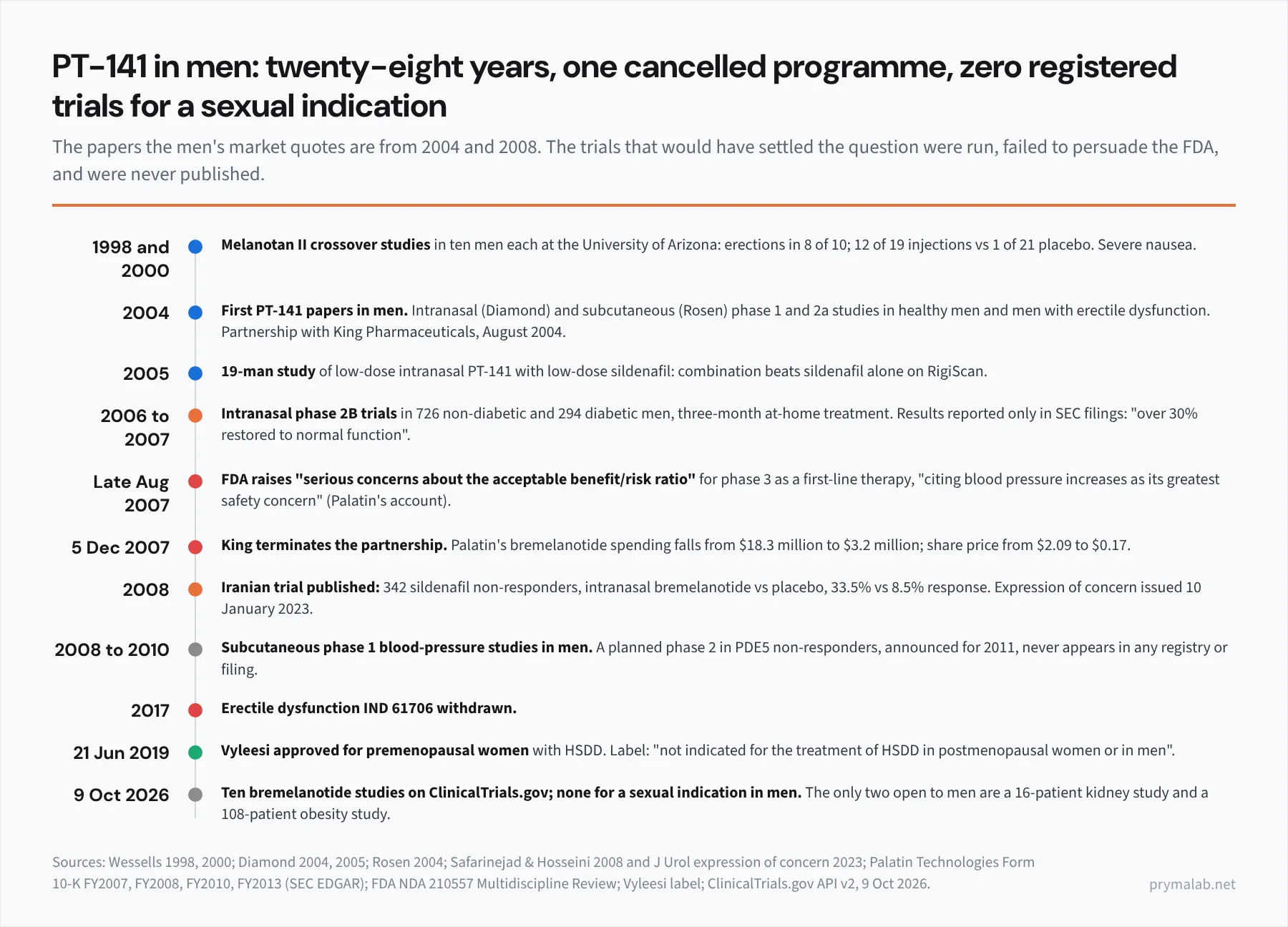
The published PT-141 data in men are three small studies and one large one. Diamond and colleagues gave intranasal PT-141 to healthy men and to sildenafil-responsive patients: median time to peak concentration 0.50 hours, half-life 1.85 to 2.09 hours, an erectile response that was significant against placebo at the higher doses tested, first erections at about 30 minutes, flushing and nausea the commonest adverse events, and "a maximum-tolerated dose was not identified".[40] Rosen and colleagues gave it subcutaneously: significant erectile response at the higher doses in healthy men and at both doses tested, in a crossover, in patients who had not responded adequately to sildenafil.[41] The 19-man sildenafil combination study is described above.[20] Then Safarinejad and Hosseini in Iran randomised 342 married men aged 28 to 59 who had not responded to sildenafil to intranasal bremelanotide or placebo and reported "positive clinical results" in 51 (33.5%) against 13 (8.5%), p=0.03, with more drug-related adverse effects.[42] On 10 January 2023 the Journal of Urology issued an expression of concern about that paper.[43] The same author's 2008 paper on intranasal bremelanotide in women with arousal disorder was retracted after reviewers "raised multiple concerning questions about the methodology, results, and statistical interpretation" and the author chose not to respond.[44] Every "PT-141 works for men" claim that cites a controlled trial is citing one of these four papers or the two ten-man melanotan II studies, and the largest of them is under a cloud.
The trials that would have settled it were Palatin's own. Its 2010 annual report describes two phase 2B double-blind trials of intranasal bremelanotide "conducted in 726 non-diabetic and 294 diabetic patients", which the 2007 report says had a three-month at-home treatment period, and claims that "over 30% of ED patients were restored to a normal level of function".[45][46] Those results never appeared in a journal. What appeared instead was the 2007 annual report's account of FDA's response: "serious concerns about the acceptable benefit/risk ratio to support progression into Phase 3 as a first-line therapy in the general population", questioning "overall efficacy results and the clinical benefit of bremelanotide in both general and diabetic populations, citing blood pressure increases as its greatest safety concern".[46] King Pharmaceuticals, Palatin's partner since August 2004, gave notice in September 2007 and the collaboration ended on 5 December 2007. Palatin's bremelanotide spending fell from $18.3 million to $3.2 million the following year, and its share price went from $2.09 to $0.17.[47] The company blamed the intranasal route, attributing the blood-pressure and nausea problems "at least partially, to high doses resulting from variability in drug uptake with nasal administration", and ran two phase 1 subcutaneous blood-pressure studies in men, one a two-week repeat-dose study and one a crossover in 49 healthy men aged 45 to 65. It said in 2010 that it intended to start an in-clinic phase 2 of subcutaneous bremelanotide in men who did not respond to PDE5 inhibitors "as early as the first quarter of calendar 2011".[45] No such trial appears on ClinicalTrials.gov or in any later filing. By 2013 the active programme was "for treatment of FSD" only.[48] FDA's review of the women's application records that "IND 61706 [male ED, nasal spray] was withdrawn in 2017" and that "some pharmacology studies related to the male indication of erectile dysfunction" were left outside that review.[10] The label states that Vyleesi "is not indicated for the treatment of HSDD in postmenopausal women or in men".[7] A ClinicalTrials.gov query on 9 October 2026 returned ten bremelanotide studies, none for a sexual indication in men; the only two open to men are a 16-patient kidney-disease study and a 108-patient obesity study.[49] The most recent men's publication I could find is a 2026 commentary asking whether bremelanotide should be considered for desire disorders in men, which is a question, not a trial.[50]
What are the side effects of PT-141?
Nausea in 40% of treated women against 1.3% on placebo, flushing in 20%, headache in 11%, vomiting in 5%. Eighteen percent discontinued for adverse reactions against 2%. Blood pressure rises by up to 6/3 mmHg, peaking 2 to 4 hours after a dose, with heart rate down by up to 5 beats per minute. Focal hyperpigmentation of the face, gums or breasts occurred in 1% at labelled frequency and in 38% of women dosed daily for eight days.
| Adverse reaction | Bremelanotide | Placebo | Detail |
|---|---|---|---|
| Nausea | 40.0% | 1.3% | Median onset within an hour, lasting about two hours; 21% after the first dose falling to about 3% after later doses; 13% took an anti-emetic; 8% discontinued. Ondansetron pre-treatment did not help in a 228-woman study[7][51] |
| Flushing | 20.3% | 0.3% | None serious; 1% discontinued[7] |
| Injection site reactions | 13.2% | 8.4% | Prefilled autoinjector[7] |
| Headache | 11.3% | 1.9% | One hospitalisation for intractable headache; 2% discontinued[7] |
| Vomiting | 4.8% | 0.2% | 1% discontinued[7] |
| Blood pressure | SBP up to +6 mmHg, DBP +3 mmHg; HR up to −5 bpm | Peak 2 to 4 h; baseline by 12 h; no accumulation over 16 daily doses. Ambulatory study in 127 women: daytime SBP +1.9 mmHg[7] | |
| Focal hyperpigmentation | 1% | 0% | Face, gingiva, breasts; 38% after 8 daily doses and a further 14% after 8 more; more likely in darker skin; resolution "not confirmed in all patients"[7] |
| Serious adverse reactions | 1.1% | 0.5% | One case of acute hepatitis in the extension, resolved after stopping; no deaths in the programme[7][6] |
| Discontinued for adverse reactions | 18% | 2% | Nausea 8%, headache 2%, vomiting 1%, flushing 1%, injection site 1%[7] |
Two label items are not in the table and matter more than their frequency suggests. The contraindication: Vyleesi is contraindicated in "uncontrolled hypertension or known cardiovascular disease", and "not recommended in patients at high risk for cardiovascular disease".[7] The blood-pressure rise is modest and brief in the trial population, which was young and screened for normal or controlled blood pressure, and the phase 2b ambulatory monitoring study found placebo-adjusted systolic rises of about 3 mmHg, with peaks typically lasting under 15 minutes.[52] It was large enough, in the older male population of the 2007 programme and with the variable nasal formulation, to end that programme. The interaction: bremelanotide slows gastric emptying, and in FDA's clinical pharmacology studies it cut the peak concentration of oral naltrexone by 64% and its exposure by 40%, and indomethacin's by 35% and 19%, while leaving sertraline, venlafaxine, pseudoephedrine and phentermine unaffected. The label tells patients to avoid it with oral naltrexone products for alcohol or opioid dependence, because a missed naltrexone level in that setting is a treatment failure with consequences.[10][7]
The rest of the safety dossier is what an approved drug has and a research compound does not. Two-year carcinogenicity studies in rats (intranasal) and mice (subcutaneous, at up to 111 times human Cmax) found no increase in tumours; genotoxicity tests were negative; fertility was unaffected in mice at hundreds of times human exposure.[7] FDA found no apparent increase in atypical nevi within the limits of the trials and noted that reversibility of hyperpigmentation "was documented in one-half of cases during the period of follow-up".[10] Seven pregnancies occurred among more than 1,057 treated women, with no major congenital anomalies, but post-implantation loss rose three- to eight-fold in dogs at the lowest dose tested, about 16 times human exposure, so the label advises effective contraception.[7] A human abuse-potential study against phentermine found responses no different from placebo, and the drug is not scheduled.[10][53]
What are the pharmacokinetics of bremelanotide?
In the label's pharmacokinetic data, bremelanotide given by the subcutaneous route was about 100% bioavailable, reached peak plasma concentration at a median of 1.0 hour, and had a terminal half-life of about 2.7 hours (range 1.9 to 4.0). It is cleared by hydrolysis of its amide bonds, with 64.8% of radioactivity recovered in urine and 22.8% in faeces.
The label gives mean Cmax of 72.8 ng/mL and AUC of 276 h·ng/mL at the approved dose, exposure that increases less than proportionally with dose, with peak concentration plateauing at higher doses; 21% protein binding; a volume of distribution of 25 L; clearance of 6.5 L/h.[7] Exposure rises 1.2-, 1.5- and 2-fold in mild, moderate and severe renal impairment and 1.2- and 1.7-fold in mild and moderate hepatic impairment, and the label advises caution in severe renal or hepatic impairment because nausea and vomiting may be more frequent and severe.[7] Intranasal administration was faster (median Tmax 0.5 h) and produced a 2.5-fold higher peak in the men's studies than the approved product, with the variability that ended the men's programme.[40][7] A 2020 paper developed an ultra-sensitive LC-MS/MS assay specifically to measure plasma bremelanotide after oral administration, which tells you that oral absorption is low enough to need one.[54] The short half-life is also the pharmacological reason the label can state that blood pressure returns to baseline within about 12 hours and that 16 days of daily use in a study produced no cumulative effect.[7]
What does the approved label specify, and why does none of it apply to research material?
The Vyleesi label sets out conditions of use for one product, a prefilled autoinjector, and this article does not repeat them. Those conditions are facts about one pharmaceutical product with a measured content and a sterile, characterised formulation. They say nothing about any other material, and this article contains no protocol.
The label is also candid about the limits of its own instruction: "the duration of efficacy after each dose is unknown and the optimal window for VYLEESI administration has not been fully characterized".[7] FDA's review explains why the label limits frequent use: very limited safety information with frequent use, a rising risk of hyperpigmentation, and more time each month spent with raised blood pressure.[10] The phase 3 product came out of a 12-week phase 2b trial, which compared three dose levels with placebo and took the highest into phase 3; that trial's primary endpoint was satisfying sexual events, which the pooled higher doses did improve (+0.7 against +0.2 a month, p=0.018) and which phase 3 then failed to replicate as a secondary endpoint.[55][21] The phase 3 endpoints then changed again: FDA's review records that, at the sponsor's request and with the agency's agreement in September 2016, after the two trials' last patient visits in July and August 2016 and before the database was locked, the desire and distress scores became the co-primary endpoints and satisfying sexual events became the key secondary endpoint. That is the "shift in primary outcomes" the Drug and Therapeutics Bulletin objected to.[10][31]
The earlier version of this page had a reconstitution calculator. It is gone, and the reason is on the FDA's website. The 24 August 2026 warning letters cite the sale of bacteriostatic water (Tex Peptides, Peptide Partners, NuScience, Peak Performance) and a "peptide guide" and "peptide calculator" (Royal Peptides) as evidence that products labelled for research are intended for human use.[56][57][58] A page that describes the label of Vyleesi is describing an approved drug. A page that tells a reader how to turn a research vial into a dose is doing something else.
Why was the nasal spray abandoned?
Because nasal absorption was variable. Palatin's own account attributes the blood-pressure increases and the nausea and vomiting in the men's programme "at least partially, to high doses resulting from variability in drug uptake with nasal administration", and the approved product is a subcutaneous autoinjector.
Every early efficacy study but one used the nasal route: Diamond's 2004 men's study (Rosen's 2004 subcutaneous study was the exception), the 2005 sildenafil combination, the 2006 study in 18 women with arousal disorder, the intranasal phase 2 in women that ran from February 2006 to May 2007, and the two phase 2B trials in 1,020 men.[40][20][59][60][45] In the intranasal studies the peak plasma concentration was 2.5 times that of the approved product.[7] After FDA's 2007 response, Palatin moved the women's programme to the subcutaneous route, ran the subcutaneous phase 2b dose-finding trial, and never returned to the nose.[45][55] The intranasal women's results from 2006 to 2007 were never published; the company's own summary says the premenopausal results were "confounded by a significant placebo effect".[48] So a nasal spray of bremelanotide is a formulation its developer tested in more than a thousand people and walked away from on pharmacokinetic grounds. That is the whole of what the primary record says about it.
Is PT-141 legal? FDA, DEA, WADA and the August 2026 warning letters
Bremelanotide is an FDA-approved prescription drug in the United States, with no approval found anywhere else; it is not a DEA-controlled substance and is not on the WADA 2026 Prohibited List. Research-grade bremelanotide sold with claims about libido, arousal or HSDD is, in FDA's words in five warning letters dated 24 August 2026, an unapproved new drug, whatever the label says.
| Authority | Bremelanotide (PT-141) | Melanotan II |
|---|---|---|
| FDA (US) | Approved: NDA 210557, 21 June 2019; Vyleesi, prescription only; current holder Cosette[9] | Never approved; listed by FDA among nominated bulk substances with safety risks (melanoma, PRES, sympathomimetic toxidrome, priapism)[61] |
| FDA warning letters | Named as an unapproved new drug in letters to Royal Peptides, Tex Peptides, Peptide Partners, NuScience Peptides and Peak Performance Peptides, all dated 24 August 2026[57][56][62][63][64] | Named in earlier compounding actions; a committee review expected before February 2027 (secondary report)[58] |
| EMA / UK / Canada / Australia | No EMA application found; no Health Canada listing; no evidence of UK or Australian approval; a 2014 European licence to Gedeon Richter was terminated in 2015[65][66] | Not approved; "unlicensed, and its sale is illegal in the United Kingdom"; TGA issued 27 infringement notices totalling AUD 101,412, paid May 2026[67][68] |
| China / South Korea | Fosun made a first sale in Hainan's free-trade zone without NMPA registration; Kwangdong completed a 193-woman bridging trial in 2023; no Korean sale by September 2026[69][70][19] | Not approved |
| DEA | Not a controlled substance; FDA found "negligible abuse potential"[53][10] | Not a controlled substance |
| WADA 2026 | Not named on the Prohibited List; an approved drug falls outside S0[71] | Prohibited at all times under S0 as a substance with "no current approval by any governmental regulatory health authority"[71] |
| Compounding (503A/503B) | Not on the 503B bulks list. As the active ingredient of an approved drug it appears to qualify as a 503A bulk substance under the statute's "component of an approved drug" clause (a reading of the statute, not an FDA statement), subject to every other 503A condition; no bremelanotide-specific FDA compounding statement was found[72] | Nomination withdrawn; on the FDA safety-risk list[61] |
The August 2026 letters are the operative document for anyone in this market. FDA reviewed vendor websites in July 2026 and wrote to Royal Peptides that "'Tirzepatide,' 'Semaglutide,' 'Retatrutide,' 'SS-31 (Elamipretide),' 'PT-141,' 'Tesamorelin,' and 'BIMORELIN' are unapproved new drugs", quoting the vendor's own PT-141 page, which described the compound as having "been tested in clinical trials as a treatment for hypoactive sexual desire disorder", as evidence of intended use.[57] To Tex Peptides it named "'PT-141 (Bremelanotide),' and 'Bacteriostatic Water 0.9% Benzyl Alcohol (10 ml)'" among the unapproved drugs, quoted the claim that PT-141 "is specifically researched for its ability to increase arousal and desire", and treated the bacteriostatic water as a drug because it supplied the means to prepare an injection.[56] The other three letters of the same day, to Peptide Partners, NuScience Peptides and Peak Performance Peptides, name the compound too, as "PT-141 (Bremelanotide)", "PT-141 Peptide (Bremelanotide)" and "PT-141".[62][63][64] A law-firm review of the wave covers four of the five and lists PT-141 among the products named in each; across the letters FDA relied on claims, a "peptide guide" and "peptide calculator", and bacteriostatic water, and rejected research-use-only disclaimers.[58] The existence of an approved product does not shelter a third party's vial; if anything it sharpens the point, because the vial is being sold for the thing the approved product is approved for.
Outside the United States the drug is, for practical purposes, unapproved. Palatin's filings from 2007 to 2026 mention no EMA submission; the European path ended when the Richter licence was terminated by mutual agreement in September 2015, before phase 3 finished.[65] Health Canada's product database returns nothing for bremelanotide or Vyleesi.[66] The Korean bridging trial (193 women, completed May 2023) has produced no commercial sale; Palatin wrote in September 2026 that it "do[es] not expect to receive this milestone payment in the foreseeable future, if at all".[70][19] As of Palatin's last disclosure in August 2023, China's only sales had been under Hainan's free-trade-port exemption from national registration.[69]
How does bremelanotide compare with melanotan II?
Same ring, different ending, different world. Bremelanotide has a label, a negative carcinogenicity programme and a measured 1% hyperpigmentation rate at labelled frequency. Melanotan II has no approval anywhere, a place on FDA's compounding safety-risk list and the WADA S0 category, and a case-report literature of melanoma, encephalopathy, systemic toxicity and priapism.
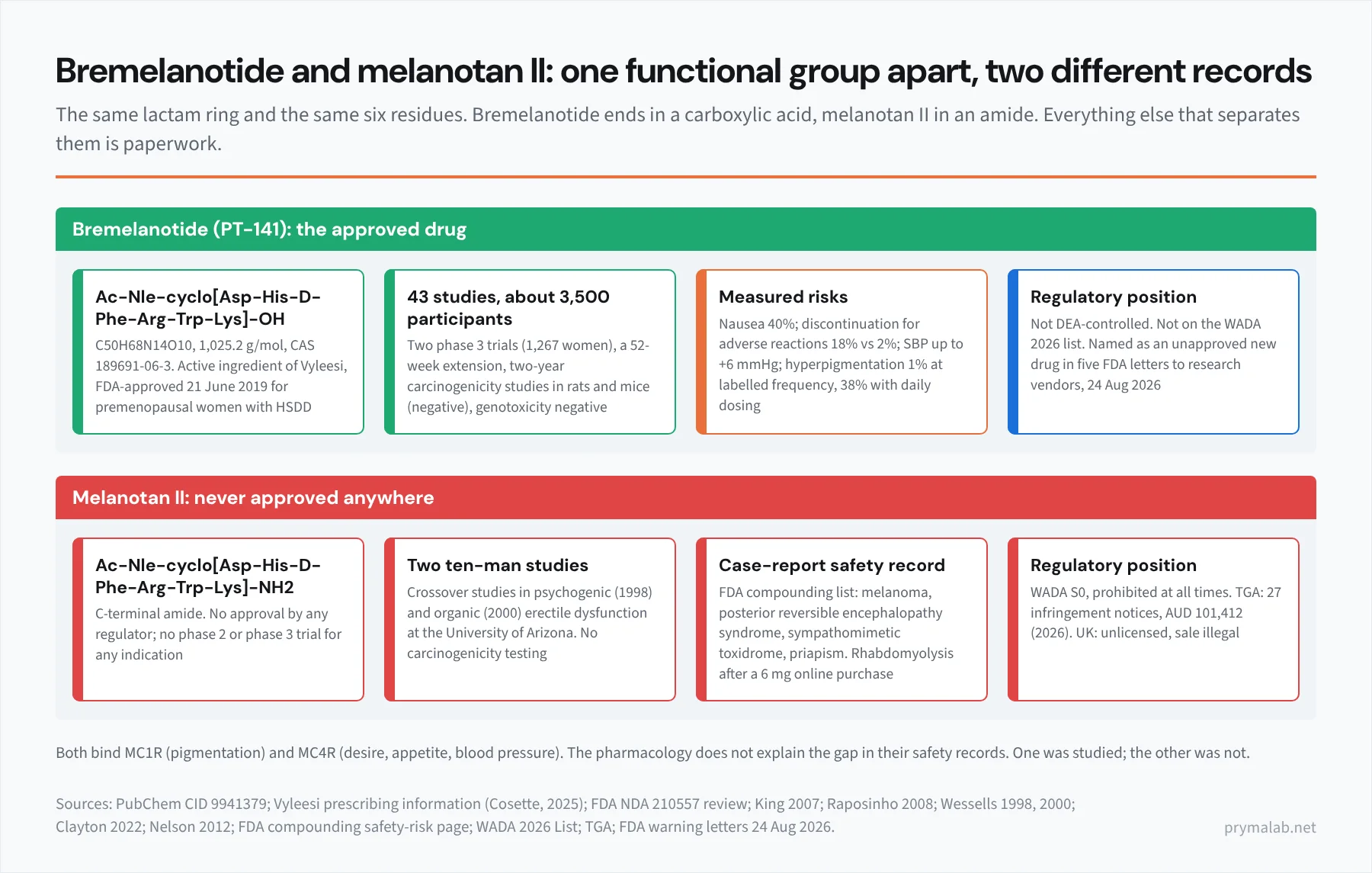
The structural relationship is exact: melanotan II is Ac-Nle-cyclo[Asp-His-D-Phe-Arg-Trp-Lys]-NH2 and bremelanotide is the same sequence ending in -OH.[11][5] Both bind MC1R, so both darken skin; both bind MC4R, so both affect desire, appetite and blood pressure. The pharmacology does not explain the gap in their safety records. The gap is that one was studied and the other was not. FDA's compounding page summarises the melanotan II literature as "serious adverse events including melanoma, posterior reversible encephalopathy syndrome, sympathomimetic toxidrome and priapism".[61] The individual reports: a 39-year-old man who had injected melanotan II bought online and presented with a blood pressure of 151/85, a heart rate of 146, dilated pupils, sweating, tremor and rhabdomyolysis;[73] eruptive atypical nevi in a man with prior melanoma who had injected a synthetic alpha-MSH peptide (the paper does not say which), which lightened when he stopped, prompting the authors to warn that synthetic alpha-MSH peptides "can drive proliferation of neoplastic melanocytic cells in predisposed patients";[74] nevi that changed under dermoscopy during use in ways that made melanoma hard to exclude;[75] an oral mucosal melanoma in a 22-year-old woman using a melanotan II nasal spray;[67] and five melanomas in situ in a 2026 patient with tanning-bed, melanotan and anabolic hormone exposure.[76] None of these establishes causation, and a mouse study found topical melanotan II suppressed melanoma growth, so the carcinogenicity question for melanotan II is open rather than answered.[77] For bremelanotide it was asked formally, in two species over two years, and answered negatively.[7] Both compounds turn up in the same black-market seizures: an Italian forensic laboratory characterised melanotan II and bremelanotide together in 2021 as sexual-function and tanning agents "not legally marketed".[78] The melanotan comparison covers the tanning side.
Where PrymaLab fits
PrymaLab supplies research-grade bremelanotide through the PT-141 research listing and offers identity and purity testing for laboratories verifying the material they hold. It is a laboratory reagent. It is not Vyleesi, it was not made under the controls that produced the label figures above, and this page exists to put the primary record next to the marketing claims so that the two can be told apart. The sexual health peptide archive collects the related references.
One analytical note follows from the chemistry. Bremelanotide and melanotan II differ by 1 Da in mass (1,025.2 against 1,024.2) and in a single functional group, which puts them within reach of each other on a low-resolution instrument and makes the free acid a plausible hydrolysis product of the amide. The 2026 degradation study also identified epimers, which share the exact mass of the parent.[12] An identity test that distinguishes the two compounds, and the parent from its epimers, needs high-resolution mass spectrometry with chromatographic separation, not a nominal-mass match. That is the standard the PT-141 test is built to.
What this article does not settle
- Whether bremelanotide works in men. The 1,020-patient phase 2B data were never published; the one large published trial has an expression of concern; no trial for a sexual indication in men is registered.[45][43][49]
- Whether the women's effect is clinically meaningful. The sponsor's responder analyses and the independent re-analyses read the same data differently, and the pooled effect sizes of the 2026 systematic review are behind a paywall.[21][28][32]
- The mechanism. The label says unknown; the hamster data contradict the dopamine hypothesis; the human fMRI study is one crossover of 31 women.[7][17][16]
- Whether PT-141 was first identified as a metabolite of melanotan II. The primary sources call it the carboxylate derivative; I found no primary document showing it was isolated from humans given melanotan II.[5]
- Melanotan II and melanoma. Case reports only, with a contrary mouse study; no controlled data either way.[74][77]
- Approval outside the US. No EMA record found is not the same as proof no application was made; the Korean regulatory outcome was not found.[65][19]
- Breast-milk transfer. The 2025 lactation study is complete; its results were not in the label at the time of writing.[27]
PT-141, bremelanotide, Vyleesi, melanotan: what the names mean
PT-141 is Palatin Technologies' development code and the name the research market uses. Bremelanotide is the international nonproprietary name; bremelanotide acetate is the salt in the approved product. Vyleesi is the US trade name; Rekynda was the trade name AMAG announced in 2017 before launch.[36] Melanotan II (MT-II, melanotan 2) is the C-terminal amide parent compound, never approved. Melanotan 1 is afamelanotide, a linear alpha-MSH analogue approved as Scenesse for erythropoietic protoporphyria, which is a different molecule and a different story. Alpha-MSH is the natural 13-residue hormone all of these imitate. MC4R is the melanocortin 4 receptor credited with the desire effect; MC1R is the pigmentation receptor. HSDD is hypoactive sexual desire disorder, the approved indication; FSFI-D and FSDS-DAO item 13 are the two questionnaire scores that were the co-primary endpoints; SSEs are satisfying sexual events, the secondary endpoint that did not move. RECONNECT is the name for the two phase 3 trials, Studies 301 and 302. NDA 210557 is the approval; IND 61706 was the men's erectile dysfunction application, withdrawn in 2017.
Frequently asked questions
Is PT-141 the same as bremelanotide?
Yes. PT-141 is Palatin Technologies' development code for bremelanotide, the active ingredient of Vyleesi. It is a cyclic heptapeptide melanocortin agonist, Ac-Nle-cyclo[Asp-His-D-Phe-Arg-Trp-Lys]-OH, CAS 189691-06-3, and differs from melanotan II only by a carboxylic acid in place of the C-terminal amide.
Is PT-141 FDA approved?
Bremelanotide is, as Vyleesi, under NDA 210557, approved on 21 June 2019 for premenopausal women with acquired, generalised hypoactive sexual desire disorder. It is not approved for men, for postmenopausal women, or to improve sexual performance, no EMA application was found, Health Canada lists no product, and no approval outside the United States was found. Research-grade PT-141 sold by peptide vendors is not the approved product, and FDA named it as an unapproved new drug in five warning letters dated 24 August 2026.
Did bremelanotide (Vyleesi) work in the phase 3 trials in women?
In the two RECONNECT phase 3 trials (1,267 women, 24 weeks), bremelanotide improved the desire score by 0.5 to 0.6 points against 0.2 on placebo (range 1.2 to 6) and the distress score by 0.7 against 0.4 (range 0 to 4), both statistically significant. It did not change the number of satisfying sexual events. About 58% of treated women versus 36% on placebo reported meaningful improvement on the sponsor's anchor question, and 40% of treated women left before 24 weeks against 13% in one study. Independent reviewers describe the benefit as modest. These are trial results for an approved drug, not statements about research material.
Is there evidence that bremelanotide works for men?
No controlled evidence establishes that it does. The published men's studies are small 2004 and 2005 trials and a 342-man Iranian trial from 2008 that carries a 2023 expression of concern. Palatin's two intranasal phase 2B trials in 1,020 men were never published; FDA raised blood-pressure and efficacy concerns in August 2007, the programme stopped, and the erectile dysfunction IND was withdrawn in 2017. The Vyleesi label states the drug is not indicated for men, and no trial for a sexual indication in men is registered as of October 2026.
What side effects did bremelanotide cause in the trials?
In the pooled phase 3 trials: nausea 40.0% versus 1.3% on placebo, flushing 20.3%, injection site reactions 13.2%, headache 11.3%, vomiting 4.8%. Eighteen percent discontinued for adverse reactions against 2%. Systolic blood pressure rises by up to 6 mmHg and heart rate falls by up to 5 beats per minute, peaking 2 to 4 hours after a dose. Focal hyperpigmentation of the face, gums or breasts occurred in 1% of women at the labelled frequency and in 38% of women dosed daily for eight days, and did not always resolve. These are label figures for an approved drug, not statements about research material.
Does bremelanotide raise blood pressure?
Yes, transiently. The label reports maximal increases of 6 mmHg systolic and 3 mmHg diastolic peaking 2 to 4 hours after a dose, with return to baseline usually within 12 hours and no accumulation over 16 days of daily dosing. Vyleesi is contraindicated in uncontrolled hypertension and known cardiovascular disease. Blood-pressure increases were, in Palatin's account of FDA's 2007 comments, the agency's "greatest safety concern", after which Palatin halted the men's programme. This is label and trial information about an approved drug, not guidance on research material.
How long does bremelanotide stay in the body?
The terminal half-life in the label's pharmacokinetic data is about 2.7 hours (range 1.9 to 4.0), with peak plasma concentration at a median of 1.0 hour and about 100% bioavailability. It is cleared by hydrolysis of its amide bonds; 64.8% of radioactivity appears in urine and 22.8% in faeces. The label states that the duration of efficacy after each dose is unknown.
What is the difference between PT-141 and melanotan II?
One functional group. Melanotan II ends in an amide (-NH2) and bremelanotide in a carboxylic acid (-OH); the cyclic ring and every other residue are identical. Bremelanotide is an FDA-approved drug with two phase 3 trials, negative two-year carcinogenicity studies and a label. Melanotan II has never been approved anywhere, appears on FDA's compounding safety-risk list with case reports of melanoma, encephalopathy, systemic toxicity and priapism, is prohibited by WADA under S0, its sale is illegal in the UK, and in Australia it is prescription-only with no registered product and has drawn infringement notices.
Is PT-141 banned in sport?
Bremelanotide is not named on the WADA 2026 Prohibited List and, as an approved drug, falls outside the S0 category for non-approved substances. Melanotan II, which has no approval anywhere, is prohibited at all times under S0 by definition. Neither is a DEA-controlled substance.
Why was Vyleesi sold twice?
AMAG licensed North American rights in January 2017 for $60 million upfront, launched in September 2019, and returned the drug to Palatin in July 2020, paying $16.3 million in total to exit. Palatin sold it for three years, reaching net sales of $4.9 million in the year to June 2023, then sold it to Cosette in December 2023 for $12 million upfront. In June 2025 Cosette settled the outstanding sales-milestone and inventory obligations for $630,000.
Does the Vyleesi label list drug interactions?
The label warns that bremelanotide slows gastric emptying and reduces the absorption of some oral drugs: it cut the peak concentration of oral naltrexone by 64% and of indomethacin by 35% in FDA's studies, and the label says to avoid it with oral naltrexone products for alcohol or opioid dependence. Sertraline, venlafaxine, pseudoephedrine and phentermine were unaffected. Alcohol did not alter its pharmacokinetics in a study of 24 adults. This is label information about an approved drug, not guidance on research material.
Why does bremelanotide cause nausea?
The FDA reviewer suggested it may relate to the drug's binding at MC3R; the label does not state a mechanism. Nausea began within about an hour of a dose and lasted about two hours; it affected 21% of women after the first dose and about 3% after later doses, 13% took an anti-emetic, and 8% left the trials because of it. Pre-treatment with ondansetron did not reduce it in a 228-woman study and is not recommended. This is label information about an approved drug, not guidance on research material.
References
- Hadley ME. Discovery that a melanocortin regulates sexual functions in male and female humans. Peptides. 2005;26(10):1687-9. PMID 15996790
- Wessells H, Fuciarelli K, Hansen J, et al. Synthetic melanotropic peptide initiates erections in men with psychogenic erectile dysfunction: double-blind, placebo controlled crossover study. J Urol. 1998;160(2):389-93. Melanotan II, 10 men with psychogenic erectile dysfunction, double-blind placebo-controlled crossover. PMID 9679884
- Wessells H, Gralnek D, Dorr R, et al. Effect of an alpha-melanocyte stimulating hormone analog on penile erection and sexual desire in men with organic erectile dysfunction. Urology. 2000;56(4):641-6. Melanotan II, 10 men with organic erectile dysfunction. PMID 11018622
- Wessells H, Levine N, Hadley ME, et al. Melanocortin receptor agonists, penile erection, and sexual motivation: human studies with Melanotan II. Int J Impot Res. 2000;12 Suppl 4:S74-9. PMID 11035391
- King SH, Mayorov AV, Balse-Srinivasan P, et al. Melanocortin receptors, melanotropic peptides and penile erection. Curr Top Med Chem. 2007;7(11):1098-1106. Describes PT-141 as "the carboxylate derivative of MT-II". PMID 17584130
- Clayton AH, Kingsberg SA, Portman D, et al. Safety Profile of Bremelanotide Across the Clinical Development Program. J Womens Health (Larchmt). 2022;31(2):171-182. Pooled safety across 43 completed studies and about 3,500 participants. PMID 35147466
- Vyleesi (bremelanotide acetate) injection, for subcutaneous use: prescribing information. Cosette Pharmaceuticals, Inc. Label effective 13 November 2025, SPL set ID f1d0c1b5-2f39-4bad-a6a4-0066e3ad5dcf. Sections cited: 1 (indication and limitations of use), 2 (dosage, as label fact), 4 (contraindications), 5.1 to 5.3 (blood pressure, hyperpigmentation, nausea), 6.1 (Table 1 adverse reactions), 7 (interactions), 8.1 (pregnancy), 11 (description), 12.1 to 12.3 (mechanism, pharmacodynamics, pharmacokinetics), 13.1 (carcinogenicity), 14 (Tables 2 to 4, RECONNECT results). DailyMed
- PubChem, National Library of Medicine: compound summary for CID 9941379 (bremelanotide). C50H68N14O10, 1025.2 g/mol, InChIKey FFHBJDQSGDNCIV-MFVUMRCOSA-N, CAS 189691-06-3, UNII 6Y24O4F92S, ChEMBL CHEMBL2070241, DrugBank DB11653, KEGG D06569. Retrieved 9 October 2026. PubChem
- US Food and Drug Administration, Drugs@FDA: NDA 210557, Vyleesi (bremelanotide acetate) autoinjector. Original approval 21 June 2019 (Type 1 new molecular entity, AMAG Pharmaceuticals); labelling supplement S-002 approved 23 October 2020; current applicant Cosette Pharmaceuticals. Drugs@FDA
- US Food and Drug Administration, Center for Drug Evaluation and Research. NDA 210557 Multidiscipline Review (bremelanotide, Vyleesi), 2019. Sources for receptor binding (MC4R Ki about 14 nM, cAMP EC50 1.1 nM, no MC2R binding), CNS penetration in mice, blood-pressure pharmacology, the naltrexone and indomethacin interaction studies, the abuse-potential assessment, the eight-dose rationale, hyperpigmentation reversibility, and the withdrawn erectile dysfunction IND 61706. FDA (PDF)
- Raposinho PD, Xavier C, Correia JD, et al. Melanoma targeting with alpha-melanocyte stimulating hormone analogs labeled with fac-[99mTc(CO)3]+: effect of cyclization on tumor-seeking properties. J Biol Inorg Chem. 2008;13(3):449-59. Gives the melanotan II sequence Ac-Nle-cyclo[Asp-His-DPhe-Arg-Trp-Lys]-NH2. PMID 18183429
- Yuvaraaj VK, Sharma N. Comprehensive characterization of bremelanotide acetate and its degradants by LC-HRMS/MS and predicting epimerization through computational modelling. Anal Methods. 2026;18(32):6968-6982. LC-HRMS/MS characterisation of bremelanotide acetate degradation products, including epimers. PMID 42485063
- Pfaus JG, Sadiq A, Spana C, et al. The neurobiology of bremelanotide for the treatment of hypoactive sexual desire disorder in premenopausal women. CNS Spectr. 2022;27(3):281-289. Industry-authored review of the hypothalamic dopamine hypothesis. PMID 33455598
- Molinoff PB, Shadiack AM, Earle D, et al. PT-141: a melanocortin agonist for the treatment of sexual dysfunction. Ann N Y Acad Sci. 2003;994:96-102. PMID 12851303
- Pfaus J, Giuliano F, Gelez H. Bremelanotide: an overview of preclinical CNS effects on female sexual function. J Sex Med. 2007;4 Suppl 4:269-79. PMID 17958619
- Thurston L, Hunjan T, Mills EG, et al. Melanocortin 4 receptor agonism enhances sexual brain processing in women with hypoactive sexual desire disorder. J Clin Invest. 2022;132(19). Randomised double-blind placebo-controlled crossover fMRI study, 31 premenopausal women with HSDD, NCT04179734. PMID 36189794
- Borland JM, Kohut-Jackson AL, Peyla AC, et al. Female Syrian hamster analyses of bremelanotide, a US FDA approved drug for the treatment of female hypoactive sexual desire disorder. Neuropharmacology. 2025;267:110299. PMID 39793696
- Spana C, Jordan R, Fischkoff S. Effect of bremelanotide on body weight of obese women: Data from two phase 1 randomized controlled trials. Diabetes Obes Metab. 2022;24(6):1084-1093. Two phase 1 randomised trials in obese women. PMID 35170192
- Palatin Technologies, Inc. Annual report on Form 10-K for the fiscal year ended 30 June 2026, filed 28 September 2026. Release and settlement agreement with Cosette of 5 June 2025 ($630,000 lump sum); Korean milestone not expected; bremelanotide plus tirzepatide phase 2 topline (4.4% versus 1.6% weight loss over eight weeks, NCT06565611) and the decision not to fund further development. SEC EDGAR
- Diamond LE, Earle DC, Garcia WD, et al. Co-administration of low doses of intranasal PT-141, a melanocortin receptor agonist, and sildenafil to men with erectile dysfunction results in an enhanced erectile response. Urology. 2005;65(4):755-9. Nineteen men; randomised crossover of low-dose sildenafil plus low-dose intranasal PT-141, sildenafil alone and placebo. PMID 15833522
- Kingsberg SA, Clayton AH, Portman D, et al. Bremelanotide for the Treatment of Hypoactive Sexual Desire Disorder: Two Randomized Phase 3 Trials. Obstet Gynecol. 2019;134(5):899-908. RECONNECT Studies 301 (NCT02333071) and 302 (NCT02338960): 1,267 randomised, 24 weeks. Full text PMC6819021. PMID 31599840
- Simon JA, Kingsberg SA, Portman D, et al. Long-Term Safety and Efficacy of Bremelanotide for Hypoactive Sexual Desire Disorder. Obstet Gynecol. 2019;134(5):909-917. 52-week open-label extension: 684 enrolled of 856 eligible, 272 completed. Full text PMC6819023. PMID 31599847
- Althof S, Derogatis LR, Greenberg S, et al. Responder Analyses from a Phase 2b Dose-Ranging Study of Bremelanotide. J Sex Med. 2019;16(8):1226-1235. PMID 31277966
- Simon JA, Kingsberg SA, Portman D, et al. Prespecified and Integrated Subgroup Analyses from the RECONNECT Phase 3 Studies of Bremelanotide. J Womens Health (Larchmt). 2022;31(3):391-400. PMID 35230162
- US Food and Drug Administration. NDA 210557 approval letter to AMAG Pharmaceuticals, 21 June 2019, signed Hylton V. Joffe. Post-marketing requirements 3635-1 to 3635-3 (pregnancy registry, pregnancy cohort study, lactation study). FDA (PDF)
- Dhillon S, Keam SJ. Bremelanotide: First Approval. Drugs. 2019;79(14):1599-1606. PMID 31429064
- ClinicalTrials.gov NCT06867835. Cosette Pharmaceuticals: single dose of Vyleesi in lactating women to measure bremelanotide in breast milk, phase 4, 10 participants, July to November 2025, completed. ClinicalTrials.gov
- Spielmans GI. Re-Analyzing Phase III Bremelanotide Trials for "Hypoactive Sexual Desire Disorder" in Women. J Sex Res. 2021;58(9):1085-1105. Re-analysis of the FDA review data; erratum published. PMID 33678061
- Kingsberg SA, Clayton AH, Portman D, et al. Failure of a Meta-analysis: A Commentary on Glen Spielmans's "Re-Analyzing Phase III Bremelanotide Trials for 'Hypoactive Sexual Desire Disorder in Women'". J Sex Res. 2021;58(9):1106-1107. PMID 33835907
- Spielmans GI, Ellefson EM. Small Effects, Questionable Outcomes: Bremelanotide for Hypoactive Sexual Desire Disorder. J Sex Res. 2024;61(4):540-561. PMID 36809187
- Mintzes B, Tiefer L, Cosgrove L. Bremelanotide and flibanserin for low sexual desire in women: the fallacy of regulatory precedent. Drug Ther Bull. 2021;59(12):185-188. PMID 34642243
- Toledo RG, Winkelman WD, Reyes-Gonzalez D, et al. Female Sexual Desire, Arousal, and Orgasmic Dysfunctions: A Systematic Review and Meta-Analysis of Treatment Options. J Minim Invasive Gynecol. 2026;33(1):16-33.e3. Systematic review and meta-analysis, 36 studies, search to December 2024. PMID 40543759
- Cipriani S, Alfaroli C, Maseroli E, et al. An evaluation of bremelanotide injection for the treatment of hypoactive sexual desire disorder. Expert Opin Pharmacother. 2023;24(1):15-21. PMID 36242769
- Mayer D, Lynch SE. Bremelanotide: New Drug Approved for Treating Hypoactive Sexual Desire Disorder. Ann Pharmacother. 2020;54(7):684-690. PMID 31893927
- Weinberger JM, Houman J, Caron AT, et al. Female Sexual Dysfunction and the Placebo Effect: A Meta-analysis. Obstet Gynecol. 2018;132(2):453-458. PMID 29995725
- Palatin Technologies, Inc. Form 8-K, exhibit 99.1, 9 January 2017: exclusive North American licence to AMAG Pharmaceuticals for Rekynda (bremelanotide); $60 million upfront, up to $80 million in regulatory milestones and $300 million in sales milestones. SEC EDGAR
- Palatin Technologies, Inc. Form 8-K, exhibit 99.1, 13 November 2019: more than 1,300 prescribers and 3,000 prescriptions in the four weeks after national launch. SEC EDGAR
- Palatin Technologies, Inc. Annual report on Form 10-K for the fiscal year ended 30 June 2023. AMAG termination agreement of 24 July 2020 ($12.0 million at closing and $4.3 million in 2021); Vyleesi gross product sales $12.5 million and net sales $4.9 million in fiscal 2023. SEC EDGAR
- Palatin Technologies, Inc. Form 8-K, exhibit 99.1, 20 December 2023: sale of Vyleesi to Cosette Pharmaceuticals for $12 million upfront and up to $159 million in sales-based milestones. SEC EDGAR
- Diamond LE, Earle DC, Rosen RC, et al. Double-blind, placebo-controlled evaluation of the safety, pharmacokinetic properties and pharmacodynamic effects of intranasal PT-141, a melanocortin receptor agonist, in healthy males and patients with mild-to-moderate erectile dysfunction. Int J Impot Res. 2004;16(1):51-9. Intranasal PT-141 in healthy men and sildenafil-responsive patients; RigiScan. PMID 14963471
- Rosen RC, Diamond LE, Earle DC, et al. Evaluation of the safety, pharmacokinetics and pharmacodynamic effects of subcutaneously administered PT-141, a melanocortin receptor agonist, in healthy male subjects and in patients with an inadequate response to Viagra. Int J Impot Res. 2004;16(2):135-42. Subcutaneous PT-141 in healthy men and, in a crossover design, in patients with an inadequate response to sildenafil. PMID 14999221
- Safarinejad MR, Hosseini SY. Salvage of sildenafil failures with bremelanotide: a randomized, double-blind, placebo controlled study. J Urol. 2008;179(3):1066-71. Intranasal bremelanotide versus placebo in 342 men not responding to sildenafil, Iran. PMID 18206919
- The Journal of Urology. Expression of concern: Salvage of sildenafil failures with bremelanotide, a randomized, double-blind, placebo controlled study (Safarinejad and Hosseini, 2008). J Urol. 2023; published online 10 January 2023. PMID 36626345. PubMed
- Safarinejad MR. RETRACTED: Evaluation of the safety and efficacy of bremelanotide, a melanocortin receptor agonist, in female subjects with arousal disorder: a double-blind placebo-controlled, fixed dose, randomized study. J Sex Med. 2008;5(4):887-897. Retracted. PMID 18179455
- Palatin Technologies, Inc. Annual report on Form 10-K for the fiscal year ended 30 June 2010. Reports the intranasal phase 2B trials in 726 non-diabetic and 294 diabetic men, attributes blood-pressure and nausea findings to variable nasal uptake, describes the subcutaneous phase 1 blood-pressure studies in men, and states the intention to start a subcutaneous phase 2 in men in 2011. SEC EDGAR
- Palatin Technologies, Inc. Annual report on Form 10-K for the fiscal year ended 30 June 2007, filed 13 September 2007. Describes the completed phase 2B erectile dysfunction trials, FDA's late-August 2007 response citing blood pressure as its greatest safety concern, and King Pharmaceuticals' notice of termination. SEC EDGAR
- Palatin Technologies, Inc. Annual report on Form 10-K for the fiscal year ended 30 June 2008. Bremelanotide spending fell from $18.3 million to $3.2 million; development for sexual dysfunction discontinued after FDA's benefit-risk concerns; share price range $2.09 to $0.17. SEC EDGAR
- Palatin Technologies, Inc. Annual report on Form 10-K for the fiscal year ended 30 June 2013. Active bremelanotide programme limited to female sexual dysfunction; 31 completed studies and more than 2,500 participants to date; intranasal results in premenopausal women described as confounded by a significant placebo effect. SEC EDGAR
- ClinicalTrials.gov API v2, query term "bremelanotide", run 9 October 2026: ten registered studies (NCT00425256, NCT01382719, NCT02333071, NCT02338960, NCT03973047, NCT04179734, NCT04943068, NCT05709444, NCT06565611, NCT06867835), none for erectile dysfunction or any sexual indication in men; the two that enrolled both sexes are the diabetic kidney disease study (NCT05709444, 16 participants) and the obesity study with tirzepatide (NCT06565611, 108 participants). ClinicalTrials.gov
- Pfaus JG, Balon R. Should Bremelanotide Be Considered for the Treatment of Sexual Arousal and Desire Disorders in Men?. J Clin Psychopharmacol. 2026;46(3):245-248. Commentary; full text not accessed. PMID 41960633
- ClinicalTrials.gov NCT03973047. AMAG Pharmaceuticals: effect of ondansetron pre-treatment on bremelanotide-induced nausea in healthy women, phase 1, 228 participants, June to July 2019. ClinicalTrials.gov
- White WB, Myers MG, Jordan R, et al. Usefulness of ambulatory blood pressure monitoring to assess the melanocortin receptor agonist bremelanotide. J Hypertens. 2017;35(4):761-768. Ambulatory blood pressure monitoring in 397 premenopausal women randomised in the phase 2b trial. PMID 27977473
- US Drug Enforcement Administration, Diversion Control Division. Controlled substances, alphabetical order (orange book list). Bremelanotide, PT-141 and melanotan absent; checked 9 October 2026. DEA (PDF)
- Sauter M, Uhl P, Burhenne J, et al. Ultra-sensitive quantification of the therapeutic cyclic peptide bremelanotide utilizing UHPLC-MS/MS for evaluation of its oral plasma pharmacokinetics. J Pharm Biomed Anal. 2020;186:113276. PMID 32353679
- Clayton AH, Althof SE, Kingsberg S, et al. Bremelanotide for female sexual dysfunctions in premenopausal women: a randomized, placebo-controlled dose-finding trial. Womens Health (Lond). 2016;12(3):325-37. Phase 2b, NCT01382719: three dose levels or placebo for 12 weeks; efficacy population 327. PMID 27181790
- US Food and Drug Administration. Warning letter to TXP Innovations LLC dba Tex Peptides, reference 735067, 24 August 2026. Names "PT-141 (Bremelanotide)" and bacteriostatic water among unapproved new drugs. FDA
- US Food and Drug Administration. Warning letter to Royal Peptides LLC, reference 734884, 24 August 2026. Names PT-141 among unapproved new drugs and quotes the vendor's PT-141 page as evidence of intended use. FDA
- Sheppard Mullin, FDA Law Update. FDA balances peptide policy with enforcement against unlawful peptide sellers, 2026. Secondary analysis of four of the 24 August 2026 warning letters (Royal Peptides, Peptide Partners, NuScience Peptides, Peak Performance Peptides); PT-141 is among the products named in each of its four summaries. Sheppard Mullin
- Diamond LE, Earle DC, Heiman JR, et al. An effect on the subjective sexual response in premenopausal women with sexual arousal disorder by bremelanotide (PT-141), a melanocortin receptor agonist. J Sex Med. 2006;3(4):628-638. Single-dose intranasal crossover in 18 premenopausal women with female sexual arousal disorder. PMID 16839319
- ClinicalTrials.gov NCT00425256. Palatin Technologies: safety and efficacy of bremelanotide in women with female sexual arousal disorder, phase 2, intranasal; February 2006 to May 2007; completed; no results posted. ClinicalTrials.gov
- US Food and Drug Administration. Safety risks associated with certain bulk drug substances nominated for use in compounding. Melanotan II entry: immunogenicity risk and "published case reports discuss serious adverse events including melanoma, posterior reversible encephalopathy syndrome, sympathomimetic toxidrome and priapism". Bremelanotide not listed. FDA
- US Food and Drug Administration. Warning letter to Peptide Partners LLC, reference 735063, 24 August 2026. Names "PT-141 (Bremelanotide)" among unapproved new drugs. FDA
- US Food and Drug Administration. Warning letter to NuScience Peptides LLC, reference 733652, 24 August 2026. Names "PT-141 Peptide (Bremelanotide)" among unapproved new drugs. FDA
- US Food and Drug Administration. Warning letter to Peak Performance Peptides, reference 735127, 24 August 2026. Names "PT-141" among unapproved new drugs. FDA
- Palatin Technologies, Inc. Form 8-K, exhibit 99, 21 September 2015: termination by mutual agreement of the August 2014 European licence with Gedeon Richter; rights reverted to Palatin. SEC EDGAR
- Health Canada, Drug Product Database API: queries for active ingredient "bremelanotide" and brand "Vyleesi" return no products. Run 9 October 2026. Health Canada DPD
- Yassin Alsabbagh A, Bhujel N, Singh RP. Melanotan II nasal spray: a possible risk factor for oral mucosal malignant melanoma?. Int J Oral Maxillofac Surg. 2025;54(9):806-808. PMID 40210573
- Therapeutic Goods Administration (Australia). Compliance notice: warning to consumers against Melanotan II tanning products; no ARTG-registered products; 27 infringement notices totalling AUD 101,412 paid May 2026. TGA
- Palatin Technologies, Inc. Form 8-K, exhibit 99.1, 8 August 2023: Fosun's first sale of Vyleesi in Hainan province under the free-trade-port exemption without NMPA registration; Kwangdong bridging trial completion. SEC EDGAR
- ClinicalTrials.gov NCT04943068. Kwang Dong Pharmaceutical: phase 3 bridging study of bremelanotide in Korean premenopausal women with HSDD, 193 participants, May 2021 to May 2023, completed. ClinicalTrials.gov
- World Anti-Doping Agency. The 2026 Prohibited List, International Standard, effective 1 January 2026. Section S0 (non-approved substances). Bremelanotide, melanotan and melanocortin do not appear anywhere in the List. WADA (PDF)
- US Food and Drug Administration. Bulk drug substances used in compounding under section 503A of the FD&C Act (Categories 1 to 3 and interim policy). Neither bremelanotide nor PT-141 appears; FDA states it does not intend to categorise substances nominated on or after 7 January 2025. FDA
- Nelson ME, Bryant SM, Aks SE. Melanotan II injection resulting in systemic toxicity and rhabdomyolysis. Clin Toxicol (Phila). 2012;50(10):1169-73. PMID 23121206
- Cardones AR, Grichnik JM. alpha-Melanocyte-stimulating hormone-induced eruptive nevi. Arch Dermatol. 2009;145(4):441-4. PMID 19380666
- Mang R, Krahl D, Assmann T. [Dermoscopic changes in melanocytic nevi during use of melanotan II]. Hautarzt. 2012;63(11):880-4. PMID 23052015
- Vadner DJ, Smith S. Five primary melanomas in situ in a patient with recent tanning bed use, melanotan exposure, and anabolic hormone use. JAAD Case Rep. 2026;73:111-114. PMID 42328529
- Wu JC, Tsai HE, Hsiao YH, et al. Topical MTII Therapy Suppresses Melanoma Through PTEN Upregulation and Cyclooxygenase II Inhibition. Int J Mol Sci. 2020;21(2). Mouse study; topical melanotan II suppressed B16-F10 melanoma progression. PMID 31968661
- Mestria S, Odoardi S, Frison G, et al. LC-HRMS characterization of the skin pigmentation and sexual enhancers melanotan II and bremelanotide sold on the black market of performance and image enhancing drugs. Drug Test Anal. 2021;13(4):876-882. PMID 33245851
Final disclaimer: This article is an educational research reference describing the published clinical trials, prescribing information, regulatory history and independent analyses of an approved pharmaceutical product, and the absence of such evidence for its use in men. Vyleesi is a prescription medicine used under medical supervision; research-grade bremelanotide is not Vyleesi. PrymaLab supplies peptides for laboratory research only. Statements have not been evaluated by the FDA. Nothing here is medical advice, no dosing, reconstitution or administration guidance for research material is given or implied, and nothing here is a reason to start, stop or change any medicine.
Research-grade material is not a pharmaceutical product and none of the trial findings above describe or support any use of it in people. Always verify the legal status of any research compound in your jurisdiction before purchase or use.
Formats stocked for the compounds in this article
PT-141: PT-141 10mg/ml preloaded 3ml pen and PT-141 Peptide Nasal Spray. Every listing is supplied for laboratory research use with a batch certificate of analysis.