Triptorelin: The GnRH Agonist That Switches the Axis Off, the Approved Uses, and the Steroid-Recovery Myth
Triptorelin is a synthetic analogue of gonadotropin-releasing hormone in which a D-tryptophan replaces the glycine at position 6: pGlu-His-Trp-Ser-Tyr-D-Trp-Leu-Arg-Pro-Gly-NH2, 1,311.5 g/mol, CAS 57773-63-4. That one substitution makes it resistant to breakdown and a stronger binder at the pituitary GnRH receptor, so that instead of a two-minute pulse it delivers continuous stimulation, and continuous stimulation desensitises the receptor: after an initial surge in LH, FSH and testosterone lasting days, output falls and testosterone reaches surgically castrate levels within 2 to 4 weeks. Delivered as a depot, it holds that state for one, three or six months. It is an FDA-approved drug (Trelstar for advanced prostate cancer since 2000; Triptodur for central precocious puberty since 2017), a European standard (Decapeptyl, Diphereline, Gonapeptyl), an IVF tool, and a WADA-listed substance. The bodybuilding idea that a single dose restarts the axis after steroids rests on one published patient. PrymaLab supplies triptorelin 2 mg vials, a preloaded autoinjector and a nasal spray for laboratory research use only.
- Sequence: pGlu-His-Trp-Ser-Tyr-D-Trp-Leu-Arg-Pro-Gly-NH2: native GnRH with D-tryptophan at position 6. C64H82N18O13, 1,311.47 g/mol, CAS 57773-63-4. Supplied as the acetate (solution, short-acting) or the pamoate (depot suspensions).
- Class: GnRH receptor agonist analogue, sometimes called an LHRH agonist. Superagonist by affinity and stability; a suppressor by pharmacology, because continuous receptor occupancy shuts the axis down. Same class as leuprolide, goserelin, buserelin, histrelin, nafarelin and deslorelin.
- Studied for: Advanced prostate cancer (palliative androgen deprivation); central precocious puberty in children from 2 years; endometriosis and uterine fibroids; suppression of the premature LH surge in IVF and, at a single low dose, as an oocyte-maturation trigger in antagonist cycles; hypersexuality with severe sexual deviation (Europe); off-label puberty and sex-hormone suppression in transgender care.
- What the literature measured: castration rates in the prostate cancer registration trials, LH suppression in central precocious puberty, suppression of the premature LH surge and oocyte maturation in IVF, and a single pituitary stimulation test in the 2010 case report. Label regimens and study amounts are not reproduced here.
- Storage: Lyophilised acetate: 2 to 8 °C short term, -20 °C for months, away from light. Reconstituted: refrigerated, used within weeks. The D-amino acid makes it far more stable in solution than gonadorelin. Pamoate depots are a pharmaceutical suspension technology, not something a research vial contains.
- Forms and sizes at PrymaLab: Triptorelin GnRH 2 mg vial, preloaded autoinjector and triptorelin nasal spray, at 99%+ HPLC purity with per-lot testing. Sold for laboratory research use only.
- Regulatory: FDA-approved (Trelstar, initial approval 2000; Triptodur, 2017) and approved across Europe; on the WHO List of Essential Medicines as a therapeutic alternative. Prescription-only everywhere it is approved. Named on the 2026 WADA Prohibited List under S2.2.1, testosterone-stimulating peptides in males, prohibited at all times. Research-grade material is for laboratory use only.
| Triptorelin | Gonadorelin | hCG | |
|---|---|---|---|
| Acts on | Pituitary GnRH receptor | Pituitary GnRH receptor | LH receptor on the gonad |
| Half-life | About 2.8 h; depot for 1 to 6 months | 2 to 10 minutes | About a day or more |
| Effect of a single dose | A surge of LH, FSH and testosterone lasting days | One pulse of LH and FSH lasting minutes | Days of gonadal stimulation |
| Effect of continuous exposure | Castrate testosterone within 2 to 4 weeks | Suppression (the 1978 monkey experiment) | Sustained stimulation |
| Approved human use | Prostate cancer, CPP, endometriosis, IVF | Diagnostic test; pump (US products discontinued) | Ovulation induction, hypogonadism |
| US compounding | Not on the 503A/503B lists; approved products only | 503B Category 1, interim | Not compoundable since 23 March 2020 |
Read the gonadorelin reference for the native peptide and the pulsatile-versus-continuous rule this article depends on, the hCG guide for the downstream comparator, and the peptide calculator for reconstituting a 2 mg vial.
Also known as: D-Trp6-GnRH, D-Trp6-LHRH, [D-Trp6]-GnRH, triptorelin acetate, triptorelin pamoate, triptorelin embonate, Trelstar, Triptodur, Decapeptyl, Diphereline, Gonapeptyl, Salvacyl, Variopeptyl, Trip, GnRH agonist, LHRH agonist.
Triptorelin is what happens when you take the native GnRH decapeptide, swap one amino acid, and remove the gap between pulses. Gonadorelin lasts minutes and stimulates; triptorelin lasts hours, is packaged in depots that last months, and suppresses. The same receptor, the opposite outcome, and both outcomes are used in medicine: triptorelin has held testosterone at castrate levels in men with prostate cancer since the 1980s, paused puberty in children who started it too early, and given IVF clinics a way to trigger egg maturation without the ovarian hyperstimulation that hCG can cause. It is also, in the research-compound market, the subject of a persistent belief that one small injection restarts a steroid-suppressed axis. That belief rests on a single published patient, and the pharmacology explains both why it looked true once and why repeating it is a different experiment. This reference sets out the molecule, the approved evidence, and the myth.
Research-use-only disclaimer: Triptorelin supplied by PrymaLab is intended strictly for laboratory research use and is not intended for human or veterinary use. The prescribing information, clinical trials and case report described below concern approved pharmaceutical products given under medical supervision and do not describe or support any use of research-grade material. Label regimens and trial doses are not reproduced. No dosing or administration guidance appears here. Nothing here is medical advice.

TL;DR
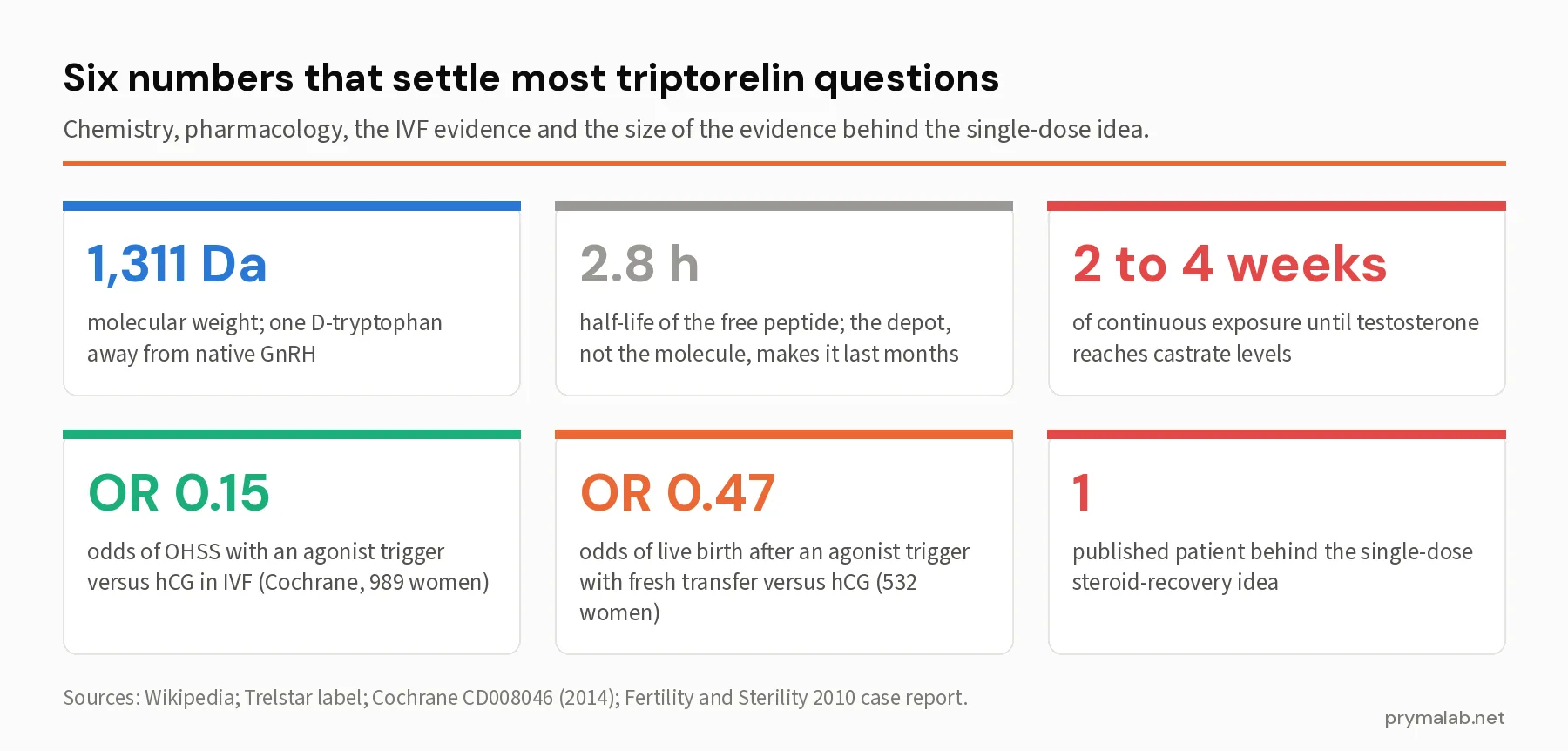
Triptorelin is D-Trp6-GnRH, 1,311 Da, native GnRH with a D-tryptophan at position 6 that resists breakdown and binds the pituitary GnRH receptor hard. Its half-life is about 2.8 hours; its depots release for one, three or six months. Continuous exposure desensitises the receptor: after a surge lasting days, testosterone falls to castrate levels within 2 to 4 weeks, reached by day 29 in 91 to 98% of men in the Trelstar trials. It is FDA-approved for advanced prostate cancer (2000) and central precocious puberty (Triptodur, 2017; LH suppressed in 93% of children at month 6), approved across Europe as Decapeptyl, and used in IVF, where a single agonist trigger cuts the odds of OHSS by 85% but lowers live birth after fresh transfer. The single-dose steroid-recovery idea rests on one 2010 case report. WADA names it under S2.2.1. Research use only.
Identity: pGlu-His-Trp-Ser-Tyr-D-Trp-Leu-Arg-Pro-Gly-NH2, C64H82N18O13, 1,311.47 g/mol, CAS 57773-63-4. Patented 1975, approved 1986; Schally's laboratory, licensed by Debiopharm in 1982.
Mechanism: Superagonist at the GnRH receptor. Days of surge, then downregulation; castrate testosterone within 2 to 4 weeks on the label. The depot, not the peptide, provides the months of exposure: 38% of the dose in 13 days, then about 0.9% per day.
Approved evidence: Trelstar: castration by day 29 in 91.2%, 97.7% and 97.5% for the three strengths, maintained in 93 to 96%. Triptodur: 44 children, LH at or below 5 IU/L in 93% at month 6 and 98% at month 12.
IVF: Continuous agonist exposure suppresses the premature LH surge. As a trigger: OHSS odds 0.15 versus hCG, but live birth odds 0.47 after fresh transfer; no difference in donor cycles (Cochrane 2014, 17 trials, 1,847 women).
The single-dose idea: One patient in Fertility and Sterility 2010: 13 years of steroids, months of hypogonadism, a single triptorelin stimulation test, testosterone 7 ng/mL at ten days. No controlled study since; repeated dosing suppresses.
Regulatory: Prescription drug in the US, Europe and beyond; WHO essential medicine alternative; WADA S2.2.1 in males, at all times; not on any US compounding list.
Status: research use only.
What triptorelin is: GnRH with one D-amino acid
Gonadotropin-releasing hormone is ten amino acids long, and in the hormone the sixth is a glycine. Triptorelin keeps nine of the ten and replaces that glycine with D-tryptophan, the mirror image of the natural amino acid: pGlu-His-Trp-Ser-Tyr-D-Trp-Leu-Arg-Pro-Gly-NH2, molecular formula C64H82N18O13, molecular weight 1,311.47 g/mol, CAS 57773-63-4.[1] Position 6 is where the native peptide bends and where serum proteases cut it, so a D-amino acid there does two things at once: it stabilises the bioactive shape and it blocks the cut. The result binds the pituitary GnRH receptor more tightly and survives in blood far longer than the hormone it copies.
It came out of Andrew Schally's laboratory at Tulane, the same group that had characterised GnRH itself; it was patented in 1975, licensed to Debiopharm in 1982 and approved for medical use in 1986.[1] Two salts are used. The acetate is the soluble, short-acting form and the form a research vial contains. The pamoate is a poorly soluble salt formulated into microparticle depots that release the peptide over months, and it is what the prostate-cancer and puberty products are made of. Brand names track the market: Trelstar and Triptodur in the United States, Decapeptyl from Ipsen and Diphereline and Gonapeptyl from Ferring in Europe, Salvacyl in the UK and Germany, Variopeptyl in Iran.[1] The World Health Organization lists it as a therapeutic alternative on its List of Essential Medicines.[1]
By the definition in the what counts as a peptide reference it is a peptide without qualification, and the gonadorelin reference covers the unmodified hormone it descends from. The two articles are two halves of one story, and the hinge is the rule that article establishes: pulsed GnRH stimulates, continuous GnRH suppresses. Triptorelin is that rule turned into a drug.
The flare, the shutdown, and why the depot matters more than the peptide
The Trelstar prescribing information states the mechanism in two sentences. Triptorelin initially causes a transient surge in LH, FSH and testosterone. After 2 to 4 weeks of continuous therapy a sustained decrease in these hormones occurs, achieving 'reduction of serum testosterone concentration to a level typically seen in surgically castrated men'.[2] That is the whole pharmacology, and both halves matter.
The surge is the agonist doing what an agonist does: it binds the receptor and the pituitary releases what it has. In a man with prostate cancer that surge can briefly feed the tumour, which is why the label warns of a 'transient increase in serum testosterone levels' in the first weeks and clinicians cover the flare with an anti-androgen.[2] The shutdown is the receptor's response to being occupied without a break: it downregulates and stops signalling, LH release falls, and the gonad, no longer instructed, stops making sex steroid. This is the 1978 monkey experiment described in the gonadorelin reference, run in reverse and on purpose.
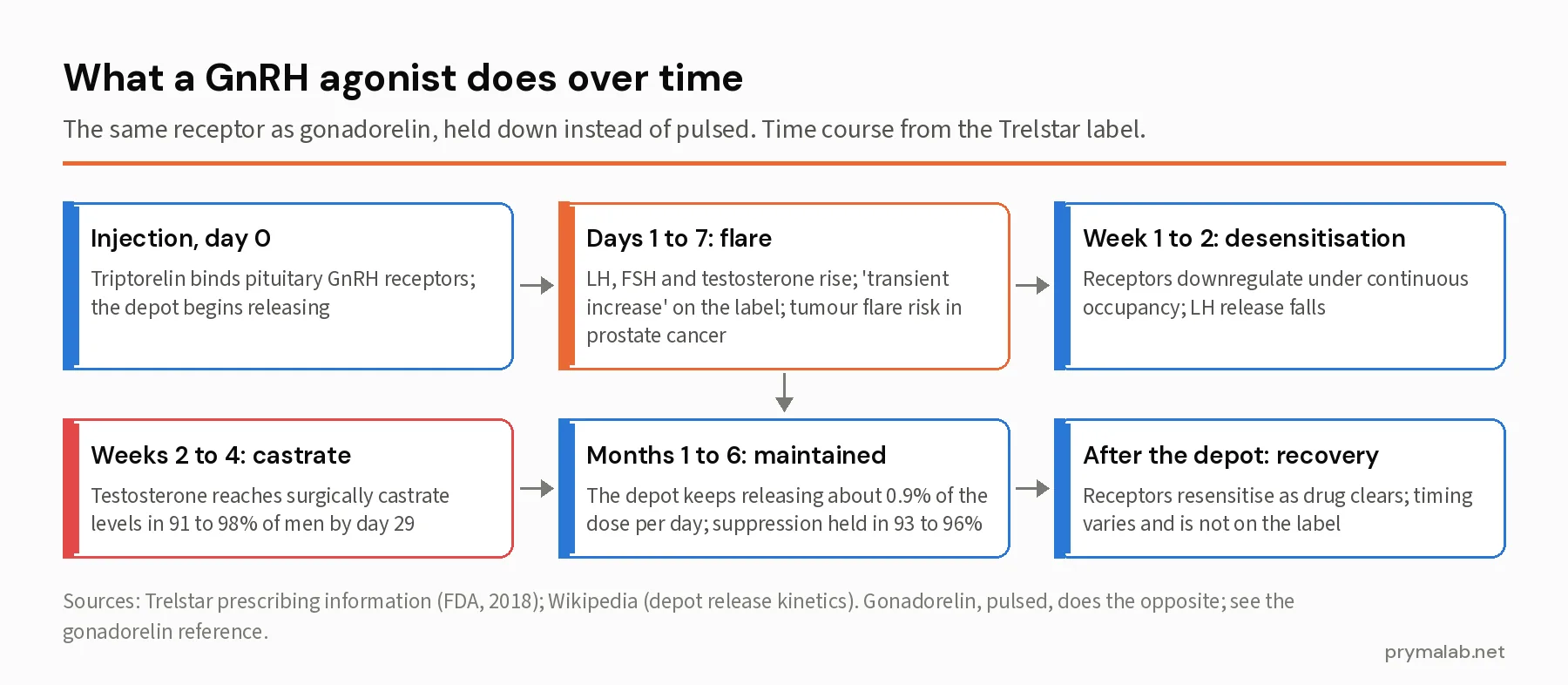
The peptide itself does not last long. After a subcutaneous dose, serum levels peak within 1 to 3 hours and the half-life in healthy volunteers is about 2.8 hours, rising to 6.6 to 7.7 hours with liver or kidney impairment; 41.7% is excreted unchanged by the kidney, and metabolism 'is unlikely to involve hepatic microsomal enzymes'.[2] What produces months of suppression is the depot: the pamoate microparticles release 38.3% of the dose in the first 13 days, about 2.9% a day, and then about 0.92% of the dose per day thereafter.[1] A 2.8-hour peptide becomes a six-month drug through formulation. A research vial of the acetate has none of that; it delivers the surge and clears.
The approved uses and what the trials showed
Triptorelin's evidence base is unusual for a compound in this library: it is a licensed drug with prescribing information written by regulators, and the numbers below are label facts about approved products given under medical supervision.
Advanced prostate cancer. Trelstar, first approved in the United States in 2000, is indicated for the palliative treatment of advanced prostate cancer as an intramuscular depot in three strengths. In the registration studies, testosterone reached castrate levels by day 29 in 91.2%, 97.7% and 97.5% of men across the three strengths, and stayed there through day 253 in 96.2% and 94.4% for the first two and through day 337 in 93.3% for the longest-acting depot.[2]
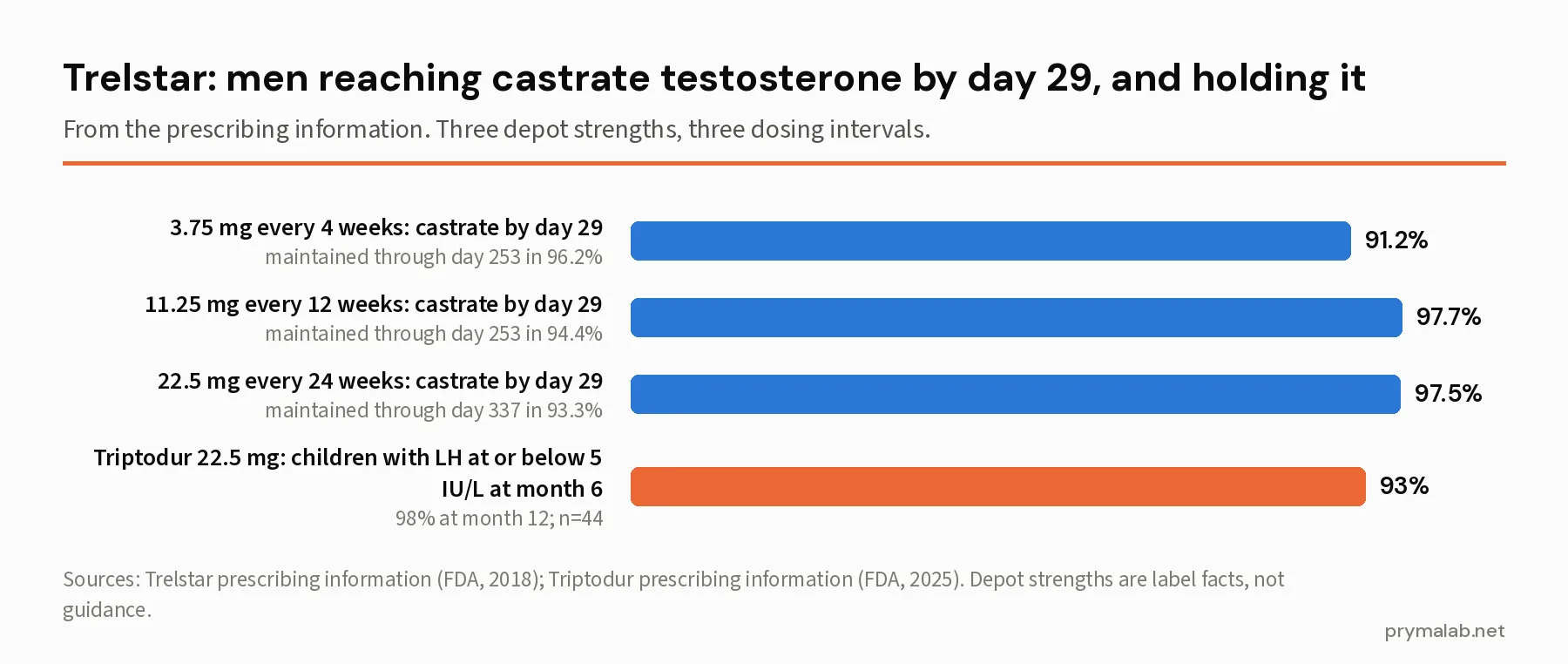
Central precocious puberty. Triptodur, a long-acting depot, is indicated for children aged 2 years and older with central precocious puberty, the condition in which the hypothalamic-pituitary axis switches on years too early. In its trial, 44 children aged 2 to 9 (39 girls, 5 boys) were treated; 93% had LH suppressed to prepubertal levels of 5 IU/L or below at month 6 and 98% at month 12.[3] The FDA approved it in 2017.[4] The label carries the same flare warning in paediatric form, 'a transient increase in clinical signs and symptoms of puberty, including vaginal bleeding', in the first weeks, and warnings for psychiatric events, convulsions and pseudotumor cerebri that apply to the GnRH-agonist class.[3]
Endometriosis, fibroids and the rest. European labels add endometriosis, reduction of uterine fibroids before surgery, and, for Salvacyl, hypersexuality with severe sexual deviation.[1] Triptorelin is also used off-label to suppress puberty or sex-hormone production in transgender care; that use sits outside this reference, which reports the licensed indications and their trial numbers.
| Product | Indication | Formulation | Key result |
|---|---|---|---|
| Trelstar (US, 2000) | Advanced prostate cancer | Intramuscular depot, three strengths | Castrate testosterone by day 29 in 91.2%, 97.7% and 97.5%; maintained in 96.2%, 94.4% and 93.3% |
| Triptodur (US, 2017) | Central precocious puberty, age 2 and up | Intramuscular depot | LH at or below 5 IU/L in 93% at month 6, 98% at month 12 (n=44) |
| Decapeptyl, Diphereline, Gonapeptyl (Europe) | Prostate cancer, endometriosis, fibroids, CPP, IVF | Acetate solution and depots | Standard of care for decades |
The IVF uses: suppression, and the agonist trigger
Two very different things are done with triptorelin in fertility medicine, and they illustrate the two-phase pharmacology better than anything else.
The first is suppression. In long-agonist IVF treatment the agonist is given continuously to shut the pituitary down so that a stimulated cycle cannot be spoiled by a premature LH surge, and studies have determined the smallest amount of triptorelin acetate that achieves this.[1] That is the downregulation phase, used deliberately.
The second is the opposite phase, used just as deliberately. In an antagonist cycle the pituitary has been kept responsive, and a single dose of agonist at the end of stimulation produces exactly the surge the label warns about: an endogenous LH peak that matures the eggs, in place of the hCG injection that has done that job for decades. Because the agonist-induced surge is short and hCG's is long, the agonist trigger nearly abolishes ovarian hyperstimulation syndrome. The 2014 Cochrane review pooled 17 randomised trials in 1,847 women: in fresh autologous cycles the agonist trigger cut the odds of OHSS to 0.15 (95% CI 0.05 to 0.47; 8 trials, 989 women), but it also lowered the odds of live birth to 0.47 (0.31 to 0.70; 5 trials, 532 women) and of ongoing pregnancy to 0.70 (0.54 to 0.91), because the short surge leaves the corpus luteum under-supported. In donor cycles there was no difference in live birth and far less OHSS. The reviewers' conclusion: the agonist trigger 'could be useful for women who choose to avoid fresh transfers, women who donate oocytes to recipients or women who wish to freeze their eggs'.[5]
Read the two uses together and you have the compound in miniature. One exposure: a surge. Continuous exposure: a shutdown. Same molecule.
The steroid-recovery idea, and the one patient behind it
Search for triptorelin outside the clinic and most of what comes back is a claim that a single injection 'restarts' the hypothalamic-pituitary-gonadal axis after a course of anabolic steroids. The claim has a source, and the source is worth reading in full, because it is a single case report.
In 2010, physicians at the University of Brescia published in Fertility and Sterility the case of a 34-year-old man who had used anabolic steroids bought on the internet for 13 years, in courses that included nandrolone, stanozolol, mesterolone, boldenone, clomiphene and hCG, and who presented with hypogonadotropic hypogonadism that had persisted for at least four months after stopping. As part of his work-up he received a single dose of triptorelin as a GnRH stimulation test. LH and FSH rose within minutes, his testosterone was 7 ng/mL ten days later, and it remained normal at three weeks.[6][7]
Three things follow from the pharmacology above. First, a single dose of any GnRH agonist produces the flare, so a rise in LH and testosterone after one injection is the expected response of a working pituitary, not evidence of a lasting reset; the case report's own value was diagnostic. Second, I could not find a controlled study of triptorelin for steroid-induced hypogonadism in the sixteen years since, in any population, so the idea has never moved past n=1. Third, and most important, the same molecule given repeatedly does the opposite of what the steroid-recovery idea intends: continuous agonist exposure downregulates the receptor and suppresses testosterone to castrate levels within 2 to 4 weeks, which is precisely what it is licensed to do.[2] Repeating the dose 'to be sure' moves the exposure to the second box on the timeline, not the first. The peptides for men overview and the gonadorelin reference cover the axis in more detail; nothing in either supports the myth.
What the labels say about safety
Triptorelin's adverse effects are, for the most part, the intended effect experienced as symptoms: they are what castrate testosterone does to a man or what paused puberty does to a child. On the Trelstar label the most common adverse reactions are hot flushes (58.6% to 73.0% across the three strengths), skeletal pain (12.1% to 13.2%), impotence or erectile dysfunction (7.1% to 10.0%) and, at the six-month strength, testicular atrophy (7.5%).[2] The warnings are the class warnings for androgen deprivation: the transient testosterone rise in the first weeks and the tumour flare it can cause; QT prolongation; hyperglycaemia and an increased risk of diabetes; and increased cardiovascular risk including myocardial infarction and stroke.[2]
The paediatric label adds warnings that are specific to suppressing a developing axis: a transient increase in pubertal signs including vaginal bleeding in the first weeks; psychiatric events, with 'symptoms of emotional lability, such as crying, irritability, impatience, anger, and aggression' reported; post-marketing reports of convulsions with GnRH agonists; and pseudotumor cerebri, with instructions to monitor for headache, papilloedema, blurred vision and vision loss. The most common adverse reactions in the Triptodur trial were injection-site reactions, menstrual or vaginal bleeding, hot flush, headache, cough and infections.[3] The general warning in the Wikipedia summary, which lists anaphylaxis, mood changes, depression, ovarian cysts and changes in blood pressure among reported effects, is consistent with the labels.[1]
None of this is a safety record for research-grade acetate, for which no human data exist; it is the record of a prescription depot in patients who needed their axis switched off.
Triptorelin vs the other GnRH analogues, and vs gonadorelin
Every GnRH agonist on the market is native GnRH with a D-amino acid at position 6 and, usually, a change at the C-terminus. Leuprolide has D-leucine at 6 and an ethylamide replacing the terminal glycinamide; goserelin has D-serine(tBu) at 6 and an azaglycine at 10; buserelin, histrelin, nafarelin and deslorelin follow the same pattern with different substitutions. Triptorelin is the one whose only change is the D-tryptophan at 6.[1] They differ in potency and in the depot technologies built around them, and they share the pharmacology: flare, then suppression, in men and women and children alike. Nafarelin is worth naming because it is the approved nasal GnRH agonist, used to suppress the axis in endometriosis and precocious puberty; no triptorelin nasal product is approved anywhere, and no human pharmacokinetics exist for intranasal triptorelin at research-market strengths.
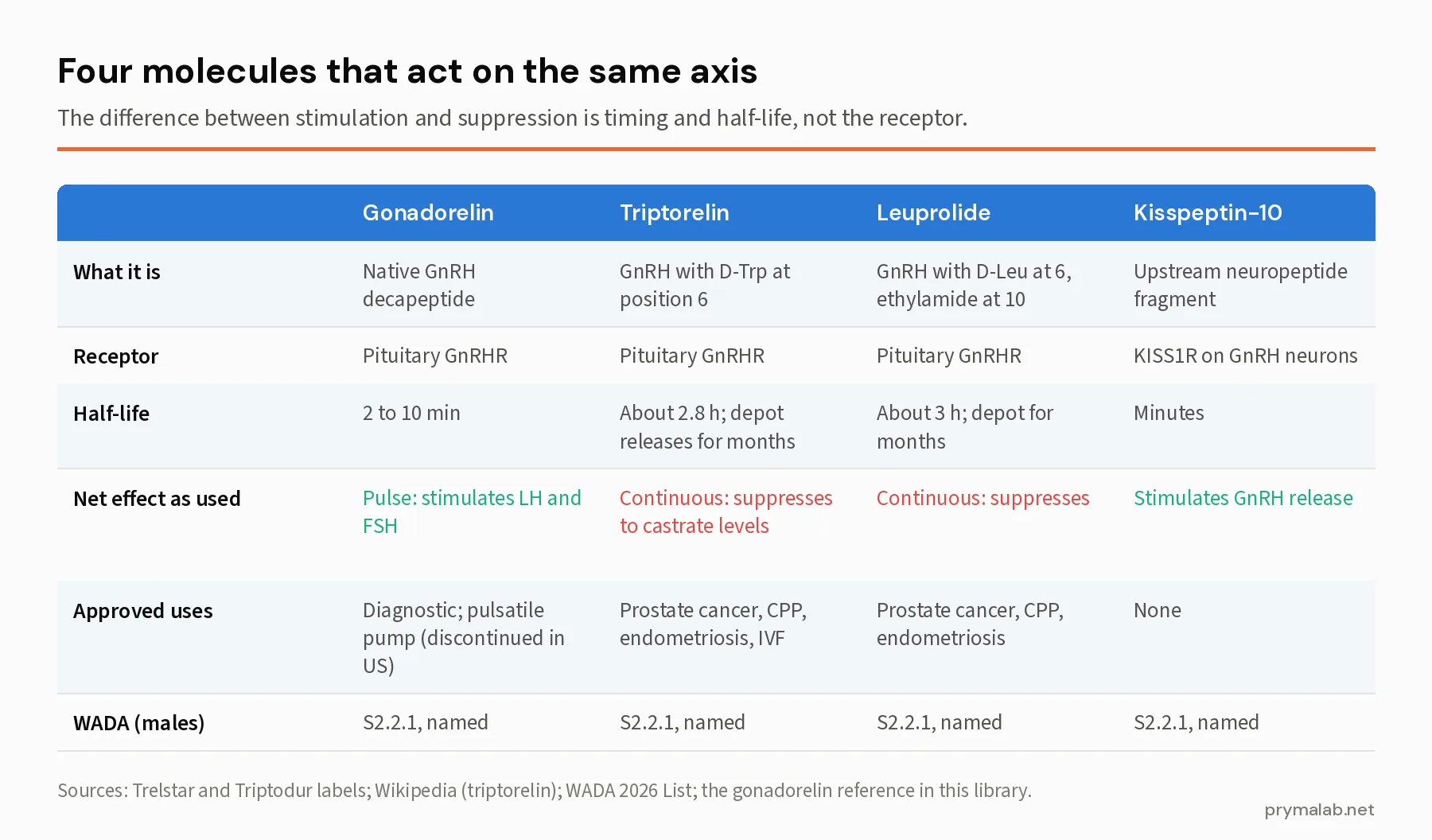
The GnRH antagonists, ganirelix, cetrorelix, degarelix and the oral elagolix and relugolix, block the receptor outright and suppress without a flare, which is why they have taken over parts of IVF and, in degarelix and relugolix, parts of prostate cancer. Kisspeptin-10 acts one step upstream, on the neurons that release GnRH, and the kisspeptin reference covers it. hCG acts one step downstream, on the gonad, and is what triptorelin's trigger replaces; the hCG guide covers that side.
| Molecule | Change from native GnRH | Type | Approved nasal form | Long-acting formulations |
|---|---|---|---|---|
| Gonadorelin | None | Native agonist; pulses stimulate | No (1977 study only) | None; pump or single dose |
| Triptorelin | D-Trp at 6 | Superagonist; continuous use suppresses | No | 1-, 3- and 6-month depots |
| Leuprolide | D-Leu at 6; ethylamide at 10 | Superagonist | No | 1-, 3-, 4- and 6-month depots |
| Goserelin | D-Ser(tBu) at 6; azaglycine at 10 | Superagonist | No | 1 or 3 months (implant) |
| Nafarelin | D-Nal(2) at 6 | Superagonist | Yes (Synarel) | Nasal spray |
| Degarelix | Multiple substitutions | Antagonist; no flare | No | 1-month depot |
Where triptorelin stands: an approved drug, a WADA-listed substance, a research compound
Triptorelin is an approved prescription drug in the United States, across Europe and in most of the world, which makes it different from almost every other compound in this library and changes what 'research use' means. An approved product is what a patient receives; research-grade acetate in a vial is the same peptide without the pharmaceutical manufacturing, the depot formulation, the label or the prescriber, and it is legal to sell and hold for laboratory research and not for human use. The legal status guide sets out that framework. Triptorelin is not on FDA's 503A or 503B bulk-substance lists because it does not need to be: approved products exist.
For athletes the position is explicit. The 2026 WADA Prohibited List names it in S2.2.1, testosterone-stimulating peptides in males: 'gonadotrophin-releasing hormone (GnRH, gonadorelin) and its agonist analogues (e.g. buserelin, deslorelin, goserelin, histrelin, leuprorelin, nafarelin and triptorelin)', prohibited at all times.[8] The listing is written for the flare, since a single dose stimulates testosterone; it applies regardless of which phase a user intends.
Research-grade triptorelin: what to verify
Triptorelin is an easy peptide to verify and a hard one to misread. Identity is by mass spectrometry against the 1,311.5 Da parent; the D-tryptophan does not change the mass, so a chiral method or a certificate stating the D-configuration at position 6 is what distinguishes triptorelin from a mis-synthesised all-L peptide, which would be a weak, short-lived agonist rather than a superagonist. Purity is by HPLC by lot, and net peptide content matters because the acetate counter-ion and water add mass. The purity testing guide covers each of these. PrymaLab's 2 mg vial, autoinjector and nasal spray are documented on that basis; ask the same of any supplier, and ask them which salt they are selling, because a research vial should be the acetate and a listing that describes pamoate depot pharmacology is describing a product it does not contain.
Handling is simpler than for gonadorelin. The D-amino acid gives triptorelin a serum half-life of hours rather than minutes, and the lyophilised acetate keeps for months refrigerated or frozen; reconstituted solution should be refrigerated and used within weeks. The peptide calculator converts a 2 mg vial and its diluent into a concentration for bench work, and the storage guide covers the general practice.
The version of the story the record supports: a one-residue variant of GnRH that binds hard and lasts, engineered into depots that hold the reproductive axis off for months; forty years of licensed use in prostate cancer, precocious puberty, endometriosis and IVF with the numbers to show for it; a receptor whose response depends entirely on whether the signal has gaps; and a research-market belief in a single-dose reset that traces to one patient and contradicts the drug's own label.
Stability and degradation in solution
Triptorelin is chemically sturdy in the right solution and vulnerable at a few known residues. Helm and Müller studied gonadorelin and triptorelin in aqueous solution across pH, temperature, buffer species, buffer concentration and ionic strength, using stability-indicating HPLC methods (Helm et al. 1990). The two peptides degraded in similar ways. Both were most stable at about pH 5, acetate had the most favorable effect, phosphate caused more degradation (more so at higher phosphate concentration), and ionic strength had no significant influence (Helm et al. 1990). In acetate buffer at pH 5 with mannitol, the predicted t90 at 20 °C was 9.0 years for gonadorelin and 7.7 years for triptorelin (Helm et al. 1990). For native GnRH, Hahn and colleagues found no appreciable loss of activity after four weeks in solution at 4 °C or at room temperature (Hahn et al. 1987).
Hoitink and colleagues located the degradation of triptorelin, buserelin and goserelin at a small number of residues. The L-serine was involved in both a solvent-catalyzed backbone hydrolysis and a hydroxyl-catalyzed epimerization, and identical reactions ran at broadly comparable rates in the different analogues (Hoitink et al. 1998). Epimerization yields a product of the same mass, which matters for identity testing by mass spectrometry. Triptorelin's two tryptophans add an oxidation route. In a hydrogen peroxide model, Simat and Steinhart found the pyrrole moiety of tryptophan the most susceptible part, with oxindolylalanine and N-formylkynurenine the main identified products, and found that short peptides lost tryptophan faster than the protein lysozyme (Simat et al. 1998).
What this article does not settle
Single-dose recovery after steroids. One case report, no controlled study, and a pharmacology that predicts the opposite on repeat dosing. The article reports the case; it does not endorse the inference.
Intranasal triptorelin. No approved nasal product and no published human pharmacokinetics; nafarelin is the nasal GnRH agonist with a label.
Recovery time after a depot. The labels describe suppression, not the interval to normal function after the last injection, which varies and is not stated.
Long-term outcomes of puberty suppression outside central precocious puberty. Outside this reference's scope; the labels cover CPP and nothing else.
Live birth after an agonist trigger with modern luteal support. The 2014 Cochrane figures predate some current practice; the OHSS result has held up, the live-birth penalty may have narrowed.
What is well established: the sequence, mass and salts; the flare-then-suppression mechanism and its 2 to 4 week time course; the depot release kinetics; the Trelstar and Triptodur registration results; the Cochrane trigger figures; the WADA listing; and the size of the evidence behind the single-dose idea.
Triptorelin, D-Trp6-GnRH, Trelstar and Decapeptyl: what the names refer to
Triptorelin is the international non-proprietary name; the 'trip' is for tryptophan and the '-relin' suffix marks a releasing-hormone analogue. D-Trp6-GnRH, D-Trp6-LHRH and [D-Trp6]-GnRH all describe the structure: gonadotropin-releasing hormone with D-tryptophan at position 6; LHRH, luteinising hormone-releasing hormone, is the older name for the same native hormone.[1] Triptorelin acetate and triptorelin pamoate (or embonate) are the two salts, the first a soluble solution form and the second the poorly soluble salt used in depot suspensions. Trelstar and Triptodur are the United States brands, for prostate cancer and central precocious puberty; Decapeptyl (Ipsen) and Diphereline and Gonapeptyl (Ferring) are the European brands; Salvacyl and Variopeptyl are national brands.[1] 'Trip' is research-market shorthand. None of the names denotes a different peptide.
The breast cancer use: ovarian suppression, and what the trials showed
The indication least discussed in research-chemical contexts is the one with the largest randomised evidence base. In premenopausal women with hormone-receptor-positive disease, shutting down ovarian oestrogen production is a treatment strategy in its own right, and a GnRH agonist is how it is done reversibly. The TEXT trial gave triptorelin to every participant as ovarian function suppression, in both the exemestane and the tamoxifen arm, though participants could switch to oophorectomy or ovarian irradiation after at least six months. Its companion SOFT trial is more often cited than read: the 2015 primary analysis did not show a significant benefit for adding suppression to tamoxifen overall, with five-year disease-free survival of 86.6 against 84.7 per cent and a hazard ratio of 0.83 that crossed one. The benefit appeared in the higher-risk group who had received prior chemotherapy, and it reached significance overall only in the eight-year update published in 2018. That is endocrine hormone therapy in the oncological sense, and the mechanism is the same shutdown this article describes throughout.
A second use in the same population is ovarian protection. Giving a GnRH agonist during chemotherapy has been studied as a way to reduce premature ovarian insufficiency afterwards, on the reasoning that quiescent follicles are less vulnerable to cytotoxic damage. The clearest positive result, POEMS, used goserelin rather than triptorelin and reported ovarian failure in 8 against 22 per cent with more pregnancies in the treated group. The triptorelin trial, PROMISE-GIM6, found only nine against four post-treatment pregnancies with a hazard ratio whose interval crossed one, and its own authors describe the fertility-preservation data as controversial. Menstrual recovery and fertility are not the same endpoint and the trials separate on exactly that point.
Both uses depend on the same pharmacology. Continuous exposure downregulates the pituitary GnRH receptor, luteinizing hormone and follicle-stimulating hormone output collapses, and the gonad loses its signal. Luteinizing hormone releasing hormone is the older name for GnRH itself and the reason this class still appears in the literature as LHRH agonists. Follicle-stimulating hormone suppression matters clinically as well: it is the FSH arm that drives follicular recruitment, so both have to fall for ovarian suppression to be complete.
What the labels list, and how each group of findings was collected
Because approved products exist, a real adverse reaction table exists, which is the main thing separating this compound from most of the catalogue. Reading it usefully means knowing which findings are mechanism and which are rare events.
The mechanism group is predictable from hypogonadism and accounts for most of what patients report. In men on androgen deprivation: hot flashes, reduced libido, erectile dysfunction, fatigue, and falling bone mineral density over time. In women and in girls treated for central precocious puberty: flushing, mood change, and vaginal bleeding in the first weeks as oestrogen falls, which the labelling addresses directly. Administration-site reactions are common across all presentations.
The flare group belongs to the first fortnight. Testosterone rises above baseline during the first week before declining to baseline or below by the end of the second, and in men with advanced prostate cancer that transient rise can worsen bone pain, urinary obstruction or spinal cord compression. Labels direct that anti-androgen cover be considered for those weeks. Bone pain in this context is a flare phenomenon rather than a chronic side effect.
The metabolic and cardiovascular group comes from long-term androgen deprivation rather than from the peptide. Labels warn about hyperglycaemia and new-onset diabetes, and about increased risk of myocardial infarction and sudden cardiac death, with monitoring directed for both. That warning is why chest pain and shortness of breath appear in patient counselling material for this class: they are symptoms a patient is told to report, not adverse reactions attributed to the drug molecule.
The hypersensitivity group is rare and serious. Allergic reactions including anaphylaxis and angioedema are described, as are hives and rash, and severe cutaneous reactions including Stevens-Johnson syndrome and toxic epidermal necrolysis have been reported for the class. Fever, vomiting, dizziness and constipation appear in the adverse reaction tables at lower frequencies. Pituitary apoplexy has been reported rarely after a first dose in patients with an undiagnosed pituitary adenoma.
Seizures deserve their own line because the warning is explicit and often missed. Labelling for the paediatric extended-release presentation reports post-marketing cases in patients with and without a history of epilepsy, cerebrovascular disorders, central nervous system anomalies or tumours, and in patients on medications associated with seizures. It is a warning rather than a reported frequency, and it applies to a monitored prescription product.
One correction worth making, since it circulates widely: swollen glands appear in patient-facing summaries of this class but not in the approved adverse reaction lists for Trelstar, Triptodur or Decapeptyl. If that is the symptom that brought someone here, the labels do not support attributing it to the drug.
Pregnancy, breastfeeding and drug interactions
Pregnancy is the clearest boundary on the label. European labelling describes a theoretical risk of abortion or foetal abnormality rather than an observed pattern of birth defects, United States labelling states the drug may cause foetal harm, and both direct that pregnancy be excluded before treatment starts. Lactation is handled differently on either side of the Atlantic, which is worth knowing precisely. The United States labels for Trelstar and Triptodur state there are no data on the presence of triptorelin in human milk and leave the choice between stopping breastfeeding and stopping the drug to a benefit-risk judgement. European and Canadian Decapeptyl labelling goes further and lists lactation as a contraindication, without reference to milk excretion either way.
Formal drug interactions are thin, and the label wording is more specific than the summaries. Trelstar states plainly that no drug-drug interaction studies involving it have been conducted. Separately, it states that hepatic microsomal enzymes are unlikely to be involved in triptorelin metabolism, because the C-terminal fragments produced by tissue degradation are either broken down within tissues, degraded further in plasma, or cleared by the kidneys. Those are two statements rather than one: the absence of interaction studies is not presented as a consequence of cytochrome P450 independence.
Two pharmacodynamic points are explicit. Hyperprolactinaemic drugs should not be used concomitantly, and the stated reason is that hyperprolactinaemia itself reduces the number of pituitary GnRH receptors, which is a prohibition rather than a caution. And androgen deprivation with this drug may prolong the QT interval, with prescribers directed to weigh benefit against risk in patients taking other QT-prolonging drugs; in United States labelling that sits in Warnings and in the European summary of product characteristics it sits under interactions. Trelstar Depot, a legacy United States brand name now consolidated into Trelstar in three strengths, carries the same warnings as the current presentations.
None of this transfers to a research preparation. Every finding above was collected from a licensed depot product, in monitored patients, under a label specifying dose, route, monitoring and contraindications. A solution of the peptide has no label, no monitoring framework and no adverse reaction table, and the absence of one is not an absence of risk.
Frequently asked questions
What is triptorelin?
A GnRH analogue with D-tryptophan at position 6 (1,311 Da) that binds the pituitary receptor strongly and, given continuously, suppresses LH, FSH and sex steroids. Approved for prostate cancer, precocious puberty, endometriosis and IVF.
Does triptorelin increase or decrease testosterone?
Both: a surge for the first days, then suppression to castrate levels within 2 to 4 weeks of continuous exposure. That suppression is the approved use.
What is the difference between triptorelin and gonadorelin?
Gonadorelin is native GnRH, lasts minutes, and stimulates when pulsed. Triptorelin has one D-amino acid, lasts hours, comes in months-long depots, and suppresses. Same receptor, opposite result.
Is triptorelin a post cycle therapy?
The idea rests on one 2010 case report (one patient, one stimulation test). No controlled study exists, the single-dose LH rise is the normal flare, and repeated dosing suppresses testosterone.
What is triptorelin approved for?
US: advanced prostate cancer (Trelstar, 2000) and central precocious puberty (Triptodur, 2017). Europe adds endometriosis, fibroids, IVF and, as Salvacyl, hypersexuality with severe sexual deviation.
How is triptorelin used in IVF?
Continuous exposure suppresses the pituitary in long-agonist IVF treatment; a single dose at the end of an antagonist cycle triggers egg maturation, cutting OHSS odds to 0.15 versus hCG but lowering live birth after fresh transfer (odds 0.47).
What are the side effects of triptorelin?
Hot flushes (59 to 73%), skeletal pain, impotence, testicular atrophy, plus label warnings for the initial flare, QT prolongation, hyperglycaemia and cardiovascular events; in children, emotional lability, convulsions and pseudotumor cerebri.
What is the half-life of triptorelin?
About 2.8 hours for the peptide. The months of effect come from the pamoate depot, which releases 38% of the dose in 13 days and about 0.9% a day thereafter.
Is triptorelin banned by WADA?
Yes: named in S2.2.1 of the 2026 list with gonadorelin and the other GnRH agonists, prohibited at all times in males.
Triptorelin acetate vs pamoate: what is the difference?
Same peptide, different salt. Acetate is the soluble short-acting form found in research vials; pamoate is the poorly soluble salt used in months-long pharmaceutical depots.
How do I verify a triptorelin sample?
Mass spectrometry against 1,311.5 Da for the sequence, plus a certificate stating the D-Trp6 configuration (mass alone cannot show it), HPLC purity by lot, net peptide content and the salt.
Is triptorelin used in breast cancer?
Yes, as ovarian function suppression in premenopausal women with hormone-receptor-positive disease. TEXT gave triptorelin to every participant alongside exemestane or tamoxifen. SOFT is more nuanced than usually reported: its 2015 primary analysis was not significant overall, with benefit in the prior-chemotherapy group, and significance overall arrived only with the 2018 eight-year update. For ovarian protection during chemotherapy, the positive POEMS trial used goserelin, while the triptorelin trial PROMISE-GIM6 found no significant pregnancy difference.
What are the commonest side effects on the approved labels?
The ones predictable from hypogonadism: hot flashes, reduced libido, erectile dysfunction, fatigue and falling bone mineral density in men; flushing, headache, mood change and early vaginal bleeding in women and girls. Administration-site reactions are common across presentations. Fever, vomiting, dizziness and constipation appear at lower frequencies.
Why do chest pain and shortness of breath appear in the safety information?
Because labels warn about increased risk of myocardial infarction, sudden cardiac death and stroke with long-term androgen deprivation, alongside hyperglycaemia and new-onset diabetes. Those are symptoms a patient is told to report rather than adverse reactions attributed to the peptide itself, and the risk comes from the hormonal state rather than from the molecule.
Do the labels warn about seizures?
Yes. Labelling for the paediatric extended-release presentation reports post-marketing cases in patients with and without a history of epilepsy, cerebrovascular disorders, central nervous system anomalies or tumours, and in patients on medications associated with seizures. It is a warning rather than a reported frequency.
What about pregnancy, nursing and interactions with other drugs?
European labelling describes a theoretical risk of abortion or foetal abnormality rather than an observed pattern of birth defects, United States labelling says the drug may cause foetal harm, and both direct that pregnancy be excluded first. On lactation the labels differ: United States labelling reports no data on triptorelin in human milk and leaves the choice between stopping breastfeeding and stopping the drug to a benefit-risk judgement, while European and Canadian Decapeptyl labelling contraindicates lactation outright. Trelstar states that no drug-drug interaction studies have been conducted, and separately that hepatic microsomal enzymes are unlikely to be involved in its metabolism; hyperprolactinaemic drugs should not be used concomitantly because hyperprolactinaemia reduces pituitary GnRH receptor numbers.
Are swollen glands a known side effect?
Not according to the labels. Swollen glands appear in patient-facing summaries of this class but not in the approved adverse reaction lists for Trelstar, Trelstar Depot, Triptodur or Decapeptyl. Allergic reactions including anaphylaxis, angioedema and hives are listed, as are Stevens-Johnson syndrome and toxic epidermal necrolysis, all rarely.
References
- Wikipedia. Triptorelin. Sequence, formula, mass, CAS, salts, brands, indications, history (patent 1975, approval 1986, Debiopharm licence 1982), depot release kinetics, IVF suppression dose, WHO essential-medicines status and reported adverse effects. Wikipedia
- US Food and Drug Administration. Trelstar (triptorelin pamoate for injectable suspension) prescribing information, 2018 revision. Indication, strengths and intervals, mechanism, pharmacokinetics, castration rates, warnings and adverse reactions. FDA (PDF)
- US Food and Drug Administration. Triptodur (triptorelin) extended-release injectable suspension prescribing information, 2025 revision. Indication, 22.5 mg every 24 weeks, trial results in 44 children, warnings and adverse reactions. FDA (PDF)
- Healio. FDA approves extended-release triptorelin for central precocious puberty. 12 July 2017. Healio
- Youssef MAFM, Van der Veen F, Al-Inany HG, et al. Gonadotropin-releasing hormone agonist versus HCG for oocyte triggering in antagonist-assisted reproductive technology. Cochrane Database Syst Rev. 2014;(10):CD008046. 17 trials, 1,847 women; OHSS OR 0.15; live birth OR 0.47; ongoing pregnancy OR 0.70. Cochrane
- Anabolic steroids purchased on the Internet as a cause of prolonged hypogonadotropic hypogonadism. Fertil Steril. 2010. PMID 20416868. University of Brescia; single case report with a 100 mcg triptorelin stimulation test. PubMed
- Ergo-Log. Single dose of triptorelin gets bodybuilder's hormones going again. Secondary summary of the 2010 case report: steroid history, the 100 mcg dose, testosterone 7 ng/mL at ten days, normal at three weeks. Ergo-Log
- World Anti-Doping Agency. The 2026 Prohibited List, International Standard. S2.2.1 wording naming triptorelin among GnRH agonist analogues; prohibited at all times. WADA
Figures come from FDA prescribing information, the Cochrane review, the published case report and its secondary summary, and the WADA list, current to 23 September 2026. Where a figure comes from a secondary summary rather than the primary paper, the reference says so.
Final disclaimer: This article is an educational research reference on the chemistry, pharmacology, approved uses and regulatory status of triptorelin. Compounds supplied by PrymaLab are sold for laboratory research use only and are not approved by any regulator for human or veterinary use. Statements have not been evaluated by the FDA. Nothing here is medical advice or a treatment claim.
Label regimens, trial results and the case report are reported as design facts about approved prescription products given under medical supervision, and do not describe or support any use of research-grade material. Triptorelin is prohibited for male athletes at all times under the World Anti-Doping Code. Always verify the legal status of any research compound in your jurisdiction before purchase or use.