15% fall discount applied automatically at checkoutFree USA shipping over $100Free worldwide shipping over $200Credit/debit checkout disabled for updates
Sign in 0

GKP BLEND 70MG

(19 customer reviews)

$109.99 or subscribe for $92.99/mo

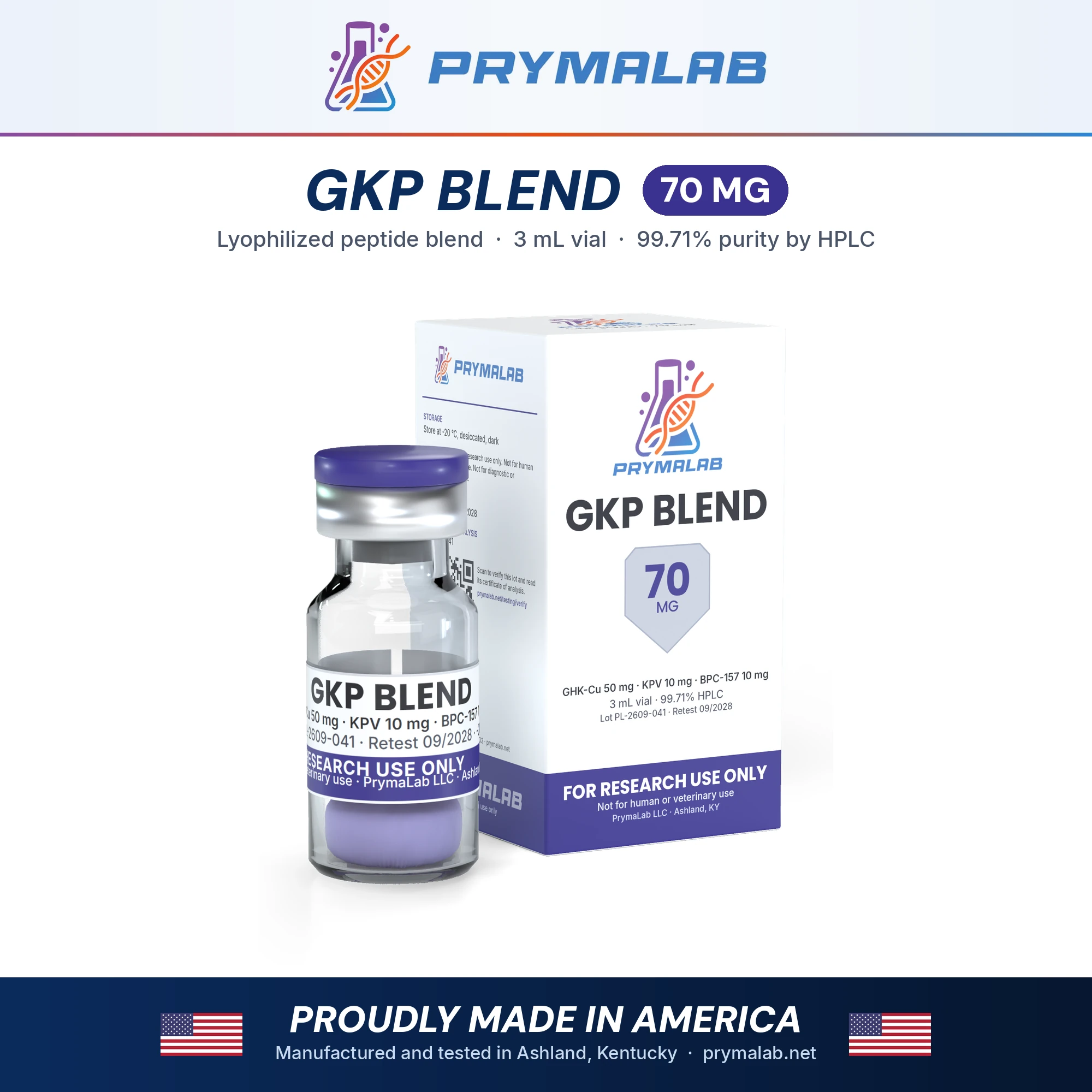
GKP BLEND 70MG is a synergistic peptide formulation combining GHK-CU copper peptide (50mg) for collagen synthesis and tissue remodeling, BPC-157 (10mg) for accelerated healing and gut protection, and KPV (10mg) for powerful anti-inflammatory effects. This research-grade blend offers comprehensive support for tissue repair, wound healing, skin rejuvenation, and inflammatory modulation through complementary mechanisms of action.

Description

PrymaLab · Research Use Only

GKP Blend 70mg

GHK-Cu 50mg + BPC-157 10mg + KPV 10mg · Three targets, three literatures

GKP Blend 70mg is a lyophilized three-component research vial containing GHK-Cu at 50mg, BPC-157 at 10mg and KPV at 10mg. The three compounds are structurally unrelated: a copper-coordinated tripeptide, a fifteen-residue gastric peptide fragment, and a melanocortin-derived tripeptide. Each has a separate published literature base.

Specification Table

GKP Blend 70mg verified chemical and handling data
Property Value
Product format Lyophilized powder, single vial
Total peptide content 70 mg
Component 1 GHK-Cu, 50 mg
Component 2 BPC-157, 10 mg
Component 3 KPV, 10 mg
CAS (blend) Not applicable. Multi-component mixture; component numbers listed separately
CAS, GHK-Cu 89030-95-5
CAS, BPC-157 137525-51-0
CAS, KPV 67727-97-3
Molecular formula, GHK-Cu C14H22CuN6O4
Molecular formula, BPC-157 C62H98N16O22
Molecular formula, KPV C16H30N4O4
Molecular weight, GHK-Cu 401.91 g/mol
Molecular weight, BPC-157 1419.55 g/mol
Molecular weight, KPV 342.43 g/mol
Sequence, GHK-Cu Gly-His-Lys, copper(II) complex
Sequence, BPC-157 Gly-Glu-Pro-Pro-Pro-Gly-Lys-Pro-Ala-Asp-Asp-Ala-Gly-Leu-Val
Sequence, KPV Lys-Pro-Val
Alternative designations GHK-Cu: copper tripeptide-1, prezatide copper. KPV: α-MSH(11-13)
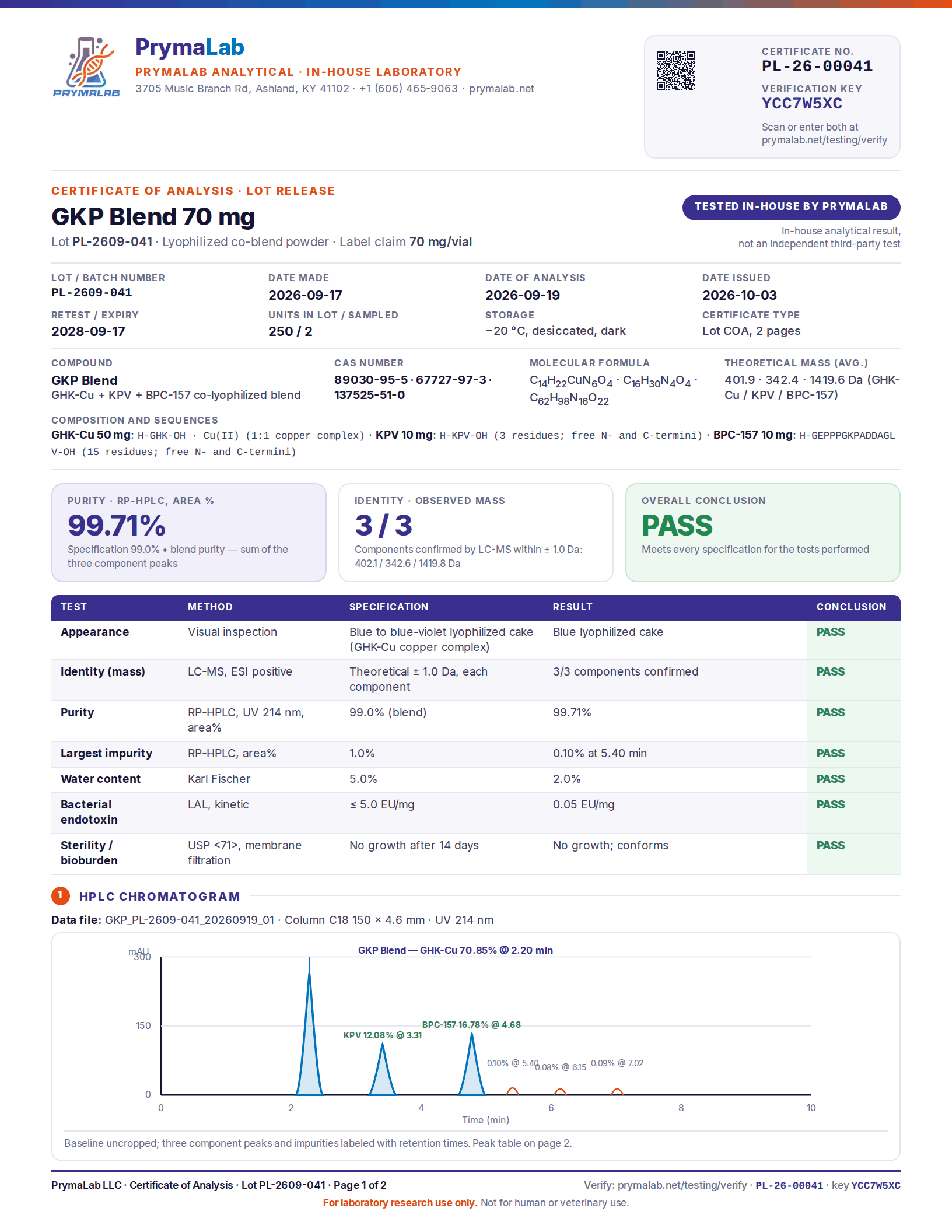
Appearance Blue to blue-violet lyophilized cake, from copper(II) coordination in GHK-Cu
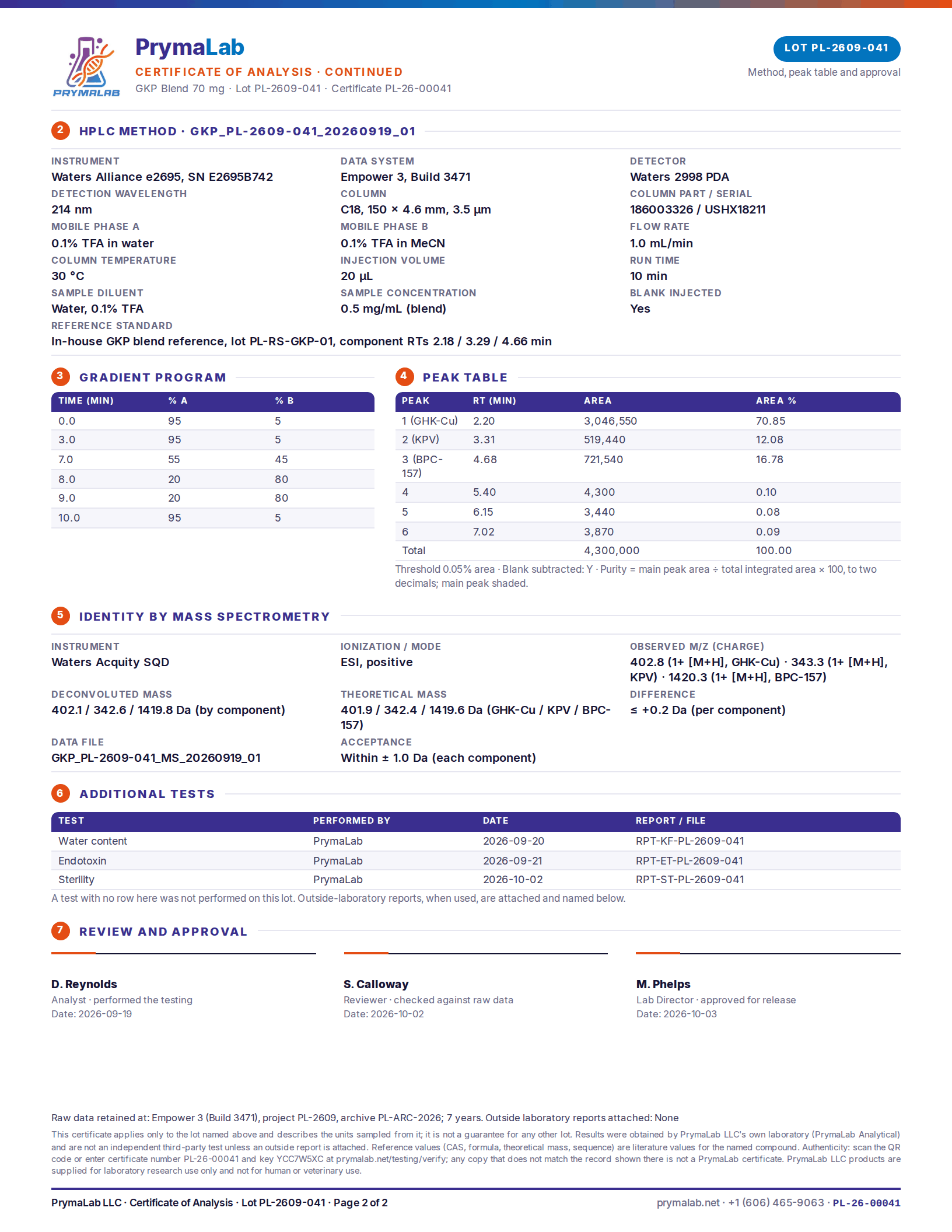
Purity Per lot-specific certificate of analysis
Solubility Soluble in bacteriostatic water and sterile water
Storage, lyophilized -20°C, protected from light and moisture
Storage, reconstituted 2-8°C, protected from light
Reconstituted stability Not established for this blend. Component data does not transfer to mixtures
Regulatory status No approved human or veterinary formulation for any component

Molecular Targets and Named Pathways

The three components act on distinct, separately characterised targets. This is the mechanistic basis for supplying them together rather than a claim about combined effect.

GHK-Cu is a tripeptide with high affinity for copper(II). Maquart and colleagues reported that it stimulated collagen synthesis in cultured dermal fibroblasts across a concentration range of 10-12 to 10-9 M, with maximal activity near 10-9 M and no accompanying change in cell number (Maquart et al., FEBS Letters, 1988). A control tripeptide, L-glutamyl-L-histidyl-L-proline, was inactive in the same assay. That comparison matters: it indicates the activity depends on the specific sequence and its copper coordination, not on copper delivery alone.

BPC-157 is a fifteen-residue partial sequence of a protein found in human gastric juice. Hsieh and colleagues characterised its association with vascular endothelial growth factor receptor 2. In human vascular endothelial cells, it increased VEGFR2 mRNA and protein expression without increasing VEGF-A, promoted VEGFR2 internalisation, and produced time-dependent activation of the VEGFR2-Akt-eNOS axis (Hsieh et al., Journal of Molecular Medicine, 2017).

KPV corresponds to residues 11 through 13 at the C-terminus of alpha-melanocyte-stimulating hormone. Dalmasso and colleagues examined its uptake through PepT1 (SLC15A1), the di- and tripeptide transporter expressed in small intestine and induced in colonic tissue during inflammation. Using NF-κB luciferase reporter assays in Caco2-BBE, HT29-Cl.19A and Jurkat lines, they reported reduced NF-κB activation and that the effect was PepT1-dependent (Dalmasso et al., Gastroenterology, 2008).

What Does the 50/10/10 Ratio in GKP Blend 70mg Represent?

The vial contains GHK-Cu at 50mg, BPC-157 at 10mg and KPV at 10mg, summing to the stated 70mg. GHK-Cu accounts for roughly 71 percent of total peptide mass. On a molar basis the imbalance is larger still, because GHK-Cu has a molecular weight of 401.91 against 1419.55 for BPC-157. Fifty milligrams of GHK-Cu is approximately 124 µmol. Ten milligrams of BPC-157 is approximately 7 µmol.

That is roughly an eighteen-fold molar excess of GHK-Cu over BPC-157, and about a four-fold excess over KPV at 29 µmol. Any study design using this vial should account for the molar ratio rather than the mass ratio, since receptor occupancy and enzyme kinetics scale with molar concentration. Researchers comparing this blend against single-component vials will need to normalise accordingly.

Why Are GHK-Cu and KPV Studied Together?

Search interest in the GHK-Cu and KPV pairing is consistent, and the mechanistic reasoning is straightforward: the two compounds sit on opposite sides of the same tissue process. GHK-Cu has been characterised as increasing extracellular matrix protein synthesis. KPV has been characterised as suppressing NF-κB-driven inflammatory signalling.

Pickart and Margolina reviewed gene expression data indicating that GHK modulates a broad set of human genes, including those governing collagen and glycosaminoglycan synthesis, antioxidant response, and the balance between matrix metalloproteinases and their tissue inhibitors (Pickart and Margolina, International Journal of Molecular Sciences, 2018). Kannengiesser and colleagues reported that KPV reduced colonic damage scores and inflammatory cytokine levels in two separate murine colitis models (Kannengiesser et al., Inflammatory Bowel Diseases, 2008).

What has not been published is a controlled study of the two used together. The pairing is mechanistically coherent. It is not, at present, empirically validated as a combination.

What Has Been Reported for GHK-Cu and BPC-157 in the Same Model?

Very little, and researchers arriving from that query should know it up front. Each compound has an independent body of work. BPC-157 has been studied extensively in rodent tendon, muscle and gastrointestinal models, with Sikiric and colleagues publishing a wide-ranging review of the gastrointestinal work (Sikiric et al., Current Pharmaceutical Design, 2011). Chang and colleagues reported that BPC-157 accelerated outgrowth from rat Achilles tendon explants, increased tendon fibroblast survival under hydrogen peroxide stress, and increased fibroblast migration in a transwell assay in a concentration-dependent manner (Chang et al., Journal of Applied Physiology, 2011).

GHK-Cu has its own literature, centred on dermal fibroblasts and matrix biology. The two lines of work rarely intersect. A search of the indexed literature returns no controlled head-to-head or combination study of GHK-Cu with BPC-157 in a shared model system. This is an open question rather than a settled one, and it is a legitimate reason to work with a combination vial: characterising the interaction is itself the experiment.

What Is Known About Combination Effects, and What Is Not?

Known: each component has a named molecular target, a measured concentration range in at least one published in vitro system, and independent replication across multiple laboratories.

Not known: whether the three compounds interact when present together. Whether copper(II) from the GHK-Cu component affects the stability of the other two peptides in solution. Whether PepT1-mediated uptake of KPV is altered in the presence of a copper-coordinated tripeptide, given that PepT1 transports a broad range of di- and tripeptides and competition is plausible. Whether the 50/10/10 mass ratio is optimal for anything, or was selected for formulation convenience.

That last point deserves emphasis. Published ratio-optimisation data for this specific combination does not exist. Any researcher treating the 50/10/10 split as an evidence-based ratio is reading more into it than the literature supports.

Sequence composition does support one inference. Copper-catalysed oxidation preferentially attacks cysteine, methionine, tryptophan, tyrosine and histidine, and neither BPC-157 nor KPV contains a single one of those five residues. BPC-157 runs Gly-Glu-Pro-Pro-Pro-Gly-Lys-Pro-Ala-Asp-Asp-Ala-Gly-Leu-Val. KPV is three residues, Lys-Pro-Val. So on composition grounds both should be less vulnerable to copper-mediated oxidation than most peptides would be in the same vial, which is reassuring but falls a long way short of an actual stability measurement.

How Should Component Contributions Be Separated?

Three peptides in one vial means three possible sources for any observed effect, plus their interactions. The blend alone cannot attribute an effect to a component, and no amount of careful measurement on the blend will change that.

Single-component arms are the direct answer. GHK-Cu, BPC-157 and KPV are each available separately, and a design running them individually alongside the blend allows the combined effect to be compared against the sum of the parts. That comparison is the only way to distinguish additive behaviour from interaction.

Copper handling deserves a dedicated control. Because GHK-Cu carries copper(II) and the other two components do not, any copper-dependent effect will track with the GHK-Cu arm and could be mistaken for peptide activity. A copper salt control at matched molar copper concentration separates the tripeptide contribution from the metal contribution, and this control is frequently omitted.

Order of addition matters in a way that is easy to overlook. Adding components sequentially to a culture rather than as a premixed solution can produce different behaviour, particularly where transporter competition is plausible. Since PepT1 carries a broad range of di- and tripeptides, KPV uptake in the presence of another small peptide is not something to assume is unaffected.

Reconstitution and Storage in Laboratory Practice

Standard practice for lyophilized peptide preparations applies. Diluent is introduced slowly against the vial wall rather than directed onto the lyophilized cake, and the vial is swirled gently until the solution clears. Vigorous agitation is avoided because mechanical shear can degrade peptides in solution.

Copper-coordinated peptides warrant additional care. Copper(II) complexes are light-sensitive and can participate in redox chemistry that generates reactive oxygen species, so amber vials or foil wrapping are common laboratory practice. Chelating agents such as EDTA in a buffer will compete for the copper and can disrupt the GHK-Cu complex, which is worth checking before selecting a buffer system.

Records should capture lot number, diluent identity and volume, preparation date, final concentration, and storage conditions. This matters more here than for a single compound. Without contemporaneous notes, a variable introduced by any one of the three components cannot be isolated afterward, and no amount of later analysis will recover it. Discard any solution showing cloudiness, particulate matter, or a shift away from the expected blue-violet. Log it.

Published Literature

Full citations for every study named above, each indexed and independently verifiable. Nothing appears on this list that was not first confirmed against the publisher record or a primary index.

  1. Maquart FX, Pickart L, Laurent M, Gillery P, Monboisse JC, Borel JP. FEBS Letters. 1988;238(2):343-346. DOI: 10.1016/0014-5793(88)80509-X
  2. Pickart L, Margolina A. International Journal of Molecular Sciences. 2018;19(7):1987. PMID: 29986520
  3. Chang CH, Tsai WC, Lin MS, Hsu YH, Pang JH. Journal of Applied Physiology. 2011;110(3):774-780. PMID: 21030672
  4. Sikiric P, Seiwerth S, Rucman R, et al. Current Pharmaceutical Design. 2011;17(16):1612-1632. PMID: 21548867
  5. Hsieh MJ, Liu HT, Wang CN, et al. Journal of Molecular Medicine. 2017;95(3):323-333. DOI: 10.1007/s00109-016-1488-y
  6. Dalmasso G, Charrier-Hisamuddin L, Nguyen HT, Yan Y, Sitaraman S, Merlin D. Gastroenterology. 2008;134(1):166-178.
  7. Kannengiesser K, Maaser C, Heidemann J, et al. Inflammatory Bowel Diseases. 2008;14(3):324-331. DOI: 10.1002/ibd.20334

Frequently Asked Questions

What is GKP Blend 70mg?

GKP Blend 70mg is a laboratory research vial containing three peptides: GHK-Cu at 50mg, BPC-157 at 10mg and KPV at 10mg. The components are chemically unrelated and act on separate molecular targets. It is supplied lyophilized for in vitro and preclinical research use only, and is not approved for human or veterinary use.

What does GKP stand for?

GKP is a supplier designation built from the component initials: GHK-Cu, KPV, and the Peptide BPC-157. It carries no chemical meaning. The abbreviation does not appear anywhere in the peer-reviewed literature, so searching PubMed or Scopus for GKP will return nothing relevant to this vial. Search the individual component names instead.

What is the difference between GKP 70 and a GHK-Cu single vial?

A GHK-Cu single vial contains one compound. GKP Blend 70mg contains GHK-Cu plus BPC-157 and KPV, with GHK-Cu making up 50mg of the 70mg total. Researchers isolating GHK-Cu activity should use the single-component vial, because the blend introduces two additional variables that cannot be separated afterward.

Are GHK-Cu and KPV studied together in the published literature?

Not in controlled combination studies. Both have independent literature bases: GHK-Cu in matrix protein synthesis and fibroblast biology, KPV in NF-kappa-B suppression and PepT1-mediated uptake. The pairing is mechanistically reasonable, since one is characterised as building matrix and the other as suppressing inflammatory signalling. No published study has tested them together.

What target does each component act on?

GHK-Cu coordinates copper(II). Published work reports stimulation of collagen synthesis in cultured dermal fibroblasts at picomolar to nanomolar concentrations, with the effect depending on the specific sequence rather than on copper delivery alone. BPC-157 has been associated with increased VEGFR2 expression and with time-dependent activation of the VEGFR2-Akt-eNOS axis. KPV enters cells through the PepT1 di- and tripeptide transporter, where it has been reported to suppress NF-kappa-B activation. Three targets. Three separate literature bases.

Why does the powder look blue?

The blue to blue-violet colour comes from copper(II) coordination in the GHK-Cu component, which makes up roughly 71 percent of the vial contents by mass. This is expected for a copper-complexed peptide. A marked shift away from that colour in a reconstituted solution suggests degradation or a buffer interaction and should be logged and the solution discarded.

Is the 50/10/10 ratio based on published data?

No. No ratio-optimisation study exists for this combination. The split should be treated as a formulation choice, not an evidence-derived ratio. Note also that mass ratio and molar ratio diverge sharply here: 50mg of GHK-Cu is roughly 124 micromoles against roughly 7 micromoles for 10mg of BPC-157, an eighteen-fold molar excess.

What storage conditions apply?

Lyophilized material is held at -20 degrees Celsius, protected from light and moisture. Reconstituted solution is held at 2 to 8 degrees Celsius and protected from light, with additional care warranted because copper(II) complexes are light-sensitive. Reconstituted stability for this specific blend has not been established, and single-component stability data should not be assumed to transfer to a mixture.

Can this be used in human or veterinary research?

No. GKP Blend 70mg is supplied strictly for laboratory research use, and none of its three components has an approved human or veterinary formulation anywhere in the world. It is not a drug, food, or cosmetic product, and under no circumstance should it be given to humans or animals. Purchase is restricted to qualified research settings.

What documentation should accompany experiments using this vial?

Lot number, diluent identity and volume, preparation date, final concentration, storage conditions, and observed appearance. Multi-component vials make retrospective troubleshooting harder than single-compound preparations, because a variable introduced by any one component cannot be isolated later without contemporaneous records.

How should the three component contributions be separated?

With single-component arms run alongside the blend. GHK-Cu, BPC-157 and KPV are each available separately, and comparing the combined effect against the sum of the individual effects is the only way to distinguish additive behaviour from interaction. The blend alone cannot attribute an effect to a component.

Why include a copper salt control?

Because GHK-Cu carries copper(II) and the other two components do not, any copper-dependent effect will track with the GHK-Cu arm and could be mistaken for peptide activity. A copper salt control at matched molar copper concentration separates the tripeptide contribution from the metal contribution. It is frequently omitted.

Compliance Statement

GKP Blend 70mg is sold exclusively for laboratory research use. It is not a drug, food, or cosmetic product, and it is not a dietary product of any kind. It is not approved by the FDA or any comparable authority for human or veterinary use. This product is not intended to diagnose, treat, cure, or prevent any disease. It must not be given to humans or animals. Purchase is restricted to qualified researchers and institutions operating within applicable laws. All handling is the responsibility of the purchasing laboratory.

Other formats of GKP BLEND

GKP BLEND is also stocked as GKP BLEND 70mg/ml preloaded 3ml pen. Each listing states its own quantity and concentration, and the pen and vial comparison explains what changes between formats.

Additional information

Weight N/A
Dimensions N/A

19 reviews for GKP BLEND 70MG

  1. Spencer Sanders
    August 2, 2026
    Tested good
    Had this order sent off to Janoshik for testing and it just came back with a perfect on the endotoxin testing and a purity of 99.97%. I will be shoppi...More
    Had this order sent off to Janoshik for testing and it just came back with a perfect on the endotoxin testing and a purity of 99.97%. I will be shopping here from now on, no vendor that I trust has better pricing.
    Helpful? 0 0
    Damon Gray
    August 2, 2026
    Thanks.
    Shipping was slow but everything came as it should.
    Helpful? 0 0
    Paula Harper
    August 1, 2026
    quality on point!
    test came back 99.71%. Will be back fs
    Helpful? 0 0
    Beverly Jones
    August 1, 2026
    Already seeing results!
    Shipping was slow but after only a week I am already seeing amazing results. Thank you.
    Helpful? 0 0
    Curtis Harper
    July 30, 2026
    will be back
    thanks
    Helpful? 0 0
    Brandon Owens
    July 12, 2026
    Best source ive found
    So happy i found this place.
    Helpful? 0 0
    Beverly Powell
    July 11, 2026
    Legit...
    Cannot recommend enough.
    Helpful? 0 0
    Sophia Berry
    July 8, 2026
    My new go to!
    Repeat customer here. The quality is exactly what i was hoping for, consistent and pure. Also most companies overcharge for the same thing but the pri...More
    Repeat customer here. The quality is exactly what i was hoping for, consistent and pure. Also most companies overcharge for the same thing but the pricing here beat everyone else i checked.
    Helpful? 0 0
    Maria Kim
    July 6, 2026
    Super impressed!
    Happy with the order. Quality was there fasho.
    Helpful? 0 0
    Tara West
    July 1, 2026
    Blown away honestly
    Honestly cant complain at all. The quality is exactly what i was hoping for. Also other brands packaging shows up crushed but this came double boxed w...More
    Honestly cant complain at all. The quality is exactly what i was hoping for. Also other brands packaging shows up crushed but this came double boxed with ice packs. These guys got a customer for life.
    Helpful? 0 0
    Grant Thomas
    July 1, 2026
    Def worth it
    happy wit the order. No real issues with the product. Will def order again. just wish shipping was faster
    Helpful? 0 0
    Karen Weaver
    June 25, 2026
    10/10 would buy again
    First time ordering and im impressed. Everything showed up perfect and sealed. I switched over after corepeptides sent the powder wus half melted but ...More
    First time ordering and im impressed. Everything showed up perfect and sealed. I switched over after corepeptides sent the powder wus half melted but the lyophilized powder here was a perfect intact puck. You can tell the difference when a company actually cares. Cant wait for my next order.
    Helpful? 0 0
    Janet Harrison
    June 24, 2026
    went smoothly
    Honestly cant complain at all. Everything arrived as expected and I feel amazing. Thank you.
    Helpful? 0 0
    Marie Collins
    June 16, 2026
    Love you guys ❤️
    Wont be buying from anywhere else. Tested 3 products from pryma through janoshik myself, all came back 99.96+ pure, swiss chems only came back 96 at t...More
    Wont be buying from anywhere else. Tested 3 products from pryma through janoshik myself, all came back 99.96+ pure, swiss chems only came back 96 at the highest.
    Helpful? 0 0
    Craig Gomez
    June 12, 2026
    Perfect
    Packaging an product were both on point. Keep it up guys.
    Helpful? 0 0
    Janet Harrison
    June 8, 2026
    no issues
    u can tell they actually care about what they send out.
    Helpful? 0 0
    Denise Turner
    June 2, 2026
    Repeat customer for life!
    I used to order from penguin peptides but I kept getting vials that were sealed bad and leaked but every vial here was sealed perfect. Gonna be my mai...More
    I used to order from penguin peptides but I kept getting vials that were sealed bad and leaked but every vial here was sealed perfect. Gonna be my main source from now on for sure. Much love
    Helpful? 0 0
    Edward Berry
    May 14, 2026
    very pleased
    Good stuff no doubt.
    Helpful? 0 0
    Eric Smith
    April 3, 2026
    Legit and high quality!
    Ordered again an its the same great quality.
    Helpful? 0 0

Only logged in customers who have purchased this product may leave a review.

Peptide Research Articles

Bacteriostatic water depiction

Bacteriostatic Water Peptide Science: Why It Matters in Reconstitution & Research

Bacteriostatic water peptide science is the foundation of safe, accurate peptide reconstitution. This 2026 guide covers bacteriostatic water composition, how to reconstitute peptides using a peptide reconstitution calculator and peptide dosage calculator, bacteriostatic water vs sterile water differences, peptide storage best practices, and a 10-step reconstitution protocol. Expert insights from PrymaLab.

wolverine blend article vial

Peptides for Injury Recovery: The Wolverine Stack Peptide Guide (BPC-157 + TB-500)

The Wolverine stack peptide combines BPC-157 and TB-500 for research into tendon, ligament, and joint recovery. This 2026 guide covers BPC-157 peptide where to buy responsibly, BPC 157 peptide side effects, peptides for tendon repair, peptides for joint recovery, peptides for elbow pain, and the BPC-157 TB-500 peptide blend scientific research. Expert insights from PrymaLab.

are peptides healthy

Are Peptides Good for You? A Complete 2026 Guide

Are peptides good for you? This comprehensive 2026 guide explores peptide therapy benefits, safety, side effects, and how peptides work in the body. Learn about peptide health benefits, research findings, and what you need to know before considering peptide therapy. Expert insights from PrymaLab.

Ovagen peptide capsules for liver health with dosage cycling chart showing 10-20 day protocols repeated 2-3 times per year

Ovagen Peptide Guide: Uses, Research, Safety & Buying Info

Ovagen peptide is a short-chain liver bioregulator developed at the St. Petersburg Institute of Bioregulation and Gerontology under Professor Vladimir Khavinson. It contains the AC-3 peptide complex (glutamic acid and aspartic acid) designed to target hepatocyte gene expression for liver cell repair, bile production, and detoxification. This guide covers dosing protocols, cycling schedules, side effects, a head-to-head comparison with NAC, milk thistle, TUDCA, and BPC-157, cost analysis ($120-360 per year), and how to verify genuine Ovagen products online.

GHK-Cu peptide vial and syringe with dosage chart showing injection protocols for skin rejuvenation and hair growth

GHK-Cu Peptide: Benefits, Dosage, Side Effects & Complete Research Guide (2026)

GHK-Cu peptide is a naturally occurring copper tripeptide that modulates over 4,000 human genes involved in collagen synthesis, wound healing, and tissue regeneration. This comprehensive guide covers injection dosage protocols, clinical research on skin rejuvenation and hair growth, side effects, safety data, and how to reconstitute GHK-Cu 50mg vials. Includes dosage charts, comparison tables, and 10 frequently asked questions answered by a peptide research specialist.

Sermorelin dosage guide for anti-aging muscle growth and weight loss showing GHRH analog pituitary stimulation

Sermorelin Dosage Guide 2025: Complete Protocol for Anti-Aging, Muscle Growth & Weight Loss

Sermorelin acetate is a growth hormone-releasing hormone (GHRH) analog that stimulates natural GH production from the pituitary gland. This comprehensive dosage guide covers protocols for anti-aging, muscle growth, weight loss, and sleep optimization — along with side effects, before-and-after timelines, and comparisons to HGH and ipamorelin.

Customer reviews

4.89
Based on 19 reviews
5
89%
17
4
11%
2
3
0%
0
2
0%
0
1
0%
0
1 2
Spencer Sanders
August 2, 2026
Tested good
Had this order sent off to Janoshik for testing and it just came back with a perfect on the endotoxin testing and a purity of 99.97%. I will be shoppi...More
Had this order sent off to Janoshik for testing and it just came back with a perfect on the endotoxin testing and a purity of 99.97%. I will be shopping here from now on, no vendor that I trust has better pricing.
Helpful? 0 0
Damon Gray
August 2, 2026
Thanks.
Shipping was slow but everything came as it should.
Helpful? 0 0
Paula Harper
August 1, 2026
quality on point!
test came back 99.71%. Will be back fs
Helpful? 0 0
Beverly Jones
August 1, 2026
Already seeing results!
Shipping was slow but after only a week I am already seeing amazing results. Thank you.
Helpful? 0 0
Curtis Harper
July 30, 2026
will be back
thanks
Helpful? 0 0
Brandon Owens
July 12, 2026
Best source ive found
So happy i found this place.
Helpful? 0 0
Beverly Powell
July 11, 2026
Legit...
Cannot recommend enough.
Helpful? 0 0
Sophia Berry
July 8, 2026
My new go to!
Repeat customer here. The quality is exactly what i was hoping for, consistent and pure. Also most companies overcharge for the same thing but the pri...More
Repeat customer here. The quality is exactly what i was hoping for, consistent and pure. Also most companies overcharge for the same thing but the pricing here beat everyone else i checked.
Helpful? 0 0
Maria Kim
July 6, 2026
Super impressed!
Happy with the order. Quality was there fasho.
Helpful? 0 0
Tara West
July 1, 2026
Blown away honestly
Honestly cant complain at all. The quality is exactly what i was hoping for. Also other brands packaging shows up crushed but this came double boxed w...More
Honestly cant complain at all. The quality is exactly what i was hoping for. Also other brands packaging shows up crushed but this came double boxed with ice packs. These guys got a customer for life.
Helpful? 0 0
Grant Thomas
July 1, 2026
Def worth it
happy wit the order. No real issues with the product. Will def order again. just wish shipping was faster
Helpful? 0 0
Karen Weaver
June 25, 2026
10/10 would buy again
First time ordering and im impressed. Everything showed up perfect and sealed. I switched over after corepeptides sent the powder wus half melted but ...More
First time ordering and im impressed. Everything showed up perfect and sealed. I switched over after corepeptides sent the powder wus half melted but the lyophilized powder here was a perfect intact puck. You can tell the difference when a company actually cares. Cant wait for my next order.
Helpful? 0 0
1 2
24/7 Online support

support@prymalab.net info@prymalab.net

Money back guarantee

30 Day return window. Satisfaction guaranteed or your money back.

FREE shipping and return

All orders over %150 in value will receive free shipping.