
Description
PrymaLab · Research Use Only
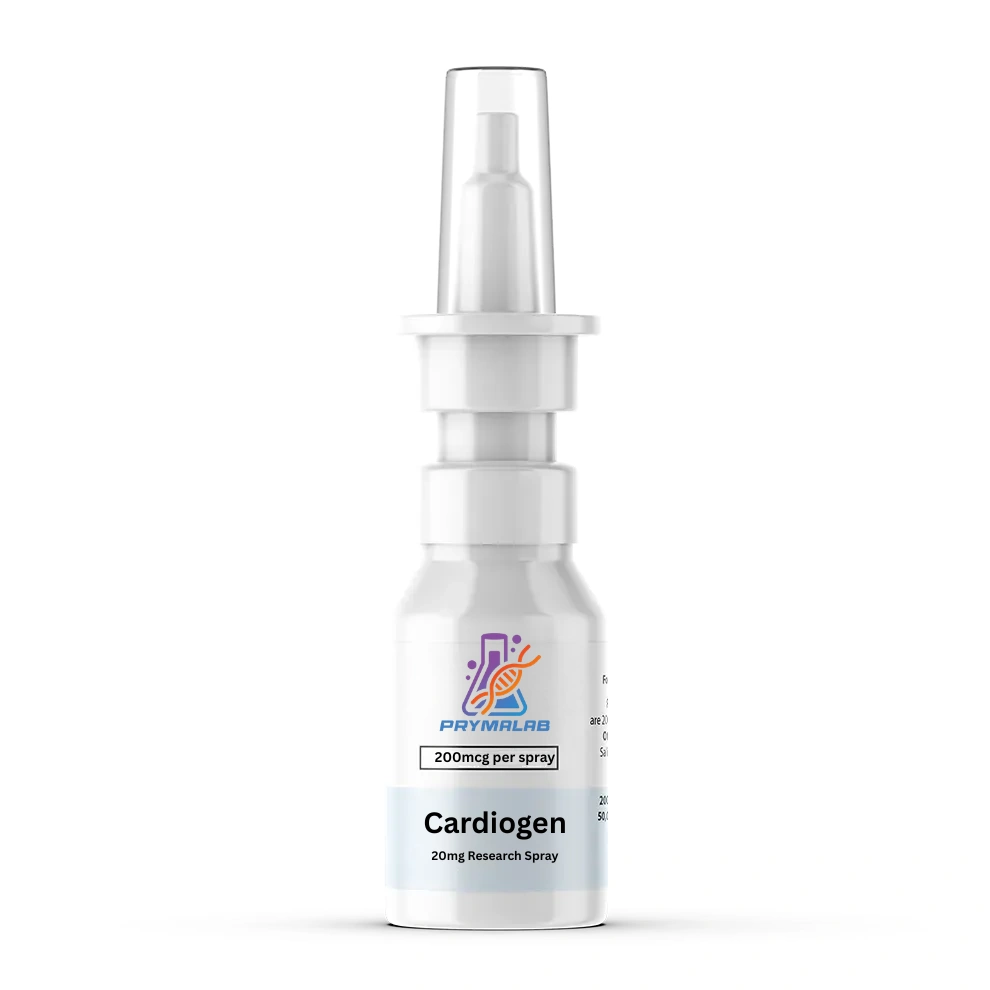
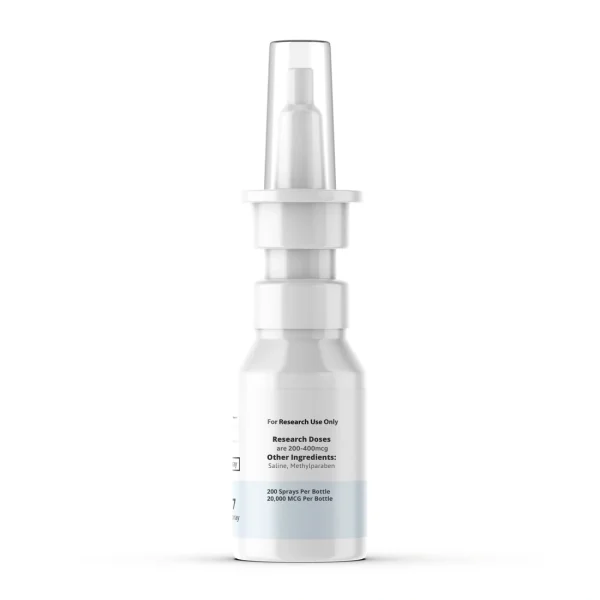
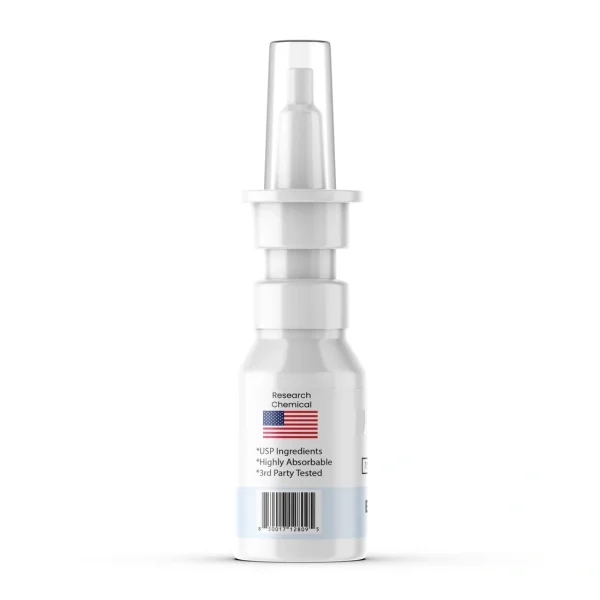
Cardiogen Nasal Spray
Ala-Glu-Asp-Arg tetrapeptide · 489.5 Da · the only cationic bioregulator
Cardiogen nasal spray supplies the tetrapeptide Ala-Glu-Asp-Arg in a metered aqueous solution at roughly 489.5 daltons. Its arginine is the only strongly basic residue anywhere in this compound family, and that single difference changes how the molecule behaves at every surface it meets.
Specification Table
| Property | Value |
|---|---|
| Compound | Cardiogen |
| Sequence designation | AEDR |
| Amino acid sequence | Alanine-Glutamate-Aspartate-Arginine |
| Sequence provenance | Secondary sources, converging. Not traced to a single primary citation. Confirm against the lot certificate before relying on it for calculation |
| Residue count | 4 |
| Molecular weight, calculated | Approximately 489.5 g/mol, computed from standard residue masses plus water |
| Position in the family | Heaviest of the sixteen bioregulators |
| Terminal residue | Arginine, guanidinium pKa near 12.5 |
| Net charge at neutral pH | Positive. The arginine stays charged across every realistic buffer condition |
| Truncation relative | Pinealon (Glu-Asp-Arg) is this compound minus its alanine |
| Chromophore | None. Concentration cannot be determined by 280 nm absorbance |
| Oxidation-prone residues | None |
| Also listed as | Cardiogen-20mg, Cardiogen peptide, AEDR |
| Not to be confused with | Etripamil (Cardamyst), an approved nasal spray for PSVT, and Cardiogen-82, a rubidium generator used in cardiac PET imaging |
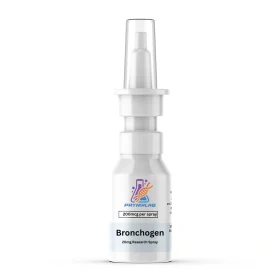
| Format | Metered nasal spray, solution state |
| Physical state | Aqueous solution, supplied ready to use |
| Purity | Per lot-specific certificate of analysis |
| Storage | 2-8°C, protected from light. Do not freeze |
| Regulatory status | No approved human or veterinary formulation in any jurisdiction |
Why Is Cardiogen Nasal Spray the Only Cationic Bioregulator?
Sixteen compounds make up this family and fifteen of them are anionic or near neutral. This is the exception.
Arginine carries a guanidinium group with a pKa near 12.5, which is far enough above physiological pH that the residue stays protonated under every condition a laboratory realistically uses.
Against the two acidic residues in the middle of the sequence, that single strongly basic group is enough to tip the molecule to a net positive charge.
Lysine appears elsewhere in the family, in Vilon, Livagen, Prostamax and Testagen. But always alongside two acidic residues that cancel it to near neutrality.
Only here does a basic residue win outright, and only Pinealon shares that property since it is this compound minus its alanine.
The consequence shows up at surfaces rather than in solution chemistry. It runs in both useful and unhelpful directions.
Mucosal surfaces carry a net negative charge, largely from sialic acid residues and sulfated glycans in the mucus layer.
A cationic molecule binds that layer electrostatically where an anionic one passes it by, which is the single most consequential difference between this compound and its fifteen relatives in a nasal format.
Is Mucoadhesion an Advantage or a Problem?
The honest answer is that it is both, and which dominates depends on what the experiment is measuring.
Binding to the mucus layer increases residence time at the epithelial surface. Material that would otherwise be cleared by mucociliary transport within minutes stays put longer.
Longer residence means more opportunity for transport across the epithelium. That is the argument in favour.
Against that, material bound to mucus is not material crossing the epithelium. Electrostatic binding to a glycan is a dead end unless the molecule releases again.
Mucociliary clearance also carries the mucus itself toward the throat over roughly fifteen to twenty minutes, so bound material is transported away rather than held indefinitely.
Which effect dominates for a given molecule is an empirical question, and it has not been answered for this compound.
What can be said is that this is the only member of the family for which the question arises at all, since the other fifteen do not bind meaningfully.
That makes this compound the natural comparator in any study asking whether mucoadhesion helps or hinders transnasal delivery of short peptides, and the family supplies fifteen matched controls.
One design point follows from this that is worth stating for anyone planning that comparison.
The fifteen non-binding family members are matched on size, on residue chemistry and on proposed mechanism, differing from this compound essentially in charge alone.
Matched controls of that quality are rare. They exist here because the compounds were designed as permutations of a shared core rather than as independent molecules.
A study running this compound against two or three anionic relatives at matched molar concentration would isolate the charge variable more cleanly than most formulation work manages.
What Does the Arginine Do Inside the Bottle?
The same charge that drives mucosal binding acts on container surfaces, and there it is unambiguously unhelpful.
Glass carries a negative surface charge from ionised silanol groups. That is why cationic species adsorb to it readily.
That effect is well documented for basic peptides and it operates at exactly the low concentrations a nasal spray delivers.
Untreated glass is therefore the worst container choice for this compound, and silanised or low-binding surfaces are meaningfully better.
Polypropylene is less strongly charged than glass but not neutral. So it reduces the loss rather than eliminating it.
The loss is concentration dependent and proportionally larger as a bottle empties, so late actuations may deliver less than early ones at identical metered volume.
A small amount of a competing cation in the formulation saturates binding sites and mitigates the effect, which is why ionic strength in the diluent is not a trivial detail.
Recording the container material alongside the concentration is the practical response, and for this compound it belongs in the record rather than being assumed.
The magnitude is worth putting in context rather than leaving as a warning.
Published work on basic peptides reports losses to untreated glass ranging from a few percent to well over half, depending on concentration, contact time and surface area.
The upper end of that range applies at low concentration with extended contact, which describes a nasal spray bottle used gradually rather than a freshly prepared working solution.
That is why the effect deserves attention here rather than the passing mention it usually gets in a handling section.
What Does the Pinealon Relationship Imply?
This compound has a structural relative in the catalogue and the relationship runs in a specific direction.
Pinealon is Glu-Asp-Arg. Remove the alanine from this compound and Pinealon is exactly what remains.
Solid-phase synthesis builds a chain backwards from the carboxy terminus, so that alanine is the last residue added here.
A failed final coupling on a batch of this compound therefore yields Pinealon, which is itself a product sold in this catalogue at roughly 418.4 daltons.
The gap is roughly 71 daltons, the residue mass of alanine, which any mass spectrometer resolves without difficulty.
Chromatographically the two also separate, since adding a hydrophobic alanine shifts retention measurably even on a generic gradient.
So this is the easy category of quality question, unlike the near-isobaric problems elsewhere in this family, and a supplier has no excuse for leaving it unanswered.
Asking whether the chromatogram shows anything near 418 is the specific version, and it takes one line on a certificate to address.
How Does the Heaviest Compound in the Family Sit for Delivery?
At roughly 489.5 daltons this is the largest of the sixteen bioregulators, though the family band is narrow enough that the distinction matters far less than it sounds.
The route between epithelial cells stops carrying useful quantities somewhere near 1,000 daltons, and every compound here sits between roughly 246 and 490.
This compound is at the top of that range and still less than half the transition weight. So size remains comfortably favourable.
The spread within the family is small enough that mass differences between its members are unlikely to produce meaningfully different paracellular transport.
Charge is where this compound differs, and charge rather than size is what will determine how it behaves at the mucosal surface.
Four residues with no aromatic side chain gives low hydrophobicity, so a transcellular route contributes little and the paracellular route does the work.
No published study characterises this compound given nasally, which means the mucoadhesion argument above remains structural rather than measured.
Is Cardiogen the FDA-Approved Nasal Spray for Heart Rhythm?
No. This confusion is worth clearing up carefully, because the two products are not the same category of thing.
An approved nasal spray for a cardiac indication does exist. It contains etripamil, it is sold as Cardamyst, and it is FDA-approved for paroxysmal supraventricular tachycardia.
Etripamil is a calcium channel blocker. A patient sprays it at the onset of an episode of PSVT, and the whole point of the format is that it replaces a hospital trip for an intravenous medication.
That is a real drug with a real trial programme, prescribing information, and a named mechanism for slowing conduction and bringing heart rate down during SVTs.
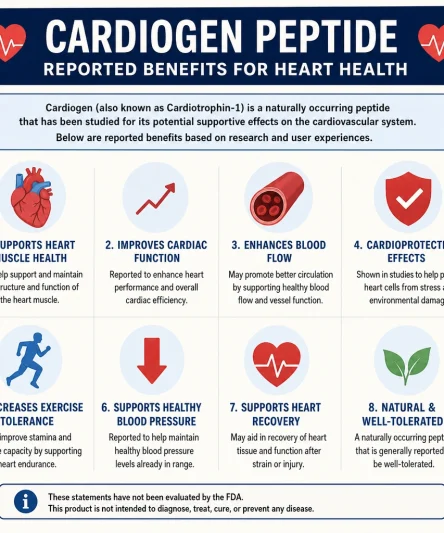
This product is none of that. It is an unapproved tetrapeptide in water, sold for laboratory research, with no approval anywhere and no clinical evidence of any kind.
The two collide in search results because both are nasal sprays connected to the heart. Nothing else about them is shared.
A third source of confusion is worth naming. Cardiogen-82 is a rubidium generator used in cardiac PET imaging, and it has no relationship to this peptide beyond four letters.
Anyone with a diagnosed arrhythmia, chronic heart failure or any other cardiovascular disease needs a clinician and an approved medicine. Nothing on this page substitutes for either.
This is also not a product for a runny nose or nasal congestion. It is not a treatment for anything.
What Does the Cardiac Claim for Cardiogen Peptide Rest On?
The organ assignment behind this compound came from the tissue the original extract was drawn from rather than from a measured affinity for heart tissue, and the same is true across the family.
What the originating programme published is cell-culture and rodent work read out through markers rather than through cardiac function.
Cell-culture work in that literature reports effects on fibroblasts, which are the workhorse cell for these assays because fibroblasts grow readily and their chromatin state is easy to score.
Very little of the published work uses a cardiomyocyte. That matters, because a result in fibroblasts establishes nothing about contractile heart tissue.
Apoptosis and p53 protein expression appear as readouts in the programme’s tumour work, including studies in rats carrying M-1 sarcoma, which sits oddly beside an organ-specific account of what these peptides do.
Reduced oxidative stress and improved tissue repair are the two mechanisms quoted most often for this compound across vendor pages. Both come from that marker literature rather than from any cardiac endpoint.
Nothing in peptide science has produced a receptor for any bioregulator peptide, and no binding constant appears anywhere in the record.
So a cardiac claim for this molecule rests on the name it was given rather than on evidence gathered afterwards.
What Research Position Applies?
The published record concerns the compound and not the delivery format.
Observations in aged rodent models appear in work from the St Petersburg group, assessed by histology and by markers of tissue-associated gene expression.
Every one of those studies used a parenteral route. Nothing in the published record describes this compound given nasally.
Cell-culture work across the family reporting chromatin decondensation is offered in support of the DNA-binding hypothesis rather than of any organ-specific claim.
No receptor has been identified for any member of this family and no binding constant is published, so no concentration follows from first principles.
No adequately powered independent Western trial has been run on this compound or on any of its relatives.
The sequence rests on converging secondary sources rather than a traced primary citation, which the specification table states rather than implies.
Does Cardiogen Nasal Spray Need Reconstitution?
No. This is a solution-state product, so no reconstitution step exists and no bacteriostatic water is added.
Where the compound is sold as Cardiogen-20mg in a vial, reconstitution is the buyer’s job, and for a cationic peptide that step carries a risk the powder buyer may not expect.
Adsorption begins the moment the peptide meets a surface. A cationic molecule reconstituted into an untreated glass vial starts losing material before the first aliquot is drawn.
So the reconstitution question here is the container question again, and the answer is to pre-rinse anything the solution touches.
Clinics offering peptide therapy quote reconstitution volumes for Cardiogen-20mg freely. Those figures come from vendor sheets rather than from any published protocol, and this product is not for administration to anyone.
How Should Cardiogen Nasal Spray Be Stored and Recorded?
Chemically undemanding, with one handling consideration that is specific to this compound.
Refrigerate between 2 and 8 degrees Celsius, keep the bottle away from light, and never freeze a solution-state product.
No cysteine, methionine or tryptophan means oxidation and photodegradation routes are absent, so light protection is a precaution.
The aspartate is followed by arginine rather than glycine, which slows the succinimide rearrangement considerably relative to the Asp-Gly members of the family.
Adsorption is the concern that does apply, and it is stronger here than for any other compound in this range because of the positive charge.
Use low-binding or silanised surfaces for anything decanted, and pre-rinse a transfer vessel with the solution before drawing a working aliquot.
Record the lot, the stated concentration, the container material, the date first opened, the storage temperature and the actuation count.
The container material is the field that matters most here, because for a cationic peptide at spray concentrations it changes the delivered amount rather than merely documenting it. Everything else on this list is provenance. That one field is data.
Published Literature
Selected references. The bioregulator literature originates almost entirely from one research programme and used parenteral routes.
- (‘Khavinson VK, Malinin VV. Gerontological Aspects of Genome Peptide Regulation. Basel: Karger; 2005.’, ‘https://doi.org/10.1159/isbn.978-3-318-01193-6’)
- (‘Anisimov VN, Khavinson VK. Peptide bioregulation of aging. Biogerontology. 2010;11(2):139-149.’, ‘https://doi.org/10.1007/s10522-009-9249-8’)
- (‘Ugwoke MI, Agu RU, Verbeke N, Kinget R. Nasal mucoadhesive drug delivery: background, applications, trends and future perspectives. Adv Drug Deliv Rev. 2005;57(11):1640-1665.’, ‘https://doi.org/10.1016/j.addr.2005.07.009’)
Frequently Asked Questions
What is Cardiogen nasal spray?
A metered aqueous solution of the tetrapeptide Ala-Glu-Asp-Arg at roughly 489.5 daltons. Supplied for laboratory research only, and approved nowhere on earth for any purpose.
Why is it the only cationic bioregulator?
Because arginine carries a guanidinium group with a pKa near 12.5, far enough above physiological pH that it stays protonated under every realistic condition and outweighs the two acidic residues.
Do other family members carry basic residues?
Yes, lysine appears in Vilon, Livagen, Prostamax and Testagen, but always alongside two acidic residues that cancel it to near neutrality. Only here and in Pinealon does a basic residue win outright.
Why does that matter for a nasal spray?
Because mucosal surfaces carry a net negative charge from sialic acid and sulfated glycans. A cationic molecule binds that layer electrostatically where an anionic one passes it by.
Is mucoadhesion good or bad?
Both. Binding increases residence time at the epithelial surface, but material bound to mucus is not material crossing the epithelium, and mucociliary clearance carries the mucus away within roughly fifteen to twenty minutes.
Has that been settled for this compound?
No. Which effect dominates is an empirical question with no published answer here. This is the only family member for which the question arises, so it is the natural comparator with fifteen matched controls available.
What does the charge do inside the bottle?
It drives adsorption. Glass carries a negative surface charge from ionised silanol groups, making untreated glass the worst container choice for this compound.
Can that be mitigated?
Yes. Silanised or low-binding surfaces help, and pre-rinsing a transfer vessel with the solution saturates binding sites before the working aliquot is drawn.
What is the Pinealon relationship?
Pinealon is Glu-Asp-Arg, which is this compound minus its alanine. A failed final coupling during synthesis yields Pinealon, itself a product sold here at roughly 418.4 daltons.
Is that hard to detect?
No. The gap is roughly 71 daltons and the two also separate chromatographically, since a hydrophobic alanine shifts retention. This is the easy category of quality question in this family.
How does its size sit for delivery?
At roughly 489.5 daltons it is the heaviest of the sixteen, still less than half the transition weight. The family band is narrow enough that charge rather than mass is what distinguishes this compound.
Is this the FDA-approved nasal spray for heart rhythm?
No. That product contains etripamil, is sold as Cardamyst, and is approved for paroxysmal supraventricular tachycardia. This is an unapproved tetrapeptide sold for laboratory research. The two share a delivery format and nothing else.
What is etripamil?
A calcium channel blocker sprayed at the onset of an episode of PSVT, so that treating SVTs no longer requires a hospital trip for an intravenous medication. It has a trial programme and prescribing information. This compound has neither.
Does Cardiogen nasal spray need reconstitution?
No. It is supplied as a solution, so no bacteriostatic water is added. A vial of Cardiogen-20mg does need reconstitution, and for a cationic peptide that step starts adsorption to the glass before the first aliquot is drawn.
What does the cardiac claim rest on?
Marker work rather than cardiac function. The cell-culture literature reports effects in fibroblasts, very little uses a cardiomyocyte, and apoptosis and p53 protein expression appear in tumour studies including M-1 sarcoma. No receptor has been identified.
Compliance Statement
Cardiogen nasal spray is sold exclusively for laboratory research use. It is not a drug, food, or cosmetic product, and it is not a dietary product of any kind. It is not approved by the FDA or any comparable authority for human or veterinary use, its proposed mechanism has not been independently established, no published study characterises this compound delivered intranasally, and whether its mucosal binding assists or obstructs delivery has not been measured. This product is not intended to diagnose, treat, cure, or prevent any disease. It must not be given to humans or animals. Purchase is restricted to qualified researchers and institutions operating within applicable laws. All handling is the responsibility of the purchasing laboratory.
Other formats of Cardiogen
Cardiogen is also stocked as Cardiogen Peptide 20mg and Cardiogen 20mg preloaded 3ml pen. Each listing states its own quantity and concentration, and the pen and vial comparison explains what changes between formats.









5 reviews for Cardiogen 20mg Nasal Spray