

Description
PrymaLab · Research Use Only
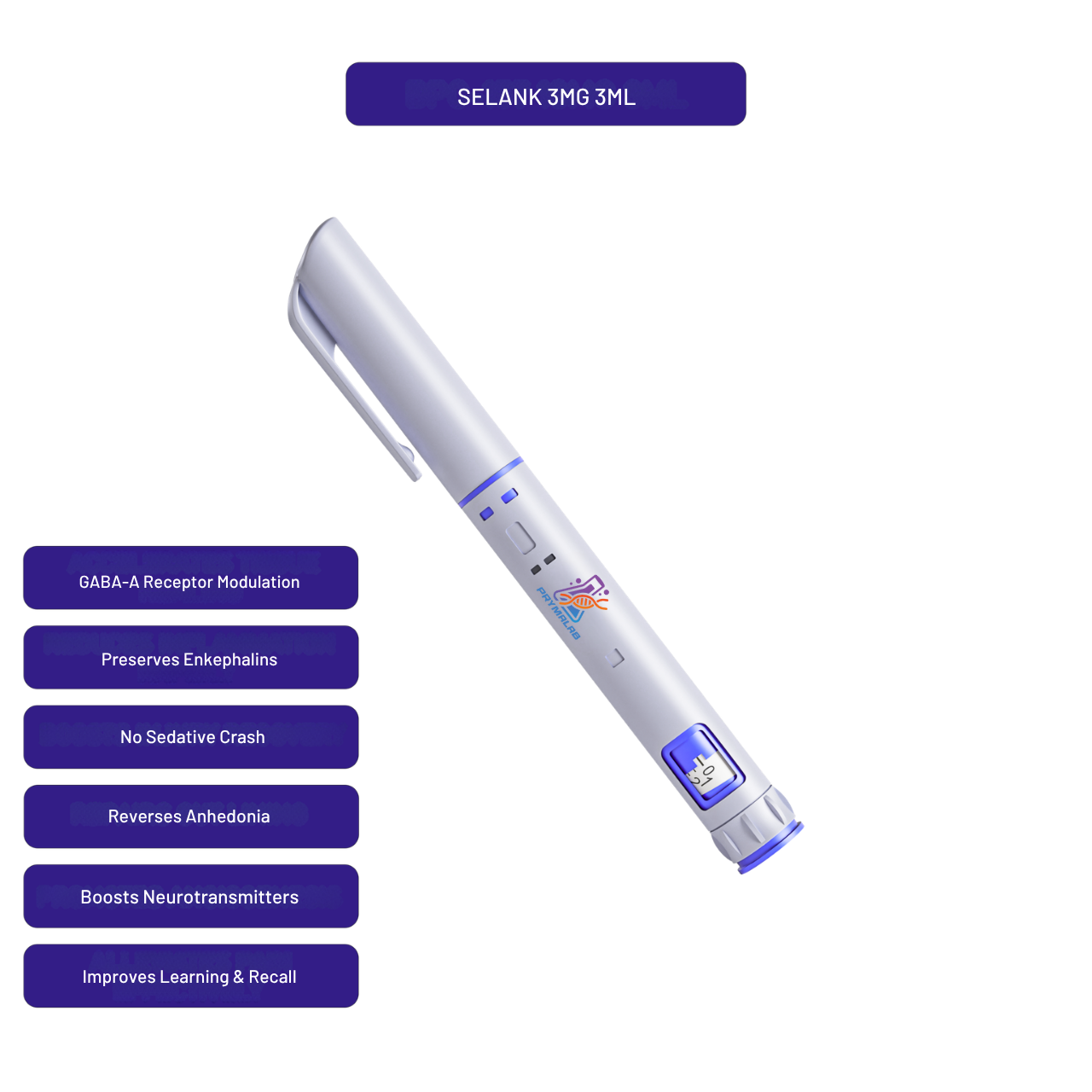
Selank Autoinjector
TKPRPGP heptapeptide · tuftsin analogue · CAS 129954-34-3
Selank autoinjector is a pre-filled device supplying the heptapeptide Thr-Lys-Pro-Arg-Pro-Gly-Pro, CAS 129954-34-3, molecular formula C33H57N11O9, molecular weight 751.88. The sequence joins the tuftsin tetrapeptide to a three-residue proline-glycine-proline extension.
Specification Table
| Property | Value |
|---|---|
| Compound | Selank |
| CAS number | 129954-34-3 |
| Molecular formula | C33H57N11O9 |
| Molecular weight | 751.88 g/mol |
| Residue count | 7 |
| Single-letter sequence | TKPRPGP |
| Three-letter sequence | Thr-Lys-Pro-Arg-Pro-Gly-Pro |
| Parent tetrapeptide | Tuftsin, Thr-Lys-Pro-Arg, residues 289 to 292 of the immunoglobulin G heavy chain |
| Extension | Pro-Gly-Pro at the carboxy terminus |
| Purpose of the extension | Reported to increase resistance to enzymatic degradation |
| Proline content | Three of seven residues |
| Net charge at neutral pH | Positive, from lysine and arginine |
| Originating programme | Institute of Molecular Genetics, Russian Academy of Sciences |
| Oxidation-prone residues | None |
| Format | Pre-filled autoinjector device |
| Physical state | Solution, supplied ready-filled |
| Appearance | Clear colourless solution |
| Purity | Per lot-specific certificate of analysis |
| Storage | 2-8°C, protected from light |
| Regulatory status | No approved human or veterinary formulation in the United States |
What Is Tuftsin and Where Does It Come From?
The first four residues supplied in a Selank autoinjector are not an arbitrary sequence, and they correspond to a naturally occurring tetrapeptide with a well-documented origin.
Tuftsin is Thr-Lys-Pro-Arg, corresponding to residues 289 to 292 of the immunoglobulin G heavy chain. It is released from the Fc region by enzymatic cleavage, which makes it a fragment of an abundant circulating protein rather than a product of a dedicated peptide precursor.
It was named for Tufts University, where it was described in the 1970s, and the literature on it concerns interactions with cells of the immune system, particularly phagocytes.
A receptor for tuftsin has been proposed in the form of neuropilin-1, though the characterisation is less complete than for well-established peptide receptors and the interaction is a subject of ongoing work rather than a settled fact.
Selank therefore inherits a partially characterised pharmacology. The tetrapeptide is real and its origin is certain, while the receptor question remains more open than descriptions of the compound typically convey.
Why Add Pro-Gly-Pro?
The three-residue extension at the carboxy terminus is the modification that turns tuftsin into Selank, and the rationale concerns stability.
Short peptides are degraded rapidly by exopeptidases working inward from the termini. A four-residue peptide offers very little to work with, and tuftsin is correspondingly short-lived in biological systems.
Proline is unusual among amino acids in that its side chain bonds back to the backbone nitrogen, forming a ring. That constrains the backbone conformation and, importantly, makes the preceding peptide bond a poor substrate for many proteases, which cannot accommodate the geometry.
Placing prolines at positions 5 and 7 therefore shields the carboxy-terminal region. The published rationale for the extension is increased resistance to enzymatic degradation, and the chemistry supports that reasoning independently of any specific measurement.
The same strategy appears in Semax, where a Pro-Gly-Pro extension is added to an ACTH fragment by the same research programme. Recognising the shared design across both compounds clarifies that this is a deliberate platform approach rather than a one-off modification.
What Does the Proline Content Mean Structurally?
Three prolines in seven residues is a high proportion and it determines the physical behaviour of the molecule.
Proline-rich sequences cannot form conventional alpha helices, because the ring structure denies the backbone the hydrogen bonding a helix requires and the nitrogen has no hydrogen to donate. Beta sheet is similarly disfavoured.
What such sequences can adopt is the polyproline II conformation, an extended left-handed helix with roughly three residues per turn. It is a genuine ordered structure, not simply disorder, and proline-rich regions in larger proteins frequently use it as a recognition surface.
The practical implication is that this peptide has little conformational entropy to lose on binding, which can favour association, and that it will not aggregate through the beta-sheet mechanism that troubles many peptides.
It also means the molecule is chemically durable in the ways that matter for storage. No cysteine, no methionine, no tryptophan, no asparagine-glycine motif. There is very little in this sequence for degradation chemistry to act on.
What Applies to the Pre-Filled Format Here?
The Selank autoinjector format suits a chemically durable short peptide better than it suits a folded protein, and Selank is at the favourable end of that spectrum.
With no oxidation-prone residues and no disulfides, the degradation routes that make solution-state storage risky for other compounds largely do not apply. The principal concerns are microbial contamination, which the sealed format addresses, and adsorptive loss.
Adsorption is worth noting. The peptide carries a net positive charge from lysine and arginine, and basic peptides adsorb to negatively charged surfaces. In a sealed device with a fixed container that loss occurs once and reaches equilibrium rather than accumulating, but it means the delivered concentration may sit slightly below the labelled one.
Freezing should be avoided as with all pre-filled devices, on mechanical grounds rather than peptide-stability grounds in this case.
Visual inspection remains worthwhile. A clear colourless solution is expected, and any cloudiness or particulate warrants rejecting the unit even though this peptide is not prone to aggregation.
What Does the Selank Autoinjector Share With the Semax Design?
Two compounds from the same Russian research programme use an identical structural strategy, and comparing them clarifies what the strategy is intended to achieve.
Semax takes an ACTH fragment, residues 4 to 7 in the sequence Met-Glu-His-Phe, and appends Pro-Gly-Pro at the carboxy terminus. The heptapeptide here takes tuftsin, Thr-Lys-Pro-Arg, and appends the same three residues in the same position.
Both parent tetrapeptides derive from larger endogenous proteins rather than from dedicated peptide precursors, one from a pituitary hormone and one from immunoglobulin G. Both are short enough to be degraded rapidly without protection.
The shared extension is therefore a platform element rather than a compound-specific design choice. The programme identified a short protective motif and applied it across candidates, which is a reasonable medicinal chemistry approach and one that leaves a recognisable signature.
That signature is useful diagnostically. A short peptide ending in Pro-Gly-Pro is likely to originate from this programme, and knowing the origin tells a reader where the supporting literature will be concentrated.
It also raises a testable question that appears not to have been systematically addressed: whether the extension contributes activity of its own rather than only protection, which a Pro-Gly-Pro-only arm would answer.
What Does the Immunoglobulin Origin Imply?
The tuftsin core comes from an antibody heavy chain, and that provenance carries implications that descriptions of the compound rarely draw out.
Immunoglobulin G is among the most abundant proteins in circulation. A tetrapeptide released from its Fc region is therefore potentially generated continuously wherever the appropriate proteolytic activity exists, rather than being produced on demand from a dedicated precursor.
That is a different regulatory logic from a conventional peptide hormone. A hormone is synthesised, stored and released in response to a signal. A fragment liberated from an abundant structural protein is generated as a function of proteolytic activity and substrate availability.
Whether the tetrapeptide constitutes a genuine signalling molecule or an incidental proteolysis product has been discussed in the literature since the 1970s, and the question is not fully settled.
For experimental design the implication is that background levels may be present in any system containing immunoglobulin and the relevant protease activity, including serum-preparationed culture medium.
Measuring or at least considering that background, rather than assuming a zero baseline, is the reasonable precaution and it is one that serum-free conditions largely resolve.
What Should a Selank Autoinjector Record Capture?
Where the peptide is this chemically forgiving and the format is sealed, the record shrinks to traceability.
Lot number, fill date, and the concentration stated on the certificate with the method used to determine it. Those three cover the material itself.
Storage temperature and any excursion, though the consequences of an excursion are milder here than for a folded protein or a coenzyme, because this sequence has very little available degradation chemistry.
Date of first use and date of each subsequent use, so that a Selank autoinjector spanning several experiments can be matched against the series it supplied.
Visual condition at each use, briefly. Clear and colourless is expected and anything else warrants stopping.
Storage and Handling in Laboratory Practice
A Selank autoinjector wants refrigeration, darkness, no freezing and inspection before use, and the requirements are modest for this compound.
Maintain 2-8°C and return the device promptly after use. Selank tolerates handling better than most compounds in this catalogue, but there is no reason to test the margin.
Keep the device in original packaging until immediately before use, which handles light exposure and protects the mechanism.
Do not freeze. The reason here is the sealed liquid-filled mechanism rather than the peptide itself, which would tolerate freezing perfectly well in an ordinary tube.
Record lot, manufacture date, storage history and dates of use. Here the log serves traceability rather than stability, which is a comfortable place to be.
A closing note on sourcing. Because this compound and its relatives come from one research programme, the supporting literature is concentrated in Russian-language journals and in their English translations.
Translation quality varies, and terminology that is standard in one tradition is unfamiliar in another. Reading the original where possible, or at least checking a translated methods section against the abstract, catches discrepancies that would otherwise propagate.
It also explains why indexed citation counts for these compounds understate the volume of work behind them.
A last note on the sequence itself. Confirm it as Thr-Lys-Pro-Arg-Pro-Gly-Pro on the certificate rather than relying on the trade name, since several short peptides from the same programme share the terminal three residues and differ only in the core.
What Does the Selank Literature Report?
Selank has a larger published record than most compounds here, and it comes almost entirely from one national research tradition, which is the frame to read it in.
The compound was developed at the Institute of Molecular Genetics in Moscow and is registered in Russia as an anxiolytic, sold there as a nasal spray rather than an injection.
Registered use covers generalized anxiety disorder and neurasthenia, and the Russian trials that support that registration compared it against benzodiazepines.
Diazepam and phenazepam are the comparators used most often, and the reported finding is comparable anxiolytic effects without the sedation, dependence and cognitive impairment those drugs produce.
That absence of sedation is the interesting claim. A compound that reduces anxiety without sedation would be genuinely useful, and it is the reason the nootropic market pays attention to it.
The proposed mechanism runs through the GABAergic system. Reported effects include altered expression of GABA A receptors, which is a slower and more indirect route than a benzodiazepine binding those receptors directly.
A second reported mechanism concerns enkephalin-degrading enzymes. Selank is described as slowing enkephalin breakdown, extending endogenous opioid peptide signalling, and that arm connects it to the tuftsin origin described above.
Serotonin and dopamine turnover changes appear in the animal work, alongside reported BDNF expression changes in the hippocampus.
Brain-derived neurotrophic factor is where the cognitive enhancement claims come from, since BDNF is the standard mechanistic hook for anything marketed on neuroplasticity.
Reported cognitive function effects are modest and secondary to the anxiolytic activity in that literature, so a nootropic peptide framing overstates what the studies were designed to detect.
Mental clarity, stress resilience, emotional balance and relief from chronic stress are marketing phrases rather than trial endpoints. Emotional balance in particular has no operational definition anyone could design a study around.
Cortisol reduction and mood regulation are quoted in the same copy, along with anhedonia, and none corresponds to a measured outcome in the published record.
The tuftsin origin also produces immune modulation claims, and reported neuroprotective and gut health effects follow from the same loose reasoning about a peptide with a broad mechanism.
GABAergic neurotransmission is the one arm of that account with actual experimental support behind it, and even there the evidence is expression data rather than receptor binding.
What Is the Regulatory and Safety Position Outside Russia?
Registration in one jurisdiction is not approval generally, and the difference matters more here than for most of this catalogue.
Selank is not FDA-approved, holds no European approval, and no Western regulator has reviewed the Russian trial data.
Independent replication outside that programme is thin, which is the same limitation that applies to the bioregulators and to Semax.
Reported side effects in the Russian record are minimal, with headaches and nasal irritation from the intranasal formulation the most commonly noted.
Minimal reported side effects from small trials in one tradition is a weaker statement than it sounds, and it is not a safety profile.
Drug interactions have not been characterised. Anyone taking SSRIs, psychiatric medications, an antidepressant or a benzodiazepine has a specific reason to raise this with a prescriber rather than to experiment.
This compound is not a treatment for anxiety, and peptides for anxiety as a category have no approved member in the United States.
This device is supplied for laboratory research only and is not for administration to humans or animals.
How Does Selank Compare With Semax and the Other Formats?
The Selank versus Semax question is the one asked most often about this compound, and the answer is cleaner than most such comparisons.
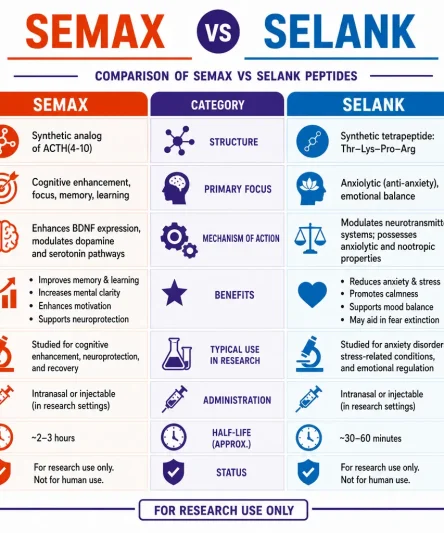
Both come from the same Moscow programme and both carry the same Pro-Gly-Pro stabilising tail. Beyond that they differ in origin and in effect.
Semax derives from ACTH and is characterised as stimulating and cognitive. Selank derives from tuftsin and is characterised as calming and anxiolytic.
So the pair is often described as complementary, with Semax peptides for focus and this one for anxiety, though no controlled study has tested them together.
DSIP, GHK-Cu and BPC-157 turn up in the same stacks and share nothing mechanistically with either.
On format, the Russian registration is for intranasal use, and the intranasal route is where essentially all the human data sits.
A nasal spray therefore has more precedent behind it than an injection does, which is an awkward thing for a device page to note and an accurate one.
Injectable Selank and compounded peptides of this kind circulate without published pharmacokinetics by that route, so bioavailability from a subcutaneous injection is unmeasured for this synthetic peptide.
Clinics offering peptide therapy quote injection sites, the upper arms and abdomen among them, and Selank peptide therapy protocols of that kind rest on vendor guidance rather than trials.
Reports of overstimulation from Selank peptide are the sort of thing that circulates on forums and appears nowhere in the published record, which is worth noting in both directions.
Does the Autoinjector Format Change Reconstitution?
Yes, and for this compound the change removes the step where most published protocols begin.
Lyophilized Selank in a vial is the common presentation, and the buyer adds bacteriostatic water and records the resulting concentration before anything else happens.
Reconstitution of that kind is where concentration error enters, and a device supplied in solution moves that arithmetic to the manufacturer. Nothing about reconstitution is difficult; it is simply one more place a number can be wrong.
Peptide therapy clinics dispensing an anti-anxiety preparation of this compound face the same arithmetic, and the anti-anxiety framing is theirs rather than a regulator’s.
What a solution format cannot remove is the shelf-life question, since a peptide in water degrades on a clock that a lyophilized powder effectively stops.
Ask for HPLC purity with the gradient stated and a COA identifying the peptide by mass as well as by retention.
Record the lot, the fill date and the storage condition. For a solution product those fields carry what a powder buyer would learn by weighing.
Published Literature
References verified against the publisher record. Note that much of the Selank literature originates from the Russian research programme that developed it.
- Najjar VA, Nishioka K. Nature. 1970;228(5272):672-673.
- Kozlovskaya MM, Kozlovskii II, Val’dman EA, Seredenin SB. Neuroscience and Behavioral Physiology. 2003;33(9):853-860.
- Semenova TP, Kozlovskaya MM, Zuikov AV, Kozlovskii II. Neuroscience and Behavioral Physiology. 2010;40(6):613-619.
- Vol’pina OM, Koroev DO, Volkova TD, et al. Russian Journal of Bioorganic Chemistry. 2015;41(4):343-349.
- Siebert A, Gensicka-Kowalewska M, Cholewinski G, Dzierzbicka K. Expert Opinion on Therapeutic Patents. 2017;27(1):59-73.
Frequently Asked Questions
What is the Selank autoinjector?
A pre-filled device supplying the heptapeptide Thr-Lys-Pro-Arg-Pro-Gly-Pro, CAS 129954-34-3, molecular weight 751.88. The sequence joins the tuftsin tetrapeptide to a proline-glycine-proline extension. For laboratory research purposes alone, never for human or veterinary use.
What is tuftsin?
A naturally occurring tetrapeptide, Thr-Lys-Pro-Arg, corresponding to residues 289 to 292 of the immunoglobulin G heavy chain. It is released from the Fc region by enzymatic cleavage, making it a fragment of an abundant circulating protein.
Where does the name come from?
Tufts University, where the tetrapeptide was described in the 1970s. The literature on it concerns interactions with cells of the immune system, particularly phagocytes, rather than the applications Selank is usually associated with.
Has a tuftsin receptor been identified?
Neuropilin-1 has been proposed, though the characterisation is less complete than for well-established peptide receptors. The interaction remains a subject of ongoing work rather than a settled fact, so Selank inherits a partially characterised pharmacology.
Why is Pro-Gly-Pro added?
For stability. Short peptides are degraded rapidly by exopeptidases working inward from the termini, and a four-residue peptide offers very little to work with. The extension shields the carboxy-terminal region against that degradation.
How does proline confer protease resistance?
Its side chain bonds back to the backbone nitrogen, forming a ring. That constrains backbone conformation and makes the preceding peptide bond a poor substrate for many proteases, which cannot accommodate that geometry.
Does the same strategy appear elsewhere?
Yes, in Semax, where a Pro-Gly-Pro extension is added to an ACTH fragment by the same research programme. Recognising the shared design clarifies that this is a deliberate platform approach rather than a one-off modification.
What structure does a proline-rich peptide adopt?
Polyproline II, an extended left-handed helix with roughly three residues per turn. It is a genuine ordered structure rather than disorder, and proline-rich regions in larger proteins frequently use it as a recognition surface.
Is Selank chemically durable?
It sits at the forgiving end of this catalogue. No cysteine, no methionine, no tryptophan and no asparagine-glycine motif, so the usual degradation routes are largely unavailable. There is very little in the sequence for degradation chemistry to act on.
Does adsorption affect the delivered concentration?
Possibly a little. The peptide carries a net positive charge from lysine and arginine, and basic peptides adsorb to negatively charged surfaces. In a sealed device that loss reaches equilibrium once rather than accumulating over time.
What is Selank?
A synthetic heptapeptide developed at the Institute of Molecular Genetics in Moscow, built from tuftsin with a Pro-Gly-Pro tail. Its amino acid sequence gives it stability tuftsin lacks. It is registered in Russia as an anxiolytic and sold there as a nasal spray.
Is Selank peptide approved anywhere outside Russia?
No. It is not FDA-approved, holds no European approval, and no Western regulator has reviewed the Russian trial data. Independent replication outside the originating programme is thin, which is the same limitation Semax carries.
How does it compare with benzodiazepines?
Russian trials used diazepam and phenazepam as comparators and report comparable anti-anxiety activity without sedation, dependence or cognitive impairment. The proposed route is altered GABA A receptor expression rather than direct binding, which is slower and more indirect.
What is the Selank vs Semax difference?
Same Moscow programme, same Pro-Gly-Pro tail, different origins. Semax derives from ACTH and is characterised as stimulating; this derives from tuftsin and is characterised as calming. No controlled study has tested them together despite the pairing being common.
Does it have nootropic effects?
Reported cognitive function effects are modest and secondary to the anxiolytic activity in that literature. BDNF changes in the hippocampus are the mechanistic hook. Mental clarity, clearer thinking and relief from brain fog are marketing phrases rather than trial endpoints.
What are the reported side effects?
Minimal in the Russian record, with headaches and nasal irritation from the intranasal formulation most commonly noted. Minimal reported headaches from small trials in one tradition is a weaker statement than it sounds, and it is not a safety profile.
Can it be combined with SSRIs or other psychiatric medication?
Drug interactions have not been characterised. Anyone taking SSRIs, an antidepressant, a benzodiazepine or other psychiatric medications has a specific reason to raise this with a prescriber. This compound is not a treatment for anxiety.
Which route has the evidence behind it?
Intranasal administration. The Russian registration is for a nasal spray and essentially all human data sits there. Injectable Selank and compounded peptides circulate without published pharmacokinetics by that route, so a subcutaneous injection has less precedent than a spray.
Does the device remove reconstitution?
Yes. A vial of lyophilized Selank needs bacteriostatic water and a recorded concentration; reconstitution is where that error enters and a solution format moves it to the manufacturer. Injection site and shelf-life questions remain either way.
Compliance Statement
Selank is sold exclusively for laboratory research use. It is not a drug, food, or cosmetic product, and it is not a dietary product of any kind. It is not approved by the FDA or any comparable authority for human or veterinary use, and the pre-filled device format does not alter that status. This product is not intended to diagnose, treat, cure, or prevent any disease. It must not be given to humans or animals. Purchase is restricted to qualified researchers and institutions operating within applicable laws. All handling is the responsibility of the purchasing laboratory.
Other formats of Selank
Selank is also stocked as Selank 5mg, Selank 10mg Nasal Spray and Selank 11mg. Each listing states its own quantity and concentration, and the pen and vial comparison explains what changes between formats.











20 reviews for Preloaded Autoinjector | Selank | 3ml Pen | 1mg/ml