
Description
PrymaLab · Research use only
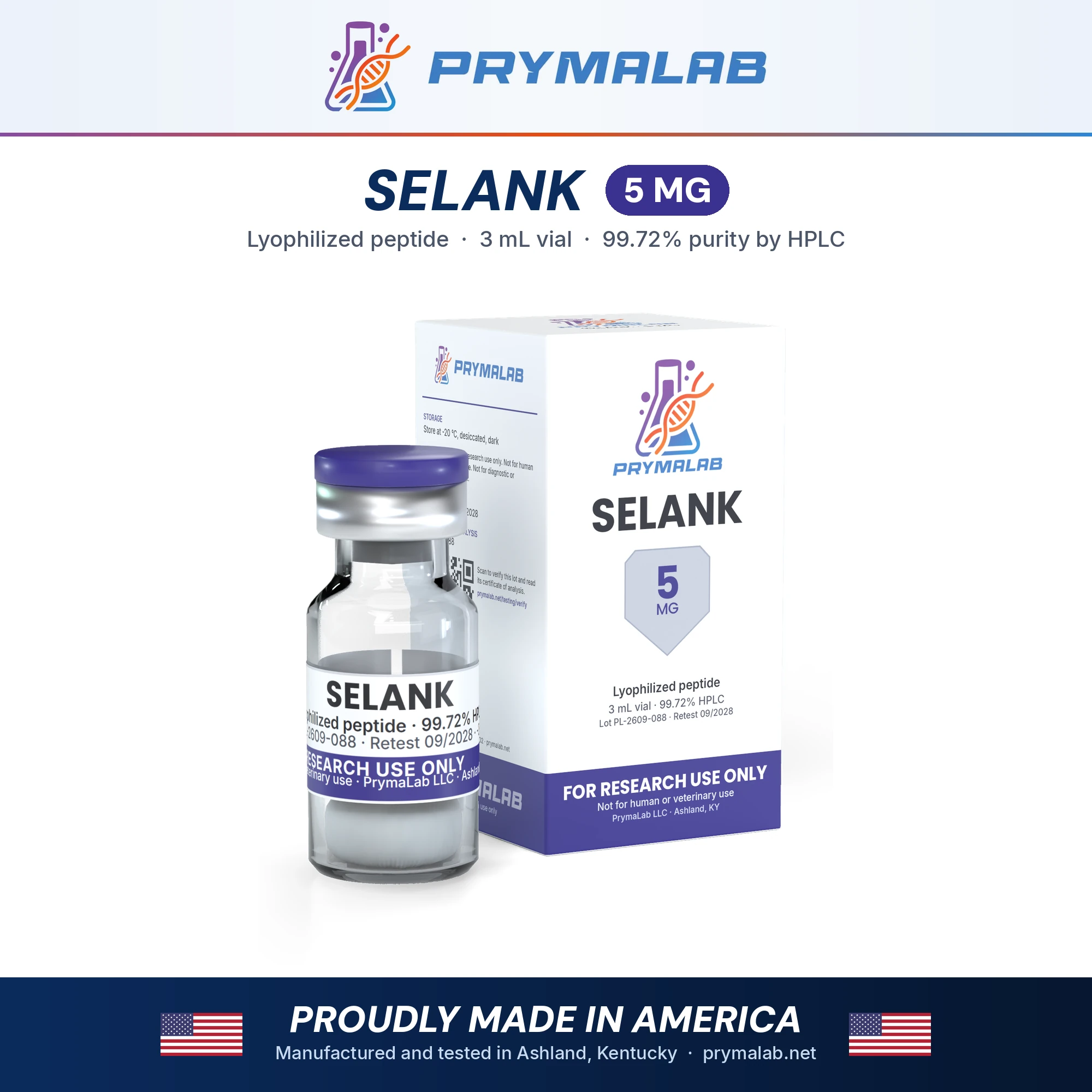
Selank 5mg
Selank (TKPRPGP): tuftsin with a Pro-Gly-Pro tail, 5 mg freeze-dried
Selank is a synthetic heptapeptide, Thr-Lys-Pro-Arg-Pro-Gly-Pro: the four residues of tuftsin, a peptide first described as a stimulator of phagocytosis, followed by a Pro-Gly-Pro tail. This listing is the 5 mg vial of freeze-dried powder, the main fill; an 11 mg vial is also sold. Research on Selank, mostly from Russian groups, has compared it with other tuftsin-family peptides in rodent stress models and measured its effects on gene expression in the rat brain.
Specifications
| Property | Value |
|---|---|
| Compound | Selank Tuftsin-Pro-Gly-Pro heptapeptide (TKPRPGP) |
| CAS number | 129954-34-3 |
| Molecular formula | C33H57N11O9 |
| Theoretical mass | 751.9 Da |
| Sequence / structure | H-TKPRPGP-OH (7 residues; free N- and C-termini) |
| Label claim | 5 mg/vial |
| Form | Lyophilized (freeze-dried) powder or cake in a sealed glass vial with a rubber stopper and aluminium crimp cap |
| Storage, sealed | −20 °C, desiccated, dark |
| Purity specification | 99.0% or higher by RP-HPLC |
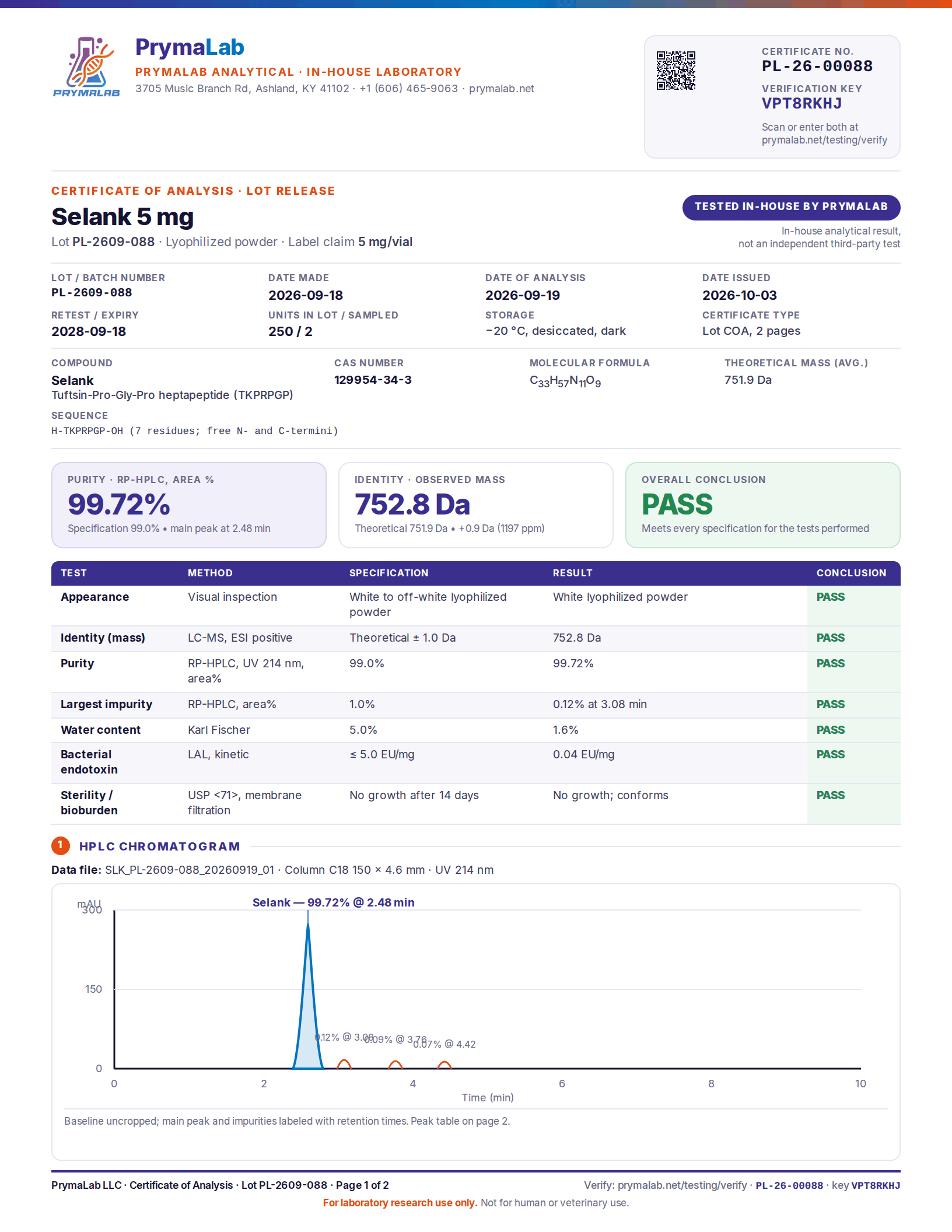
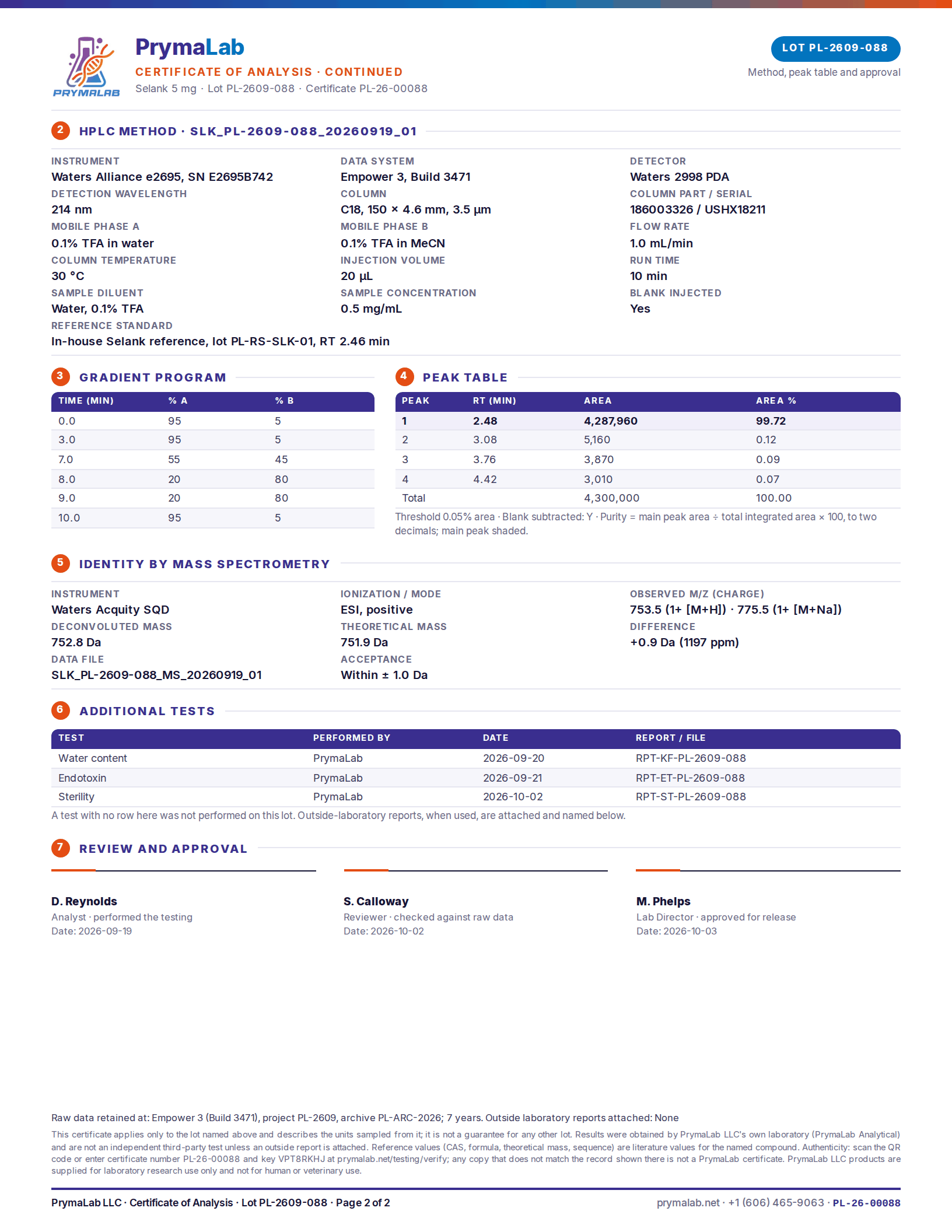
| Lot certificate | Results for the lot now shipping are in the certificate panel on this page |
| Safety data sheet | PL-SDS-143 |
Fills in this range
Selank is sold in 2 fills. The compound and the testing are the same in every fill; only the amount in the vial changes.
| Fill | Listing |
|---|---|
| 5 mg | Selank 5mg (this page) |
| 11 mg | Selank 11mg |
Which Selank this vial contains
The certificate gives the sequence as H-TKPRPGP-OH: seven residues with a free amino terminus and a free carboxyl terminus, formula C33H57N11O9, theoretical mass 751.9 Da. This is the parent peptide, not N-acetyl Selank amidate, a modified variant with blocked ends and a different mass that the LC-MS identity result on the certificate would tell apart. In molar terms the vial holds about 6.6 µmol (5 mg at 751.9 Da), slightly less after the water content on the certificate is allowed for.
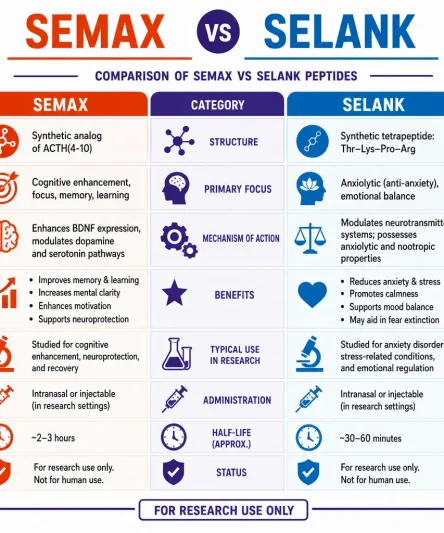
The sequence has no methionine and no cysteine, so the oxidation route that makes Semax awkward to store has no obvious target here. The two peptides share the Pro-Gly-Pro tail and little else; the comparison is laid out in Semax vs Selank.
Handling notes: peptides and container surfaces
Dilute peptide solutions can lose material to the walls of the tubes and vials that hold them. Goebel-Stengel and colleagues measured this with eight radiolabelled endocrine peptides chosen to span a range of net charge, size, end groups and modifications, incubated for 48 hours in glass and plastic tubes, some untreated and some siliconised1. Recovery differed widely between surfaces. Siliconising reduced it, adding 1% bovine serum albumin improved it, and freeze-drying the peptides with albumin in the best-suited tubes gave more than 89% recovery for all of them1. The authors concluded that container choice decides whether peptide is lost unpredictably and recommended testing surfaces for each peptide1.
Selank was not among the peptides tested. It does carry two basic side chains, lysine and arginine, as well as a free amino terminus, so recovery from the specific containers an assay uses is worth confirming in the laboratory.
What the research covers
Tuftsin, the parent sequence
Selank begins with tuftsin, Thr-Lys-Pro-Arg. Najjar and Nishioka reported tuftsin in Nature in 1970 as a natural peptide that stimulates phagocytosis2. Later work treated it as an immunomodulator, a substance that can stimulate or suppress the immune response, and a 2017 review of 86 papers grouped its synthetic analogues by anti-tumour, anti-inflammatory, antimicrobial and antiviral activity3. Most analogues in that review showed anti-tumour, anti-inflammatory or antibacterial effects, and eleven of the papers concerned tuftsin-based peptides built into vaccines3. Selank keeps the tuftsin core and adds Pro-Gly-Pro at the C-terminus, the same tail found on Semax.
Tuftsin-family peptides in rodent stress models
Kozlovskaya and colleagues compared ten tuftsin-family peptides with Selank in white laboratory rats, inbred C57BL/6 and BALB/c mice and Wistar rats, each population sorted beforehand by type of emotional reactivity4. Emotional stress was produced by a conflict situation. The authors reported positive emotional and antistress effects for the peptides, with individual differences they attributed to the molecular structure of each peptide or to its degradation fragments4. The abstract gives the direction of the findings but no effect sizes.
Gene expression in the rat frontal cortex
Volkova and colleagues set out to test whether Selank shares a mechanistic basis with benzodiazepines5. They measured 84 genes involved in neurotransmission, among them GABA receptor subunits, transporters, ion channels and dopamine and serotonin receptors, in the frontal cortex of rats one and three hours after Selank or GABA5. By real-time PCR, 45 genes had changed significantly at one hour and 22 at three hours, and the changes after Selank correlated positively with those after GABA5. The authors proposed allosteric modulation of the GABAergic system as one possible mechanism and described Selank’s effects on nerve cells as complex5.
What is not established
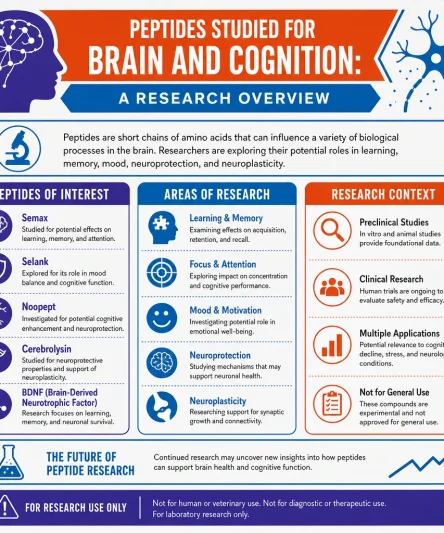
The Selank studies cited here come from Russian authors, and the volume of work available in English is small. The gene expression study measured mRNA in one brain region at two time points; it did not show what Selank binds, and allosteric modulation of GABA receptors was the authors’ proposal, not a measured interaction. The stress study reports which way effects went but not how large they were. Whether any of tuftsin’s immune activity survives in Selank is not addressed by these papers. Human studies are not among the references here, and none of the work used PrymaLab material. The overview of peptides studied for brain and cognition places Selank alongside the related compounds.
The Selank Peptide guide covers the literature in more depth.
How each lot is tested
Every lot is tested in PrymaLab’s own laboratory in Ashland, Kentucky before release: RP-HPLC for purity, LC-MS for identity, Karl Fischer titration for water, LAL for endotoxin and USP <71> for sterility. The results for the lot now shipping are in the certificate panel on this page, and the certificate number, key and QR code can be checked on the verify page. These are in-house results from PrymaLab Analytical, not an independent test, and the lab is not accredited to ISO 17025. The third-party testing guarantee on this page still applies: if any independent laboratory finds the wrong compound, or less than the stated purity or amount, the order is refunded and the cost of the test is reimbursed.
Frequently asked questions
What is the difference between Selank and tuftsin?
Tuftsin is the four-residue peptide Thr-Lys-Pro-Arg. Selank is tuftsin with Pro-Gly-Pro added at the C-terminus, giving seven residues and a theoretical mass of 751.9 Da. The tail was added to slow breakdown by peptidases, and the two are separate compounds with separate literatures.
How do the 5 mg and 11 mg vials differ?
Only in fill. Both hold freeze-dried H-TKPRPGP-OH, and each fill is made as its own lot with its own certificate. The 11 mg vial contains a full 11 mg of peptide, about 14.6 µmol, against roughly 6.6 µmol in this vial.
How should the vial be stored?
Sealed, at −20 °C, desiccated and away from light, and warmed to room temperature before opening. Reconstituted solution belongs at 2 to 8 °C, protected from light, for a period your laboratory has established. Selank has no methionine or cysteine, so oxidation is less of a concern than for Semax.
How do I check the certificate for my vial?
Match the lot number printed on the vial to a certificate. The panel on this page shows the lot now shipping, the testing results page lists earlier lots, and the verify page confirms a certificate from its number and key.
What does the published research show?
Rodent studies from Russian groups report changes in neurotransmission gene expression in the rat frontal cortex and behavioural effects of tuftsin-family peptides under stress. The papers do not identify what Selank binds, give no human results here, and did not use this product.
Is Selank for human use?
No. This vial is sold for laboratory research only. It is not approved by the FDA for human or veterinary use and must not be given to people or animals. Nothing on this page describes a clinical use.
References
- Goebel-Stengel M, Stengel A, Taché Y, et al. The importance of using the optimal plasticware and glassware in studies involving peptides. Anal Biochem. 2011;414(1):38-46. DOI · PubMed
- Najjar VA, Nishioka K. "Tuftsin": a natural phagocytosis stimulating peptide. Nature. 1970;228(5272):672-3. DOI · PubMed
- Siebert A, Gensicka-Kowalewska M, Cholewinski G, et al. Tuftsin – Properties and Analogs. Curr Med Chem. 2017;24(34):3711-3727. DOI · PubMed
- Kozlovskaya MM, Kozlovskii II, Val'dman EA, et al. Selank and short peptides of the tuftsin family in the regulation of adaptive behavior in stress. Neurosci Behav Physiol. 2003;33(9):853-60. DOI · PubMed
- Volkova A, Shadrina M, Kolomin T, et al. Selank Administration Affects the Expression of Some Genes Involved in GABAergic Neurotransmission. Front Pharmacol. 2016;7:31. DOI · PubMed
Research use only
For laboratory research use only. Selank 5mg is not a drug, food, cosmetic or dietary supplement, is not approved by the FDA or any comparable authority for human or veterinary use, and must not be given to people or animals. It is sold to qualified researchers and institutions, and the buyer is responsible for lawful handling and disposal.
Other formats of Selank
Selank is also stocked as Selank 1mg/ml preloaded 3ml pen and Selank 10mg Nasal Spray. Each listing states its own quantity and concentration, and the pen and vial comparison explains what changes between formats.








1 review for Selank 5mg