
Description
PrymaLab · Research Use Only
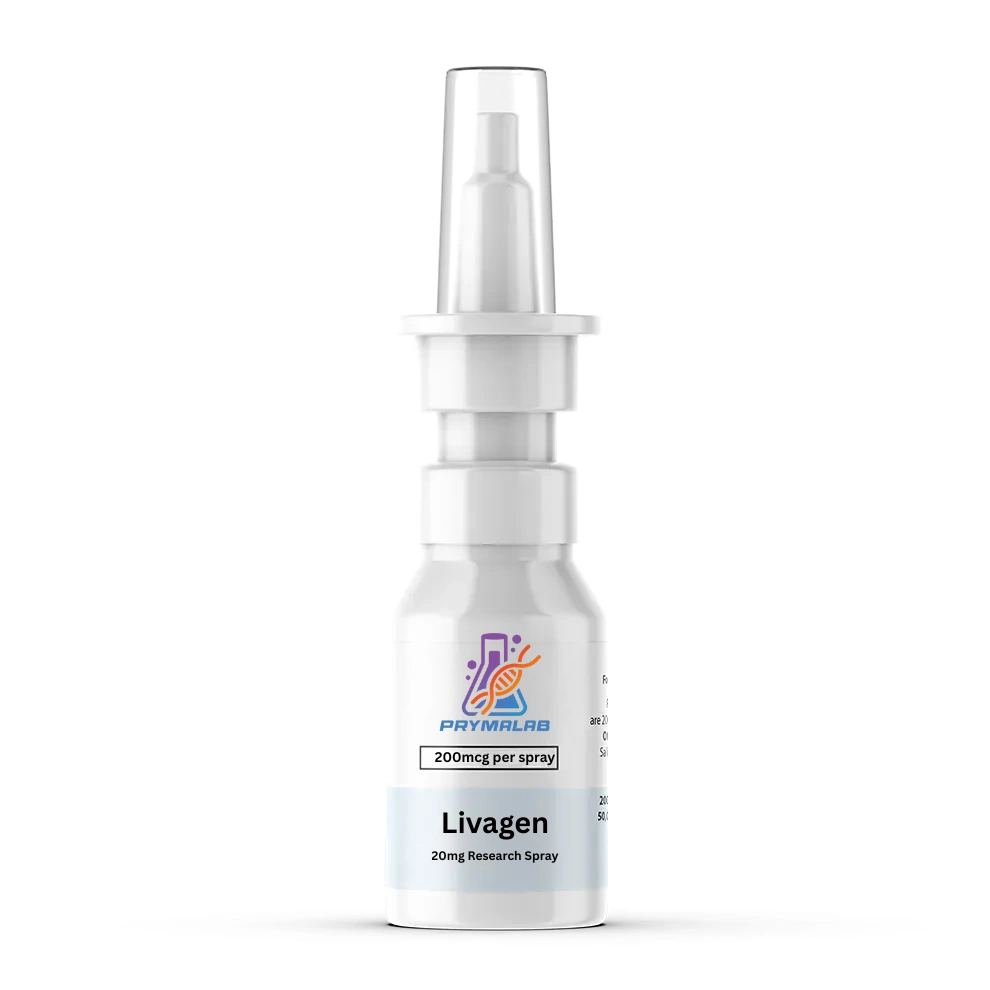
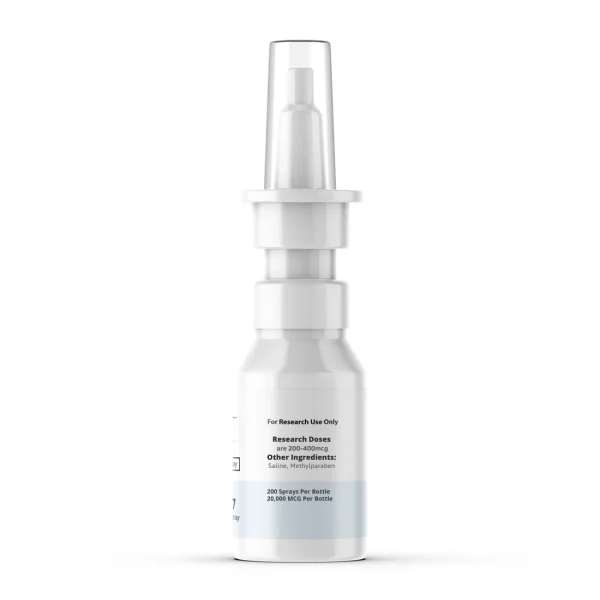
Livagen Nasal Spray
Lys-Glu-Asp-Ala tetrapeptide · 447.5 Da · one of three near-isobaric compounds
Livagen nasal spray supplies the tetrapeptide Lys-Glu-Asp-Ala in a metered aqueous solution at roughly 447.5 daltons. Two other compounds sold in this same catalogue sit within about a dalton of that figure, which turns identity into a question a buyer has to ask rather than assume.
Specification Table
| Property | Value |
|---|---|
| Compound | Livagen |
| Sequence designation | KEDA |
| Amino acid sequence | Lysine-Glutamate-Aspartate-Alanine |
| Sequence provenance | Secondary sources, converging. Not traced to a single primary citation. Confirm against the lot certificate before relying on it for calculation |
| Residue count | 4 |
| Molecular weight, calculated | Approximately 447.5 g/mol, computed from standard residue masses plus water |
| Near-isobaric compound 1 | Testagen, Lys-Glu-Asp-Gly, at roughly 447.5 |
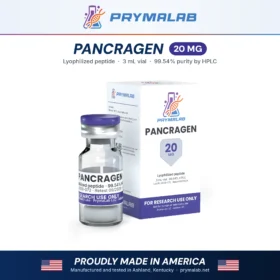
| Near-isobaric compound 2 | Pancragen, Lys-Glu-Asp-Gly, at roughly 447.4 |
| Distinguishing residue | Alanine at position 4 where the others carry glycine |
| Mass difference from those two | Under one dalton |
| Net charge at neutral pH | Near neutral. One basic residue against two acidic residues |
| Chromophore | None. Concentration cannot be determined by 280 nm absorbance |
| Oxidation-prone residues | None |
| Format | Metered nasal spray, solution state |
| Physical state | Aqueous solution, supplied ready to use |
| Purity | Per lot-specific certificate of analysis |
| Storage | 2-8°C, protected from light. Do not freeze |
| Regulatory status | No approved human or veterinary formulation in any jurisdiction |
Why Do Three Compounds Share This Mass?
Mapping the calculated masses across this catalogue produces a coincidence worth setting out plainly, and livagen nasal spray sits at the centre of it.
This compound is Lys-Glu-Asp-Ala at roughly 447.5. Testagen is Lys-Glu-Asp-Gly at roughly 447.5. Pancragen carries the same four-letter designation as Testagen and sits at roughly 447.4.
The first three residues are identical across all three. Only the terminal residue differs, and alanine against glycine is a difference of a single methyl group.
A methyl group is 14 daltons, which would ordinarily separate two compounds cleanly. The masses here converge because the sequences differ in more than one place in ways that partly cancel.
Whatever the arithmetic, the practical position is that three products in one catalogue sit within about a dalton of each other.
A nominal-mass instrument reports 447 for all three. A good instrument in high-resolution mode separates them, but only if someone is looking for the distinction rather than confirming a single expected value.
That is the difference between a confirmatory measurement and a discriminating one, and most certificates report the former.
Asking which of the three a spectrum was checked against is a fair question, and one that reveals whether the coincidence was noticed at all.
A further consequence follows for anyone holding more than one of the three. It concerns labelling rather than chemistry.
Once bottles are decanted or aliquoted, the only thing distinguishing three near-identical clear solutions is the label on the tube.
For compounds separable by mass that is recoverable, since a spectrum settles the question. For these three it is not.
Labelling discipline therefore carries more weight in this corner of the catalogue than anywhere else in it. A mislabelled aliquot may be unrecoverable.
Why Does a Spray Make This Harder?
Livagen nasal spray changes what a buyer can do about the identity question, and it changes it in one direction only.
With a lyophilized powder, a researcher who doubts an identity can weigh out material and run their own analysis on a sample they control.
With a solution at an unstated true concentration, the same analysis is harder to interpret, since a mass spectrum confirms identity but a quantitative result depends on knowing how much was there.
More fundamentally, the buyer of a spray is one step further from the material. There is no powder, no weighing. No opportunity to split a sample before anything was dissolved.
What the buyer holds is a bottle and a certificate describing what was in it at fill time.
For a compound with two near-isobaric siblings in the same catalogue, that concentration of trust into a single document is worth naming rather than glossing.
The reasonable response is to ask for the discriminating analysis explicitly before committing material to a study, rather than after a result looks strange.
A supplier who resolved all three by high-resolution mass or by chromatographic retention against reference standards has done real work, and one who reports a nominal mass has not.
What Does Chromatography Offer Instead?
Where mass fails to discriminate, retention time can, and for this trio the separation is more tractable than the mass difference suggests.
Alanine carries a methyl side chain and glycine carries none, so this compound is marginally more hydrophobic than its two isobaric relatives.
That difference is small but real. A shallow gradient tuned for short polar peptides resolves it where a generic method would not.
The requirement is a reference standard for each compound run on the same method, since retention time is only meaningful relative to something.
A supplier stocking all three should be able to show a chromatogram with three resolved peaks, and that single trace answers the question for the whole group.
Ion-exchange chromatography is the alternative, since the compounds differ subtly in charge distribution even where net charge is similar.
Amino acid analysis after hydrolysis also works and is arguably the cleanest answer, since it returns an alanine to glycine ratio that separates this compound from the other two unambiguously.
That method is unusual in being more informative for short peptides than for long ones, which makes it a good fit for this family and it is rarely offered.
What Does Near-Neutral Charge Mean Here?
One basic residue against two acidic residues leaves this compound close to neutral at physiological pH, with the usual consequence for a dilute solution.
Near-neutral molecules lack the electrostatic repulsion that keeps charged species off container surfaces, so they adsorb to glass and to polypropylene.
At the concentrations typical of a nasal spray that loss is measurable rather than theoretical, and it grows as the bottle empties and the surface-to-volume ratio rises.
The same property affects mucosal interaction. A near-neutral molecule neither binds strongly to the negatively charged mucosal surface nor is repelled by it.
That is arguably the least favourable position of the three, since cationic peptides at least gain residence time from mucoadhesion even while binding slows their transit.
Low-binding consumables address the container problem cheaply for anything decanted, though not for the primary bottle.
Recording the container type alongside the concentration is the practical response, since adsorption is invisible unless the container is part of the record.
This compound shares the near-neutral problem with Vilon and Pinealon in this range, and the three of them are where container choice measurably affects a result.
How Does 447 Daltons Affect the Nasal Route?
Size places livagen nasal spray comfortably in the favourable region for transnasal transport. That is true of the bioregulator family generally.
Nasal absorption declines steeply with molecular weight, with the practical transition near 1,000 daltons where passage between epithelial cells stops carrying useful quantities.
At roughly 447.5 daltons this compound sits well below that boundary, larger than Chonluten at roughly 319.3 and smaller than Cardiogen at roughly 489.5.
The whole bioregulator family occupies a narrow band between roughly 246 and 490 daltons, which makes them collectively the best-placed group in this catalogue on the size variable.
Four residues with no aromatic side chain means low hydrophobicity, which limits transcellular passage and leaves the paracellular route doing the work.
That is no great limitation at this size. Paracellular transport stays efficient well below the transition weight.
Nobody has published a study of this compound given nasally, so the argument above rests on structure rather than on measurement.
What Does the Liver Claim for Livagen Peptide Rest On?
This compound is sold as a liver bioregulator, and the label follows the family pattern: an organ assignment inherited from the tissue an original extract was drawn from.
What sets this member apart is that its most cited work is not about the liver at all.
The chromatin studies are why this compound appears in the literature more often than most of its relatives, and they were done in lymphocytes rather than in hepatocytes.
Cultured lymphocytes from elderly donors carry more condensed chromatin than those from young donors. The reported finding is that this peptide decondenses some of it.
Heterochromatin is the tightly packed, transcriptionally quiet fraction, and heterochromatin decondensation is what the microscopy in those papers scores.
The specific readout is activation of nucleolar organizer regions on the acrocentric chromosomes, which is a countable morphological change rather than an inferred one.
Those regions carry the ribosomal RNA genes, so their activation is read as a proxy for restored protein synthesis capacity in an aged cell.
That is a coherent account of cellular aging and it is the strongest single result anywhere in the bioregulator record.
It is also chromatin work in white blood cells, and it establishes nothing about the liver.
Epitalon is the compound studied alongside it most often in that chromatin literature, and the two are frequently reported in the same papers. Epitalon carries the larger share of that attention, which is worth knowing before citing the literature as though it were about this compound.
Cellular aging claims for this family stretch as far as Alzheimer’s disease in some vendor copy. Nothing in the chromatin work supports that, and the studies were never designed to.
A separate strand reports that this peptide affects enkephalin-degrading enzymes, with knock-on discussion of opioid receptors. That line is thinner and has not been independently replicated.
Hepatitis, fibrosis, atherosclerosis, hypertrophic cardiomyopathy and effects on the gastrointestinal system all appear in vendor copy for this molecule. No controlled trial supports any of them.
Reduced oxidative stress is quoted here as it is for every member of the family, and here as elsewhere it comes from marker data rather than from a measured pathway.
How Does It Compare With the Peptides It Is Sold Beside?
A short peptide bioregulator is rarely bought in isolation, and the shelf it sits on holds molecules with wildly different amounts of evidence behind them.
BPC-157 is the peptide compared with this one most often, largely because BPC-157 dominates the research peptide market by volume.
That comparison is weak. BPC-157 is a fifteen-residue fragment of a gastric protein with a substantial rodent literature on tissue repair, and it shares no sequence, no origin and no proposed mechanism with the peptide bioregulators.
Anyone reasoning from BPC-157 results toward expectations about this compound is reasoning across two unrelated bodies of work.
Semax and Selank come from a different Russian programme again. Semax is a fragment analogue of ACTH, Selank derives from tuftsin, and both are longer than any bioregulator.
Both Semax and Selank have been studied intranasally, which is more than can be said here, though that work is also largely confined to its programme of origin.
DSIP and oxytocin round out the group. Oxytocin carries the largest published intranasal record of any short peptide, and DSIP has almost none despite selling widely.
The market has moved since those comparisons were set. Tirzepatide, retatrutide and cagrilintide now dominate peptide search traffic, and each is an approved or late-stage pharmaceutical with a large trial programme behind it.
They appear in the same searches as this compound and share nothing else with it, which is worth saying plainly rather than letting the adjacency imply otherwise.
Clinics offering peptide therapy group all of these together. That grouping is commercial and it is not a statement about evidence.
On nasal spray delivery specifically, the honest ranking within that group puts oxytocin first, Semax and Selank some distance behind, and the peptide bioregulators including this one at zero published studies.
Does Livagen Nasal Spray Need Reconstitution?
No. It is supplied as a solution, so no powder is weighed and no bac water is added.
For a near-neutral peptide that removes one adsorption surface and leaves another. The vial a powder buyer reconstitutes into is a loss the spray buyer avoids, and the primary bottle is a loss neither avoids.
Which returns to the point made above. Record the container, because for this compound it is part of the measurement rather than part of the paperwork.
What Research Position Applies?
The published record concerns the compound. It says nothing about this format, and keeping those apart is what makes a statement defensible.
Work from the St Petersburg programme reports observations in aged rodent models with histological assessment and markers of tissue-associated gene expression.
Those studies were parenteral. No published work characterises this compound given by the nasal route.
Family-wide cell-culture work on chromatin decondensation supports the DNA-binding hypothesis rather than any tissue-specific claim.
The mechanism remains a hypothesis not independently established outside the originating programme, with no receptor identified and no binding constant on record.
No adequately powered independent Western trial has been conducted on this compound, nor on any of its relatives.
The chemistry is settled, the research record is modest, and the mechanism is unresolved. Holding those three apart is what makes a claim about this compound defensible.
How Should Livagen Nasal Spray Be Stored and Recorded?
Four residues with no reactive side chain makes livagen nasal spray a chemically undemanding product to store.
Store the bottle at 2 to 8 degrees Celsius in the dark, and never freeze a solution-state product.
There is no cysteine, methionine or tryptophan, so oxidation and photodegradation do not apply and light protection is a precaution rather than a requirement.
There is no Asp-Gly motif either, since the aspartate is followed by alanine rather than glycine, which makes this compound less prone to the isomerisation that troubles Chonluten.
That is a small structural advantage worth noting, because the same substitution that creates the isobaric problem removes a degradation problem.
What remains is slow backbone hydrolysis, adsorption at low concentration, and microbial growth in an opened aqueous container.
Record the lot, the stated concentration, the date first opened, the container type, the storage temperature and the actuation count. Where more than one of the isobaric trio is held in the same laboratory, record which bottle each aliquot came from as well, because that chain is the only thing standing between a labelling slip and an unrecoverable result. None of this is onerous, and all of it is cheaper than repeating a study whose material cannot be identified afterwards.
For this compound above all, record which discriminating analysis the supplier ran, because identity is the field most likely to be assumed rather than established.
Published Literature
Selected references. The bioregulator literature originates almost entirely from one research programme and used parenteral routes.
- (‘Khavinson VK, Malinin VV. Gerontological Aspects of Genome Peptide Regulation. Basel: Karger; 2005.’, ‘https://doi.org/10.1159/isbn.978-3-318-01193-6’)
- (‘Anisimov VN, Khavinson VK. Peptide bioregulation of aging. Biogerontology. 2010;11(2):139-149.’, ‘https://doi.org/10.1007/s10522-009-9249-8’)
- (‘Illum L. Nasal drug delivery: new developments and strategies. Drug Discov Today. 2002;7(23):1184-1189.’, ‘https://doi.org/10.1016/S1359-6446(02)02529-1’)
Frequently Asked Questions
What is Livagen nasal spray?
A metered aqueous solution of the tetrapeptide Lys-Glu-Asp-Ala at roughly 447.5 daltons. Supplied for laboratory research only. No jurisdiction has approved it as a human or veterinary formulation.
Which compounds share its mass?
Testagen at roughly 447.5 and Pancragen at roughly 447.4. All three share the first three residues, and all three are sold in this same catalogue.
Can mass spectrometry separate them?
Only in high-resolution mode, and only if someone is looking for the distinction rather than confirming a single expected value. A nominal-mass instrument reports 447 for all three.
Why does the format make it harder?
Because a buyer of a solution has no powder to weigh, no sample to split before dissolution, and no opportunity to run an independent analysis on material they control. There is only the bottle and the fill-time certificate.
What should be asked before committing material?
Which of the three the spectrum was checked against, and whether the analysis was discriminating or merely confirmatory. That question reveals whether the coincidence was noticed at all.
Does chromatography help?
Yes. Alanine carries a methyl side chain where glycine carries none, so this compound is marginally more hydrophobic. A shallow gradient tuned for short polar peptides resolves the difference.
What is the cleanest method?
Amino acid analysis after hydrolysis, which returns an alanine to glycine ratio separating this compound from the other two unambiguously. It is more informative for short peptides than long ones and is rarely offered.
What does near-neutral charge cause?
Adsorption to glass and polypropylene, growing as the bottle empties and the surface-to-volume ratio rises. It also means the molecule neither binds the mucosal surface strongly nor is repelled by it.
How does its size affect nasal transport?
At roughly 447.5 daltons it sits well below the 1,000 dalton transition. The whole bioregulator family occupies a narrow band between roughly 246 and 490 daltons, the best-placed group in this catalogue on size.
Does it share the Chonluten isomerisation problem?
No. Its aspartate is followed by alanine rather than glycine, which makes the succinimide rearrangement considerably slower. The substitution that creates the isobaric problem removes a degradation problem.
Is the nasal route supported by published work?
No. The published record used parenteral routes, and intranasal delivery of this compound is not characterised anywhere in the literature.
What is the chromatin work on Livagen?
Cultured lymphocytes from elderly donors carry more condensed chromatin than young donors do, and this peptide is reported to decondense some of it. The readout is activation of nucleolar organizer regions on the acrocentric chromosomes, read as restored protein synthesis capacity.
Does that work say anything about the liver?
No. It is heterochromatin work in white blood cells. The liver bioregulator label comes from the tissue the original extract was drawn from, not from hepatocyte data. Hepatitis and fibrosis claims are vendor copy with no controlled trial behind them.
How does it compare with BPC-157?
Weakly. BPC-157 is a fifteen-residue fragment of a gastric protein with its own rodent literature on tissue repair. It shares no sequence, no origin and no proposed mechanism with the peptide bioregulators, so results do not transfer either way.
Does Livagen nasal spray need reconstitution?
No. It ships as a solution, so no powder is weighed and no bac water is added. That removes the reconstitution vial as an adsorption surface, which matters here because this compound is near neutral and adsorbs readily.
Compliance Statement
Livagen nasal spray is sold exclusively for laboratory research use. It is not a drug, food, or cosmetic product, and it is not a dietary product of any kind. It is not approved by the FDA or any comparable authority for human or veterinary use, its proposed mechanism has not been independently established, no published study characterises this compound delivered intranasally, and two other compounds in this catalogue sit within about a dalton of its calculated mass. This product is not intended to diagnose, treat, cure, or prevent any disease. It must not be given to humans or animals. Purchase is restricted to qualified researchers and institutions operating within applicable laws. All handling is the responsibility of the purchasing laboratory.
Other formats of Livagen
Livagen is also stocked as Livagen Peptide 20mg and Livagen 20mg preloaded 3ml pen. Each listing states its own quantity and concentration, and the pen and vial comparison explains what changes between formats.









5 reviews for Livagen 20mg Nasal Spray