

Is tirzepatide a peptide? Where the boundary sits, and why the FDA drew it at exactly forty amino acids
A peptide is a chain of amino acids joined by amide bonds. The FDA counts 40 or fewer amino acids as a peptide and anything larger as a protein regulated as a biologic. Tirzepatide (39 residues) and semaglutide (31, sold as Ozempic) are peptides; insulin (51) is not. PrymaLab supplies research-grade Tirzepatide 10mg and Semaglutide 5mg vials for research use.
- Chemical definition: two or more amino acids joined by peptide (amide) bonds; chemistry draws no line between peptide and protein.
- Regulatory line: 40 or fewer amino acids is a peptide under FDA rules; 41 and up is a protein, a biologic.
- Tirzepatide: 39 amino acids with a C20 diacid, one short of the line; approved as a drug, not a biologic.
- Semaglutide (Ozempic, Wegovy): 31 amino acids with a C18 fatty diacid; a peptide drug by both the chemical and the legal definition.
- Insulin: 51 amino acids in two chains; moved to the biologics pathway in March 2020, so a protein in law.
- Growth hormone: 191 amino acids; a protein by any definition and never a peptide, whatever a catalog says.
- Forms at PrymaLab: research-grade Tirzepatide 10mg and Semaglutide 5mg lyophilized vials; not Mounjaro, Zepbound or Ozempic.
| Molecule | Length | Chemistry | US regulatory category |
|---|---|---|---|
| BPC-157 | 15 amino acids | Unmodified peptide | Research compound, not an approved drug |
| Semaglutide (Ozempic, Wegovy) | 31 amino acids | Peptide with a C18 fatty diacid | Peptide drug (NDA) |
| Tirzepatide (Mounjaro, Zepbound) | 39 amino acids | Peptide with a C20 fatty diacid | Peptide drug (NDA) |
| Insulin | 51 amino acids, two chains | Protein | Biologic (BLA) since 2020 |
| Human growth hormone | 191 amino acids | Protein | Biologic (BLA) |
The peptide reconstitution calculator covers mixing for lyophilized research vials; the semaglutide research guide covers the molecule behind Ozempic in more depth.
Tirzepatide is 39 amino acids long. Add two more and it would be regulated under a different federal statute, by a different approval pathway, with biosimilars instead of generics. The line is at 40, it is deliberately arbitrary, and the FDA said so in writing when it drew it. Almost every “is X a peptide” question has two answers, one from chemistry and one from law, and the second one is the one with consequences.
Research-use-only disclaimer: Compounds discussed are supplied for in-vitro and laboratory research use only and are not intended for human or veterinary use. Approved medicines named in this article, including semaglutide, tirzepatide and insulin, are described for classification purposes only. Nothing here is medical advice, administration guidance, or a treatment claim, and this article is not legal advice.

TL;DR
Biochemistry has no hard boundary between peptide and protein. United States regulation does. The FDA’s final rule, effective 23 March 2020, defines a protein as any alpha amino acid polymer with a defined sequence greater than 40 amino acids. Forty or fewer is a peptide, regulated as a drug. Forty-one or more is a biological product under a different statute. So tirzepatide at 39 residues is a drug and insulin at 51 is a biologic, and insulin’s status changed on that date without the molecule changing at all. Semaglutide is 31 residues and heavily modified, which does not affect the count. NAD+ contains no amino acids and is not a peptide by any definition. Research use only.
Biochemistry: no hard boundary. The 50-residue convention is arbitrary.
FDA, from 23 March 2020: protein is more than 40 amino acids.
40 or fewer: peptide, regulated as a drug, generics possible.
More than 40: biological product, licensed, biosimilars instead.
Tirzepatide: 39 residues. One under the line.
NAD+: a dinucleotide. Not a peptide by any definition.
Status: research use only.
Chemistry Has No Line Here
Ask a biochemist where a peptide becomes a protein and you will get a shrug and a number that varies by who you asked.
The usual answer is somewhere around 50 amino acids, sometimes 100, sometimes framed as whether the chain folds into a stable tertiary structure rather than as a count at all. None of those is a law of nature. A 45-residue chain and a 55-residue chain are the same kind of molecule, built by the same bonds, made by the same machinery.
The folding criterion is the most defensible and it is still awkward. Plenty of short chains adopt stable structures and plenty of long ones are intrinsically disordered. Insulin folds properly at 51 residues; some proteins several times that length have no fixed structure at all.
So the honest chemical answer to “is X a peptide” is that it depends what you want the word to do, and that for most purposes the distinction does not carry any weight.
Which would be the end of the article, except that one organisation needed the word to do something specific and could not afford a shrug.
The FDA Drew One Anyway
On 23 March 2020 a final rule took effect defining the term biological product for regulatory purposes. In it, the FDA defines a protein as:
any alpha amino acid polymer with a specific, defined sequence that is greater than 40 amino acids in size[1]
Which produces the complementary definition by subtraction. An amino acid polymer of 40 or fewer residues is not a protein, and continues to be regulated as a drug under the Food, Drug, and Cosmetic Act.[1]
Two details in the rulemaking are worth having.
The FDA knew the number was arbitrary and said so. Commenters pointed out that proteins can be smaller than 40 amino acids. The agency did not dispute it. It kept the definition on the grounds that it establishes a scientifically reasonable, bright-line rule that provides regulatory clarity, reducing uncertainty for both the agency and applicants.[1]
I find that unusually candid for a regulatory document. The line is not a claim about chemistry. It is an administrative decision to have a line at all, made openly, because the alternative was arguing about folding on a case-by-case basis forever.
Synthesis route does not matter. The FDA clarified that even chemically synthesised polypeptides over 40 amino acids fall within the definition of a biological product.[1] So you cannot make something a drug rather than a biologic by building it on a synthesiser instead of in a cell. The count is the count.
What Sits on Either Side of the Number
The classification is not a label. It determines which statute governs the product, and the two regimes are different in ways that matter commercially.
A peptide at 40 or fewer residues is a drug under the FD&C Act. It goes through a new drug application, and after exclusivity expires it can face generic competition through an abbreviated pathway that rests on demonstrating the same active ingredient.
A protein above 40 is a biological product under the Public Health Service Act. It goes through a biologics licence application, and competitors arrive as biosimilars, which is a longer and more expensive route because you cannot simply assert chemical identity for a molecule whose properties depend on folding and glycosylation.
I have no idea whether anyone has ever designed a molecule with the number in mind, and I would be speculating if I claimed they had. What I can say is that tirzepatide is 39 amino acids and the line is at 40, and that is a narrow margin for something with that much riding on it.
Insulin, and the Day the Definition Took Effect
If you want to see what the boundary actually does, insulin is the clearest case available, because it crossed the line without changing.
Human insulin is 51 residues, an A chain of 21 and a B chain of 30 held together by disulfide bonds. Over 40. A protein by the definition.
For decades insulin was regulated as a drug, approved under the FD&C Act, because that was where it had always sat. On 23 March 2020, under a transition provision of the Biologics Price Competition and Innovation Act, insulin and a set of other previously-approved protein products were deemed to be licensed as biological products.[1][2]
Nothing about insulin changed. Not the sequence, not the manufacturing, not the clinical use. The statute governing it changed, on a scheduled date, because of a residue count.
The practical point of the transition was to open insulin to biosimilar competition, which the drug pathway had not been delivering. Whether it worked is a separate argument I am not qualified to have. As an illustration of what the 40-residue line does, it is the cleanest one there is.
Semaglutide, and What Modification Does Not Change
Semaglutide is where people’s intuitions break, and the reason is that it does not look like the tidy amino acid chain the word peptide suggests.
The backbone is 31 amino acids, based on the GLP-1 sequence. Then come the modifications that make it a weekly drug rather than a molecule with a two-minute half-life:
- A non-natural amino acid, aminoisobutyric acid, substituted at position 8 to block DPP-IV cleavage. Same enzyme problem described in the secretagogue comparison.
- A C18 fatty diacid attached through a spacer to the lysine at position 26, which binds albumin and keeps the molecule in circulation.
So is that a peptide? By the regulatory definition, yes, comfortably, because 31 is well under 40 and the definition counts amino acids in the polymer rather than asking what has been attached to them.
Biochemically it is a peptide with a substantial amount of non-peptide chemistry hanging off it, and by mass a meaningful share of the molecule is not amino acid at all. If your mental model of a peptide is a bare chain, semaglutide will not fit it, and the model is what needs updating rather than the classification.
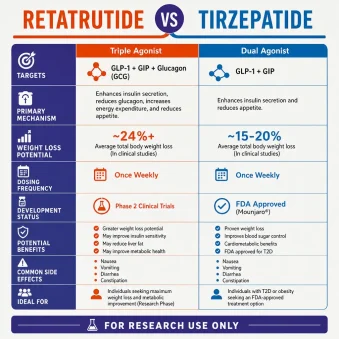
The same applies across that class. Tirzepatide at 39 residues carries a similar lipid modification. Retatrutide, covered in the triple agonist comparison, is built the same way.
— Michael Phelps, Founder & Peptide Research Specialist, PrymaLab
Two Words in the Definition That Do a Lot of Work
Read the FDA wording again and two qualifiers are doing more than the number is.
The definition covers any alpha amino acid polymer with a specific, defined sequence greater than 40 amino acids.[1]
Alpha. That word restricts it to polymers of alpha amino acids, meaning the standard arrangement where the amino group sits on the carbon adjacent to the carboxyl. It leaves out beta-peptides, peptoids and other backbone-modified chains that chemists build precisely because they resist the enzymes that cut ordinary peptide bonds. A 45-residue beta-peptide is not a protein by this definition, whatever else it is.
Specific, defined sequence. This one has a consequence the collagen section below runs straight into. A hydrolysate has no specific defined sequence. Break a protein into fragments and you get a distribution of many sequences, so the material fails that clause regardless of how long any individual fragment happens to be. Collagen peptides are not proteins under this definition, and it is not because the fragments are short.
I would not have predicted either of those from the headline number, and both are the kind of detail that decides an argument if one ever arises about a particular product.
There is a related observation on the metabolic drugs that I want to state carefully. Native GIP is 42 amino acids. Tirzepatide, which is built on a GIP analogue backbone, is 39. So the natural hormone sits above the line and the drug derived from it sits below. I am not claiming anyone shortened it for that reason, and I have seen no evidence that they did. It is a fact about two numbers that I noticed while assembling the table and could not stop looking at.
Peptides Are Not Steroids
This question gets nearly ten thousand searches a month and the answer is short, so the section is short.
Steroids are built on a fused four-ring carbon skeleton, derived biosynthetically from cholesterol. Testosterone, cortisol, oestradiol, and the anabolic steroids all share that core. No amino acids anywhere.
Peptides are chains of amino acids joined by peptide bonds, with no ring system of that kind.
They also do different things. Steroids are small and lipophilic, so they cross the cell membrane and bind intracellular receptors that act as transcription factors. Most peptides bind receptors on the cell surface and signal through second messengers without entering the cell. That is the same divide covered in the SARMs and peptides comparison, since SARMs act on the same intracellular receptor steroids do.
The two categories share a marketplace and nothing else.
What Changes With Length, Analytically
The regulatory line is administrative. There is a separate, real gradient in how hard a molecule is to verify, and it tracks length closely enough to be worth setting out. This is the part of the article with a practical use.
Under about fifteen residues. Tandem mass spectrometry can sequence the molecule directly, reading it residue by residue from the fragmentation pattern. You get the mass and the residue order. KPV at three residues and BPC-157 at fifteen sit here. If a supplier of a short peptide cannot confirm sequence, that is a choice rather than a limitation of the technique.
Roughly fifteen to forty. Mass confirmation is straightforward, sequencing is harder, and the practical problem becomes deletion sequences: chains missing one residue from a coupling step that did not go to completion. A 30-mer missing one glycine differs by 57 daltons and can co-elute with the correct product on a routine gradient. Purity by a single-wavelength chromatographic method will not always separate them. VIP at 28 residues and semaglutide at 31 are here.
Above forty. Now folding matters, and no purity assay detects it. A chain with the correct sequence and the correct mass can be misfolded and inactive, and reversed-phase chromatography will not tell you. If the material was expressed in cells rather than synthesised, glycosylation enters as well, and glycosylation patterns vary with the host cell line. Size-exclusion chromatography becomes the method that earns its place, because it detects the aggregates these molecules form readily.
That gradient explains why the recombinant items discussed in the myostatin reference need different certificates from the fifteen-residue compounds that make up most of this catalogue. It also explains why the 40-residue line, arbitrary as the FDA admitted it to be, is not a stupid place to put it. Somewhere around there is where the analytical questions genuinely change.
Things in Peptide Catalogues That Are Not Peptides
Including ours, which is why I am writing this section rather than leaving it out.
A peptide catalogue is organised by what people buy together, not by chemical class. That is a reasonable commercial decision and it produces a category label that is not a chemical claim. Some examples from our own shelves:
- NAD+ is a dinucleotide of roughly 663 daltons, built from adenine, nicotinamide, two ribose sugars and two phosphates. No amino acids. The delivery problems that follow from its size and charge are covered in the NAD+ routes reference.
- Methylene blue is a phenothiazine dye. A small organic molecule, no relation.
- 5-amino-1MQ is a small molecule enzyme inhibitor.
- SARMs contain no amino acids at all, as covered in the comparison above.
- Tesofensine is a small molecule reuptake inhibitor.
Two genuine edge cases where the answer surprises people. Glutathione is a peptide, a tripeptide of glutamate, cysteine and glycine, though it is joined by an unusual gamma linkage at the glutamate rather than the standard alpha peptide bond. And cerebrolysin is a mixture of low molecular weight peptides and free amino acids derived from porcine brain tissue, which makes it peptide-containing rather than a peptide.
None of this is a criticism of how the industry organises itself. It is a warning against reasoning from the shelf to the chemistry. If a supplier tells you a product is a peptide, that is a statement about where it sits in their catalogue.
Collagen Peptides Are a Different Kind of Noun
Collagen peptides get more search volume than every research peptide combined, and they are a different sort of object from anything else in this article.
A research peptide is a single defined sequence. BPC-157 is GEPPPGKPADDAGLV, the same fifteen residues in every vial, characterised by that sequence.
Collagen peptides are hydrolysed collagen: a protein broken into fragments by acid, alkali or enzyme treatment. The result is a mixture of many different fragments of varying lengths and sequences, characterised by an average molecular weight distribution rather than by a sequence, because there is no single sequence to state.
So “peptide” in the two phrases does different work. One names a molecule. The other names a size class of protein fragments.
That distinction has a consequence for how each can be verified. You can confirm a defined peptide by mass spectrometry against an expected mass. You cannot do that for a hydrolysate, because there is no single expected mass, which is why those products are specified by molecular weight ranges instead.
Where Everything Lands
| Compound | Amino acids | Peptide? | US regulatory class |
|---|---|---|---|
| KPV | 3 | Yes | Drug pathway |
| BPC-157 | 15 | Yes | Drug pathway |
| VIP | 28 | Yes | Drug pathway |
| Semaglutide | 31 | Yes, modified | Drug |
| Tirzepatide | 39 | Yes, modified | Drug, one under the line |
| Insulin | 51 | No, protein | Biologic since 23 Mar 2020 |
| Human growth hormone | 191 | No, protein | Biologic |
| NAD+ | 0 | No | Not applicable |
| Ostarine | 0 | No | Not applicable |
Growth Hormone, and Why It Is in a Different Conversation
Human growth hormone gets asked about in the same breath as the peptides on this site and it belongs somewhere else entirely.
hGH is 191 amino acids. Nearly five times the FDA line. It is a protein, a biological product, and it has an internal structure of four helices held by two disulfide bonds that has to be correct for the molecule to work.
Which puts it firmly in the analytical tier where purity figures stop answering the question. A correctly-sequenced hGH that folded wrong is inactive, and a chromatography peak will not distinguish it from one that folded right.
The reason people group it with peptides is functional rather than chemical: the growth hormone secretagogues, sermorelin and ipamorelin and the rest, are short peptides that act on the pituitary to change hGH output. Those are peptides. The hormone they act on is not. That distinction runs through the whole secretagogue comparison, where the entire premise is stimulating an endogenous protein rather than supplying it.
It is a good illustration of how the category label misleads. Sermorelin at 29 residues and hGH at 191 sit at opposite ends of the classification, opposite sides of the regulatory line, and in the same conversation, because what they have in common is a pathway rather than a chemistry.
Why Any of This Matters to a Buyer
Three things, and the third is the one I care about.
It tells you which regulatory conversation a compound is in. The July 2026 compounding review covered peptides, and no protein above 40 residues was on that agenda, because compounding rules for biologics work differently. That is set out in the legality reference.
It tells you what analytical methods are appropriate. A defined peptide can be confirmed by mass spectrometry against an expected mass. A protein above 40 residues has folding and, if expressed rather than synthesised, glycosylation, neither of which a purity figure detects. A hydrolysate has no single expected mass at all.
And it tells you when a supplier’s category label is doing no work. If a page says peptide and the compound has no amino acids, the word is describing a shelf. That is not dishonest, and it becomes a problem the moment anyone reasons from the label to the chemistry, which is what happens whenever someone applies peptide storage guidance to a small molecule or expects a dinucleotide to behave like a chain of residues.
What This Article Does Not Settle
Whether 40 is the right number. The FDA chose it for administrative clarity rather than as a claim about where protein behaviour begins, and it acknowledged that proteins can be smaller.
Whether any molecule has been designed with the threshold in mind. Tirzepatide at 39 residues is one under it, which I have noted and am not going to build an argument on.
How other jurisdictions draw the line, which I have not researched. Everything here is United States regulation and should not be assumed to transfer.
What is well established: the FDA definition and its effective date, the reasoning the agency gave, that chemically synthesised polypeptides above 40 residues are biological products, and that insulin transitioned on that date. Those are checkable in the rulemaking documents.
Is Ozempic a peptide?
Yes. Ozempic is a brand name for semaglutide, a 31-amino-acid analogue of human GLP-1(7-37) with three deliberate changes: alpha-aminoisobutyric acid at position 8 so that DPP-4 cannot cleave it, arginine at position 34, and a C18 fatty diacid attached through a linker at lysine 26 so that the molecule binds albumin and stays in circulation for about a week. Each of those changes is a modification to a peptide, not a departure from being one. At 31 residues semaglutide sits well under the FDA’s 40-amino-acid ceiling, so by chemistry and by law the active ingredient in Ozempic is a peptide drug. The same is true of Wegovy and of the oral tablet Rybelsus, which contain the same molecule at different doses.
What separates it from the peptides in a research catalog is everything wrapped around the molecule rather than the molecule itself. Ozempic is a sterile, preserved solution in a fixed-dose pen, manufactured under a New Drug Application, with a label that specifies a 0.25 mg starting dose and the 0.5, 1 and 2 mg steps that follow. A research peptide is usually a lyophilized powder in a vial, sold by mass rather than by dose, with a certificate of analysis for identity and purity and no clinical label at all. The small peptides that fill research catalogs are also far less engineered than semaglutide: BPC-157 at 15 residues and DSIP at 9 carry no fatty acid chain, do not bind albumin, and have half-lives measured in minutes rather than days, which is one reason their literature is thinner and their dosing in studies so much less settled.
PrymaLab sells research-grade semaglutide as lyophilized vials, from Semaglutide 5mg to Semaglutide 30mg, for laboratory use. It does not sell Ozempic, Wegovy or any other prescription product, and a research vial is not a substitute for one. The same distinction applies to tirzepatide: the Tirzepatide 10mg vial is research-grade peptide, not Mounjaro or Zepbound. The semaglutide research guide covers the molecule and its trials in detail, and the peptide reconstitution calculator covers what a lyophilized vial becomes once bacteriostatic water is added.
Frequently Asked Questions
Is Ozempic a peptide?
Yes. Ozempic is a brand of semaglutide, a 31-amino-acid GLP-1 analogue carrying a C18 fatty diacid chain that binds albumin and extends its half-life to about a week. At 31 residues it sits under the FDA’s 40-amino-acid ceiling for peptides, so it is a peptide drug by both chemistry and law. PrymaLab sells research-grade semaglutide, not Ozempic.
Is tirzepatide a peptide?
Yes. Tirzepatide is 39 amino acids long, one short of the 40-residue line the FDA uses to separate peptides from proteins, and it carries a C20 fatty diacid on lysine 20. It was approved as a drug under a New Drug Application rather than as a biologic, which is why its eventual copies will be generics rather than biosimilars. Research-grade tirzepatide is the same peptide without the clinical formulation.
What is the difference between a peptide and a protein?
Chemically there is no hard line: both are chains of amino acids joined by amide bonds, and proteins are simply longer chains that fold into stable structures. The line that has consequences is legal. In the United States the FDA counts a molecule of 40 or fewer amino acids as a peptide, regulated as a drug, and 41 or more as a protein, regulated as a biologic.
Is insulin a peptide?
Chemically insulin is often called a peptide hormone, but in US law it is a protein. Its 51 amino acids sit in two chains linked by disulfide bonds, which puts it above the FDA’s 40-residue ceiling, and in March 2020 insulin products were transferred to the biologics pathway. Copies of insulin are therefore biosimilars, while copies of a 39-residue peptide such as tirzepatide would be generics.
Are collagen peptides the same as research peptides?
No. Collagen peptides are a food ingredient: hydrolyzed collagen broken into short fragments of mixed length and sequence, sold by the gram as a supplement. Research peptides are single defined sequences, such as BPC-157 or semaglutide, synthesized to a specification and sold by the milligram with a certificate of analysis. The word is the same; the chemistry, regulation and use are not.
Is tirzepatide a peptide?
Yes, and only just by the regulatory definition. It is 39 amino acids, one under the FDA’s 40-residue line, which makes it a drug rather than a biological product.
Where does a peptide become a protein?
Biochemistry has no hard line. The FDA does: greater than 40 amino acids is a protein, effective 23 March 2020. Forty or fewer is a peptide regulated as a drug.
Is Ozempic a peptide?
Semaglutide is 31 amino acids, so yes. It carries a non-natural residue at position 8 and a fatty diacid on lysine 26, neither of which changes the classification.
Is insulin a peptide or a protein?
A protein at 51 residues. It was deemed licensed as a biological product on 23 March 2020, without the molecule changing at all.
Are peptides steroids?
No. Steroids are built on a four-ring carbon skeleton from cholesterol and contain no amino acids. They also act on intracellular receptors rather than surface ones.
Is NAD+ a peptide?
No. It is a dinucleotide of about 663 daltons with no amino acids. It appears in peptide catalogues because those are organised commercially.
Are collagen peptides the same kind of thing?
No. They are hydrolysed collagen, a mixture of fragments characterised by average molecular weight rather than a single defined sequence.
Why does the FDA definition say “specific, defined sequence”?
Because it excludes mixtures. A hydrolysate has no single defined sequence, so it fails that clause whatever the fragment lengths are. The word “alpha” does similar work, leaving out backbone-modified chains such as beta-peptides and peptoids.
What changes analytically as peptides get longer?
Under about fifteen residues you can sequence directly by tandem mass spectrometry. Between fifteen and forty the problem is deletion sequences that co-elute with the correct product. Above forty, folding matters and no purity assay detects it.
Why does the classification matter?
It decides which statute applies. Peptides are drugs with generics; proteins are biological products with biosimilars. The FDA called the 40-residue rule a bright line chosen for clarity.
Related reading
- Tesofensine: trials, half-life and approval status
- MK-677 (ibutamoren): mechanism, trials and side effects
References
- US FDA. Definition of the term “biological product”, final rule, effective 23 March 2020. Defines protein as any alpha amino acid polymer with a specific, defined sequence greater than 40 amino acids in size, and states the bright-line rationale. Federal Register and FDA guidance
- Transition of previously approved protein products, including insulin, to being deemed licensed biological products under the Biologics Price Competition and Innovation Act.
- Amino acid counts for semaglutide, tirzepatide, insulin and human growth hormone.
Regulatory positions described are United States federal law as of 19 August 2026 and should not be assumed to apply in other jurisdictions. This article is not legal advice.
Final disclaimer: This article is an educational research reference on chemical and regulatory classification. Compounds supplied by PrymaLab are sold and studied for laboratory research use only and are not approved by any regulatory authority for human or veterinary use. Statements have not been evaluated by the FDA. Nothing here is medical advice, administration guidance, or a treatment claim.
Approved medicines are named for classification purposes only and their inclusion does not describe or support any use of research-grade material. This article is written by a peptide supplier rather than a lawyer and is not legal advice. Always verify the legal status of any research compound in your jurisdiction before purchase or use.
Formats stocked for the compounds in this article
Tirzepatide: Tirzepatide 5mg, Tirzepatide 15mg, Tirzepatide 20mg, Tirzepatide 30mg, Tirzepatide 40mg and Tirzepatide 50mg. Every listing is supplied for laboratory research use with a batch certificate of analysis.