Description
PrymaLab · Research use only
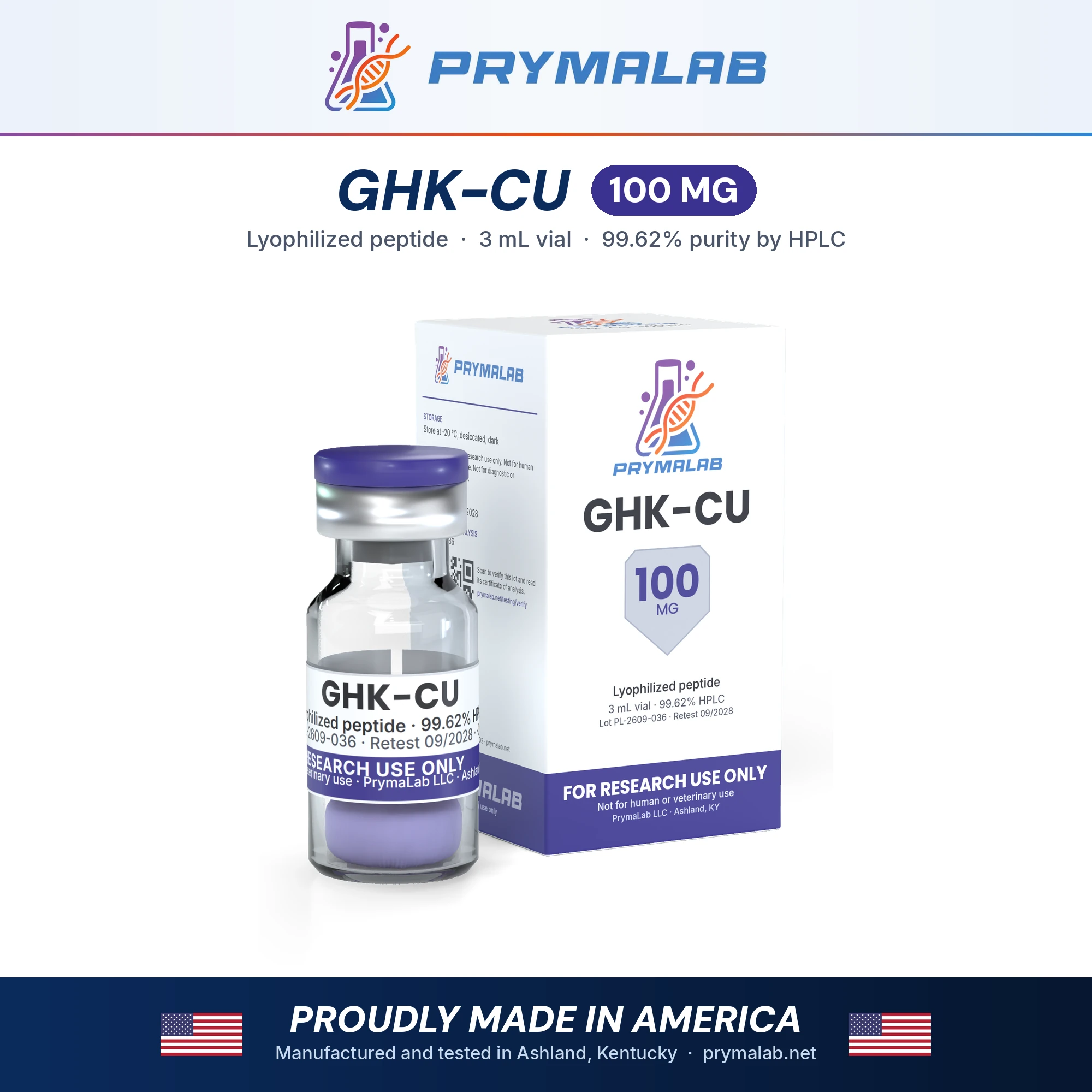
GHK-CU 100MG
Copper(II) complex of glycyl-histidyl-lysine, 100 mg of blue freeze-dried powder
GHK-Cu is the tripeptide glycyl-L-histidyl-L-lysine holding one copper(II) ion, a complex first found in human plasma. This listing is the 100 mg vial of blue freeze-dried powder, the main fill of the range; a 50 mg vial, a preloaded pen and a nasal spray are also sold. Published work on GHK-Cu deals mostly with dermal fibroblasts and the extracellular matrix: collagen and glycosaminoglycan synthesis, the enzymes that remodel the matrix, and gene expression data gathered later.
Specifications
| Property | Value |
|---|---|
| Compound | GHK-Cu Copper tripeptide-1; Gly-His-Lys · Cu(II) |
| CAS number | 89030-95-5 |
| Molecular formula | C14H22CuN6O4 |
| Theoretical mass | 401.9 Da |
| Sequence / structure | H-GHK-OH · Cu(II) (1:1 complex; copper bound by the Gly α-amine, the Gly–His amide nitrogen and the His imidazole) |
| Label claim | 100 mg/vial |
| Form | Lyophilized (freeze-dried) powder or cake in a sealed glass vial with a rubber stopper and aluminium crimp cap |
| Storage, sealed | −20 °C, desiccated, dark |
| Purity specification | 99.0% or higher by RP-HPLC |
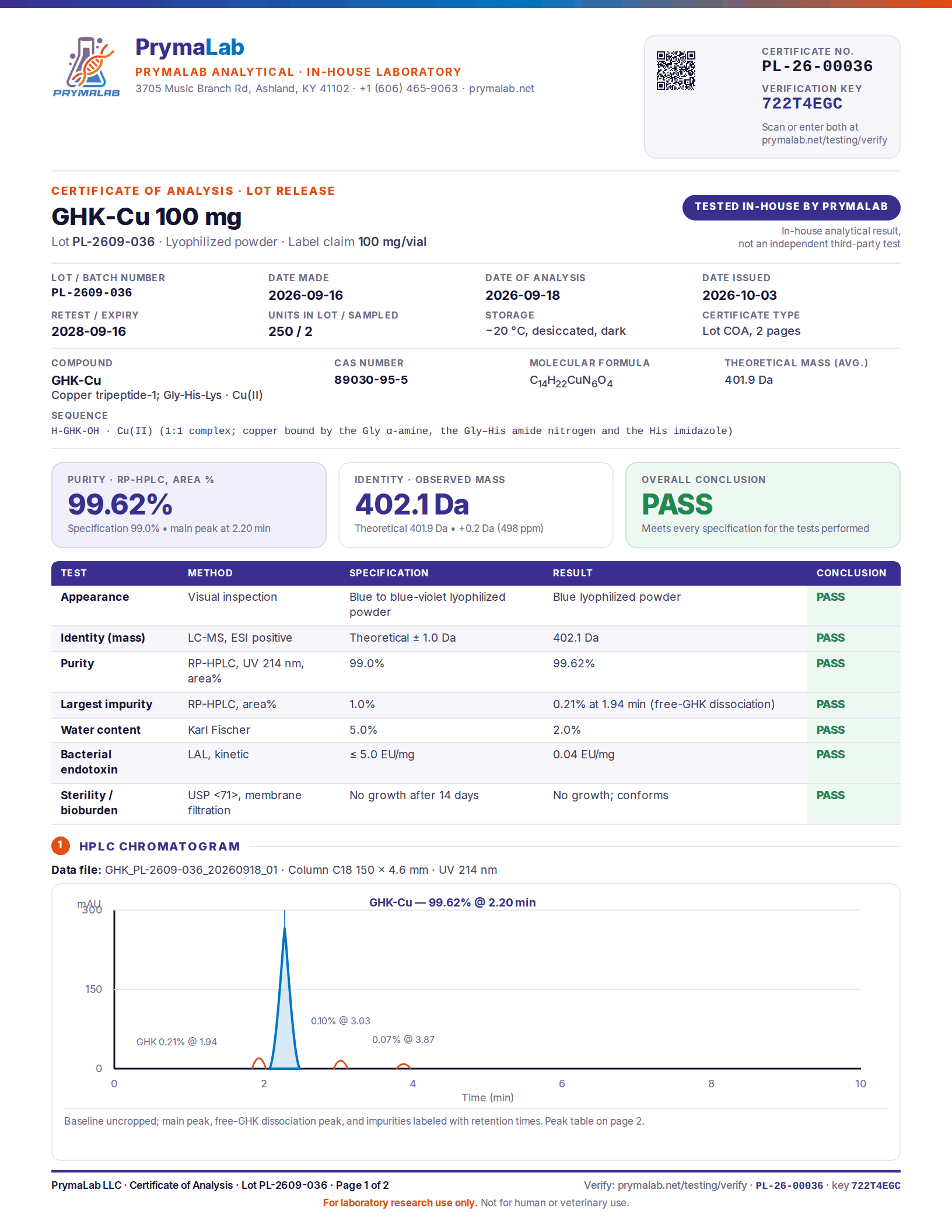
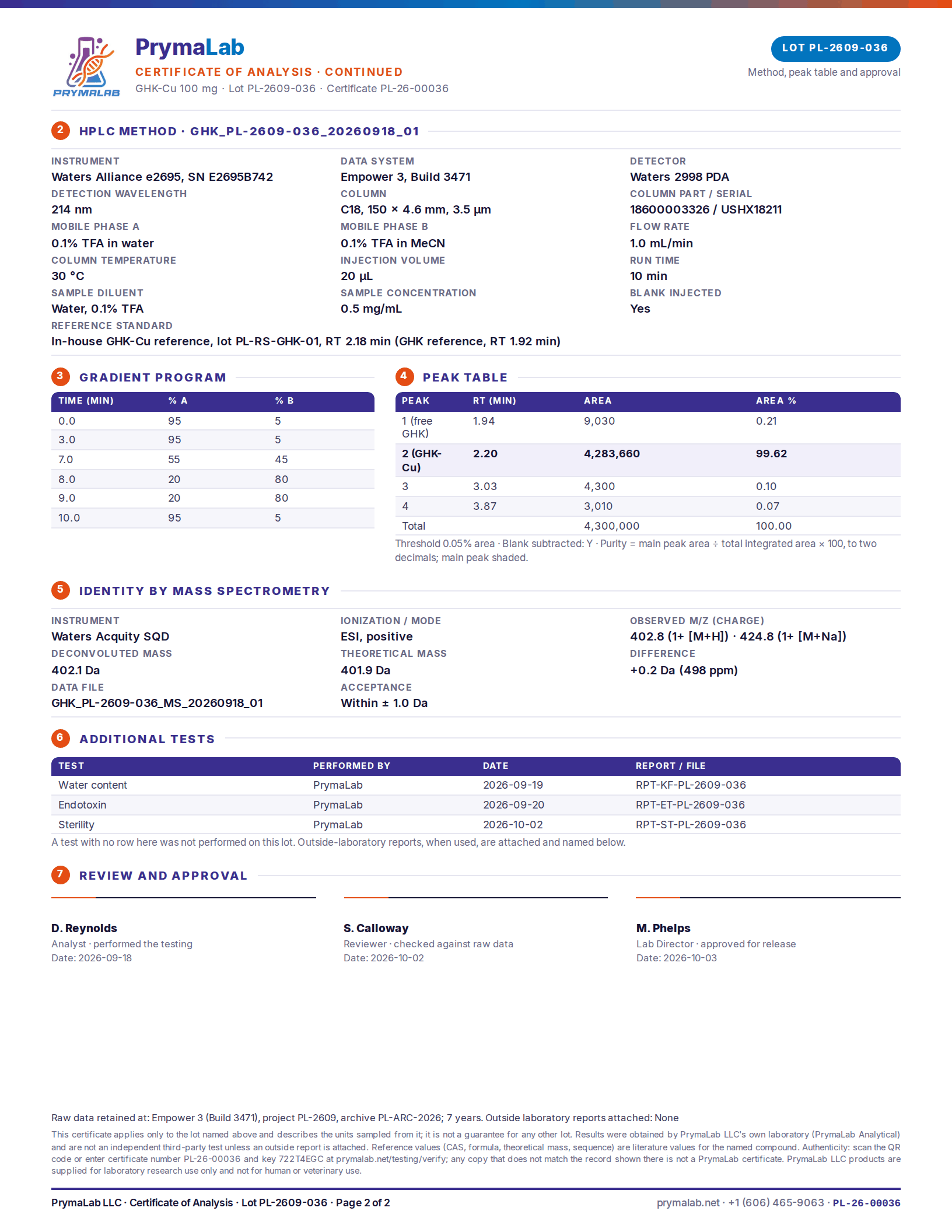
| Lot certificate | Results for the lot now shipping are in the certificate panel on this page |
| Safety data sheet | PL-SDS-058 |
Fills in this range
GHK-Cu is sold in 2 fills. The compound and the testing are the same in every fill; only the amount in the vial changes.
| Fill | Listing |
|---|---|
| 50 mg | GHK-CU 50MG |
| 100 mg | GHK-CU 100MG (this page) |
The copper complex in this vial
The certificate describes a 1:1 complex: one Gly-His-Lys chain holding one Cu(II) ion, bound through the glycine α-amine, the amide nitrogen between glycine and histidine, and the histidine imidazole. The formula is C14H22CuN6O4 and the theoretical mass 401.9 Da; the LC-MS identity result on the current lot certificate is 402.1 Da. At that mass, 100 mg comes to about 249 µmol of complex, a little less in practice because the powder also carries the residual water the certificate reports.
The copper is also why the powder is blue, and GHK-Cu solutions keep the colour: the safety data sheets for the ready-made formats describe them as clear blue to blue-violet and say to discard solution that has discoloured or turned cloudy. One disposal point is specific to this compound. Copper ions are toxic to aquatic organisms, so concentrated solutions should not go down a drain. More on keeping the complex intact is in GHK-Cu storage and handling.
What the research covers
What GHK-Cu is
GHK is a tripeptide with an affinity for copper(II) ions, and it was first isolated from human plasma1. It has since been found in saliva and urine as well, and its plasma level falls with age2. Pickart and colleagues proposed that it works as a complex with copper that speeds wound healing and skin repair2. Maquart’s group pointed to a possible source: the GHK sequence occurs within the α2(I) chain of type I collagen, so proteases breaking down collagen at a wound might release the tripeptide where repair is under way1. In that paper the release was a suggestion, not a measurement.
Fibroblast and matrix studies
The founding cell result dates from 1988. In fibroblast cultures, GHK-Cu raised collagen synthesis from concentrations between 1 and 10 picomolar, with the largest effect at 1 nanomolar, and the rise did not depend on any change in cell number1. A study published in 2000 looked at the enzymes that break the matrix down. GHK-Cu raised MMP-2 in the medium of cultured dermal fibroblasts, together with its mRNA, and it also increased secretion of the inhibitors TIMP-1 and TIMP-23. Copper ions alone reproduced the MMP-2 effect, while GHK without copper did not3. The authors concluded that the complex drives remodelling of the matrix as well as its production3.
Reviews by Pickart and co-authors widen the list. The 2015 review describes GHK as stimulating both the synthesis and the breakdown of collagen and glycosaminoglycans, increasing dermatan sulfate, chondroitin sulfate and the small proteoglycan decorin, restoring the capacity of fibroblasts to divide after radiation, and drawing immune and endothelial cells to an injury2.
Animal and cosmetic findings
The same review lists faster wound healing in skin, hair follicles, the gastrointestinal tract, bone and the foot pads of dogs, and systemic wound healing in rats, mice and pigs2. It also summarises cosmetic studies in which products containing the peptide tightened loose skin, improved elasticity and density, and reduced fine lines, photodamage and hyperpigmentation2. The abstract gives no designs or sample sizes for these, so the individual papers have to be read before weighing them. The 2018 review adds repair of lung connective tissue, liver and stomach lining, along with reported anti-inflammatory and anti-cancer activity and suppression of NF-κB4.
Gene expression
Later work moved from single proteins to gene expression. The 2015 review states that GHK can raise or lower the expression of at least 4,000 human genes2, and the 2018 review argues that these data may explain how one small molecule produces so many unrelated actions4. The exact gene count differs between secondary sources, so the primary analyses are where to check the method and the threshold used.
What is not established
Much of this literature passes through one author. Loren Pickart, who isolated GHK, is a co-author of three of the four papers cited here, and the 2018 review calls every known action of the peptide health-positive, a summary judgement rather than a tested result4. The two primary studies are cell culture work1,3. The animal and cosmetic results reach this page through review abstracts, without the designs needed to judge them, and none of the papers used PrymaLab material. The GHK-Cu peptide guide covers the wider literature, including the wound and hair-follicle studies.
How each lot is tested
Every lot is tested in PrymaLab’s own laboratory in Ashland, Kentucky before release: RP-HPLC for purity, LC-MS for identity, Karl Fischer titration for water, LAL for endotoxin and USP <71> for sterility. The results for the lot now shipping are in the certificate panel on this page, and the certificate number, key and QR code can be checked on the verify page. These are in-house results from PrymaLab Analytical, not an independent test, and the lab is not accredited to ISO 17025. The third-party testing guarantee on this page still applies: if any independent laboratory finds the wrong compound, or less than the stated purity or amount, the order is refunded and the cost of the test is reimbursed.
Frequently asked questions
Why is GHK-Cu powder blue?
The colour comes from the copper(II) ion held by the peptide. The certificate lists the appearance as blue lyophilized powder, and solutions made from it are clear and blue as well. A solution that turns cloudy or changes colour is no longer behaving like the complex on the certificate and should be set aside.
How do the 100 mg and 50 mg vials differ?
Only in the amount of complex. Both hold the same Gly-His-Lys copper(II) complex as blue freeze-dried powder, and each fill is made and tested as its own lot with its own certificate number. With the same volume of diluent, the 100 mg vial gives twice the concentration.
Is GHK the same thing as GHK-Cu?
No. GHK is the tripeptide on its own; GHK-Cu is that tripeptide holding one copper ion, which is what this vial contains. The distinction matters in experiments: in one fibroblast study, copper ions reproduced the effect of GHK-Cu on the enzyme MMP-2 while GHK without copper did not.
How should the vial be stored before and after reconstitution?
Sealed, at −20 °C, desiccated and protected from light. Let the vial warm to room temperature before opening so moisture does not condense on the powder. Once reconstituted, keep the solution at 2 to 8 °C away from light and use it within the period your laboratory has established.
Where do I find the certificate for my lot?
The lot number is printed on the vial label. Match it to the certificate panel on this page, which shows the lot now shipping, or look up older lots on the testing results page. The verify page confirms a certificate from its number and key.
Can GHK-Cu from this listing be used on people or animals?
No. It is sold for laboratory research only, has no FDA or other regulatory approval for human or veterinary use, and must not be given to people or animals, applied to skin or added to any cosmetic product.
References
- Maquart FX, Pickart L, Laurent M, et al. Stimulation of collagen synthesis in fibroblast cultures by the tripeptide-copper complex glycyl-L-histidyl-L-lysine-Cu2+. FEBS Lett. 1988;238(2):343-6. DOI · PubMed
- Pickart L, Vasquez-Soltero JM, Margolina A. GHK Peptide as a Natural Modulator of Multiple Cellular Pathways in Skin Regeneration. Biomed Res Int. 2015;2015:648108. DOI · PubMed
- Siméon A, Emonard H, Hornebeck W, et al. The tripeptide-copper complex glycyl-L-histidyl-L-lysine-Cu2+ stimulates matrix metalloproteinase-2 expression by fibroblast cultures. Life Sci. 2000;67(18):2257-65. DOI · PubMed
- Pickart L, Margolina A. Regenerative and Protective Actions of the GHK-Cu Peptide in the Light of the New Gene Data. Int J Mol Sci. 2018;19(7). DOI · PubMed
Research use only
For laboratory research use only. GHK-CU 100MG is not a drug, food, cosmetic or dietary supplement, is not approved by the FDA or any comparable authority for human or veterinary use, and must not be given to people or animals. It is sold to qualified researchers and institutions, and the buyer is responsible for lawful handling and disposal.
Other formats of GHK-CU
GHK-CU is also stocked as GHK-Cu Nasal Spray and GHK-CU 50mg/ml preloaded 3ml pen. Each listing states its own quantity and concentration, and the pen and vial comparison explains what changes between formats.








Reviews
There are no reviews yet.