
Description
PrymaLab · Research Use Only
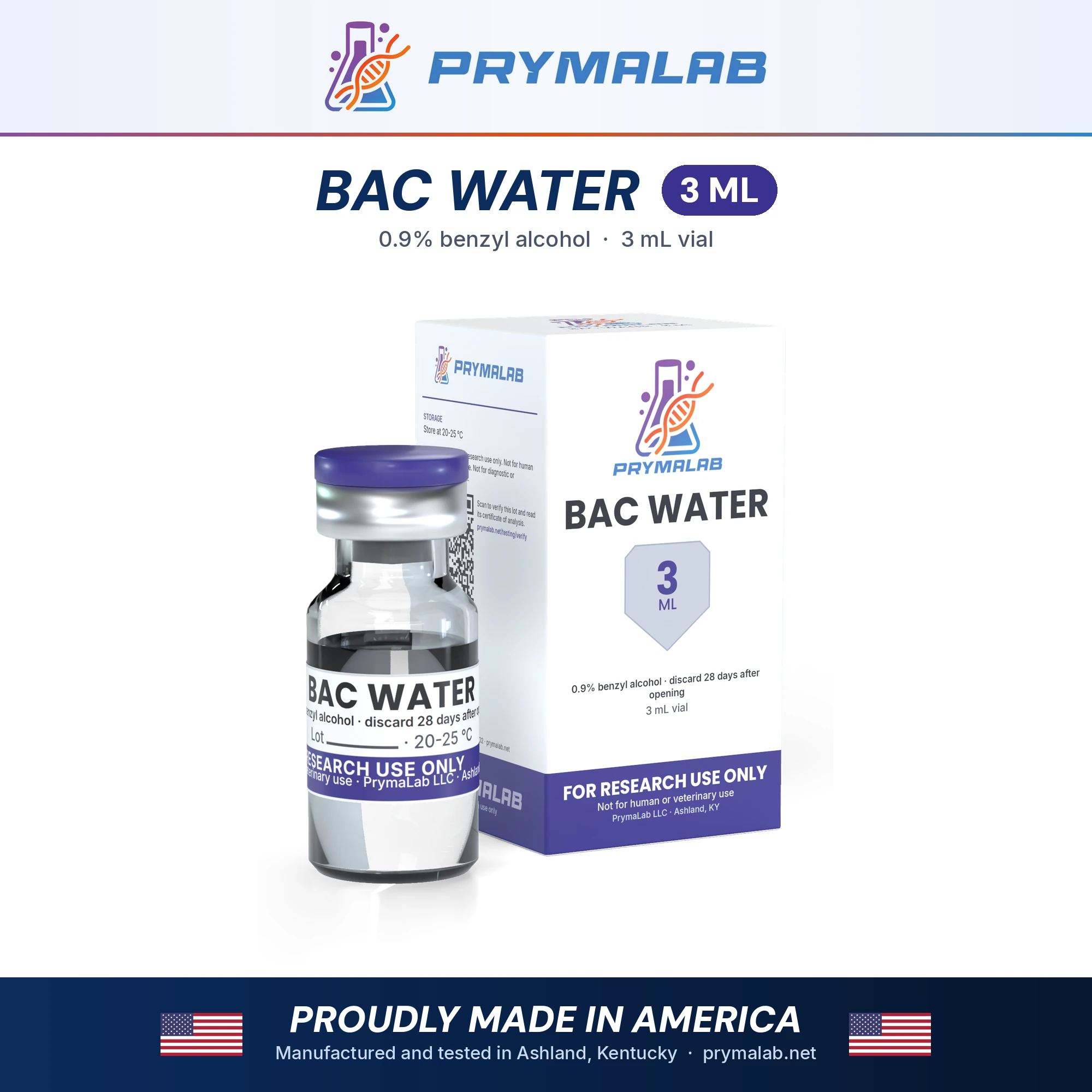
Bacteriostatic Water 3ml
The container that gets emptied before the preservative question matters
Bac water 3ml is the same liquid as the 10ml, at the same preservative concentration, in a smaller container. The reason to choose it has nothing to do with needing less water. It is that a smaller container gets used up faster, and almost every problem a preserved diluent has gets worse with time and with entries.
Specification Table
| Property | Value |
|---|---|
| Article | Bacteriostatic water, laboratory diluent |
| Composition | Water with benzyl alcohol added as an antimicrobial preservative |
| Preservative concentration | 0.9 percent weight by volume, the same as the larger format |
| Volume | 3 millilitres |
| Comparison format in this catalogue | 10 millilitres |
| Difference in composition | None. Only the volume differs |
| Typical entries before empty | Considerably fewer than a 10ml vial |
| Consequence for the preservative | Less benzyl alcohol carried into a study in total |
| Consequence for the container | Less time between first entry and last |
| Consequence for the stopper | Fewer punctures, so less coring risk over the life of the vial |
| What bacteriostatic means | Inhibits bacterial multiplication. It does not sterilise |
| Not supplied as | A drug product. Approved bacteriostatic water for injection is a separate regulated article |
| Storage | Room temperature, sealed, away from light |
| After first entry | Record the date. Preserved does not mean indefinite |
Why Choose Bac Water 3ml Over the Larger Vial?
Because the arguments against a preserved diluent are all arguments about accumulation, and a bac water 3ml container accumulates less.
The 10ml page in this catalogue sets out the chemistry. Benzyl alcohol partitions into hydrophobic protein interiors, stabilises partially unfolded states and promotes aggregation, and that has been in the pharmaceutical sciences literature since the 1990s.
It is a small effect on a short synthetic peptide and a real one on anything larger or aggregation prone.
Every preparation made from a preserved vial carries some of it into the experiment.
A 3 millilitre vial supplies fewer preparations, so less of the preservative ends up in the work overall.
That is a weaker argument than it first sounds, because the concentration in any single preparation is set by the dilution rather than by the container size.
The stronger argument is about time.
A vial that is emptied in three weeks spends three weeks being entered, exposed to headspace air and losing a little preservative to oxidation each time it is opened. A vial that takes six months to empty spends six months doing that, and the solution at the end is not the solution at the start.
What Happens to a Diluent Vial Over Time?
Three things happen to a bac water 3ml vial over time, and none of them is dramatic.
Benzyl alcohol oxidises slowly to benzaldehyde and then to benzoic acid on exposure to air and light. That is slow at room temperature in a closed vial and it is not zero, and every entry replaces some headspace with fresh air.
The preservative concentration falls as volume is withdrawn and headspace grows, which means the bacteriostatic margin narrows over the life of the vial rather than staying constant.
The stopper accumulates punctures. Coring, where a fragment of stopper is pushed into the vial by a needle, becomes more likely with each entry, and a cored vial contaminates every preparation made from it afterwards.
Nobody checks for coring. It is a visible failure if you look for it and almost nobody does.
All three of those scale with entries rather than with volume, which is the whole case for the smaller container.
When Is the Larger Vial Still Right?
When the alternative is buying four bac water 3ml vials, which is worse.
Four containers means four first-entry dates, four lot numbers if they came from different lots, and four opportunities to grab the wrong one.
A laboratory running continuously through diluent should buy the volume it actually consumes, and for many that is the 10 millilitre.
The 3 millilitre suits a defined piece of work with a start and an end: one study, one container, discarded at the end whether or not it is empty.
That last part is the bit people resist, and it is the point. A diluent vial retained across studies is a variable carried between them, and the whole value of the small format is that discarding it costs almost nothing.
I would rather see a laboratory throw away 1 millilitre of preserved water than carry a six-month-old vial into a new experiment, and the cost difference is trivial next to the cost of an uninterpretable result.
What Should the Label Establish?
The same fields the larger format needs, since the article is identical.
The preservative named with its concentration, rather than the word bacteriostatic alone.
The water grade the preservative was added to.
Sterility as a claim with a method behind it.
An endotoxin figure where the work involves cell culture, since endotoxin passes through a sterilising filter.
The container closure type, because a stopper that reseals reliably is what any multiple-entry format depends on.
Lot number and an expiry or retest date.
On a small vial the closure specification carries slightly more weight than it does on a large one, because the stopper is smaller and the same needle takes a proportionally larger bite out of it.
How Many Entries Is Too Many?
Nobody has published a number and I am not going to invent one.
What can be said is which direction the risk runs and what governs it.
Each entry replaces withdrawn volume with room air, which brings oxygen for the slow oxidation of benzyl alcohol and whatever the air in that room contains.
Each entry also punctures the stopper once more, and stopper resealing is specified for a finite number of punctures rather than for indefinite use.
Manufacturers of multiple-entry containers do test closure integrity across repeated punctures, and the figures live in stability documentation rather than on a label.
Asking a supplier what puncture count the closure was qualified for is a reasonable question and I have never seen anyone ask it.
The practical position is that a 3 millilitre vial will be empty long before any plausible limit, which removes the question rather than answering it.
That is the honest case for the small format: not that it solves the entry problem, but that it makes the problem too small to need solving.
What About Unpreserved Water?
It is the correct choice more often than people assume, and this catalogue does not sell it, which I should say rather than skip past.
Sterile water for injection carries no preservative, so a container is entered once and discarded.
For a single preparation used the same day, that is strictly better than a preserved diluent: no benzyl alcohol enters the experiment, no diluent-only control is needed, and the entry-count question never arises.
The case for a preserved diluent is entirely about repeated entry, and a preparation made once does not need it.
Where the 3 millilitre preserved format wins is the middle ground: a stock that will be sampled a handful of times over a couple of weeks, which is too many entries for an unpreserved container and far too few to justify a 10 millilitre one.
That middle ground covers a lot of laboratory work, which is why the format exists.
Worth adding that the choice between preserved and unpreserved is one of the few decisions on this page that a laboratory can get right without knowing anything about the compound being dissolved.
Count the number of times the container will be entered. One means unpreserved. More than one means preserved, and then the only remaining question is which size.
What Does Coring Look Like?
A small grey or black fleck in the solution, and that is all.
It happens when a needle punches out a fragment of the rubber stopper and carries it into the vial instead of parting the material cleanly.
Blunt needles do it more than sharp ones, large gauges more than small, and a stopper that has already been punctured several times more than a fresh one.
Inserting the needle at an angle rather than straight down reduces it, which is a technique point rather than a product one.
The reason it matters is that the fleck does not dissolve and does not always get drawn up, so a cored vial can look normal for the rest of its life while carrying particulate into every preparation.
Holding the vial up to a light before each entry is a two-second check that almost nobody performs.
On a 3 millilitre vial the total number of punctures stays low enough that the risk is small, which is one more thing the small format quietly buys.
How Should the Vial Be Handled?
Store bac water 3ml at room temperature, sealed and away from light.
Swab the stopper before each entry and use a fresh needle every time.
Write the date of first entry on the vial. On a 3 millilitre container that date and the empty date will be close together, which is the entire point of the format.
Keep a count of entries if the work is quantitative. It takes a pencil mark and it is the only record of how many times the closure has been punctured.
Do not decant into an unpreserved secondary container and then rely on it as preserved.
Discard at the end of the study rather than retaining the remainder.
Record the diluent, its lot, the preservative concentration and the first-entry date alongside the compound in any experimental record.
The diluent belongs in that record for the same reason the buffer does. A study that names the peptide and not the solvent has described half the preparation, and on a preserved diluent the half it left out is the one with a documented effect on protein structure.
One final point about the discard recommendation, since it is the part of this page most likely to be ignored.
A partly used diluent vial sitting in a drawer between studies has an unknown entry count, an unknown storage history and a first-entry date somebody wrote in pencil months ago.
It costs almost nothing and it carries an unknown into whatever it is used for next. Bin it and open a fresh one.
Published Literature
Selected references on preservative use in multiple-entry containers, on the effect of benzyl alcohol on protein conformation and on peptide storage generally. The 10ml page carries the same list, since the article is the same.
- Meyer BK, Ni A, Hu B, Shi L. Journal of Pharmaceutical Sciences. 2007;96(12):3155-3167. DOI: 10.1002/jps.20976
- Zhang Y, Roy S, Jones LS, Krishnan S, Kerwin BA, Chang BS, et al. Journal of Pharmaceutical Sciences. 2004;93(12):3076-3089. DOI: 10.1002/jps.20219
- Bis RL, Singh SM, Cabello-Villegas J, Mallela KMG. Journal of Pharmaceutical Sciences. 2015;104(2):407-415. DOI: 10.1002/jps.24105
- Manning MC, Chou DK, Murphy BM, Payne RW, Katayama DS. Pharmaceutical Research. 2010;27(4):544-575. DOI: 10.1007/s11095-009-0045-6
Frequently Asked Questions
Is the 3ml different from the 10ml?
No. Same water, same benzyl alcohol at 0.9 percent weight by volume. Only the volume differs.
Why choose the smaller vial then?
Because the problems a preserved diluent has all scale with entries and with time, and a smaller container is emptied faster.
Does it reduce preservative in a preparation?
No. The concentration in any single preparation is set by the dilution, not by the container size. It reduces the total carried into a study.
What is the stronger argument?
Time. A vial emptied in three weeks spends three weeks being entered and exposed to headspace air. One that takes six months does that for six months.
What happens to benzyl alcohol over time?
It oxidises slowly to benzaldehyde and then to benzoic acid on exposure to air and light. Slow in a closed vial, and every entry replaces headspace with fresh air.
Does the preservative concentration stay constant?
No. It falls as volume is withdrawn and headspace grows, so the bacteriostatic margin narrows over the life of the vial.
What is coring?
A fragment of stopper pushed into the vial by a needle. It becomes more likely with each entry and a cored vial contaminates every preparation made from it afterwards.
Is coring checked for?
Almost never. It is visible if you look and nobody looks.
When is the larger vial still correct?
When the alternative is four small ones. Four containers means four first-entry dates, four possible lots, and four chances to pick the wrong one.
What does the small format suit?
A defined piece of work with a start and an end. One study, one container, discarded at the end whether or not it is empty.
Should the remainder really be discarded?
Yes. A diluent vial retained across studies is a variable carried between them, and discarding 1 millilitre of preserved water costs almost nothing.
What belongs in the record?
The diluent, its lot, the preservative concentration and the first-entry date, recorded alongside the compound the same way a buffer would be.
Compliance Statement
Bacteriostatic water is sold exclusively for laboratory research use. It is not a drug, food, or cosmetic product, and it is not a dietary product of any kind. It is not approved by the FDA or any comparable authority for human or veterinary use, it is supplied as a laboratory diluent and is not a drug product, approved bacteriostatic water for injection is a separate regulated article and nothing here should be read as referring to it, the benzyl alcohol it carries is documented to affect protein conformation and is not an inert component of any preparation made with it, and no article in this range is offered for any human or veterinary purpose. This product is not intended to diagnose, treat, cure, or prevent any disease. It must not be given to humans or animals. Purchase is restricted to qualified researchers and institutions operating within applicable laws. All handling is the responsibility of the purchasing laboratory.
Other formats of BAC Water
BAC Water is also stocked as BAC Water (Bacteriostatic Water) 10ML. Each listing states its own quantity and concentration, and the pen and vial comparison explains what changes between formats.







24 reviews for BAC Water (Bacteriostatic Water) 3ML