15% SUMMER DISCOUNT APPLIED AUTOMATICALLY AT CHECKOUT FREE USA SHIPPING OVER $100  FREE WORLDWIDE SHIPPING OVER $200

15% SUMMER DISCOUNT APPLIED AUTOMATICALLY FREE USA SHIPPING OVER $100  FREE WORLDWIDE SHIPPING OVER $200

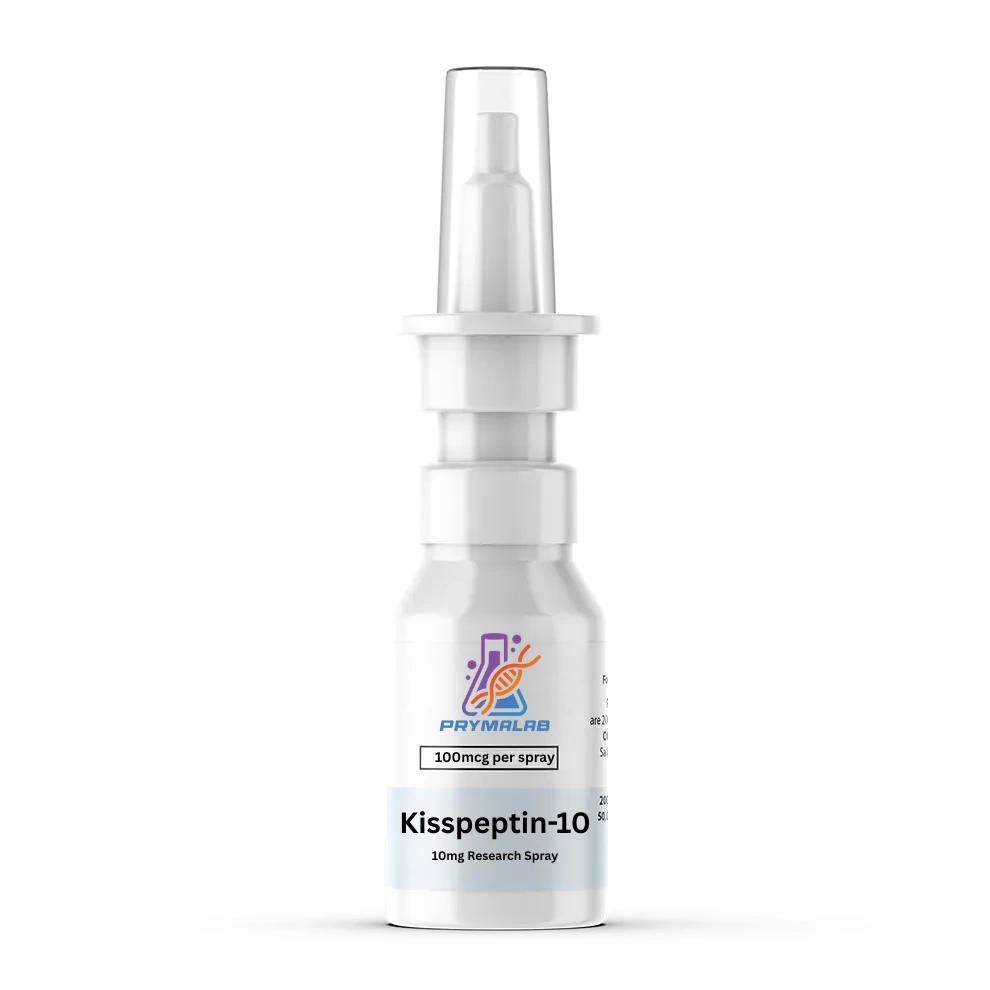
Kisspeptin-10 10mg Nasal Spray

(5 customer reviews)

$89.99 or subscribe for $75.99/mo

Kisspeptin-10 nasal spray supplies KP-10, the decapeptide YNWNSFGLRF-NH2 (CAS 374675-21-5, C63H83N17O14, 1302.4 Da), the C-terminal fragment shared by all active kisspeptins and the minimal sequence for full activity at KISS1R. C-terminal amidation is required for activity. Characterized by reversed-phase HPLC for purity and mass spectrometry for identity, with independent third-party testing. In-vitro laboratory research only. Not for human use.

Description

This kisspeptin-10 nasal spray supplies KP-10, the decapeptide Tyr-Asn-Trp-Asn-Ser-Phe-Gly-Leu-Arg-Phe-NH2 (YNWNSFGLRF-NH2), CAS 374675-21-5, molecular formula C63H83N17O14, molecular weight 1302.4 Da. One naming point causes more confusion than anything else about this compound, so it goes first: kisspeptin-10 is the same molecule as metastin (45-54), and the same as KISS1 (112-121). The KISS1 gene product is cleaved into kisspeptin-54, kisspeptin-14, kisspeptin-13 and kisspeptin-10, and all four share this identical C-terminal decapeptide. If you see those names on different pages, they are one peptide. Supplied for laboratory research use only.

Why this peptide sits at the top of the reproductive axis

Kisspeptin occupies an unusual position in endocrinology: it is upstream of almost everything else in reproductive signaling.

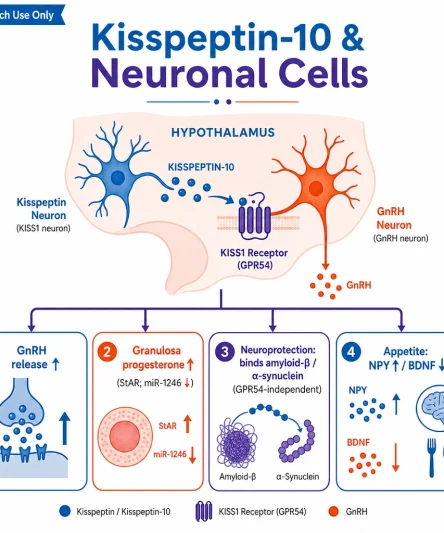
The KISS1 gene encodes a precursor, and the KISS1 gene product is cleaved into the kisspeptins, of which kisspeptin-54 is the longest and KP-10 the shortest active form. Acting on KISS1R, the receptor still widely called GPR54, kisspeptin neurons in the hypothalamus drive release of gonadotropin-releasing hormone. GnRH then reaches the pituitary gland and triggers gonadotropin secretion, meaning luteinizing hormone (LH) and follicle-stimulating hormone (FSH), which act on the gonads. That chain is the hypothalamic-pituitary-gonadal (HPG) axis, and kisspeptin sits at its head, which is why loss-of-function mutations in this pathway cause hypogonadotropic hypogonadism.

Because of that position, clinical research has examined it across a range of conditions affecting the reproductive system: infertility and fertility treatments including work alongside HCG, disordered ovulation, polycystic ovary syndrome or PCOS, and hypothalamic amenorrhea. Reproductive disorders of hypothalamic origin are the natural target for a compound acting at this level, and endocrine function studies typically measure reproductive hormone release and reproductive hormone levels, including serum testosterone levels, as the readout. Studies of this kind belong in a clinical trial setting with monitored participants.

That clinical framing is what gets stripped away in consumer writing, where the same biology is repackaged as libido, sexual arousal, sexual desire, sexual health, hormonal balance or a fix for hormonal imbalances, sometimes positioned alongside TRT and testosterone replacement therapy, and occasionally filed with nootropics. None of those outcomes is established for research material and none is claimed here. Reproductive health is a clinical matter for a clinician.

What is the impact of peptide sequence modifications on stability and receptor affinity?

Kisspeptin is close to a textbook case for this question, which is why it belongs on this page rather than a generic answer.

Start with truncation. The longer family members carry 54, 14 or 13 residues, and every one of them ends in the same ten. Despite carrying far more sequence, the extended forms do not outperform the decapeptide: the C-terminal fragment KP-10 shows higher receptor affinity and more potent functional responses than its longer counterparts. The extra residues are not doing the receptor work. That makes KP-10 the minimal sequence for full intrinsic activity and the reason it, rather than kisspeptin-54, is the standard laboratory tool.

Then the C-terminal amide. Kisspeptins belong to the RFamide family, named for the Arg-Phe-amide ending. That amide is not decorative. Removing it, or leaving a free acid where an amide belongs, changes the molecule’s behaviour at the receptor. When you check a certificate of analysis for this peptide, confirming amidation is as relevant as the purity figure, because a free-acid impurity is not a weaker version of the compound so much as a different one.

The third lever is protease resistance. Native KP-10 is cleaved rapidly, which is precisely why analogs exist. TAK-448 is the best-known example, engineered for stability while retaining KISS1R activity, and it appears alongside KP-10 in the recent structural work below. Comparing a native peptide against an engineered analog in the same assay is the cleanest way to separate a receptor effect from a stability artefact.

What the 2024 receptor structures show

KISS1R, also called GPR54, is a Gq-coupled class A GPCR, and until recently it had no experimental structure. In 2024 that changed. Shen and colleagues published cryo-EM structures of KISS1R bound to KP-10 and to the synthetic analog TAK-448 in Cell Reports, resolving the contacts between the peptides and the receptor’s extracellular loops that drive activation. A companion 2024 study on ligand recognition and G protein subtype selectivity covers the same receptor from a different angle, and coordinates are deposited as PDB 8ZJD.

The structural detail I find most useful is geometric. KISS1R shows roughly a 40 degree angular deviation in its intracellular TM6 region compared with other Gq-coupled receptors, which changes how it engages Gq. For anyone doing comparative work across Gq receptors, that is a reason to expect this one to behave as its own case rather than as a member of a uniform group. It also gives structure-guided docking a real target, which was not available before 2024.

KP-10 outside the reproductive axis

Most writing about this peptide stays on the reproductive-endocrinology story, and our research library covers the neuronal side. Two other lines of KP-10 in vitro research are worth knowing because they are where the newer work is.

The KISS1 gene was originally described as a metastasis suppressor, and KP-10 has been studied in that context directly. Work in Cancer Research reported that KP-10 inhibits tumor angiogenesis by suppressing Sp1-mediated VEGF expression and by acting on FAK and Rho GTPase signaling. Endothelial and tumor-cell assays are the usual systems there.

More recently, a 2024 paper in Nature Communications reported KP-10 binding GPR54 on osteoclasts and preventing bone loss through Dusp18-mediated dephosphorylation of Src. Osteoclast biology is a long way from the hypothalamus, and this is the kind of finding that tends not to reach vendor pages for several years. If you work in bone or endothelial systems, KISS1R expression in your model is worth checking rather than assuming absent.

Reading out a Gq-coupled receptor

KISS1R couples to Gq, which sets the assay options. Gq activation runs through phospholipase C to generate IP3 and diacylglycerol, and IP3 releases calcium from intracellular stores. That gives two practical readouts.

Calcium mobilization is the fast one. Load cells with a fluorescent calcium indicator, add peptide, and read the transient on a plate reader with injection capability. The signal peaks within seconds and decays, so the instrument has to add compound while reading. Cells cannot be added first and read later, which is the mistake that produces a flat plate and a confused afternoon.

Accumulation of inositol monophosphate is the slower, more forgiving alternative. Lithium chloride blocks the enzyme that degrades IP1, so the product accumulates over 30 to 60 minutes and can be read as an endpoint. It loses kinetic information and gains a great deal of practicality, and for concentration-response curves it is usually the better choice.

Two design points specific to this receptor. Because the 2024 structures showed KISS1R engaging Gq through an unusual TM6 geometry, results from it should not be assumed to transfer from other Gq receptors you have worked with. And because KP-10 is degraded quickly, a short calcium read is less exposed to that problem than a one-hour accumulation assay in serum-containing buffer, which is a reason to think about which artefact you would rather have.

Kisspeptin-10 nasal spray specifications

Core identity data for this kisspeptin-10 peptide nasal spray. Quote the sequence and CAS number in your methods section rather than the product name, and state which kisspeptin form you used, since the naming overlap causes real confusion in the literature.

Compound Kisspeptin-10 (KP-10), human
Also known as Metastin (45-54); KISS1 (112-121)
Sequence YNWNSFGLRF-NH2, written Tyr-Asn-Trp-Asn-Ser-Phe-Gly-Leu-Arg-Phe-NH2 or H-Tyr-Asn-Trp-Asn-Ser-Phe-Gly-Leu-Arg-Phe-NH2
Composition Ten amino acids; a synthetic decapeptide and a neuropeptide by class
C-terminus Amidated; RFamide family, required for activity
Molecular formula C63H83N17O14
Molecular weight 1302.4 Da
CAS number 374675-21-5
Receptor KISS1R (GPR54), Gq-coupled class A GPCR
Structural reference Cryo-EM, KISS1R with KP-10, 2024 (PDB 8ZJD)
Relationship to longer forms Shared C-terminal decapeptide of KP-54, KP-14 and KP-13
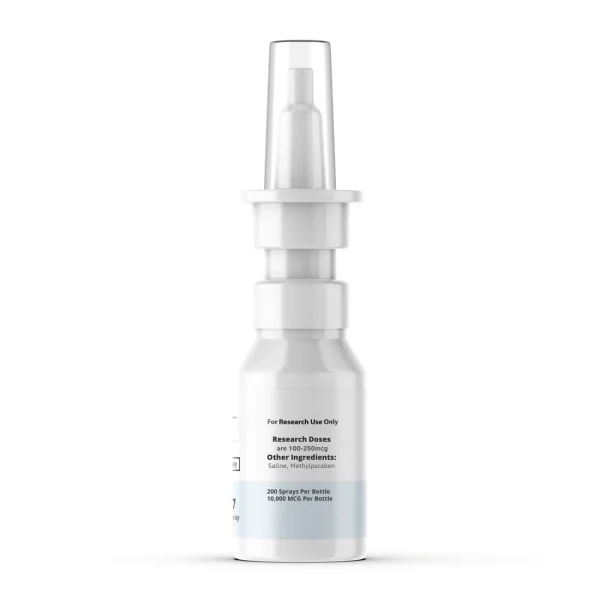
Format Metered spray bottle
Analytical verification Reversed-phase HPLC for purity, mass spectrometry for identity, independent third-party testing
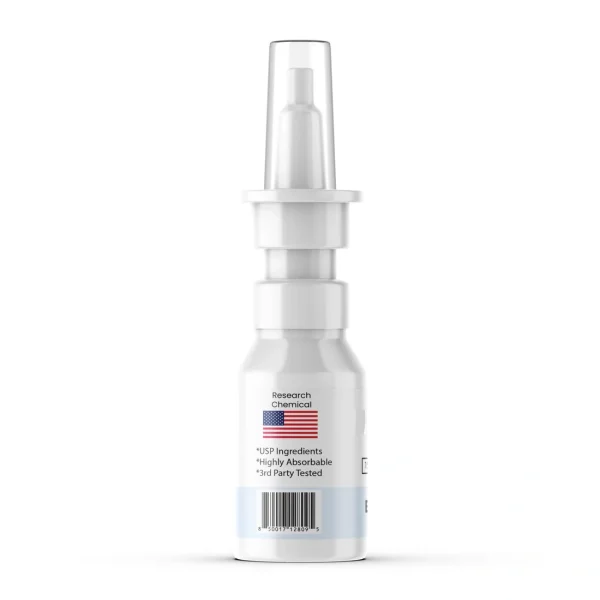
Classification Research chemical. In-vitro laboratory use only. Not for human or veterinary use.

Kisspeptin-10 storage and handling

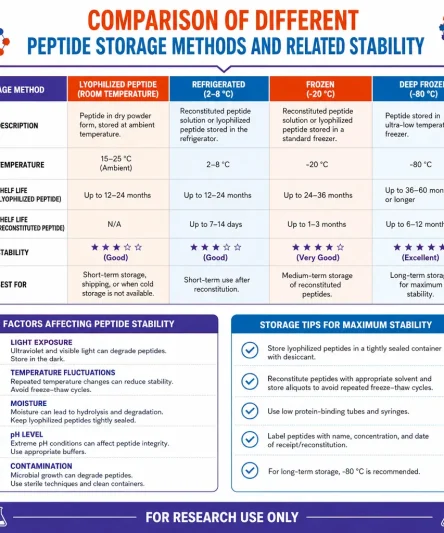
This peptide has two properties that drive handling: it is rapidly degraded, and it contains residues that are prone to specific chemical changes.

On degradation, KP-10 is cleaved quickly in biological matrices, and its breakdown behaviour has been characterized directly by LC-MS/MS alongside a described decomposition product in work published in 2014. The practical consequence for cell work is that in serum-containing medium over a long incubation you are working against a falling concentration. Shorter exposures, or a protease-resistant analog as a comparator, make the result cleaner. Kisspeptin-10 stability is the variable most likely to explain a weak response that should have been strong.

On chemistry, the sequence carries a tryptophan, which is among the residues most sensitive to oxidation and to light. Keep the material out of light, minimize air exposure, and treat a yellowing solution as a reason to discard rather than to proceed. The routine measures apply as well: keep it cold and sealed, work from single-use aliquots rather than repeatedly freezing and thawing one container, and use low-binding plasticware at the low concentrations typical of receptor assays.

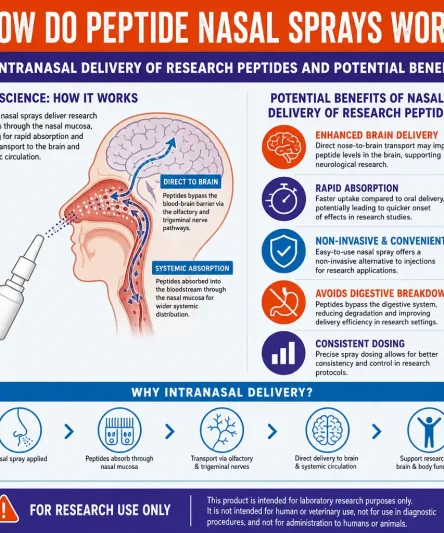
On format and documentation. This material is supplied lyophilized, and a lyophilized peptide or lyophilized powder needs reconstitution before use, most often with bacteriostatic water, with the diluent and final concentration recorded as part of the method. It appears elsewhere as a kisspeptin peptide vial, as a kisspeptin nasal spray without the fragment number, and in sizes such as 5mg kisspeptin. Marketing language about rapid absorption or non-invasive administration describes the delivery format rather than any property demonstrated for this compound. When comparing research-grade compounds between suppliers, the certificate of analysis (COA) is the document that decides it, and the same standard applies whether you are buying this decapeptide, a copper peptide such as GHK-Cu, or a repair compound such as BPC-157.

How this material is characterized

For an amidated peptide, verification has two jobs: confirm the sequence and confirm the C-terminal amide. Reversed-phase HPLC establishes purity, and mass spectrometry confirms identity, with the amidated form differing from the free acid by one mass unit, which is a small difference that matters here. This kisspeptin-10 nasal spray is supplied under the same verification PrymaLab applies across its research peptides, HPLC and MS confirmation plus independent third-party testing. No specific lot figures are asserted on this page; request the certificate of analysis for the lot you receive, and if amidation is central to your work, ask for it to be addressed explicitly rather than inferred from a purity percentage.

For the neuronal signaling and receptor biology behind this peptide, see Kisspeptin 45-54 and Neuronal Cells in the PrymaLab Research Library. That article covers the same molecule under its fragment name.

Frequently asked questions

What is kisspeptin-10?

Kisspeptin-10 is the decapeptide YNWNSFGLRF-NH2 (CAS 374675-21-5, 1302.4 Da), the C-terminal fragment of the KISS1 gene product and an agonist at KISS1R. It is also called metastin (45-54) and KISS1 (112-121). Material supplied here is a research chemical for in-vitro laboratory use only.

Is kisspeptin-10 the same as kisspeptin 45-54?

Yes, identical. KP-10 is residues 45 to 54 of kisspeptin-54, and the same decapeptide is shared by kisspeptin-14 and kisspeptin-13. The different names describe numbering conventions, not different molecules, which is a frequent source of confusion in this literature.

Why is KP-10 more potent than kisspeptin-54?

Because the C-terminal decapeptide carries the receptor-binding activity, and the additional residues in the longer forms do not add to it. KP-10 shows higher receptor affinity and more potent functional responses than the extended forms, which is why it is the standard laboratory tool.

Does the C-terminal amide matter?

Yes. Kisspeptins are RFamide-family peptides and the C-terminal amide is required for activity. A free-acid species is not a weaker version of the peptide, it behaves differently, so amidation belongs on the certificate of analysis alongside purity.

Is kisspeptin-10 nasal spray approved for human use?

No. This material is a research chemical for in-vitro laboratory use only and is not intended for human or veterinary use. Kisspeptin has been studied in human clinical research in other contexts, which has no bearing on research-chemical material. Nothing here is medical advice.

Ordering and compliance

Every PrymaLab research compound ships from the United States and is sold research-use-only. This kisspeptin-10 nasal spray is supplied for in-vitro laboratory research, is not intended for human or veterinary use, is not a drug or supplement, and has not been evaluated by the FDA for the research-chemical context. Verify the legal status of any research compound in your jurisdiction before ordering. Certificates of analysis are available on request for the lot you receive.

Additional information

Weight N/A
Dimensions N/A

5 reviews for Kisspeptin-10 10mg Nasal Spray

  1. Spencer Sanders
    August 2, 2026
    Tested good
    Had this order sent off to Janoshik for testing and it just came back with a perfect on the endotoxin testing and a purity of 99.97%. I will be shoppi...More
    Had this order sent off to Janoshik for testing and it just came back with a perfect on the endotoxin testing and a purity of 99.97%. I will be shopping here from now on, no vendor that I trust has better pricing.
    Helpful? 0 0
    Damon Gray
    August 2, 2026
    Thanks.
    Shipping was slow but everything came as it should.
    Helpful? 0 0
    Paula Harper
    August 1, 2026
    quality on point!
    test came back 99.71%. Will be back fs
    Helpful? 0 0
    Beverly Jones
    August 1, 2026
    Already seeing results!
    Shipping was slow but after only a week I am already seeing amazing results. Thank you.
    Helpful? 0 0
    Curtis Harper
    July 30, 2026
    will be back
    thanks
    Helpful? 0 0

Only logged in customers who have purchased this product may leave a review.

Peptide Research Articles

Bacteriostatic Water Peptide Science: Why It Matters in Reconstitution & Research

Bacteriostatic water peptide science is the foundation of safe, accurate peptide reconstitution. This 2026 guide covers bacteriostatic water composition, how to reconstitute peptides using a peptide reconstitution calculator and peptide dosage calculator, bacteriostatic water vs sterile water differences, peptide storage best practices, and a 10-step reconstitution protocol. Expert insights from PrymaLab.

Peptides for Injury Recovery: The Wolverine Stack Peptide Guide (BPC-157 + TB-500)

The Wolverine stack peptide combines BPC-157 and TB-500 for research into tendon, ligament, and joint recovery. This 2026 guide covers BPC-157 peptide where to buy responsibly, BPC 157 peptide side effects, peptides for tendon repair, peptides for joint recovery, peptides for elbow pain, and the BPC-157 TB-500 peptide blend scientific research. Expert insights from PrymaLab.

Are Peptides Good for You? A Complete 2026 Guide

Are peptides good for you? This comprehensive 2026 guide explores peptide therapy benefits, safety, side effects, and how peptides work in the body. Learn about peptide health benefits, research findings, and what you need to know before considering peptide therapy. Expert insights from PrymaLab.

Ovagen peptide capsules for liver health with dosage cycling chart showing 10-20 day protocols repeated 2-3 times per year

Ovagen Peptide Guide: Uses, Research, Safety & Buying Info

Ovagen peptide is a short-chain liver bioregulator developed at the St. Petersburg Institute of Bioregulation and Gerontology under Professor Vladimir Khavinson. It contains the AC-3 peptide complex (glutamic acid and aspartic acid) designed to target hepatocyte gene expression for liver cell repair, bile production, and detoxification. This guide covers dosing protocols, cycling schedules, side effects, a head-to-head comparison with NAC, milk thistle, TUDCA, and BPC-157, cost analysis ($120-360 per year), and how to verify genuine Ovagen products online.

GHK-Cu peptide vial and syringe with dosage chart showing injection protocols for skin rejuvenation and hair growth

GHK-Cu Peptide: Benefits, Dosage, Side Effects & Complete Research Guide (2026)

GHK-Cu peptide is a naturally occurring copper tripeptide that modulates over 4,000 human genes involved in collagen synthesis, wound healing, and tissue regeneration. This comprehensive guide covers injection dosage protocols, clinical research on skin rejuvenation and hair growth, side effects, safety data, and how to reconstitute GHK-Cu 50mg vials. Includes dosage charts, comparison tables, and 10 frequently asked questions answered by a peptide research specialist.

Sermorelin dosage guide for anti-aging muscle growth and weight loss showing GHRH analog pituitary stimulation

Sermorelin Dosage Guide 2025: Complete Protocol for Anti-Aging, Muscle Growth & Weight Loss

Sermorelin acetate is a growth hormone-releasing hormone (GHRH) analog that stimulates natural GH production from the pituitary gland. This comprehensive dosage guide covers protocols for anti-aging, muscle growth, weight loss, and sleep optimization รขโ‚ฌโ€ along with side effects, before-and-after timelines, and comparisons to HGH and ipamorelin.

Customer reviews

4.60
Based on 5 reviews
5
60%
3
4
40%
2
3
0%
0
2
0%
0
1
0%
0
Spencer Sanders
August 2, 2026
Tested good
Had this order sent off to Janoshik for testing and it just came back with a perfect on the endotoxin testing and a purity of 99.97%. I will be shoppi...More
Had this order sent off to Janoshik for testing and it just came back with a perfect on the endotoxin testing and a purity of 99.97%. I will be shopping here from now on, no vendor that I trust has better pricing.
Helpful? 0 0
Damon Gray
August 2, 2026
Thanks.
Shipping was slow but everything came as it should.
Helpful? 0 0
Paula Harper
August 1, 2026
quality on point!
test came back 99.71%. Will be back fs
Helpful? 0 0
Beverly Jones
August 1, 2026
Already seeing results!
Shipping was slow but after only a week I am already seeing amazing results. Thank you.
Helpful? 0 0
Curtis Harper
July 30, 2026
will be back
thanks
Helpful? 0 0
24/7 Online support

support@prymalab.net info@prymalab.net

Money back guarantee

30 Day return window. Satisfaction guaranteed or your money back.

FREE shipping and return

All orders over %150 in value will receive free shipping.