
Description
PrymaLab · Research Use Only
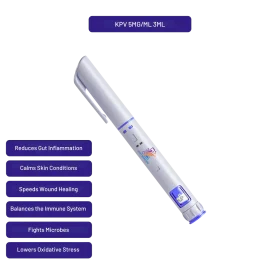
Preloaded Autoinjector | Kisspeptin-10 | 3ml Pen | 10mg
Amidated decapeptide in solution · 3ml at 3.33mg/ml · No reconstitution step
The kisspeptin-10 pen is a preloaded 3ml research autoinjector containing the amidated decapeptide YNWNSFGLRF-NH2 in solution at 3.33 mg/ml, giving 10 mg of total peptide. Two asparagines make deamidation the headline liability, and because deamidation shifts mass by only 1 dalton, most of the degradation this peptide undergoes in a cartridge is close to invisible to a routine mass check.
Specification Table
| Property | Value |
|---|---|
| Device format | Preloaded autoinjector pen, glass cartridge |
| Fill volume | 3 ml |
| Concentration | 3.333 mg/ml |
| Total compound in device | 10 mg |
| Molar concentration | 2.56 mM (2,560 micromolar) |
| Compound | Kisspeptin-10, the C-terminal decapeptide of the KiSS-1 gene product, also designated metastin 45-54 |
| CAS number | 374675-21-5 (free peptide; some suppliers apply it to the TFA salt) |
| Molecular formula | C63H83N17O14 |
| Molecular weight | 1302.4 g/mol average, 1301.63 Da monoisotopic |
| Amino acid sequence | Tyr-Asn-Trp-Asn-Ser-Phe-Gly-Leu-Arg-Phe-NH2 |
| Solution appearance | Clear and colourless, free of visible particulate |
| Reconstitution required | None. Supplied as solution |
| Excipient system | Not published on the product record. Confirm against certificate of analysis |
| Solution pH | Not published on the product record |
| Storage | 2-8°C, protected from light, do not freeze-thaw repeatedly |
| Light sensitivity | Meaningful. Trp3 and Tyr1 absorb in the near-UV and drive photo-oxidation |
| Solution stability | Not established over device shelf life in published data |
| Deamidation sites | Asn2 and Asn4. The Asn4-Ser5 context is the labile one; the shift is +1 Da |
| C-terminal modification | Alpha-amidation at Phe10. Hydrolysis to the free acid abolishes receptor activity |
| Net charge at pH 7 | Approximately +2 (Arg9 and the N-terminus; no Asp or Glu) |
| Purity | Per lot-specific certificate of analysis |
| Regulatory status | No approved formulation under FDA, EMA, PMDA, TGA or Health Canada |
What Changes When Kisspeptin-10 Ships in Solution?
A sealed aqueous fill starts three clocks at once for this decapeptide: deamidation at two asparagines, oxidation at tryptophan 3, and slow hydrolysis of the C-terminal amide that the receptor pharmacophore depends on.
Deamidation is the headline route because of where the asparagines sit. Asn2 is followed by tryptophan, and a bulky next residue slows the reaction, so that site is comparatively quiet. Asn4 is followed by serine, a context that supports succinimide formation readily, which makes Asn4-Ser5 the site to watch. The reaction yields a mixture of aspartate and isoaspartate, isoaspartate usually dominating.
The consequence is the awkward part. Deamidation adds 0.98 daltons, so a peptide of 1302.4 g/mol becomes one of 1303.4 g/mol. On a low-resolution instrument that is inside the noise, and even on a good instrument nobody looking for gross degradation would flag it. Isoaspartate is also chromatographically subtle, eluting close to the parent on reversed phase. So the material can be substantially deamidated while a certificate reporting identity by mass and purity by area percent still looks clean. This is the single fact worth carrying away about kisspeptin-10 in a standing solution.
Tryptophan 3 is the oxidation target, running to oxindole and kynurenine derivatives, and those do shift mass detectably: +16 daltons for a single oxygen addition, +32 for two. Tyrosine 1 adds a second near-UV chromophore. Between them, this peptide has a genuine photochemical liability, which is why light protection here is a mechanism rather than a formality. This is the opposite situation to a peptide such as LL-37, which contains neither residue.
The C-terminal amide is the modification that decides whether the molecule is active at all. Phe10-NH2 forms the RF-amide pharmacophore, and hydrolysis to the free acid abolishes KISS1R activity. A hydrolysed C-terminus is therefore an inactive impurity rather than a variant of the compound, and it carries a mass shift of +1 dalton, the same near-invisible increment as deamidation. Two distinct failure routes converge on the same barely detectable mass change.
Aggregation is not the concern here. A short decapeptide at 3.333 mg/ml has no fibrillation reputation, and no specific fibrillation study for it was located. Adsorption is modest: a net +2 peptide binds anionic glass to some degree, and handling protocols for this family call for low-binding tips and tubes. Quantitative adsorption inside a cartridge is unverified.
There is no reference formulation to argue from. No approved kisspeptin-10 drug product exists, so no manufacturer has published the buffer and pH a long shelf-life aqueous presentation would need. In the clinical studies the peptide was prepared for immediate infusion, not held for weeks.
What Is Known About Kisspeptin-10 Solution Stability?
More than for most research peptides, because a defined decomposition product has been characterised, and still nothing at all about a preloaded device held for months.
Liu and colleagues published an LC-MS/MS assay for this peptide in 2013, characterised its decomposition product and measured pharmacokinetics in rats. That work is direct evidence that the molecule is chemically labile under ordinary aqueous handling and that its breakdown produces something identifiable rather than a smear. Anyone treating kisspeptin-10 solution stability as an open question can at least point to a method paper that had to solve the problem before it could quantify anything.
What has not been published is a long-term stability study of the compound in a sealed cartridge at 2-8°C: no shelf-life curve, no degradation-rate constant, no specification limit for total deamidated species. Kisspeptin-10 solution stability over a device lifetime is therefore unverified, and the honest position is that the clock starts at the fill line and nobody has published how fast it runs.
Direction of travel is at least predictable. Deamidation accelerates with pH above neutral and with temperature, and Trp oxidation with light, dissolved oxygen and trace metal. Cold, dark and mildly acidic conditions slow all of it.
What Does the Kisspeptin-10 Pen Deliver Per Increment?
Ten milligrams in 3 ml is 3.333 mg/ml, and dividing that by the molecular weight of 1302.4 g/mol gives 2.56 mM, or 2,560 micromolar, or 2,560,000 nanomolar for anyone working in receptor units.
Per-increment metrology follows directly. One 0.01 ml increment, the smallest most pen mechanisms resolve, delivers 0.0333 mg, which is 33.3 micrograms or about 25.6 nanomoles. A 0.1 ml increment delivers 0.333 mg, which is 333 micrograms or about 256 nanomoles. The whole 3 ml device holds about 7,680 nanomoles of peptide.
Set that against the concentrations the receptor actually works at. Kotani and colleagues reported low-nanomolar affinity of kisspeptins for the receptor in 2001, so reaching roughly 10 nM at a target from a 2.56 mM stock is about a 256,000-fold dilution. That is an ordinary serial-dilution problem, not one the device makes easier or harder.
The comparison with published human work invites a false equivalence and is worth stating precisely. George and colleagues gave intravenous boluses of 0.01 to 3.0 micrograms per kilogram in healthy men in 2011. A 1 microgram per kilogram bolus for a 70 kg subject is about 70 micrograms, roughly 0.021 ml of this fill. The studied route was intravenous, an autoinjector delivers subcutaneously, and a subcutaneous depot has different absorption kinetics, particularly for a peptide cleared this fast.
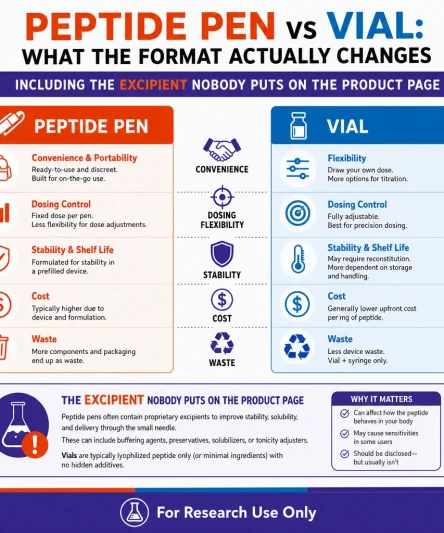
Kisspeptin-10 Pen vs Vial: Which Suits This Peptide?
The kisspeptin-10 pen vs vial question resolves differently here than for a chemically inert compound, because the peptide’s degradation is both real and hard to see, which shifts the balance toward material that has spent less time in water.
The generic argument for the format is set out on the pen versus vial comparison and across the preloaded autoinjector range, and all of it applies here.
For this peptide the last of those is the sharp end of the kisspeptin-10 pen vs vial trade. A lyophilized 10mg presentation keeps the material dry until the day it is used, which is the strongest available defence against deamidation, and the dry cake can be inspected before reconstitution. A cartridge trades that away for eight or twelve identical draws with no preparation variance between them.
The format therefore suits repeated-measures work where between-session preparation variance is the dominant error term, and suits quantitative structure-activity work poorly, because the proportion of isoaspartate and free-acid species in the fill at week eight is unknown. A nasal presentation of the same compound carries the same solution chemistry in a different container.
What the Product Record Does Not State
Four fields are missing, and for a peptide whose chief liability is pH-sensitive, one of them matters more than the rest.
Solution pH is unpublished. Deamidation rate is strongly pH-dependent and rises above neutral, so a formulation held near pH 5 and one held near pH 7.4 convert the Asn4-Ser5 site at different rates. Without the number, no shelf-life estimate is possible even in principle.
The excipient system is unpublished. Any antioxidant present is working on the Trp3 oxidation route, any chelator on metal-catalysed oxidation, and any surfactant on surface losses. All three change what arrives in a downstream assay.
The counter-ion is unpublished. Acetate is the usual research salt and TFA is also marketed, and residual trifluoroacetate is cytotoxic at concentrations overlapping those used in cell work, so the two are not interchangeable. Net peptide content, which is what a molar calculation requires, is also absent, as are the fill date and any shelf-life figure. Request all of it against the certificate of analysis before quantitative work, on the basis set out in peptide storage and stability.
Verifying a Kisspeptin-10 Pen and Confirming Its Contents
This peptide is one of the easier ones to quantify and one of the harder ones to qualify, and separating those two questions is the whole of a sensible verification plan.
Quantitation is easy because tryptophan and tyrosine are both present. Absorbance at 280 nanometres works on this sequence, so a diluted aliquot read against buffer gives a usable concentration estimate in minutes. Inspect the solution against a white background first: clear, colourless, no particulate.
Qualification is where the effort belongs. An intact-mass measurement against 1302.4 g/mol average or 1301.63 Da monoisotopic confirms that the backbone is present, and it will happily confirm that while a third of the material has deamidated, because deamidation moves mass by 0.98 daltons and C-terminal amide hydrolysis by about 1 dalton. High-resolution mass spectrometry can resolve those shifts; a bench-top instrument reporting a nominal mass will not.
Distinguishing aspartate from isoaspartate needs a method chosen for the purpose: protein isoaspartyl methyltransferase assays, specific proteolysis followed by LC-MS/MS, or a chromatographic separation developed against an authentic deamidated standard. Tryptophan oxidation is easier, since +16 and +32 dalton species separate on reversed phase and shift the near-UV spectrum. Comparing a drawn aliquot against a freshly reconstituted sample of the same compound run on the same day is more informative than comparing against a literature retention time.
Let the device reach room temperature before actuating, since cold solution is more viscous and a spring-driven mechanism meters it differently. Gravimetric verification of delivered volume, run once onto a tared vessel, removes a standing assumption.
Kisspeptin 54 vs Kisspeptin 10: What the Half-Life Difference Explains
The kisspeptin 54 vs kisspeptin 10 comparison comes down mostly to circulating persistence rather than to receptor pharmacology, and the numbers are far apart enough to explain most of the observed difference in potency.
The kisspeptin-10 half life in plasma is about 4 minutes. For kisspeptin-54 the figure is about 32 minutes in the primary source cited here, with roughly 28 minutes appearing elsewhere in the Imperial College literature. d’Anglemont de Tassigny and colleagues examined this directly in 2017 and concluded that the longer-lived peptide, with better central nervous system access, is more potent in vivo for reasons that are pharmacokinetic rather than a difference in intrinsic receptor activity.
That single figure carries most of the practical difference. Repeated boluses of the shorter peptide do not reproduce the sustained luteinising hormone rise obtained with the longer one, because each is cleared before the next arrives. The clinical fertility literature, including work on ovulation triggering, is largely kisspeptin-54 work and should not be attributed to the decapeptide.
Both peptides share the C-terminal RF-amide motif and act at the same receptor. The kisspeptin 54 vs kisspeptin 10 distinction is about exposure over time, not about which molecule the receptor prefers.
What the Human Literature Reports
The human record is real, acute, intravenous and mechanistic: three published studies in healthy volunteers establishing that this decapeptide raises gonadotropins in men, and nothing supporting a self-administered subcutaneous regimen for any endpoint.
Kotani and colleagues identified the receptor in 2001, showing that the KiSS-1 gene product supplies the natural ligands of the orphan receptor then called GPR54, now KISS1R, whose activation drives phospholipase C, IP3, calcium mobilisation and MAPK signalling. The gene had been discovered earlier as a metastasis suppressor; the reproductive biology came second.
George and colleagues reported in 2011 that intravenous boluses of 0.01 to 3.0 micrograms per kilogram, and a 4-hour infusion, produced dose-related rises in luteinising hormone and increased pulse frequency in healthy men. Jayasena and colleagues reported in 2011 that the response is sexually dimorphic: gonadotropins rose in men, while women in the follicular and preovulatory phases showed little effect. In 2015 the same group compared intravenous kisspeptin-10, kisspeptin-54 and GnRH head to head in men at 0.1, 0.3 and 1.0 nmol per kilogram per hour, and found that all three raised luteinising hormone and follicle-stimulating hormone with GnRH the most potent of the three.
The animal literature is extensive on GnRH and LH stimulation, and Liu 2013 supplies rat pharmacokinetics alongside the decomposition-product work. Background on the fragment in neuronal preparations sits in the kisspeptin 45-54 research note. What has not been studied is the part the market talks about: there is no controlled human trial of subcutaneous self-administered kisspeptin-10 for libido, fertility, testosterone or any wellness endpoint.
Safety and Regulatory Position
Acute intravenous administration in the cited volunteer studies was generally well tolerated, and that is the whole of the human safety record: no chronic exposure data, no subcutaneous data, no approval anywhere.
This compound is not approved as a drug under the FDA, EMA, PMDA, TGA or Health Canada, and no FDA-approved labelling exists for it. Receptor-targeted analogues have been taken into clinical development by industry, but no kisspeptin-10 product has been approved. Whether the compound appears on the FDA 503A or 503B bulk drug substance lists for pharmacy compounding was not confirmed in the sources used here and is unverified. It is not a recognised entry on the WADA Prohibited List, and its status against the current list was not separately verified.
Two points belong in any risk assessment. The parent gene is a metastasis suppressor and the receptor signals across many tissues, so the consequences of chronic exogenous exposure are uncharacterised. And the response is sex-dependent, so a protocol built on the male volunteer data has no basis for predicting anything else.
Where Does Kisspeptin Sit in the HPG Axis?
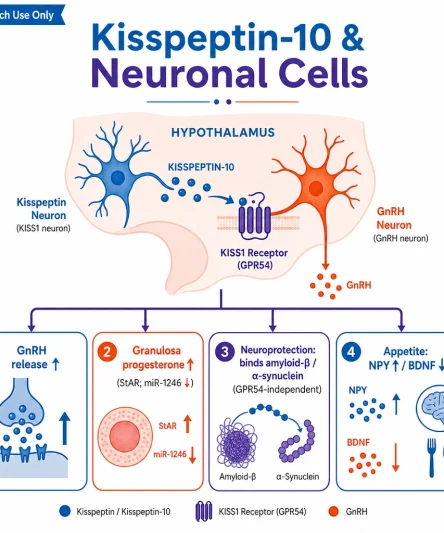
At the top of it, above the point most people think of as the beginning. The hypothalamic-pituitary-gonadal axis is usually drawn as gonadotropin-releasing hormone from the hypothalamus driving the pituitary gland to release luteinizing hormone and FSH, which then act on the gonads. Kisspeptin sits one step earlier: kisspeptin neurons in the arcuate and preoptic regions signal onto GnRH neurons through their own receptor, and they are what makes those neurons fire in pulses.
The KISS1 gene encodes the precursor from which kisspeptin-54, kisspeptin-14, kisspeptin-13 and kisspeptin-10 are all derived, and all four share the C-terminal decapeptide that binds the receptor. The discovery route was clinical rather than biochemical: families with loss-of-function mutations in KISS1R presented with hypogonadotropic hypogonadism, failing to enter puberty despite intact gonads and an intact pituitary, and activating mutations produced central precocious puberty. Those two phenotypes established the gene as the gatekeeper of reproductive physiology more firmly than any pharmacology could.
What follows is the mechanism behind the human studies. Administering the decapeptide raises gonadotropin secretion within minutes, and the rise in luteinizing hormone and in FSH is measurable and reproducible. In men that produces a testosterone rise, and the size of the testosterone response tracks the size of the luteinising signal; in women the response varies across the menstrual cycle, being largest in the preovulatory phase when the axis is already primed. Testosterone is the readout most often used in male studies for that reason. Reproductive function in this framework is downstream of a signal that kisspeptin controls rather than supplies.
What Have the Human Studies Measured?
Mostly hormone responses over hours, in small groups, at academic centres. The Imperial College group in London has run most of the work: single injections and short infusions in healthy men and women, in women with hypothalamic amenorrhoea, and as a trigger for oocyte maturation in IVF cycles in place of hCG. That last application is the most developed. Using the peptide instead shortens the luteinising signal and reduced ovarian hyperstimulation risk in the published series, because the conventional trigger has a long half-life and the endogenous pathway does not.
Tachyphylaxis is the finding that shapes everything else. Continuous exposure desensitises KISS1R and the gonadotropin response fades, in the same way continuous GnRH exposure downregulates its own receptor. Pulsatile administration preserves the response; sustained administration abolishes it. Any protocol built on this compound has to respect that, and it is the main reason dosing in the published work is expressed as short infusions or discrete boluses rather than as a daily figure. There is no established dosing schedule outside those study protocols.
Beyond reproductive disorders, the compound has been examined for its effects on sexual and emotional brain responses in small imaging studies, and proposed for reproductive health applications including diagnosis of hypothalamic dysfunction. It is not approved anywhere for any indication. Studies of the kisspeptin peptide are almost all single-centre, and the signaling pathways downstream of KISS1R involve Gq/11 and phospholipase C, which is standard receptor biology rather than anything unusual.
What Should the CoA Show for an Amidated Decapeptide?
Two things that a generic certificate often misses. The first is confirmation of C-terminal amidation, since the free acid form is inactive at the receptor and differs from the amide by one dalton, which needs an instrument resolving well enough to see it. The second is a purity method capable of separating the deamidated variants, because two asparagines in ten residues make deamidation the dominant degradation route and the isoaspartate products have the same mass as the parent plus one.
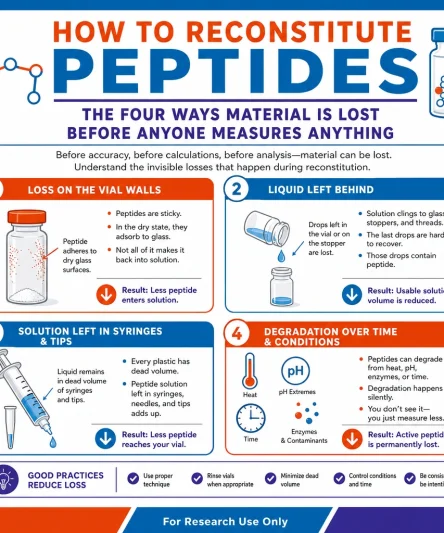
Ask for purity by HPLC with the gradient described, an accurate mass, water content and the counter-ion percentage on a lot-specific certificate. A vial of this material arrives dry and is reconstituted with bacteriostatic water at the bench, which lets the concentration be chosen and keeps the asparagines out of water until they are needed. This pen fixes the concentration and starts the deamidation clock at a fill date the record does not state. For subcutaneous injection work at defined molar concentrations, that missing date is the limiting piece of information.
Published Literature
Six entries, each checked against a primary index before it was listed here. All concern the compound; the device format itself has no published literature.
- Kotani M, Detheux M, Vandenbogaerde A, et al. The metastasis suppressor gene KiSS-1 encodes kisspeptins, the natural ligands of the orphan G protein-coupled receptor GPR54. J Biol Chem. 2001;276(37):34631-34636. DOI: 10.1074/jbc.M104847200 PMID: 11457843
- George JT, Veldhuis JD, Roseweir AK, et al. Kisspeptin-10 is a potent stimulator of LH and increases pulse frequency in men. J Clin Endocrinol Metab. 2011;96(8):E1228-E1236. DOI: 10.1210/jc.2011-0089 PMID: 21632807
- Jayasena CN, Nijher GMK, Comninos AN, et al. The effects of kisspeptin-10 on reproductive hormone release show sexual dimorphism in humans. J Clin Endocrinol Metab. 2011;96(12):E1963-E1972. DOI: 10.1210/jc.2011-1408 PMID: 21976724
- Liu Z, Ren C, Jones WP, et al. LC-MS/MS quantification of a neuropeptide fragment kisspeptin-10 (NSC 741805) and characterization of its decomposition product and pharmacokinetics in rats. J Chromatogr B. 2013;926:1-8. DOI: 10.1016/j.jchromb.2013.02.027 PMID: 23524040
- Jayasena CN, Abbara A, Narayanaswamy S, et al. Direct comparison of the effects of intravenous kisspeptin-10, kisspeptin-54 and GnRH on gonadotrophin secretion in healthy men. Hum Reprod. 2015;30(8):1934-1941. DOI: 10.1093/humrep/dev143 PMID: 26089302
- d’Anglemont de Tassigny X, Jayasena C, Murphy KG, et al. Mechanistic insights into the more potent effect of KP-54 compared to KP-10 in vivo. PLoS ONE. 2017;12(5):e0176821. DOI: 10.1371/journal.pone.0176821 PMID: 28464043
Frequently Asked Questions
What is the kisspeptin-10 pen?
A preloaded 3ml research autoinjector holding 10 mg of the amidated decapeptide YNWNSFGLRF-NH2 in solution at 3.333 mg/ml, which is 2.56 mM. No reconstitution step is required. It is supplied strictly for laboratory research and no approved formulation of this compound exists in any jurisdiction.
Why is deamidation the headline stability problem here?
Because two asparagines sit in the sequence and one of them, Asn4, is followed by serine, a context that supports succinimide formation readily. The reaction yields aspartate and isoaspartate, changes mass by only 0.98 daltons and produces a species that elutes close to the parent on reversed phase.
What does mass-silent degradation mean in practice?
It means a certificate can report the right mass on substantially degraded material. Deamidation adds about 1 dalton and C-terminal amide hydrolysis adds about 1 dalton, both inside the resolution of a nominal-mass instrument. High-resolution mass spectrometry or a purpose-built chromatographic method is needed to see either.
Why does the C-terminal amide matter so much?
Because it forms the RF-amide pharmacophore that KISS1R recognises. Hydrolysis of Phe10-NH2 to the free acid abolishes receptor activity, so the hydrolysed species is an inactive impurity rather than a variant of the compound. It is also one of the two routes that shift mass by only a dalton.
What is known about kisspeptin-10 solution stability?
Liu 2013 characterised a defined decomposition product while developing an LC-MS/MS assay, which establishes that the molecule is labile in ordinary aqueous handling. No long-term shelf-life study of a sealed device at 2-8°C has been published, so kisspeptin-10 solution stability over a device lifetime is unverified.
Is light protection necessary for this peptide?
Yes, with a mechanism behind it. Tryptophan 3 and tyrosine 1 both absorb in the near-UV, and tryptophan photo-oxidation runs to oxindole and kynurenine species that shift mass by 16 and 32 daltons. Keep the device in its packaging between sessions rather than on an illuminated bench.
What does one 0.01 ml increment deliver?
0.0333 mg, which is 33.3 micrograms or about 25.6 nanomoles, drawn from a 3.333 mg/ml solution. A 0.1 ml increment delivers 0.333 mg, that is 333 micrograms or about 256 nanomoles. The full 3 ml device holds roughly 7,680 nanomoles of peptide.
How far is the fill from the concentrations used in receptor assays?
A long way. Kotani reported low-nanomolar affinity at the receptor, and the fill is 2.56 mM, which is 2,560,000 nanomolar. Reaching about 10 nM at a target is roughly a 256,000-fold serial dilution, the same arithmetic as from a reconstituted vial at the same concentration.
Do the pen increments correspond to the published research doses?
No. George 2011 used intravenous boluses of 0.01 to 3.0 micrograms per kilogram; 1 microgram per kilogram in a 70 kg subject is about 70 micrograms, near 0.021 ml of this fill. The studied route was intravenous while an autoinjector delivers subcutaneously, and the kinetics differ.
How does the kisspeptin-10 pen vs vial choice play out for this peptide?
The kisspeptin-10 pen vs vial trade is preparation variance against time in water. A lyophilized presentation keeps the material dry until use, which is the strongest defence against deamidation. A cartridge removes hand-measured diluent and reconstitution error but starts the degradation clock at the fill line.
Can absorbance at 280 nm be used to check the contents?
Yes, unusually for a short peptide. Tryptophan 3 and tyrosine 1 both absorb at 280 nanometres, so a diluted aliquot read against buffer gives a usable concentration figure. That answers how much peptide is present; it says nothing about how much of it is still the intact amidated species.
Which measurements would confirm the device contents are intact?
High-resolution intact mass against 1302.4 g/mol average or 1301.63 Da monoisotopic, reversed-phase chromatography against a freshly reconstituted same-day reference, and a method chosen to separate isoaspartate: methyltransferase assay, targeted proteolysis with LC-MS/MS, or a separation developed against an authentic deamidated standard.
What is the kisspeptin-10 half life?
About 4 minutes in plasma. That kisspeptin-10 half life is short enough to explain why repeated boluses do not sustain a luteinising hormone rise, since each is cleared well before the next arrives. Kisspeptin-54 sits at roughly 32 minutes in the primary source cited here.
Kisspeptin 54 vs kisspeptin 10: which is more potent in vivo and why?
Kisspeptin-54, for pharmacokinetic reasons. The kisspeptin 54 vs kisspeptin 10 difference is roughly eightfold in circulating half-life, 32 minutes against 4, plus better central nervous system access. d’Anglemont de Tassigny 2017 attributed the potency gap to exposure over time rather than to intrinsic receptor activity.
What did the human studies actually measure?
Acute gonadotropin release after intravenous administration in healthy volunteers. George 2011 reported dose-related rises in luteinising hormone and increased pulse frequency in men. Jayasena 2015 compared this decapeptide, kisspeptin-54 and GnRH at 0.1, 0.3 and 1.0 nmol per kilogram per hour and found GnRH the most potent.
Does the response differ between men and women?
Yes. Jayasena 2011 reported sexual dimorphism: gonadotropins rose in men, while women studied in the follicular and preovulatory phases showed little response. A protocol built on the male volunteer data therefore has no published basis for predicting effects outside that group.
What is the regulatory position?
Not approved under the FDA, EMA, PMDA, TGA or Health Canada, and no FDA-approved labelling exists. Presence on the FDA 503A or 503B bulk drug substance lists was not confirmed here and is unverified, as is status against the current WADA Prohibited List. Chronic exposure is uncharacterised.
Where does kisspeptin act in the HPG axis?
One step above GnRH. Kisspeptin neurons signal onto GnRH neurons and make them fire in pulses, which then drives the pituitary gland to release gonadotropins. The hypothalamic-pituitary-gonadal axis as usually drawn starts at gonadotropin-releasing hormone; this sits upstream of that.
How was the KISS1 gene linked to puberty?
Through human genetics. Loss-of-function mutations in KISS1R produced hypogonadotropic hypogonadism, with failure to enter puberty despite intact gonads and pituitary, while activating mutations produced central precocious puberty. Those two phenotypes established the gene’s place in reproductive physiology more firmly than pharmacology could.
What have the human studies shown?
Reproducible gonadotropin secretion within minutes of administration, with testosterone rising in men, testosterone tracking the luteinising signal, and the response in women varying across the menstrual cycle. The most developed application is as a trigger for oocyte maturation in IVF in place of hCG, which shortened the luteinising signal and reduced ovarian hyperstimulation risk in the published series.
What is tachyphylaxis and why does it matter here?
Continuous exposure desensitises KISS1R and the response fades, as continuous GnRH exposure downregulates its own receptor. Pulsatile administration preserves the response and sustained administration abolishes it, which is why dosing in the published work is short infusions or discrete boluses rather than a daily figure. No established schedule exists outside those protocols.
What should the certificate confirm for this peptide?
C-terminal amidation, since the free acid is inactive and differs by one dalton, and a purity method that separates the deamidated variants, since two asparagines make deamidation the dominant route and the products share the parent mass plus one. Ask for a lot-specific CoA with the HPLC gradient described. A vial reconstituted with bacteriostatic water keeps those asparagines dry until needed; this device does not.
Compliance Statement
The kisspeptin-10 pen is sold exclusively for laboratory research use. It is not a drug, food, or cosmetic product, and it is not a dietary product of any kind. It is not approved by the FDA or any comparable authority for human or veterinary use. This product is not intended to diagnose, treat, cure, or prevent any disease. It must not be given to humans or animals. Purchase is restricted to qualified researchers and institutions operating within applicable laws. All handling is the responsibility of the purchasing laboratory.
Other formats of Kisspeptin-10
Kisspeptin-10 is also stocked as KissPeptin-10 5mg. Each listing states its own quantity and concentration, and the pen and vial comparison explains what changes between formats.









Reviews
There are no reviews yet.