15% SUMMER DISCOUNT APPLIED AUTOMATICALLY AT CHECKOUT FREE USA SHIPPING OVER $100  FREE WORLDWIDE SHIPPING OVER $200

15% SUMMER DISCOUNT APPLIED AUTOMATICALLY FREE USA SHIPPING OVER $100  FREE WORLDWIDE SHIPPING OVER $200

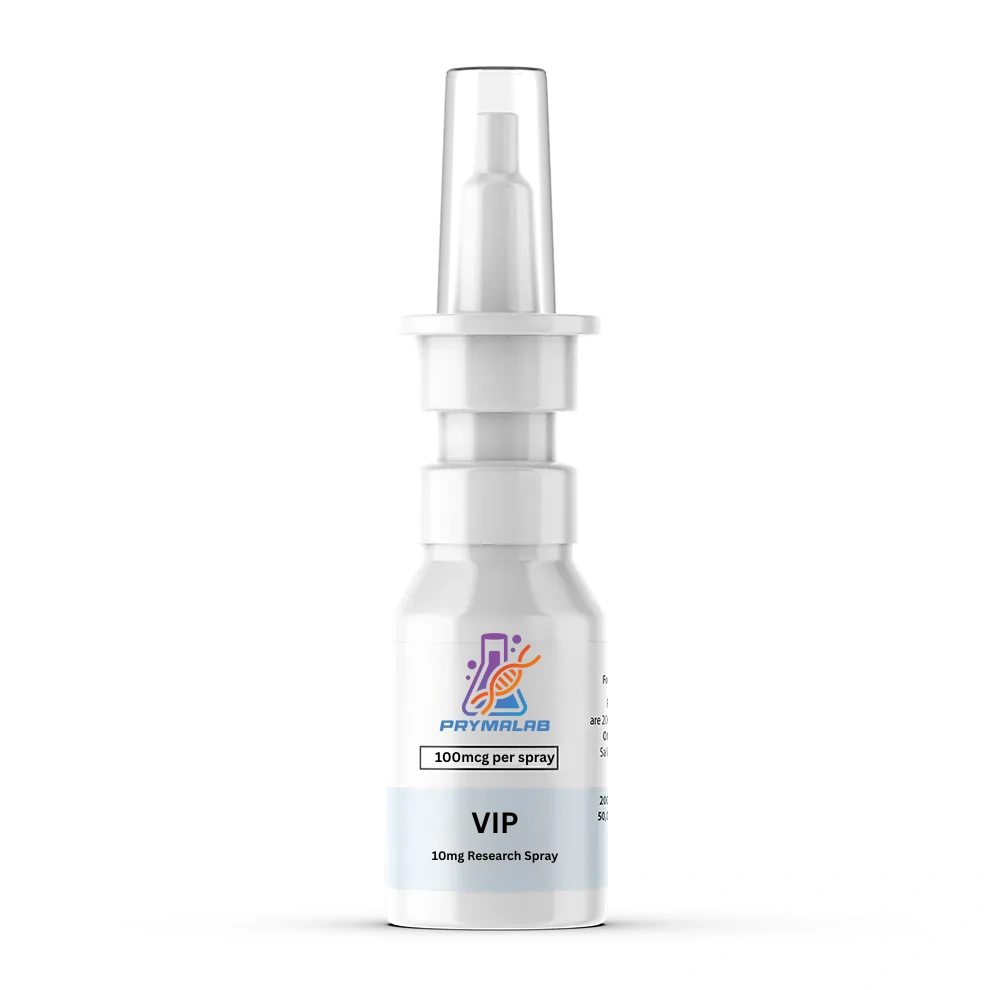
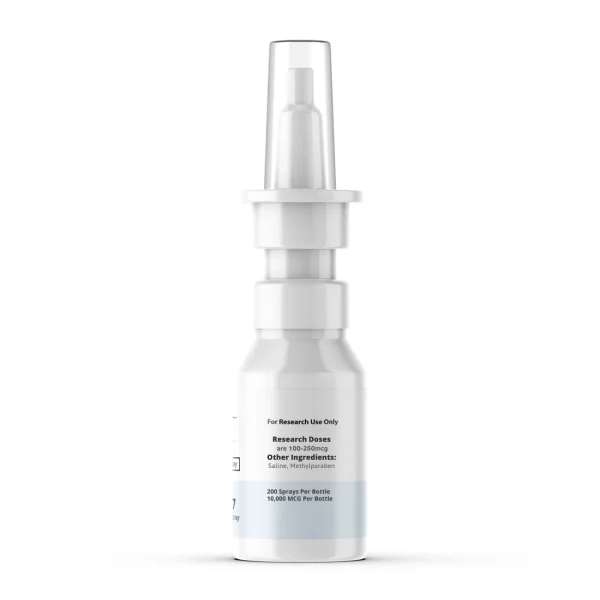
VIP 10mg Nasal Spray

(5 customer reviews)

$119.99 or subscribe for $101.99/mo

VIP nasal spray supplies vasoactive intestinal peptide, the 28-residue amidated neuropeptide (CAS 40077-57-4, ~3326 Da) that signals through the class B GPCRs VPAC1 and VPAC2. Sequence HSDAVFTDNYTRLRKQMAVKKYLNSILN-NH2. Characterized by reversed-phase HPLC for purity and mass spectrometry for identity, with independent third-party testing. Supplied strictly for in-vitro laboratory research. Not for human or veterinary use.

Description

PrymaLab · Research Use Only

VIP Nasal Spray

Vasoactive intestinal peptide · 28 residues · 3325.8 Da

VIP nasal spray supplies vasoactive intestinal peptide, a 28-residue sequence of molecular weight approximately 3325.8, in a metered spray. It belongs to the secretin peptide family and acts at two class B G protein-coupled receptors designated VPAC1 and VPAC2.

Specification Table

Vasoactive intestinal peptide verified data
Property Value
Compound Vasoactive intestinal peptide
Common designation VIP
CAS number 37221-79-7
Approximate molecular weight 3325.8 g/mol
Residue count 28
Single-letter sequence HSDAVFTDNYTRLRKQMAVKKYLNSILN-NH2
C-terminus Amidated
Peptide family Secretin family, alongside PACAP, secretin, glucagon and GHRH
Closest relative PACAP, sharing roughly 68 percent sequence identity
Molecular targets VPAC1 and VPAC2 receptors
Receptor class Class B G protein-coupled receptors
Principal coupling Gs, raising cyclic AMP
Selectivity between VPAC1 and VPAC2 Essentially none. VIP binds both with comparable affinity
Third related receptor PAC1, which prefers PACAP over VIP by a wide margin
Oxidation-prone residues One methionine at position 17
Format Metered nasal spray, solution state
Purity Per lot-specific certificate of analysis
Storage 2-8°C, protected from light. Do not freeze
Regulatory status No approved formulation in the United States

What Is the Secretin Family and Why Does It Matter Here?

A VIP nasal spray is rarely explained in family context, and the context is what makes its pharmacology tractable.

The secretin family includes secretin itself, glucagon, GHRH, PACAP and VIP among others. All are moderately sized peptides, all act at class B G protein-coupled receptors, and all share a broadly similar receptor engagement mechanism.

Class B receptors bind their ligands through two domains. A large extracellular domain captures the carboxy-terminal half of the peptide, and the amino terminus then engages the transmembrane bundle to trigger activation.

That architecture explains a pattern seen across the whole family: amino-terminally truncated analogues frequently retain binding while losing activation, which makes them antagonists rather than agonists.

It also explains cross-reactivity. Family members share enough sequence that a peptide can engage a relative receptor at higher concentration, and the VIP and PACAP pair is among the closest, sharing roughly 68 percent identity.

Which Receptors Does VIP Engage?

Three receptors sit in this system and knowing how VIP distributes across them determines what an experiment can conclude.

VPAC1 and VPAC2 both bind VIP with comparable affinity. There is essentially no selectivity between them, which means VIP alone cannot distinguish their contributions in any system expressing both.

PAC1 is the third receptor. It prefers PACAP by a wide margin and engages VIP only weakly, so it is usually a minor consideration in VIP work unless concentrations run high.

All three couple predominantly to Gs and raise cyclic AMP. A cyclic AMP readout therefore measures the sum across whichever receptors the system expresses, and separating them requires selective antagonists or genetic manipulation.

Selective tool compounds exist for this system, including VPAC1-preferring and VPAC2-preferring agonists developed for exactly this problem. Any design attributing an effect to one receptor should use them rather than relying on VIP alone.

Receptor distribution differs by tissue, so which of the two dominates in a given preparation is an empirical question rather than something to assume from the literature.

What VIP Nasal Spray Dosage and Benefits Data Exist?

Both searched phrasings deserve direct answers, and both answers are shorter than the search volume suggests.

Published work on VIP is substantial at the receptor and cell level, covering smooth muscle relaxation, secretory responses and immune cell signalling in isolated preparations. Those are in vitro and ex vivo measurements.

Intranasal work specifically is limited. Where inhaled and intranasal VIP has been studied, the amounts reported sit in the range of tens to low hundreds of micrograms per exposure, and the studies are small.

A short circulating half-life is the recurring practical obstacle across the whole literature. VIP is degraded quickly in plasma, which is why analogues with improved stability have been pursued and why native VIP is used mainly as a reference rather than a candidate.

For research purposes that instability is the reason to prefer a measured injection when the question is receptor pharmacology, and the reason the nasal route is interesting when the question is whether local exposure avoids the systemic degradation problem.

What Should VIP Work Control For?

The family relationships described above generate a specific and mostly ignored control list.

A PACAP comparator arm is worth including whenever VPAC receptors are the target, since PACAP engages both VPAC receptors as well as PAC1 and any divergence between the two peptides is informative.

Receptor-selective agonists rather than VIP alone, wherever the conclusion names one receptor. VIP cannot make that distinction on its own and no amount of careful measurement changes that.

A protease inhibitor arm, or at minimum a stated position on degradation, in any preparation containing plasma or tissue. A concentration measured at the start of an incubation is not the concentration acting at the end.

Concentration-response in the low nanomolar range, where the receptors respond, rather than a single higher concentration where PAC1 and other family receptors become plausible contributors.

A vehicle arm matched for the full spray formulation rather than saline, since preservative and viscosity agents are not inert on mucosa.

What Does the Nasal Route Offer for a 28-Residue Peptide?

Size places VIP in an awkward middle band for intranasal delivery, above the range where absorption is straightforward and below the range where it is hopeless.

At roughly 3326 daltons the peptide is well past the one kilodalton threshold where paracellular transport through tight junctions becomes difficult. Absorption across the respiratory epithelium will be a small percentage at best.

The olfactory pathway offers a route to the central nervous system that bypasses the blood-brain barrier, and it is less size-restricted than epithelial absorption because transport is along nerve bundles rather than across membranes.

The counterweight is that the olfactory region occupies a small share of human nasal surface area, proportionally smaller than in the rodents where most nose-to-brain work was done.

For VIP specifically there is a further argument. Its short plasma half-life means a systemic route delivers a brief exposure regardless, so a delivery method achieving local tissue concentration may serve some questions better than a rapid systemic peak.

Whether that argument holds is an empirical question rather than an established fact, and a design should measure what arrives rather than assume the mechanism it prefers.

What Does Amidation Contribute to VIP?

The carboxy-terminal amide is easy to overlook in a 28-residue sequence and it is doing real work.

An unmodified peptide terminates in a free carboxylate carrying a negative charge at physiological pH. Amidation replaces the hydroxyl with an amino group, neutralising that terminus.

Two consequences follow. Carboxypeptidases generally require the free acid and cannot act on an amide, so the modification blocks an entire class of degradative enzyme at that end of the chain.

Receptor affinity is usually improved as well, because class B receptors capture the carboxy-terminal half of their ligand and many endogenous family members are naturally amidated. The receptor evolved against the amidated form.

Analytically the amide is one dalton lighter than the corresponding acid, a difference that needs high-resolution mass spectrometry to resolve reliably. It is consequently among the more commonly missed synthesis defects.

A preparation carrying a substantial free-acid fraction differs in both protease susceptibility and affinity, so confirming amidation is worth requesting explicitly rather than assuming.

How Should the Spray Be Stored?

A VIP nasal spray wants cold, dark, unfrozen storage and a recorded in-use window.

Hold at 2 to 8 degrees Celsius and return the bottle promptly. The methionine at position 17 is the single oxidation-sensitive residue, and a pump draws fresh air into the headspace with every actuation.

Protect from light. Keeping the bottle in its packaging between uses handles both light exposure and physical protection of the mechanism.

Do not freeze, on mechanical grounds relating to the pump rather than the peptide.

At 28 residues with amphipathic character, adsorption to surfaces is worth considering when drawing material for analysis. Low-binding consumables reduce the loss.

Note the date of first actuation on the bottle. For a solution product the in-use interval is the one variable no label records.

One last consideration concerns the analogues. Because native VIP is degraded so quickly, a substantial share of the useful literature uses stabilised analogues rather than the native sequence.

Those analogues carry substitutions that alter receptor selectivity as well as stability, so a finding obtained with one does not transfer cleanly to native VIP. Checking which molecule a paper used is a necessary step.

Native VIP remains the right choice as a reference compound and as the ligand receptor pharmacology is defined against. It is the wrong choice when the question requires sustained exposure.

One practical consequence follows for anyone comparing across papers. Reported potencies for VIP analogues at VPAC1 and VPAC2 vary considerably between laboratories, and much of that spread is assay format rather than genuine disagreement.

Comparing figures obtained in the same system is worth more than comparing figures obtained in the same units.

A closing note on nomenclature. VIP is occasionally written as vasoactive intestinal polypeptide rather than peptide, and both refer to the same 28-residue sequence.

Searching under both spellings surfaces work that either one alone will miss, which matters for a compound whose literature spans five decades and several naming conventions.

The same applies to the receptor names. VPAC1 and VPAC2 were previously designated VIP1 and VIP2 respectively, and papers published before the current nomenclature settled use the older terms throughout.

Mapping the old names onto the new ones is necessary before comparing any receptor figure drawn from the earlier literature.

Published Literature

References verified against the publisher record. VIP receptor pharmacology rests on a large independent literature.

  1. Said SI, Mutt V. Science. 1970;169(3951):1217-1218.
  2. Harmar AJ, Fahrenkrug J, Gozes I, Laburthe M, May V, Pisegna JR, Vaudry D, Vaudry H, Waschek JA, Said SI. British Journal of Pharmacology. 2012;166(1):4-17.
  3. Couvineau A, Laburthe M. British Journal of Pharmacology. 2012;166(1):42-50.
  4. Delgado M, Ganea D. Amino Acids. 2013;45(1):25-39.
  5. Vaudry D, Falluel-Morel A, Bourgault S, Basille M, Burel D, Wurtz O, Fournier A, Chow BK, Hashimoto H, Galas L, Vaudry H. Pharmacological Reviews. 2009;61(3):283-357.
  6. Illum L. Journal of Pharmacy and Pharmacology. 2004;56(1):3-17.
  7. Lochhead JJ, Thorne RG. Advanced Drug Delivery Reviews. 2012;64(7):614-628.

Frequently Asked Questions

What is VIP nasal spray?

A metered spray supplying vasoactive intestinal peptide, a 28-residue amidated sequence of approximately 3325.8 daltons, CAS 37221-79-7. It acts at the VPAC1 and VPAC2 receptors. Laboratory research use only.

What is the secretin family?

A group including secretin, glucagon, GHRH, PACAP and VIP. All are moderately sized peptides acting at class B G protein-coupled receptors through a broadly similar two-domain engagement mechanism.

How do class B receptors bind their ligands?

Through two domains. A large extracellular domain captures the carboxy-terminal half of the peptide, then the amino terminus engages the transmembrane bundle to trigger activation. Truncating the amino terminus often yields an antagonist.

Is VIP selective between VPAC1 and VPAC2?

Essentially not at all. It binds both with comparable affinity, which means VIP alone cannot distinguish their contributions in any system expressing both receptors.

What about PAC1?

It is the third receptor in the system and prefers PACAP by a wide margin, engaging VIP only weakly. It becomes a consideration mainly at higher concentrations rather than in the normal working range.

How can the receptors be separated?

With selective tool compounds. VPAC1-preferring and VPAC2-preferring agonists were developed for exactly this problem, and any design naming one receptor should use them rather than relying on VIP.

Why can a cyclic AMP readout not separate them?

Because all three receptors couple predominantly to Gs. The signal is a sum across whichever receptors the preparation expresses, so the limitation is structural rather than a matter of measurement precision.

What amounts appear in intranasal work?

Where inhaled and intranasal VIP has been studied, reported amounts sit in the range of tens to low hundreds of micrograms per exposure, and the studies are small. The intranasal literature is much thinner than the receptor literature.

What is the recurring practical obstacle?

A short circulating half-life. VIP is degraded quickly in plasma, which is why stabilised analogues have been pursued and why native VIP is used mainly as a reference compound rather than a candidate.

Why include a PACAP comparator?

Because PACAP engages both VPAC receptors as well as PAC1, and it shares roughly 68 percent sequence identity with VIP. Any divergence between the two peptides in the same system is informative about which receptor dominates.

Which residue governs storage?

The methionine at position 17, the only oxidation-sensitive residue in the sequence. Keeping the bottle cold, dark and promptly returned after use addresses it, since a pump replenishes the air headspace with every actuation.

Compliance Statement

VIP nasal spray is sold exclusively for laboratory research use. It is not a drug, food, or cosmetic product, and it is not a dietary product of any kind. It is not approved by the FDA or any comparable authority for human or veterinary use, no approved formulation exists in the United States, and amounts cited are figures from published studies. This product is not intended to diagnose, treat, cure, or prevent any disease. It must not be given to humans or animals. Purchase is restricted to qualified researchers and institutions operating within applicable laws. All handling is the responsibility of the purchasing laboratory.

Additional information

Weight N/A
Dimensions N/A

5 reviews for VIP 10mg Nasal Spray

  1. Spencer Sanders
    August 2, 2026
    Tested good
    Had this order sent off to Janoshik for testing and it just came back with a perfect on the endotoxin testing and a purity of 99.97%. I will be shoppi...More
    Had this order sent off to Janoshik for testing and it just came back with a perfect on the endotoxin testing and a purity of 99.97%. I will be shopping here from now on, no vendor that I trust has better pricing.
    Helpful? 0 0
    Damon Gray
    August 2, 2026
    Thanks.
    Shipping was slow but everything came as it should.
    Helpful? 0 0
    Paula Harper
    August 1, 2026
    quality on point!
    test came back 99.71%. Will be back fs
    Helpful? 0 0
    Beverly Jones
    August 1, 2026
    Already seeing results!
    Shipping was slow but after only a week I am already seeing amazing results. Thank you.
    Helpful? 0 0
    Curtis Harper
    July 30, 2026
    will be back
    thanks
    Helpful? 0 0

Only logged in customers who have purchased this product may leave a review.

Peptide Research Articles

Bacteriostatic Water Peptide Science: Why It Matters in Reconstitution & Research

Bacteriostatic water peptide science is the foundation of safe, accurate peptide reconstitution. This 2026 guide covers bacteriostatic water composition, how to reconstitute peptides using a peptide reconstitution calculator and peptide dosage calculator, bacteriostatic water vs sterile water differences, peptide storage best practices, and a 10-step reconstitution protocol. Expert insights from PrymaLab.

Peptides for Injury Recovery: The Wolverine Stack Peptide Guide (BPC-157 + TB-500)

The Wolverine stack peptide combines BPC-157 and TB-500 for research into tendon, ligament, and joint recovery. This 2026 guide covers BPC-157 peptide where to buy responsibly, BPC 157 peptide side effects, peptides for tendon repair, peptides for joint recovery, peptides for elbow pain, and the BPC-157 TB-500 peptide blend scientific research. Expert insights from PrymaLab.

Are Peptides Good for You? A Complete 2026 Guide

Are peptides good for you? This comprehensive 2026 guide explores peptide therapy benefits, safety, side effects, and how peptides work in the body. Learn about peptide health benefits, research findings, and what you need to know before considering peptide therapy. Expert insights from PrymaLab.

Ovagen peptide capsules for liver health with dosage cycling chart showing 10-20 day protocols repeated 2-3 times per year

Ovagen Peptide Guide: Uses, Research, Safety & Buying Info

Ovagen peptide is a short-chain liver bioregulator developed at the St. Petersburg Institute of Bioregulation and Gerontology under Professor Vladimir Khavinson. It contains the AC-3 peptide complex (glutamic acid and aspartic acid) designed to target hepatocyte gene expression for liver cell repair, bile production, and detoxification. This guide covers dosing protocols, cycling schedules, side effects, a head-to-head comparison with NAC, milk thistle, TUDCA, and BPC-157, cost analysis ($120-360 per year), and how to verify genuine Ovagen products online.

GHK-Cu peptide vial and syringe with dosage chart showing injection protocols for skin rejuvenation and hair growth

GHK-Cu Peptide: Benefits, Dosage, Side Effects & Complete Research Guide (2026)

GHK-Cu peptide is a naturally occurring copper tripeptide that modulates over 4,000 human genes involved in collagen synthesis, wound healing, and tissue regeneration. This comprehensive guide covers injection dosage protocols, clinical research on skin rejuvenation and hair growth, side effects, safety data, and how to reconstitute GHK-Cu 50mg vials. Includes dosage charts, comparison tables, and 10 frequently asked questions answered by a peptide research specialist.

Sermorelin dosage guide for anti-aging muscle growth and weight loss showing GHRH analog pituitary stimulation

Sermorelin Dosage Guide 2025: Complete Protocol for Anti-Aging, Muscle Growth & Weight Loss

Sermorelin acetate is a growth hormone-releasing hormone (GHRH) analog that stimulates natural GH production from the pituitary gland. This comprehensive dosage guide covers protocols for anti-aging, muscle growth, weight loss, and sleep optimization รขโ‚ฌโ€ along with side effects, before-and-after timelines, and comparisons to HGH and ipamorelin.

Customer reviews

4.60
Based on 5 reviews
5
60%
3
4
40%
2
3
0%
0
2
0%
0
1
0%
0
Spencer Sanders
August 2, 2026
Tested good
Had this order sent off to Janoshik for testing and it just came back with a perfect on the endotoxin testing and a purity of 99.97%. I will be shoppi...More
Had this order sent off to Janoshik for testing and it just came back with a perfect on the endotoxin testing and a purity of 99.97%. I will be shopping here from now on, no vendor that I trust has better pricing.
Helpful? 0 0
Damon Gray
August 2, 2026
Thanks.
Shipping was slow but everything came as it should.
Helpful? 0 0
Paula Harper
August 1, 2026
quality on point!
test came back 99.71%. Will be back fs
Helpful? 0 0
Beverly Jones
August 1, 2026
Already seeing results!
Shipping was slow but after only a week I am already seeing amazing results. Thank you.
Helpful? 0 0
Curtis Harper
July 30, 2026
will be back
thanks
Helpful? 0 0
24/7 Online support

support@prymalab.net info@prymalab.net

Money back guarantee

30 Day return window. Satisfaction guaranteed or your money back.

FREE shipping and return

All orders over %150 in value will receive free shipping.