
Description
PrymaLab · Research Use Only
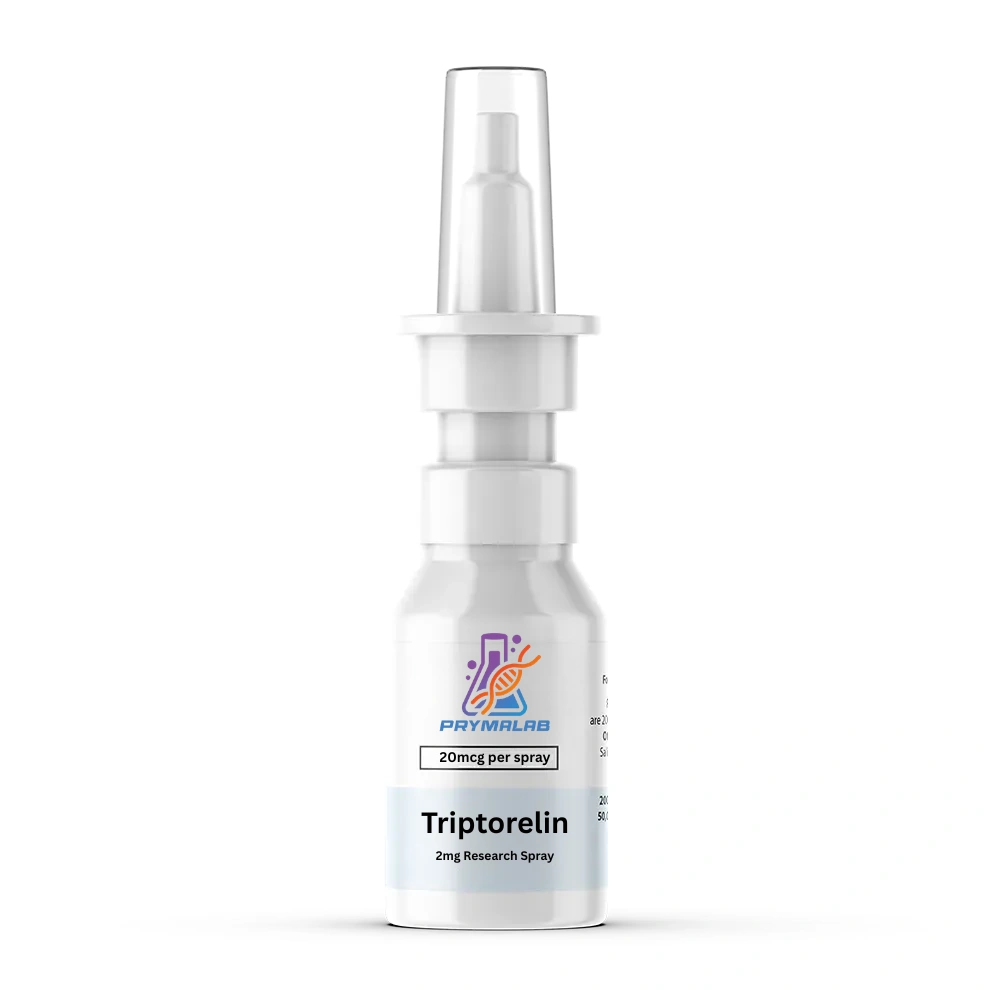
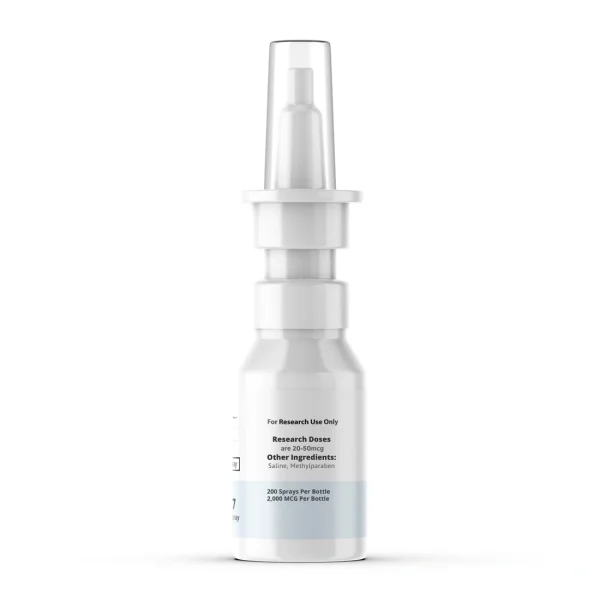
Triptorelin Nasal Spray
pGlu-His-Trp-Ser-Tyr-D-Trp-Leu-Arg-Pro-Gly-NH2 · CAS 57773-63-4 · 1311.45 Da
Triptorelin nasal spray supplies the decapeptide pGlu-His-Trp-Ser-Tyr-D-Trp-Leu-Arg-Pro-Gly-NH2, CAS 57773-63-4, molecular weight 1311.45. It is native GnRH with one residue changed, and that residue happens to be the one the degrading enzyme needs.
Specification Table
| Property | Value |
|---|---|
| Compound | Triptorelin |
| CAS number | 57773-63-4 |
| Molecular formula | C64H82N18O13 |
| Molecular weight | 1311.45 g/mol |
| Residue count | 10 |
| Sequence | pGlu-His-Trp-Ser-Tyr-D-Trp-Leu-Arg-Pro-Gly-NH2 |
| Parent molecule | Native GnRH, gonadorelin, 1182.29 g/mol |
| Modification | Glycine at position 6 replaced by D-tryptophan |
| Mass difference from parent | 129 daltons |
| Why position 6 | It is the site of the Gly6-Leu7 bond cut by the GnRH-specific endopeptidase |
| Tryptophan count | Two, at positions 3 and 6. Position 6 is D-configuration |
| Amino terminus | Pyroglutamate, blocked |
| Carboxy terminus | Glycinamide, blocked |
| Chromophore | Two tryptophans plus tyrosine. Strong 280 nm absorbance |
| Oxidation-prone residues | Two tryptophans |
| Format | Metered nasal spray, solution state |
| Physical state | Aqueous solution, supplied ready to use |
| Purity | Per lot-specific certificate of analysis |
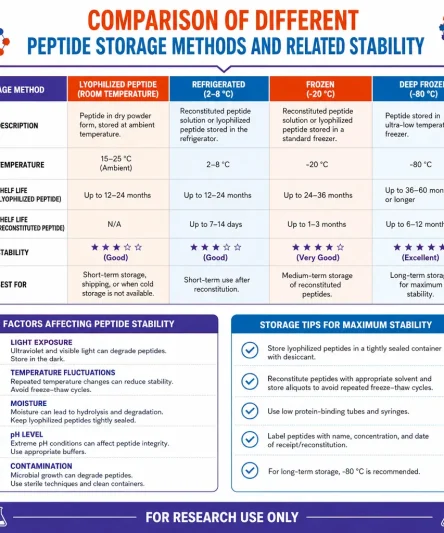
| Storage | 2-8°C, protected from light. Do not freeze |
| United States status | An injectable depot preparation holds an active FDA approval under the trade name Trelstar |
| Approved route | Intramuscular or subcutaneous depot. No approved nasal formulation exists anywhere |
| Status of this product | Research chemical. Not the approved depot preparation in a different container |
Why Is Position 6 the Only Change That Was Needed?
Triptorelin nasal spray carries an analogue differing from the native hormone at exactly one position out of ten, which raises the obvious question of why that particular one.
Native GnRH is cleaved by a specific endopeptidase between the glycine at position 6 and the leucine at position 7, and that bond accounts for most of its rapid disappearance.
Replacing the glycine removes the substrate the enzyme recognises. There is no longer a Gly6-Leu7 bond to cut.
D-tryptophan compounds the effect twice over. It is bulky, which sterically obstructs the active site, and it is D-configuration, which the enzyme was never built to accommodate.
The result is a molecule that survives far longer than the native sequence while retaining engagement at the same receptor.
Reported receptor affinity is also higher than the native hormone, which was not the primary design objective but follows from the conformational change the substitution produces.
One residue delivering both durability and affinity from a single edit is an efficient piece of design, and it is why position 6 substitution is the common feature of essentially every GnRH agonist in clinical use.
Anyone comparing this compound against gonadorelin is comparing a durability difference as much as a potency one, and separating the two requires attention to timing rather than to concentration alone.
It is worth noting what the substitution does not change, since that is equally informative.
Positions 1 through 5 and 7 through 10 are identical to the native hormone, so the receptor contact residues are untouched.
The pyroglutamate terminus, the glycinamide terminus, the arginine at position 8 and the proline at position 9 all carry over unchanged.
That conservation is why the analogue engages the same receptor rather than a related one, and why the comparison against the native hormone is meaningful at all.
A substitution elsewhere in the sequence would more likely have cost receptor engagement than bought durability. That is what makes position 6 the fortunate choice.
Glycine at that position is also the least constrained residue available, so replacing it with a bulky D-residue produces the largest possible conformational change for a single edit.
What Does the Approved Depot Tell You About Triptorelin Nasal Spray?
The approved preparation of this molecule is a depot injection, and understanding why it is a depot explains something important about a spray.
Native GnRH signalling depends on rhythm. Pulses stimulate, continuous exposure suppresses through receptor desensitisation and downregulation.
The approved depot is engineered to deliver continuous exposure over weeks or months, which produces sustained suppression rather than stimulation.
That is the intended outcome for its licensed indications, and the depot format is the mechanism by which it is achieved.
A nasal spray does not do that. It delivers a bolus absorbed over some interval, which is closer to a pulse than to a depot even though it is not a clean pulse either.
So the format and the approved product sit at opposite ends of the same pharmacological axis. A result obtained with one does not transfer to the other.
Citing the clinical record for the depot preparation in support of a statement about a nasal research preparation crosses both the route and the exposure profile.
For experimental design the implication is that delivery kinetics need characterising rather than assuming. The direction of any observed effect depends on them.
How Do Two Tryptophans Affect Solution Stability?
The substitution that makes triptorelin nasal spray durable in vivo also gives it a second copy of the least stable coded residue.
Native GnRH carries one tryptophan at position 3. This analogue carries that one plus the D-tryptophan at position 6.
Tryptophan oxidises and photodegrades more readily than any other coded amino acid, so doubling the count roughly doubles the exposure under any given light or oxygen load.
A single oxygen addition shifts the mass from 1311.45 to roughly 1327, and a second to roughly 1343. Both are resolvable on a competent instrument.
The D-configuration at position 6 offers no protection against oxidation, since that chemistry acts on the indole ring rather than on the backbone stereocentre.
That produces an unusual trade. The substitution buys enzymatic durability in vivo and costs chemical durability in the bottle.
For a solution-state product held for months, the bottle problem is the one that actually applies, so light protection matters more here than the in vivo half-life advantage would suggest.
An amber container or opaque outer packaging is worth insisting on, and a clear bottle on an open bench is a genuine problem for this compound.
How Is Triptorelin Distinguished From Gonadorelin?
The two compounds sit in the same catalogue and differ by 129 daltons, which makes the check straightforward once someone runs it.
This compound sits at 1311.45 and the native hormone at 1182.29, a gap no mass spectrometer would miss.
Chromatographically the D-tryptophan substitution adds substantial hydrophobicity. So this analogue elutes considerably later than the native sequence.
Both separations are large enough that a generic gradient resolves them, which is not true of every pair in this catalogue.
Incomplete substitution during synthesis is the plausible route to contamination, since the D-tryptophan is incorporated as a separately protected building block.
Shared equipment is the second route. Any supplier stocking both compounds carries that exposure whether or not they mention it.
The shared pyroglutamate terminus means the uncyclised check applies here too, with an uncyclised species sitting 17 daltons heavier at roughly 1328.
That figure sits close to the singly oxidised mass near 1327, so the same resolution caution applies as for the native hormone, and it is worth stating explicitly rather than leaving for someone to discover.
What Is the Actual Regulatory Position?
The generic no-approved-formulation statement would be wrong here, and stating the position accurately is more useful than defaulting to caution.
An injectable depot preparation of this molecule holds an active FDA approval in the United States under the trade name Trelstar.
That approval covers licensed indications including palliative use in advanced prostate cancer, central precocious puberty and endometriosis.
The approved route is intramuscular or subcutaneous depot, formulated for sustained release over weeks to months.
No approved nasal formulation of this molecule exists in any jurisdiction, and this product is not the approved depot in a different container.
The distinction is not a technicality. The depot exists specifically to produce an exposure profile a spray cannot reproduce, as set out above.
A research preparation of an approved molecule is still a research preparation, and the clinical record attaches to the approved product rather than to the compound in the abstract.
Anyone drawing on the published literature should note which preparation, which route and which exposure profile each study used.
How Does 1311 Daltons Affect the Nasal Route?
Triptorelin nasal spray holds one of the larger compounds in this range, and size works against it on the variable that most reliably predicts transnasal transport.
Somewhere near 1,000 daltons the paracellular route between epithelial cells stops carrying useful quantities.
At 1311.45 daltons this compound is above that line, marginally larger than kisspeptin-10 at 1,302 and well above gonadorelin at 1,182.
The added hydrophobicity from the D-tryptophan favours transcellular passage across the lipid membrane, which partly offsets the size penalty.
Against that, the arginine and histidine give a net positive charge at physiological pH, and cationic molecules bind a negatively charged mucosal surface rather than passing it.
Nasal formulations of related GnRH analogues have a clinical history, so the route is established for the compound class even where data for this specific molecule by this route is thin.
Nothing published establishes intranasal pharmacokinetics for this analogue, and the clinical record rests on depot injection rather than on any nasal preparation.
How Should Triptorelin Nasal Spray Be Stored and Recorded?
Two tryptophans make triptorelin nasal spray one of the more demanding products in this range to store, despite the compound being enzymatically durable.
Refrigerate between 2 and 8 degrees Celsius, in the dark, and keep a solution-state product out of the freezer entirely.
Light protection is the governing requirement here, alongside GHRP-6 which shares the two-tryptophan problem from a different structural position.
Watch for species near 1327 and 1343, representing one and two oxygen additions, and note that 1327 overlaps closely with the uncyclised pyroglutamate mass.
Limit the number of times the bottle is opened, since oxidation proceeds by dissolved oxygen without light as well as with it.
Avoid metal contact where possible, since trace copper and iron catalyse oxidation of aromatic residues.
Both termini are blocked and there is no cysteine or methionine, so exopeptidase and thiol routes do not apply.
Record the lot, the stated concentration, the date first opened, the storage temperature, light exposure conditions and the actuation count for each experiment.
What Are the Approved Triptorelin Products Licensed For?
This molecule is a real drug with real approvals, which makes it different from most of this catalogue and makes the separation between drug and research spray more important rather than less.
Decapeptyl is the depot formulation marketed across Europe, and Trelstar and Triptodur are the corresponding products in the United States. All are injected, and all are approved.
Decapeptyl is given as an intramuscular or subcutaneous depot at one, three or six month intervals depending on the presentation.
The compound is a GnRH agonist. Gonadotropin-releasing hormone agonists, sometimes written LHRH agonists, act on the pituitary gland to release luteinising hormone and follicle-stimulating hormone.
Continuous rather than pulsatile stimulation then desensitises the receptor, and FSH and LH output falls after an initial surge.
That downstream suppression of oestrogens or testosterone is the therapeutic effect, and it is why a synthetic hormone that first stimulates is used to suppress.
Androgen deprivation therapy in advanced prostate cancer is the largest approved use, monitored on PSA. Endometriosis, uterine fibroids and central precocious puberty, abbreviated CPP, account for most of the rest.
Triptodur specifically is licensed for early puberty, where the goal is to halt premature sexual development until an appropriate age.
Short courses also appear in assisted reproductive technologies, where the agonist controls ovulation timing and carries a risk of ovarian hyperstimulation syndrome.
The side effects of that suppression follow from the hormone withdrawal it creates. Hot flashes, sometimes written hot flushes, are the most reported, alongside decreased libido, mood changes and reduced quality of life scores.
Longer courses raise bone turnover, and osteoporosis is the documented risk that drives bone density monitoring on extended androgen deprivation therapy.
In women the record includes amenorrhea, spotting, irregular menstruation and pelvic pain, with the initial flare worsening symptoms before suppression takes hold.
Rarer entries cover allergic reaction, liver injury, sore throat and pituitary apoplexy, the last associated with an undiagnosed pituitary adenoma.
Contraception advice accompanies the approved products, since suppression is not reliable contraception during the initial flare.
Every item above belongs to an approved injectable depot formulation prescribed and monitored by a clinician. None of it describes this product.
Does Any of the Approved Pharmacokinetics Transfer to a Nasal Spray?
No, and this is where a lot of confusion sits, because the pharmacokinetics of the approved products are well characterised and easy to quote out of context.
Published pharmacokinetics for triptorelin describe intramuscular and subcutaneous depot administration. The depot exists precisely because the peptide is cleared quickly when it is not formulated for slow release.
A depot is engineered to hold a plasma level for weeks. A metered spray is the opposite kind of object, and no pharmacokinetics have been published for this molecule given intranasally.
Claims of rapid absorption for a nasal route here have no measured bioavailability behind them, and at 1311.45 daltons the transport argument runs against the compound rather than for it.
Anyone searching to buy triptorelin nasal spray should understand that no such product is approved anywhere, and that laboratory studies are the only setting this material belongs in.
A triptorelin peptide vial and a triptorelin pre-mixed pen both appear in the research market alongside sprays. None of those formats is the approved depot, and none carries its evidence.
PubChem lists the compound under CAS 57773-63-4, which identifies the molecule and says nothing about any particular formulation of it.
The molecule is the same in all of them. The evidence attaches to the formulation and the route, not to the molecule, and that distinction is the whole of the argument on this page.
Published Literature
Selected references verified against the publisher record. Note that the clinical literature concerns the approved depot preparation given parenterally.
- (‘Vale W, Rivier C, Brown M, et al. Pharmacology of hypothalamic regulatory peptides. Clin Endocrinol. 1976;5 Suppl:261s-273s.’, ‘https://doi.org/10.1111/j.1365-2265.1976.tb03836.x’)
- (‘Coy DH, Vilchez-Martinez JA, Coy EJ, Schally AV. Analogs of luteinizing hormone-releasing hormone with increased biological activity produced by D-amino acid substitutions in position 6. J Med Chem. 1976;19(3):423-425.’, ‘https://doi.org/10.1021/jm00225a017’)
- (‘Millar RP, Lu ZL, Pawson AJ, et al. Gonadotropin-releasing hormone receptors. Endocr Rev. 2004;25(2):235-275.’, ‘https://doi.org/10.1210/er.2003-0002’)
- (‘Simat TJ, Steinhart H. Oxidation of free tryptophan and tryptophan residues in peptides and proteins. J Agric Food Chem. 1998;46(2):490-498.’, ‘https://doi.org/10.1021/jf970818c’)
Frequently Asked Questions
What is Triptorelin nasal spray?
A metered aqueous solution of the D-Trp6 GnRH analogue, CAS 57773-63-4, molecular weight 1311.45. Supplied for laboratory research only, and not the approved depot preparation in a different container.
Why was position 6 the residue changed?
Because native GnRH is cleaved between the glycine at position 6 and the leucine at position 7. Replacing that glycine removes the substrate the degrading endopeptidase recognises.
Why D-tryptophan specifically?
It compounds the effect twice over. The residue is bulky, which sterically obstructs the enzyme active site, and it is D-configuration, which the enzyme was never built to accommodate.
Does affinity change too?
Yes. Reported receptor affinity is higher than the native hormone. That was not the primary design objective but follows from the conformational change the substitution produces.
Why is the approved product a depot?
Because GnRH signalling depends on rhythm. Continuous exposure suppresses through receptor desensitisation, and a depot delivers exactly that over weeks or months, which is the intended outcome for its indications.
How does a spray differ?
It delivers a bolus absorbed over some interval, closer to a pulse than to a depot. The format and the approved product sit at opposite ends of the same pharmacological axis.
What does the substitution cost?
Chemical stability in the bottle. Native GnRH has one tryptophan; this analogue has two. Doubling the count roughly doubles oxidation exposure under any given light or oxygen load.
How is oxidation detected?
By species near 1327 and 1343, representing one and two oxygen additions. Note that 1327 overlaps closely with the uncyclised pyroglutamate mass. So instrument resolution matters.
How is it distinguished from Gonadorelin?
By 129 daltons, 1311.45 against 1182.29, which no mass spectrometer would miss. The D-tryptophan also adds substantial hydrophobicity, so this analogue elutes considerably later.
Is there an approved formulation?
Yes. An injectable depot holds an active FDA approval under the trade name Trelstar, with licensed indications spanning advanced prostate cancer, central precocious puberty and endometriosis. No approved nasal formulation exists anywhere.
What are triptorelin’s side effects?
The documented side effects belong to the approved depot products. Hot flashes lead the list, with decreased libido, mood changes, amenorrhea and spotting, plus osteoporosis risk on extended courses. No side effects profile exists for a nasal spray of this compound.
What is Decapeptyl approved for?
Decapeptyl is the depot formulation marketed across Europe, with Trelstar and Triptodur in the United States. Approved uses cover androgen deprivation therapy in prostate cancer, endometriosis, uterine fibroids and central precocious puberty. All are injected.
How does a GnRH agonist work?
It acts on the pituitary gland to release LH and follicle-stimulating hormone. Continuous rather than pulsatile stimulation desensitises the receptor, so FSH and LH fall after an initial surge, suppressing testosterone or oestrogens downstream.
Does the approved pharmacokinetic data apply here?
No. Published pharmacokinetics describe intramuscular and subcutaneous depot administration, and the depot exists because the peptide clears quickly otherwise. No pharmacokinetics have been published for this molecule given intranasally.
Are there local effects on the nasal mucosa?
Unstudied. No published work characterises this peptide against nasal mucosa, so nothing can be said about local tolerance, a runny nose, or any drug interaction by that route. The approved products are injected and their labels describe injection.
How does its size affect nasal transport?
At 1311.45 daltons it sits above the roughly 1,000 dalton transition, marginally larger than kisspeptin-10 at 1,302. Added hydrophobicity from the D-tryptophan partly offsets the size penalty.
Compliance Statement
Triptorelin nasal spray is sold exclusively for laboratory research use. It is not a drug, food, or cosmetic product, and it is not a dietary product of any kind. It is not approved by the FDA or any comparable authority for human or veterinary use, this product is a research preparation rather than the injectable depot holding an active FDA approval, no approved nasal formulation exists in any jurisdiction, and the clinical record concerns a depot exposure profile that a spray does not reproduce. This product is not intended to diagnose, treat, cure, or prevent any disease. It must not be given to humans or animals. Purchase is restricted to qualified researchers and institutions operating within applicable laws. All handling is the responsibility of the purchasing laboratory.
Other formats of Triptorelin
Triptorelin is also stocked as Triptorelin 6mg preloaded 3ml pen and Triptorelin GnRH 2mg. Each listing states its own quantity and concentration, and the pen and vial comparison explains what changes between formats.










5 reviews for Triptorelin 2mg Nasal Spray