

Description
PrymaLab · Research use only
Preloaded Autoinjector | CJC-1295 (No DAC) + Ipamorelin | 3ml Pen | 15mg
CJC-1295 without DAC plus ipamorelin, 7.5 mg each in a preloaded 3 mL pen
This pen holds two growth hormone secretagogues in one solution: CJC-1295 without DAC (modified GRF(1-29)), a 29-residue GHRH analogue, and ipamorelin, a pentapeptide that acts on the ghrelin receptor. The 3 mL cartridge contains 7.5 mg of each, 15 mg in total, dissolved in bacteriostatic water and ready to use without reconstitution. Research on the pair comes from separate studies of each peptide; none of the papers cited here tested the combination.
Specifications
| Property | Value |
|---|---|
| Components | CJC-1295 (no DAC); Modified GRF (1-29); tetrasubstituted GHRH(1–29) analogue (D-Ala2, Gln8, Ala15, Leu27) Ipamorelin (NNC 26-0161; selective growth hormone secretagogue pentapeptide) |
| CJC-1295 (no DAC) CAS number | 863288-34-0 |
| Ipamorelin CAS number | 170851-70-4 |
| Contents | CJC-1295 (no DAC): 7.5 mg per 3 mL pen (0.25% w/v) Ipamorelin: 7.5 mg per 3 mL pen (0.25% w/v) |
| Form | Sterile aqueous solution in bacteriostatic water (0.9% benzyl alcohol), supplied in a 3 mL glass cartridge inside a preloaded autoinjector pen fitted with a needle |
| Storage, sealed | Store at 2–8 °C in the original carton, protected from light |
| Safety data sheet | PL-SDS-041 |
What is in the pen
According to the safety data sheet, each pen holds a 3 mL glass cartridge with 7.5 mg of CJC-1295 without DAC and 7.5 mg of ipamorelin, each at 0.25% w/v. That is 2.5 mg/mL of each peptide and 5 mg/mL combined, an equal split by mass. The solvent is bacteriostatic water with 0.9% benzyl alcohol as an antimicrobial preservative. The sheet lists ipamorelin as a skin, eye and respiratory irritant (H315, H319, H335) and benzyl alcohol as harmful if swallowed or inhaled, an eye irritant and a possible skin sensitiser; CJC-1295 is not classified.
Keep the pen at 2 to 8 °C in its original carton, away from light, and capped between uses. It must not be frozen, and a pen whose solution has frozen, changed colour or turned cloudy should be discarded. The trade-offs between ready-made solutions and freeze-dried vials are covered in peptide pen vs vial.
Two peptides in one solution
Neither peptide is kept dry in a pen, so how each behaves in water matters more than it does in a vial. The best-documented weak point of GRF peptides in neutral solution is asparagine 8. In a Leu27 GRF analogue held at pH 7.4 and 37 °C, deamidation at that residue was the main route of degradation and gave a product 400 to 500 times less potent, while analogues with serine at position 8 kept full potency over 14 days1. CJC-1295 without DAC carries glutamine at position 8 instead of asparagine, and ipamorelin’s five residues include no asparagine. The papers cited here do not report the stability of either peptide in this solution.
What the research covers
The CJC-1295 name comes from Jetté and colleagues, who built a tetrasubstituted GRF(1-29) with an extra C-terminal lysine carrying a maleimide that bonds to serum albumin; that version stayed in rat plasma beyond 72 hours2. The CJC-1295 in this pen has the substituted 29-residue chain but not the albumin-binding lysine, so the long persistence measured for the DAC form does not describe it.
Ipamorelin, Aib-His-D-2-Nal-D-Phe-Lys-NH₂, was introduced in 1998 as the first selective growth hormone secretagogue. Antagonist experiments placed its action at the GHRP receptor rather than the GHRH receptor, and in swine it released growth hormone without the ACTH and cortisol rise seen with GHRP-6 and GHRP-2, even at more than 200 times its ED50 for growth hormone release3. Gobburu and colleagues later studied it in healthy male volunteers given 15-minute infusions at five levels: its terminal half-life was 2 hours, and each exposure produced a single episode of growth hormone release that peaked at 0.67 hours and then fell away exponentially4.
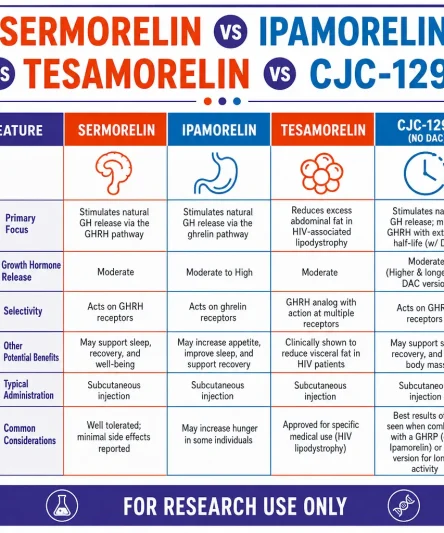
The case for pairing them is that each acts through a different pituitary receptor. None of the papers cited here tested the two together or in a preloaded solution. The CJC-1295 and ipamorelin guide covers the literature on both peptides in full.
How each lot is tested
Every lot is tested in PrymaLab’s own laboratory in Ashland, Kentucky before release: RP-HPLC for purity, LC-MS for identity, Karl Fischer titration for water, LAL for endotoxin and USP <71> for sterility. Published certificates are listed on the results page and can be checked by number and key on the verify page. The certificate covers the peptide lot used to fill the pen, not the finished solution. These are in-house results from PrymaLab Analytical, not an independent test, and the lab is not accredited to ISO 17025. The third-party testing guarantee on this page still applies: if any independent laboratory finds the wrong compound, or less than the stated purity or amount, the order is refunded and the cost of the test is reimbursed.
Frequently asked questions
How much of each peptide does the pen contain?
7.5 mg of CJC-1295 without DAC and 7.5 mg of ipamorelin in 3 mL, so 2.5 mg/mL of each and 5 mg/mL combined, 15 mg per pen. The concentration is fixed at filling; a freeze-dried vial is the format to use when a study needs a concentration of its own.
Is the CJC-1295 in the pen the DAC form?
No. It is modified GRF(1-29), the 29-residue chain without the albumin-binding lysine. The multi-day half-life reported for CJC-1295 in healthy adults was measured with the DAC form and does not apply to this pen.
What does the certificate cover for the pen?
It covers the peptide lots used to fill the pen, not the finished solution in the cartridge. The testing section on this page explains where published certificates are listed and how to check one by number and key.
Is the pen intended for human use?
No. Like every PrymaLab product it is sold only for laboratory research. It is not approved for human or veterinary use, and nothing on this page should be read as a guide to using it in people or animals.
References
- Friedman AR, Ichhpurani AK, Brown DM, et al. Degradation of growth hormone releasing factor analogs in neutral aqueous solution is related to deamidation of asparagine residues. Replacement of asparagine residues by serine stabilizes. Int J Pept Protein Res. 1991;37(1):14-20. DOI · PubMed
- Jetté L, Léger R, Thibaudeau K, et al. Human growth hormone-releasing factor (hGRF)1-29-albumin bioconjugates activate the GRF receptor on the anterior pituitary in rats: identification of CJC-1295 as a long-lasting GRF analog. Endocrinology. 2005;146(7):3052-8. DOI · PubMed
- Raun K, Hansen BS, Johansen NL, et al. Ipamorelin, the first selective growth hormone secretagogue. Eur J Endocrinol. 1998;139(5):552-61. DOI · PubMed
- Gobburu JV, Agersø H, Jusko WJ, et al. Pharmacokinetic-pharmacodynamic modeling of ipamorelin, a growth hormone releasing peptide, in human volunteers. Pharm Res. 1999;16(9):1412-6. DOI · PubMed
Research use only
For laboratory research use only. This product is not a drug, food, cosmetic or dietary supplement, is not approved by the FDA or any comparable authority for human or veterinary use, and must not be given to people or animals. It is sold to qualified researchers and institutions, and the buyer is responsible for lawful handling and disposal.
Other formats of CJC-1295 (No DAC) + Ipamorelin
CJC-1295 (No DAC) + Ipamorelin is also stocked as CJC-1295 (no DAC), Ipamorelin 10mg (Blend), CJC-1295 (NO DAC) 5MG, CJC-1295 (NO DAC) 10MG, Ipamorelin 5mg, Ipamorelin 10mg and Ipamorelin 10mg Nasal Spray. Each listing states its own quantity and concentration, and the pen and vial comparison explains what changes between formats.







Reviews
There are no reviews yet.