Description
PrymaLab · Research use only
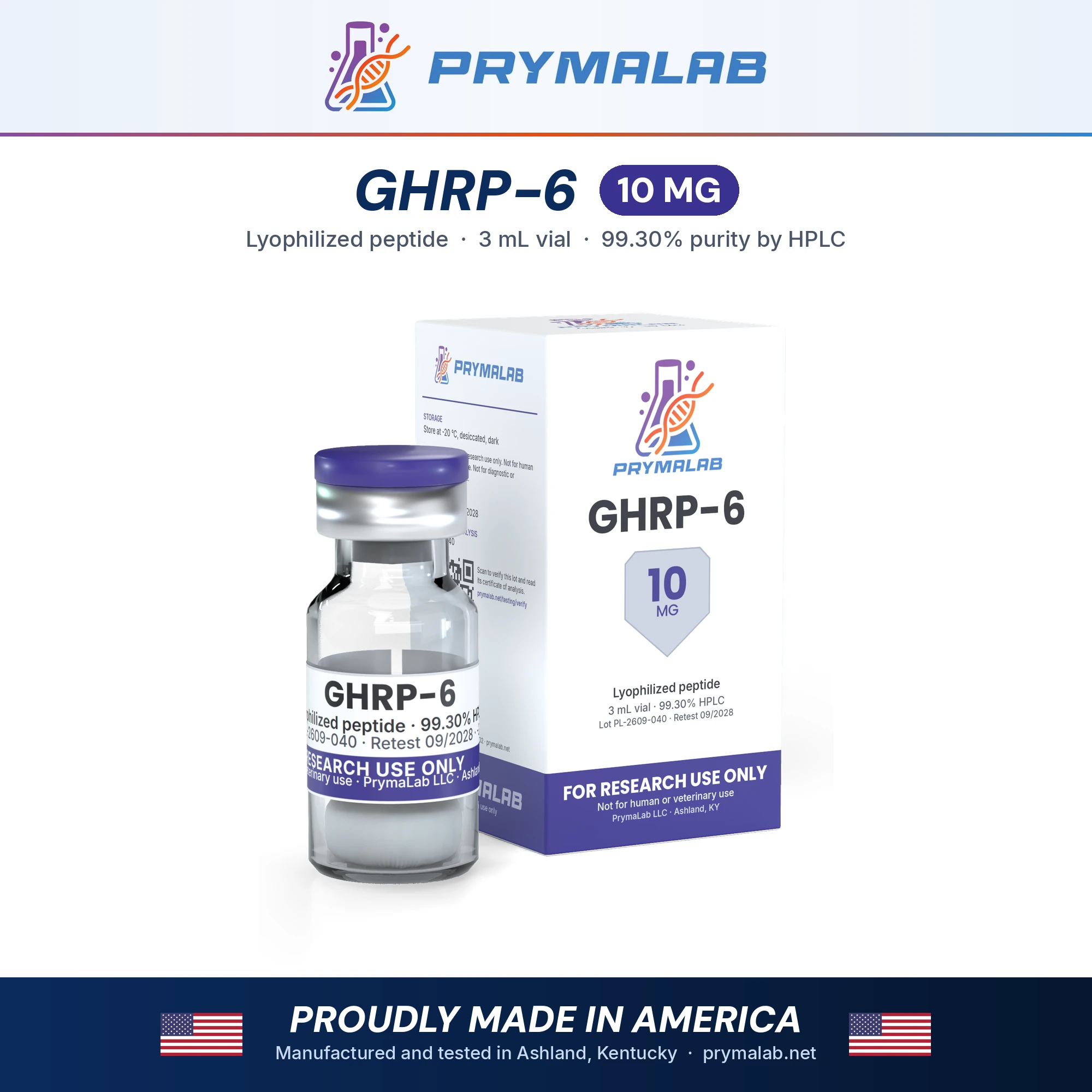
GHRP-6 10mg
The 1984 growth hormone-releasing hexapeptide, freeze-dried in a 10 mg vial
GHRP-6 is the synthetic hexapeptide His-D-Trp-Ala-Trp-D-Phe-Lys-NH2, which Cyril Bowers and colleagues described in 1984 as releasing growth hormone from the pituitary without releasing LH, FSH, TSH or prolactin. This listing is the 10 mg vial of freeze-dried powder, the main fill of the range, and a 5 mg vial is also sold. Its literature runs from pituitary and animal work through the first human studies to the cloning of its receptor and the discovery of ghrelin, the receptor’s natural ligand.
Specifications
| Property | Value |
|---|---|
| Compound | GHRP-6 Growth hormone-releasing peptide-6 |
| CAS number | 87616-84-0 |
| Molecular formula | C46H56N12O6 |
| Theoretical mass | 873.0 Da |
| Sequence / structure | H-H-[D-Trp]-A-W-[D-Phe]-K-NH₂ (6 residues; C-terminal amide) |
| Label claim | 10 mg/vial |
| Form | Lyophilized (freeze-dried) powder or cake in a sealed glass vial with a rubber stopper and aluminium crimp cap |
| Storage, sealed | −20 °C, desiccated, dark |
| Purity specification | 99.0% or higher by RP-HPLC |
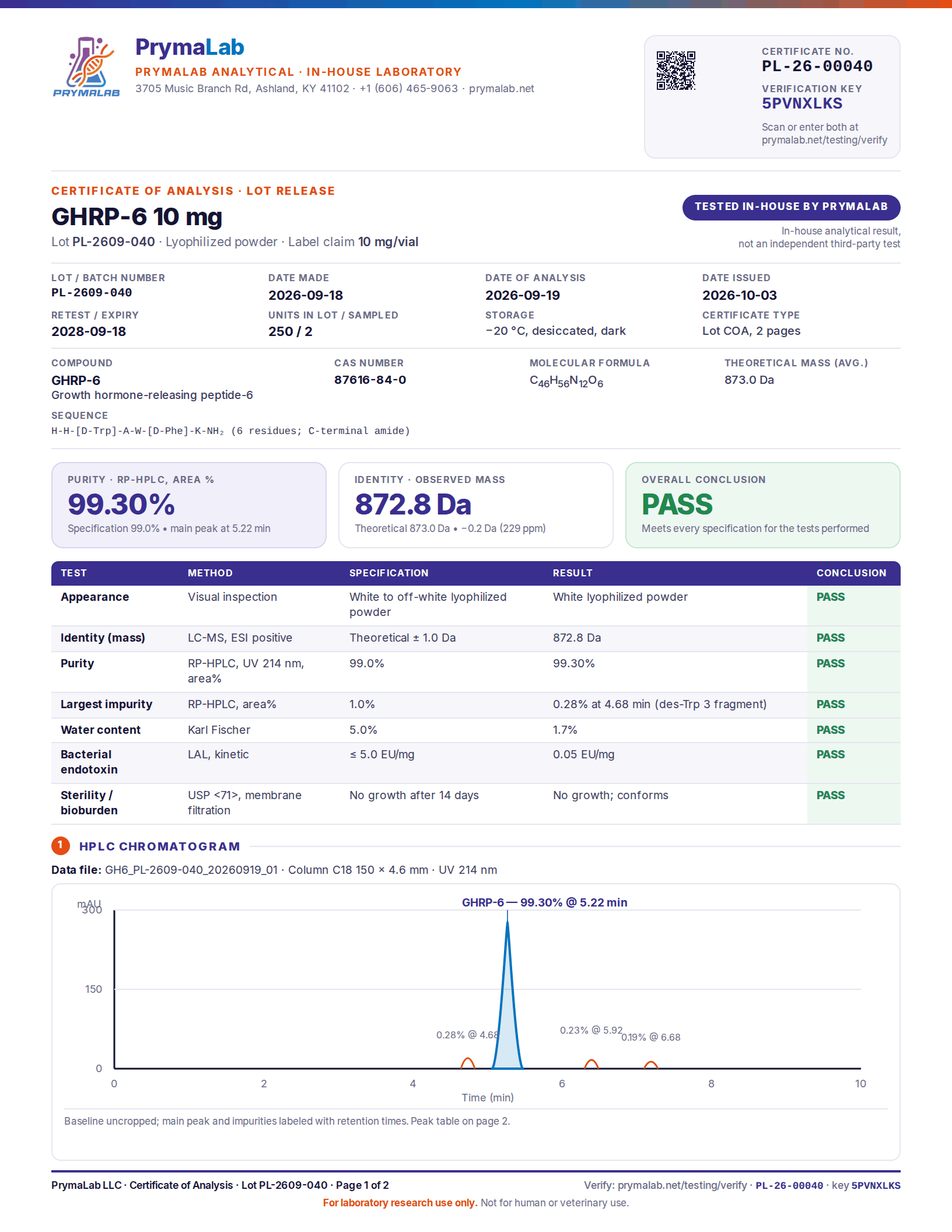
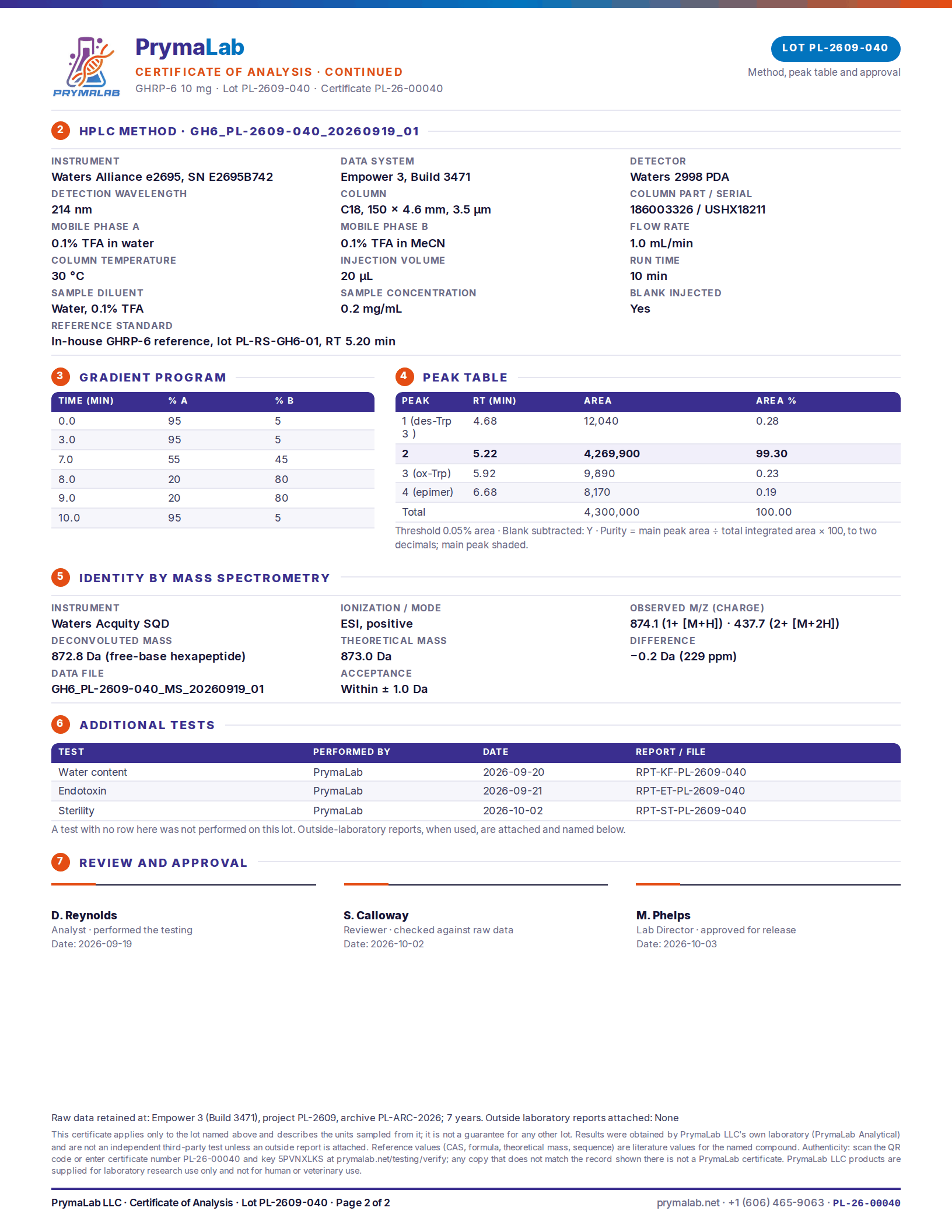
| Lot certificate | Results for the lot now shipping are in the certificate panel on this page |
| Safety data sheet | PL-SDS-064 |
Fills in this range
GHRP-6 is sold in 2 fills. The compound and the testing are the same in every fill; only the amount in the vial changes.
| Fill | Listing |
|---|---|
| 5 mg | GHRP-6 5mg |
| 10 mg | GHRP-6 10mg (this page) |
Handling notes: two tryptophans
Two of GHRP-6’s six residues carry an indole ring: D-tryptophan at position 2 and tryptophan at position 4. Tryptophan is among the residues that undergo primary photo-oxidation in proteins, along with tyrosine, phenylalanine and cysteine, and a review of light damage in protein products links photodegradation to structural changes that could alter stability and activity1. Counting the D-phenylalanine, GHRP-6 has three of those residues in six positions, so the instruction to keep it dark applies to a solution as much as to the powder.
The same rings give a simple optical handle. Pace and colleagues’ equation predicts absorbance at 280 nm from the numbers of tryptophan, tyrosine and cystine residues, with tryptophan contributing the most per residue2. GHRP-6 has no tyrosine or cystine, so its 280 nm absorbance comes from the two indoles, which makes UV absorbance a practical way to estimate the concentration of a solution. The equation was fitted to folded proteins, so for a hexapeptide it gives an estimate rather than an exact value.
What the research covers
Discovery and specificity
Bowers and colleagues reported GHRP-6 in 1984 under the name [His1,Lys6]GHRP3. In pituitary incubations and in live animals it released growth hormone in a graded way without releasing LH, FSH, TSH or prolactin, and in limited tests it did not release insulin or glucagon either3. It was active in rats, monkeys, lambs and calves, which the authors read as a lack of species dependence3. In rats growth hormone rose within minutes and peaked at 10 to 20 minutes, the response lasted longer than that of the larger releasing factors GHRF-44 and GHRF-40, and both forms of somatostatin blocked it, with SRIF-28 about four times as active as SRIF-14 in vitro3.
First human data
The first human study, published by Ilson and colleagues in 1989, enrolled 17 healthy men, with saline as the control in eight4. Growth hormone rose consistently above a threshold amount and in proportion to the amount used, while LH, FSH, TSH and ACTH did not change, and the peptide was well tolerated4. Pharmacokinetic data came much later. In 2013 Cabrales and colleagues measured GHRP-6 in the plasma of nine healthy men with a validated LC-MS method5. Its disposition fitted a two-compartment model with a distribution half-life of 7.6 minutes and an elimination half-life of 2.5 hours, and exposure rose roughly in proportion to the amount5. The authors also describe GHRP-6 as supporting tissue viability in several organs, though the abstract does not present that evidence5.
The receptor and ghrelin
For twelve years GHRP-6 acted through a receptor nobody had identified. In 1996 Howard and colleagues cloned a G protein-coupled receptor from the pituitary and hypothalamus of pigs and humans, showed that it was the target of the growth hormone secretagogues, and argued that these synthetic compounds mimic a hormone not yet discovered6. That hormone turned up in 1999, when Kojima and colleagues purified a 28-residue peptide from rat stomach, with an n-octanoyl group on serine 3 that is required for activity, and named it ghrelin7. In rats, ghrelin stimulated feeding as well as growth hormone release, with a rapid onset, and in one set of experiments it also raised ACTH and lowered TSH8.
What is not established
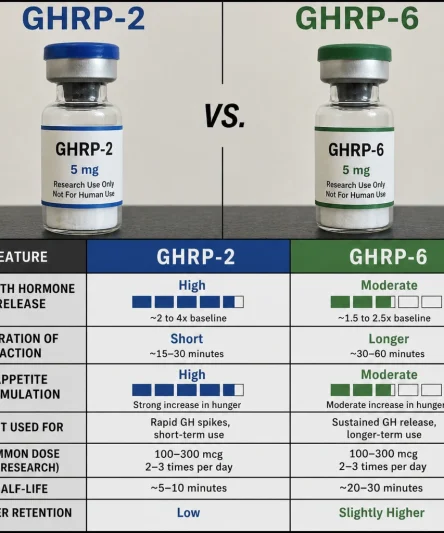
GHRP-6 is often described as the most appetite-stimulating peptide of its class, yet none of the abstracts cited here measured food intake after GHRP-6. The feeding data are for ghrelin in rats8, and carrying them over to GHRP-6 depends on the shared receptor. The human studies cited measured short-term responses in small groups of healthy men, so they say little about repeated or long-term exposure. None of these studies used PrymaLab material. The GHRP-2 vs GHRP-6 guide sets the two peptides side by side.
How each lot is tested
Every lot is tested in PrymaLab’s own laboratory in Ashland, Kentucky before release: RP-HPLC for purity, LC-MS for identity, Karl Fischer titration for water, LAL for endotoxin and USP <71> for sterility. The results for the lot now shipping are in the certificate panel on this page, and the certificate number, key and QR code can be checked on the verify page. These are in-house results from PrymaLab Analytical, not an independent test, and the lab is not accredited to ISO 17025. The third-party testing guarantee on this page still applies: if any independent laboratory finds the wrong compound, or less than the stated purity or amount, the order is refunded and the cost of the test is reimbursed.
Frequently asked questions
How is GHRP-6 different from GHRP-2?
GHRP-6 starts His-D-Trp where GHRP-2 starts D-Ala-D-2-naphthylalanine; the last four residues and the C-terminal amide are the same. GHRP-6 is the heavier at 873.0 Da against 818.0 Da, and it is the older peptide, the one on which the class's early discovery work was done.
What separates the 10 mg vial from the 5 mg?
The peptide is identical and the amount differs. Each fill is manufactured and tested as a separate lot with its own certificate. Dissolved in the same volume of diluent, the 10 mg vial gives twice the concentration of the 5 mg, and in molar terms it holds about 11.5 µmol.
Why does the storage advice stress keeping GHRP-6 dark?
Two of its six residues are tryptophans, and tryptophan is among the amino acids most open to photo-oxidation. Keep the sealed vial at −20 °C, dry and dark, let it reach room temperature before opening, and hold any solution at 2 to 8 °C away from light.
Where is the certificate for this vial?
The certificate panel on this page shows the lot now shipping. Match the lot number on the vial label to a certificate there or on the testing results page, then confirm it on the verify page with the certificate number and key.
Can GHRP-6 be used in people?
No. It is sold for laboratory research only, is not approved for human or veterinary use by the FDA or any other authority, and must not be given to people or animals. The human studies on this page were controlled clinical research, not a guide to use.
References
- Kerwin BA, Remmele RL Jr. Protect from light: photodegradation and protein biologics. J Pharm Sci. 2007;96(6):1468-79. DOI · PubMed
- Pace CN, Vajdos F, Fee L, et al. How to measure and predict the molar absorption coefficient of a protein. Protein Sci. 1995;4(11):2411-23. DOI · PubMed
- Bowers CY, Momany FA, Reynolds GA, et al. On the in vitro and in vivo activity of a new synthetic hexapeptide that acts on the pituitary to specifically release growth hormone. Endocrinology. 1984;114(5):1537-45. DOI · PubMed
- Ilson BE, Jorkasky DK, Curnow RT, et al. Effect of a new synthetic hexapeptide to selectively stimulate growth hormone release in healthy human subjects. J Clin Endocrinol Metab. 1989;69(1):212-4. DOI · PubMed
- Cabrales A, Gil J, Fernández E, et al. Pharmacokinetic study of Growth Hormone-Releasing Peptide 6 (GHRP-6) in nine male healthy volunteers. Eur J Pharm Sci. 2013;48(1-2):40-6. DOI · PubMed
- Howard AD, Feighner SD, Cully DF, et al. A receptor in pituitary and hypothalamus that functions in growth hormone release. Science. 1996;273(5277):974-7. DOI · PubMed
- Kojima M, Hosoda H, Date Y, et al. Ghrelin is a growth-hormone-releasing acylated peptide from stomach. Nature. 1999;402(6762):656-60. DOI · PubMed
- Wren AM, Small CJ, Ward HL, et al. The novel hypothalamic peptide ghrelin stimulates food intake and growth hormone secretion. Endocrinology. 2000;141(11):4325-8. DOI · PubMed
Research use only
For laboratory research use only. GHRP-6 10mg is not a drug, food, cosmetic or dietary supplement, is not approved by the FDA or any comparable authority for human or veterinary use, and must not be given to people or animals. It is sold to qualified researchers and institutions, and the buyer is responsible for lawful handling and disposal.
Other formats of GHRP-6
GHRP-6 is also stocked as GHRP-6 10mg Nasal Spray and GHRP-6 10mg preloaded 3ml pen. Each listing states its own quantity and concentration, and the pen and vial comparison explains what changes between formats.







Reviews
There are no reviews yet.